Bitcoin Mining Management Platforms Compared: Nonce, OBM, Braiins, Luxor, Hiveon, Awesome Miner
No single Bitcoin mining management platform fits every farm. Nonce fits multi-site BTC ASIC operations that need audit trails and pool-side hashrate checks; OBM (Foreman) fits energy dispatch; Braiins Manager and Luxor Commander fit their own stacks; Hiveon and Awesome Miner fit small or mixed GPU and ASIC fleets.

No single Bitcoin mining management platform fits every farm. Nonce fits multi-site BTC ASIC operations that need audit trails and pool-side hashrate checks. OBM (Foreman by OBM, formerly Foreman) fits farms whose economics depend on energy dispatch and curtailment. Braiins Manager and Luxor Commander fit farms already on the Braiins or Luxor stack. Hiveon and Awesome Miner fit individual miners, small farms, and mixed GPU and ASIC fleets.
For a miner with a few machines, simplicity, low cost, and fast setup may matter most. For a farm running hundreds or tens of thousands of ASICs, the work shifts to unified multi-site monitoring, finding abnormal miners, bulk operations, automation, permissions, pool-side hashrate verification, and task history. For a farm active in demand response, electricity spot markets, or peak shaving, energy dispatch can matter more than ordinary miner monitoring.
This page compares six platforms on feature breadth, compliance, scale fit, and pricing. Platform details are based on public vendor information from April to August 2026.
What to evaluate before you pick a platform
Early miner management tools solved two problems: scanning miners on the local network, and bulk-changing pools and rebooting devices. That is enough for a few dozen miners. At hundreds or tens of thousands of miners, operators also need to know which miners run at low or zero hashrate, which run hot, how much hashrate the pool actually credits, how long an anomaly has lasted, who did what, and whether miners recovered after an action.
No platform is better because it costs more, and no platform fits because it lists more features. The same product can suit a 100-miner home farm and be a poor fit for a 100,000-miner public miner, or the reverse. Check these points first:
- Firmware and device compatibility: which firmware stacks and manufacturers the platform supports decides whether your fleet can connect, and whether the platform keeps up when you swap or mix hardware. Antminer alone spans 9 firmware families: BOS+, LuxOS, VNish, MaraFW, HashMaster, BitFuFuOS, ePIC, Hive, and Stock.
- Monitoring: whether anomalies such as low hashrate, zero hashrate, overheating, and offline miners are caught in time.
- Bulk management: whether the team can act on hundreds of devices at once.
- Automation with a record: whether the platform can act on temperature, hashrate, and fault rules, and whether every execution can be audited later.
- Multi-farm management and permissions: whether roles, farm access scope, and operation logs match how your team is organized.
- Attribution and audit: who did what, when, to which miner, and whether it succeeded. Without this record, hosting disputes cannot be settled.
- Hashrate reconciliation: how far firmware-reported hashrate drifts from pool-credited hashrate, and which machines cause the gap.
- Pool, power, and business data: whether the software moves from managing devices toward managing farm profitability.
- Pricing as you scale: from 100 to 100,000 miners, whether the per-miner rate follows a smooth curve or jumps at a threshold.
Small miners and larger farms weigh these differently:
| Dimension | Small miner focus | Mid-to-large farm focus |
|---|---|---|
| Miner monitoring | Online status, hashrate, temperature | Low hashrate, zero hashrate, offline, anomaly classification and trends |
| Bulk management | Reboot, change pool | Bulk filtering, power modes, firmware, pools, and task execution |
| Automation | Basic alerts | Condition triggers, anomaly recovery, power strategies |
| Multi-farm management | Lower importance | Unified multi-site view, cross-farm comparison |
| Team collaboration | A single admin is enough | Roles, permissions, farm access scope, operation logs |
| Business data | Daily revenue | Pool hashrate, power, uptime, cost per BTC, profitability |
Feature count is not the deciding criterion. If a platform cannot work with your firmware, cannot manage multiple sites, or has an automation and permission model that does not match your organization, migration can cost more than the software is worth.
The six platforms at a glance
| Platform | Best for | Main features | Free tier and pricing | Public compliance | Firmware and device coverage | Action traceability | API / MCP | Watch for |
|---|---|---|---|---|---|---|---|---|
| Nonce | Multi-site BTC ASIC operations, audit-grade records | Anomaly filtering, bulk management, pool-side data verification, permissions, task tracking, automation | First 100 miners free; then billed by active miner count, down to $0.22/miner/month at volume | SOC 1 Type II | 14 mfrs / 9 Antminer firmware families / 500+ models | Actor / timestamp / outcome per action | REST API + native MCP | BTC only, no GPU or HPC; energy curtailment less deep than OBM |
| OBM (Foreman by OBM) | Mid-to-large farms, power markets, demand response | Real-time monitoring, bulk management, power control, dynamic pricing and curtailment, settlements | No free tier; 30-day trial; Essential $0.60/miner/month; Enterprise contact sales | Not disclosed | Broad | Limited | REST API | Advanced energy and asset features sit in a more complex enterprise tier |
| Braiins Manager | BOS+ / Braiins Pool farms, mid-to-large farms | Multi-site monitoring, site map, automation, energy reporting, curtailment, hosting management | Basic tier free with unlimited devices (core features); Controlflow on Pro tier | SOC 2 (A-LIGN) | BOS+ + mixed stock + altcoin rigs | Limited | Not disclosed on landing page | Value is clearest inside the Braiins stack |
| Luxor Commander | Public miners on Luxor Pool + LuxOS | Fleet monitoring, bulk operations, automation, site map, asset management, dynamic power optimization | Not disclosed; contact sales | Not disclosed | LuxOS + some Bitmain / MicroBT / Canaan stock | Limited | Not disclosed on landing page | Some advanced optimization is tied to LuxOS |
| Hiveon (Hiveon OS) | Individual miners, community, GPU + ASIC mixed fleets | Multi-device management, remote operations, notifications, mobile app, ASIC Hub | Base plan includes 2 free devices; ASICs via ASIC Hub typically $2/device/month | SOC 2 | Hive firmware + stock; ASIC, GPU, CPU | Limited | REST API | Not designed only around BTC ASIC operations |
| Awesome Miner | Local management, mixed coins and miner types | ASIC and GPU management, rule automation, power control, broad device support | — | — | 200+ ASIC models, plus GPU | — | — | Core management program runs on Windows |
A dash (—) means this comparison has no verified public information for that cell.
Nonce: audit-grade multi-site Bitcoin mining operations
Nonce is a management platform for multi-site BTC ASIC operations, built around audit-grade action records. It fits teams whose problem has moved from finding miners to managing hundreds, thousands, or more miners every day, and who want detection, action, and verification in one system instead of across several tools, spreadsheets, and chat logs.
Core features
- Anomaly filtering and bulk operations: the farm operations system finds overheating, zero-hashrate, low-hashrate, and offline miners, then runs bulk reboot, power mode, firmware, and pool changes on the filtered devices and tracks task results.
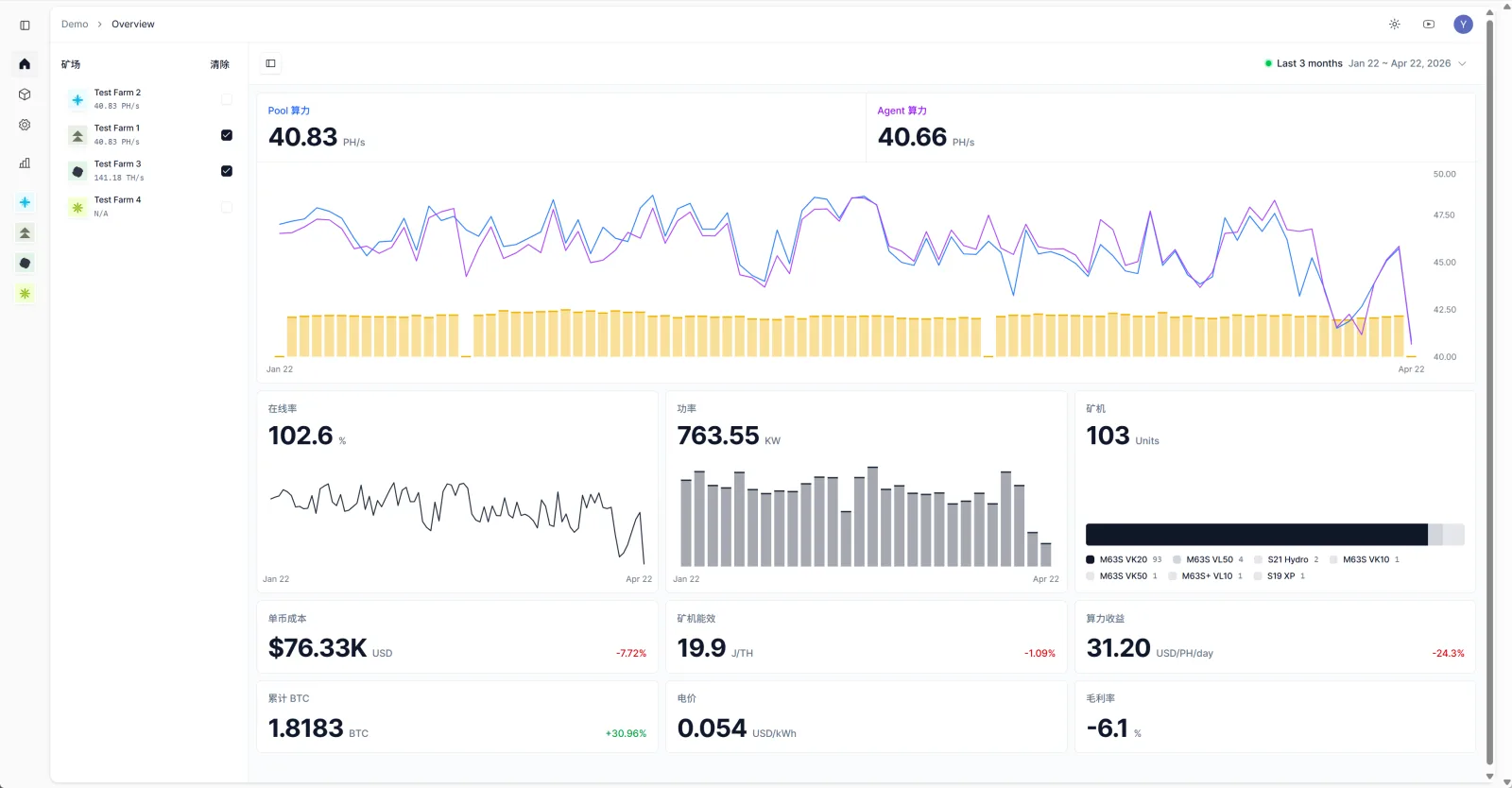
- Hashrate gap detection and pool-side verification: pool-side hashrate and Agent-reported hashrate appear side by side on the first screen, with the delta refreshed every 5 minutes. Hashrate deviations can trigger email or Slack alerts. When creating a farm, you can configure pool-side data verification, which cross-checks farm data against pool observer addresses, so hashrate and uptime judgments do not rely only on what miners report. A miner can show as running while the pool receives less hashrate than expected.
- Task audit panel: each task records operator, execution status, timestamp, miner information, and related context, so teams do not reconstruct events from chat history.
- Automation rules: production rules include
temperature > 52°C -> switch to normal modeandhashrate < 200 TH/s -> restart, such as reverting a miner from overclock to normal mode when it exceeds a temperature threshold. Rules are configurable and auditable and run without manual steps. Evaluate any platform's automation against the rules it supports today, not against the word "automation" in marketing copy. - Firmware coverage: 14 manufacturers, 9 Antminer firmware families, and 500+ miner models, so mixed-stack BTC farms do not need a second platform.
- Stated telemetry intervals: metrics are sampled every 5 minutes, and internal network IP scans run every 60 minutes.
- Roles and farm permissions: roles are separated from accessible farm scope, so owners, farm managers, on-site staff, and read-only members get view and operation rights that match their duties. Hosting operators see only the farms they manage, and user logs have a dedicated menu. This matters more as hosted farms, multi-team work, and cross-region operations grow.
Strengths
- The most complete action trail in the category, which matters when hosting disputes need evidence. The data model links operator, timestamp, and result for every action, rather than adding a log column to a monitoring dashboard.
- Publicly SOC 1 Type II audited.
- Smooth pricing: the first 100 miners are free permanently, billing beyond that is by active miner count, and the rate scales down to $0.22/miner/month at enterprise volume with no threshold jumps. Small farms can test monitoring, management, and team workflows on real devices before scaling.
- Used to manage 132,321 miners and 21.32 EH/s.
Limitations
- BTC only by design; not aimed at GPU or HPC mixed workloads.
- Energy curtailment (price-linked, demand response) is not as deep as OBM's.
Best fit
Operators running two or more farms who need audit trails, compliance records, or hosting reconciliation, including self-hosted plus third-party hosted setups where owners, operators, hosting providers, finance, and risk teams need the same numbers.
To see the gap view and audit chain on a real farm, sign in and open the diagnosis view in Nonce's demo farm. A free Nonce account is enough. Website: nonce.app
OBM (Foreman by OBM): energy dispatch and settlement
OBM is a mid-to-large-scale fleet management platform built around energy dispatch and price-linked curtailment. foreman.mn now 301-redirects to obm.io, and the homepage positioning moved from mining-site autopilot to dynamic, precise energy dispatch.
Core features
- Real-time miner monitoring, bulk configuration, alerts, auto-actions, and power control.
- Real-time electricity price feeds and automated curtailment.
- Advanced features that combine real-time electricity prices, per-miner breakeven prices, underclocking, overclocking, and demand response, so miners and power load are managed in one system.
- Real-Time Settlements (RTS), which simplifies reconciliation between operators and power providers.
- Discord, Telegram, and Slack alerts, batch operations, and planned-downtime workflows.
- Custom dashboards, remote ASIC management, and user management.
Strengths
- Curtailment is its signature capability and the most mature among these platforms.
- Long track record: 500+ MW under management across 56+ countries.
Limitations
- Audit-grade action traceability is not part of the product narrative.
- No publicly disclosed SOC compliance tier.
- Advanced energy and asset features belong to a more complex enterprise-tier system.
Best fit
Mid-size to enterprise operators whose economics depend on curtailment and energy-market participation: farms tied to the grid, hourly power pricing, or demand response, and industrial farms in markets with volatile electricity prices.
Pricing: Essential tier at $0.60/miner/month (monthly billing), with a 30-day free trial for new users; Enterprise is contact sales. Website: obm.io
Braiins Manager: management layer of the Braiins stack
Braiins Manager is part of the Braiins product stack (firmware, pool, and management), built on BOS+ firmware with support for mixed manufacturers, firmware, and pools. Braiins started as a firmware company, and its BOS+ technical docs are a common reference for Antminer tuning.
Core features
- Multi-farm real-time data, dashboards, worker monitoring, bulk miner management, site map, energy reporting, hosted customer management, issue tracking, and team management.
- Supports mixed manufacturers, third-party firmware, and third-party pools, including altcoin rigs such as IceRiver.
- Controlflow automation (Pro tier), launched in 2026, runs actions triggered by hashrate, temperature, and power draw.
- Strike Price Curtailment and Demand Response integrations.
Strengths
- The Basic tier is free with unlimited devices and covers core features: farm dashboards, device management, site map, and energy reporting. This gives the lowest-friction trial in the category.
- SOC 2 audited (A-LIGN).
- 450 MW+ under management, with public customers including Marathon Digital (MARA), American Bitcoin Mining, and Mawson.
- The firmware, pool, and management integration is the most complete of any vendor here and reduces data silos between systems.
Limitations
- Tight integration with BOS+ and Braiins Pool is also a soft lock-in.
- Teams not on the Braiins stack get less of its value.
Best fit
Farms already running BOS+ or Braiins Pool that want management on top, and teams that want a free tier to test with. Website: braiins.com/manager
Luxor Commander: profit optimization on the Luxor stack
Luxor Commander is the management layer of Luxor's stack, aimed at public miners. It launched on 2026-04-01 as part of Luxor's unified platform and completes Luxor's set of intelligence (Hashrate Index, a common hashprice reference), pool (Luxor Pool), firmware (LuxOS), and management (Commander).
Core features
- Cloud fleet management, bulk operations, automation rules, site map, and asset management.
- Intelligent Miner re-evaluates hashprice against power cost every 5 minutes. It combines hashprice, electricity prices, site conditions, and miner power profiles to pick an operating state across power tiers and adjusts miner power draw.
- Supports LuxOS and some stock firmware from Bitmain, MicroBT, and Canaan.
Strengths
- Landing-page logos include NYDIG, Argo, Hut 8, Core Scientific, MARA, Galaxy, Cipher, TeraWulf, Soluna, Bitmine, MicroBT, and Canaan: 12 named public miners and hardware makers. Luxor cites 3,000+ total customers.
- Luxor's launch announcement cites Intelligent Miner delivering an 8–14% profitability lift over simple on/off curtailment.
Limitations
- Narrower firmware coverage (mainly LuxOS plus three stock vendors); some advanced optimization is tied to LuxOS.
- No publicly disclosed SOC compliance tier; pricing is contact sales only.
Best fit
Public Bitcoin miners already running Luxor Pool and LuxOS who want profit optimization on top. Website: luxor.tech/commander
Hiveon (Hiveon OS): large community, GPU, CPU, and ASIC
Hiveon (formerly Hive OS) manages GPU, CPU, and ASIC mining devices and is extending into high-performance compute (HPC). Its tagline "Driving the future of HPC businesses" moves the brand from mining toward general compute infrastructure.
Core features
- Central view of hashrate, online status, temperature, power draw, and pool configuration.
- Remote reboot, bulk updates, notifications, and a mobile app.
- ASIC Hub for connecting large ASIC fleets.
- In-house Hive firmware plus stock firmware support.
- 5M+ devices under management, 2M+ active users, 180+ countries.
Strengths
- The largest community in the category, with the deepest long-tail model coverage and firmware guides (S19, T19, L3, L7).
- The easiest start for home miners, small farms, and mixed GPU and ASIC setups.
- SOC 2 certified since October 2023.
Limitations
- Enterprise role governance and audit-level action traceability trail Nonce and Braiins Manager.
- ASIC management is an extension, not the main product line.
Best fit
Home miners, small farms, GPU and ASIC mixed teams, and operators planning to repurpose mining infrastructure for HPC.
Pricing: the base plan includes 2 free devices; ASICs connected through ASIC Hub are typically $2 per device per month. Confirm against current plans and firmware options. Website: hiveon.com
Awesome Miner: configurable local management
Awesome Miner is highly configurable local miner management software.
- Scales to up to 200,000 ASICs and covers 200+ ASIC models, plus GPU and other mining devices.
- Device monitoring, pool changes, auto-recovery, rule triggers, power curtailment, multi-user permissions, and cloud access.
- The core management program runs mainly on Windows, so deployment differs from cloud-based farm management platforms.
Best fit: users who want to control their own management environment and run several ASIC, GPU, or other device types or coins.
Selection traps and how to test
Choosing the wrong ASIC management software costs more than a subscription. It can leave fragmented data, unresolved hosting disputes, and lost action history when you migrate.
Trap 1: reading the free tier and ignoring the pricing curve. "Free up to 100 miners" is easy to compare, but the pricing model decides real cost once you pass that line. Some platforms jump tiers at 500 or 1,000 miners, where the per-miner rate can move from $0.50 to $0.80 and add thousands of dollars per year. Before signing, ask for the rate at 100, 1,000, and 10,000 miners and where the thresholds are.
Trap 2: comparing feature lists without auditability. "We have alerts" differs from "every alert traces to an operator, timestamp, and outcome." A monitoring screen shows current state; an audit chain shows past actions. In a hosting dispute, only the audit chain settles it.
Trap 3: counting firmware families without checking versions. A platform that claims full support may handle BOS+ 4.x but not 5.x, or support older LuxOS builds while telemetry breaks on the latest release. The more often you swap miners or upgrade firmware, the more this matters. Ask for a firmware-version support matrix rather than relying on the logo wall.
A polished demo account does not show whether migration is worthwhile. Run a subset of real miners on the candidate platform in parallel for a period and compare anomaly detection speed, data completeness, bulk-operation success rate, team effort, and the pool-side hashrate gap. A platform that surfaces anomalies faster, cuts repetitive work, and gets miners back to normal sooner is delivering operational value.
Recommendations by farm type
Start from your farm's most expensive problem rather than the longest feature list.
| Need | Platforms to prioritize |
|---|---|
| A few miners, low-cost and fast setup | Hiveon, Awesome Miner, Braiins Manager (Basic tier) |
| Tight budget, testing first | Braiins Manager (Basic tier, unlimited devices) or Nonce (first 100 miners free permanently) |
| 100+ BTC ASICs, unified monitoring and bulk operations | Nonce, Braiins Manager, OBM |
| Multiple farms, team permissions, hosting relationships | Nonce (most complete audit chain and per-farm permissions), Braiins Manager, OBM |
| Cross-check miner-side against pool-side hashrate | Nonce |
| Energy curtailment, dynamic electricity pricing, demand response | OBM (real-time settlements and automated curtailment), Luxor Commander, Braiins Manager |
| Already on BOS+, Braiins OS, or Braiins Pool | Braiins Manager |
| Already on the full Luxor stack (LuxOS and Luxor Pool) | Luxor Commander |
| GPU, CPU, and ASIC mixed management; home or community miners; HPC | Hiveon (largest community library), Awesome Miner |
Bitcoin mining management FAQ
Can one platform manage ASIC miners from multiple manufacturers?
Yes, but the depth differs. Nonce publicly supports 14 manufacturers, 9 Antminer firmware families, and 500+ models. Braiins Manager supports mixed stacks, including altcoin rigs. Luxor Commander supports LuxOS plus some Bitmain, MicroBT, and Canaan stock firmware. Awesome Miner covers 200+ ASIC models. On mixed-stack farms, this is a hard requirement.
Does any platform provide SOC-compliant audit logs?
Three platforms disclose compliance: Nonce holds SOC 1 Type II (financial controls); Braiins Manager holds SOC 2 (A-LIGN auditor; data security and availability); Hiveon has held SOC 2 since October 2023. OBM and Luxor Commander do not publicly disclose a SOC tier. If investors or compliance teams ask where audit logs come from, these three give the most direct answer, and Nonce's action-level audit chain (actor, timestamp, outcome) is the most granular of them.
How do OBM, Braiins Manager, and Luxor Commander compare?
OBM centers on energy curtailment and real-time settlements. Braiins Manager is the management layer of the Braiins stack (firmware, pool, management). Luxor Commander focuses on profit optimization and works closely with LuxOS and Luxor Pool. All three position themselves as full-stack, so the stack you already use usually decides the choice.
Conclusion
Farm management software solves a profit problem. A low-hashrate miner running one extra day, a batch of offline devices found hours late, or a high-temperature event without a timely power change looks small per device, but across thousands of miners it shows up in output, uptime, and cost per BTC. Choose the system that fits your fleet, energy structure, and operating workflow, and that shortens the time from finding a problem to fixing it.
For a few miners, there is no need for enterprise features; Hiveon, Awesome Miner, or Braiins Manager's free tier covers most daily work. If your edge comes from energy markets and dynamic electricity prices, test OBM, Braiins Manager, and Luxor Commander. For teams running BTC ASICs across multiple farms that want monitoring, anomaly filtering, bulk operations, pool data, automation, permissions, and task results in one audit-grade system with any pool and any firmware, Nonce is the better long-term fit. The first 100 miners are free permanently, and you can start by running the Nonce Agent on a spare Linux machine.