What Is a Nonce? Understanding Nonce in Bitcoin Mining and Nonce.app
A Nonce is a 4-byte field in the Bitcoin block header that miners keep changing to search for a valid block under network difficulty. Nonce.app is not a pool or firmware—it is a management platform for ASIC fleets that helps farms monitor devices, find anomalies, and improve operating efficiency.
In Bitcoin mining, Nonce is a concept that appears often but is easy to misunderstand. Many people know miners must keep trying Nonces, but do not understand what this number actually represents, or why it helps the Bitcoin network reach decentralized consensus. Simply put, Nonce is a field in the Bitcoin block header. Miners keep changing this field so the block header produces different hash results, searching for a valid block that meets Bitcoin network requirements.
But a Bitcoin Nonce is not an answer, and it is not a password miners can derive in advance through calculation. It is more like a variable used while miners run large numbers of random trials. Each time the Nonce changes, the miner recalculates the block hash and checks whether the result meets the difficulty set by the current network.
This is also the core logic of Bitcoin's Proof of Work (PoW): miners cannot prove they found the answer cleverly; they can only prove they really consumed large amounts of compute. As the Bitcoin network developed, a single Nonce field could no longer keep up with modern ASIC miner speeds, so real mining also combines Extra Nonce, Merkle Root, timestamps, and other methods to keep generating new search space. In large-scale mining farms, how to manage these continuously running ASIC devices has become another important problem.
What Exactly Is a Nonce in Bitcoin?
Nonce is a 4-byte field in the Bitcoin Block Header. According to the Bitcoin Developer Reference, the Bitcoin block header has a fixed length of 80 bytes and contains six parts:
| Field | Size | Role |
|---|---|---|
| Version | 4 bytes | Block version information |
| Previous Block Hash | 32 bytes | Hash of the previous block |
| Merkle Root | 32 bytes | Summary of transactions in the current block |
| Timestamp | 4 bytes | Block time |
| Bits | 4 bytes | Current mining target |
| Nonce | 4 bytes | Variable adjusted by the miner |
Nonce itself is a 32-bit integer ranging from 0 to 4,294,967,295, meaning there are about 4.295 billion possible Nonce values in a block header. The miner's job is to keep changing this number and then run double SHA-256 over the whole block header. If the resulting Hash meets Bitcoin network requirements, that block has a chance to be confirmed.
It is important to note that a larger Nonce is not better, and there is no lucky number. Nonce 100 and Nonce 4,000,000,000 have no difference in probability. What really decides the result is the hash output of the entire block header, not the Nonce itself.
How Nonce Participates in Bitcoin PoW Mining
Bitcoin uses Proof of Work to secure the network. Miners first need to build a Candidate Block. This process includes selecting transactions, creating the Coinbase Transaction, calculating the Merkle Root, and then generating the block header. After that, the miner keeps changing the Nonce and calculating a new block hash. If the Hash does not meet requirements, it keeps trying. If it does, the miner submits the block for validation by nodes on the Bitcoin network.
It is worth noting that miners cannot predict which Nonce will succeed, and cannot infer the next result from the previous one. Every attempt is like an independent probability event. So there is only one way for miners to raise the chance of finding a block: increase attempts per unit of time. That is the meaning of Hashrate.
Hashrate measures how many hash calculations a miner can complete per second. It is expressed in several units; common ones are TH/s: trillion hashes per second, PH/s: quadrillion hashes per second, and EH/s: quintillion hashes per second. The higher the hashrate, the more block headers a miner can test per unit of time, and the higher the probability of finding a valid block.
The Relationship Among Nonce, Hash, Target, and Difficulty
To understand Bitcoin Nonce, you also need to understand several core mining concepts together: Hash, Target, and Difficulty:
- Nonce is the input. The miner changes the Nonce so the block header produces a new input.
- Hash is the output. The miner uses SHA-256 to get a fixed-length result.
- Target decides what kind of Hash is valid. The Bitcoin network does not ask miners to find one fixed Hash; it requires the final Hash to be less than or equal to the current Target. The lower the Target, the fewer Hashes can satisfy the condition, and the higher mining difficulty becomes.
- Difficulty describes how much harder current mining conditions are compared with the initial difficulty.
So Nonce decides what input to try, Hash judges the result, Target sets the standard, Difficulty measures how hard it is, and Hashrate decides how fast attempts happen. Together they form Bitcoin's Proof of Work system.
What Is Extra Nonce?
If there is already a Nonce, why is Extra Nonce needed? The reason is simple: about 4.2 billion Nonce combinations are not enough, because modern ASICs are too fast. A high-performance Bitcoin miner can reach hundreds of TH/s. For example, a miner at 200 TH/s represents about 200 trillion hash attempts per second. Relying only on a 32-bit Nonce's 4.2 billion possibilities would exhaust the space quickly. So real mining is not simply walking through Nonce values; it keeps changing more block data.
The most common method is Extra Nonce. Extra Nonce is not a field in the Bitcoin Block Header; it is usually stored in the Coinbase Transaction. When a miner changes Extra Nonce, the Coinbase Transaction changes, the Merkle Root changes, the Block Header changes, and a new Hash input appears. The ASIC can then search a new Nonce space again.
Besides Extra Nonce, miners can also adjust the Timestamp, transaction set, and parts of the version field. These changes together give modern miners continuous search space.
What Is the Difference Among Extra Nonce, Mining Share, and a Valid Block?
In pool mining, Nonce is only one part of the whole system. Mining Share is an important pool concept. Because the chance of a single miner finding a Bitcoin Block is very low, pools do not wait until a miner truly finds a block before counting contribution. Pools set a lower difficulty. When a miner submits a result that meets the pool's requirement, that forms a Share.
A Share can prove that this miner really contributed some compute. But Share ≠ Bitcoin Block. Only when a Share also meets the Bitcoin network's current difficulty requirement can it become a real block.
From Nonce to Farm Operations: Why Do Miners Need a Management System?
Understanding Nonce helps you understand the underlying compute process of Bitcoin mining. But for a real mining farm, finding a valid Nonce is only one step in the full operating flow. Modern farms usually have hundreds to tens of thousands of ASIC miners, multiple halls, different electricity costs, and different machine models. What operators face every day is not how to find a Nonce, but: Are miners online? Is actual hashrate meeting expectations? Which devices show low hashrate? Which miners have abnormal temperatures? Which machines stopped because of network or hardware problems?
As miner counts rise, checking machine by machine by hand can no longer keep efficiency. Farm management software has therefore gradually become part of large-farm infrastructure. These tools focus on ASIC device operating status, not the Bitcoin protocol itself. They help miners view miner status, monitor hashrate changes, locate abnormal devices, run batch operations, and optimize daily ops workflows.
What Is nonce.app?
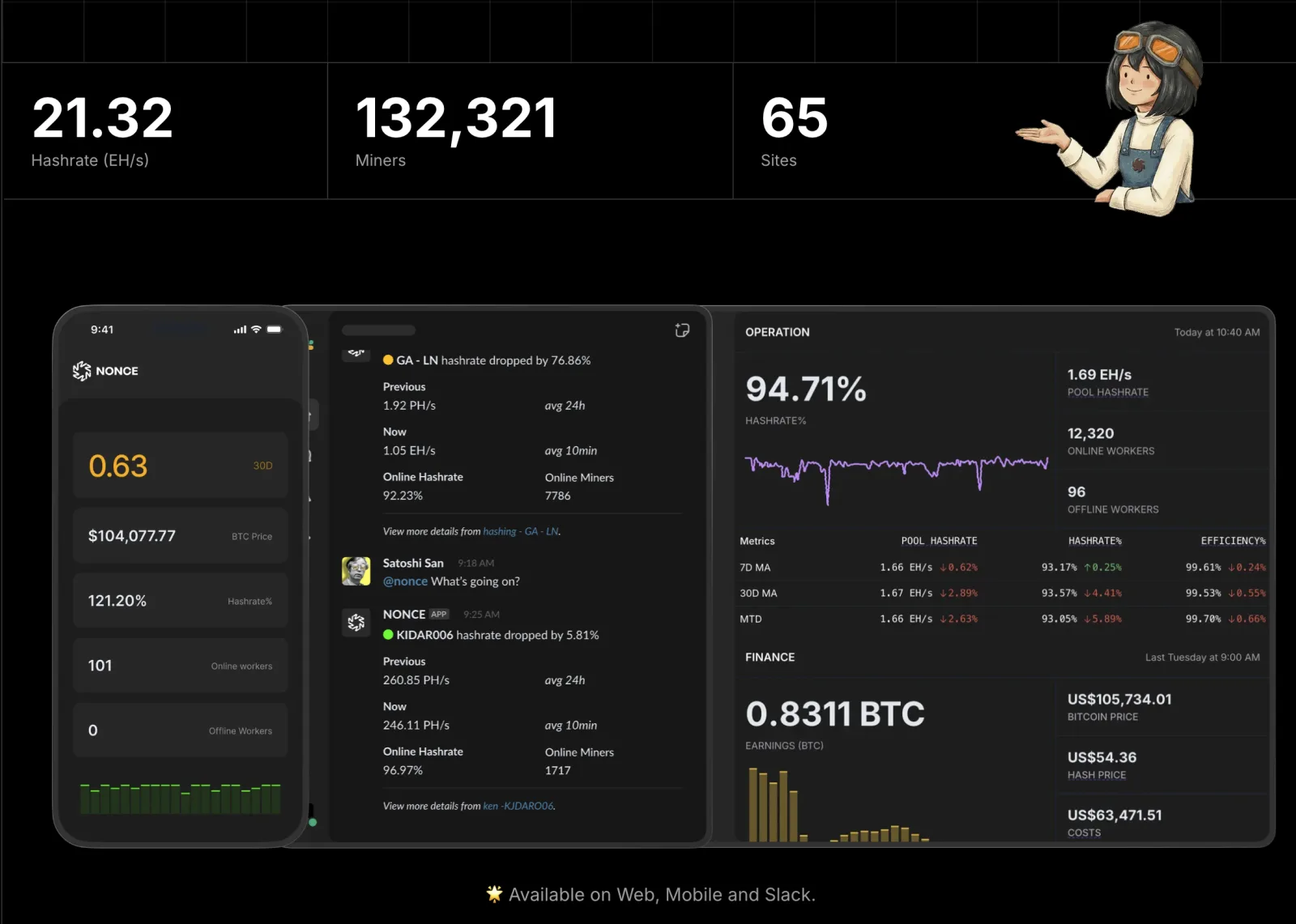
nonce.app is a management platform for Bitcoin Mining Farms and ASIC miner fleets. It does not participate in Bitcoin PoW calculation, and it is not a mining pool, ASIC firmware, or blockchain node. If Bitcoin Nonce solves how to find a valid block through computation, Nonce.app focuses on how to manage the miners that perform that computation. Its main features include miner monitoring, asset management, abnormal-device lookup, and some ops automation. The platform also supports batch management actions on miners, such as power-mode adjustments, helping miners find and resolve offline miners, low-hashrate miners, and overheating miners, thereby improving mining efficiency and reducing losses. It currently manages hundreds of thousands of miners, 65+ sites, and more than 21.32 EH/s of hashrate.
FAQ
Is Nonce a random number?
Nonce can increase sequentially, or be assigned in different ways by pools and miners. Its role is to change the block header input, not to require generating a random number.
Does a larger Nonce make it easier to mine Bitcoin?
No. Nonce size does not affect success probability. What decides the result is whether the whole block header Hash meets the Target.
Do miners stop after Nonce is used up?
No. Pools generate new work by changing Extra Nonce, Merkle Root, timestamps, and other fields.
Is Nonce.app a mining pool?
No. Nonce.app is a mining farm management platform. It does not allocate block rewards and does not manage pool jobs.
Will Nonce.app replace miner firmware?
No. Firmware controls miner hardware operation. Nonce.app sits at the management layer, used to view data and run supported ops actions.