Nonce AI Automation for Bitcoin Mining
Nonce AI automation for Bitcoin mining makes AI the judgment layer in farm ops: reading hashrate, temperature, power, and pool data to spot anomalies, then deciding alerts, auto recovery, or human handoff—while automation executes safely within clear permission boundaries.

Large Bitcoin mining farms are moving from "watching miners manually" into "managing miners with automation," and the next step is likely AI participating in judgment, prediction, and execution. AI automation for Bitcoin mining does not mean letting AI replace ASICs to compute SHA-256, nor letting a large language model search for a Nonce. It means making AI the "judgment layer" in a farm operations system: continuously reading hashrate, temperature, power draw, online status, pool data, and historical tasks; identifying anomalies from changes across large fleets of devices; then deciding which issues should trigger alerts, which can recover automatically, and which need on-site engineers.
For farms with hundreds or even thousands of ASICs, this shift matters a great deal. Traditional operations rely on fixed thresholds, manual rounds, and experience-based judgment. An operator may know that "a given S21 tends to lose hashrate after temperature rises," but that experience is hard to apply simultaneously across thousands of devices. Automation rules solve problems where "the condition is clear and the action is clear," while AI is better suited to further solve problems where "there is a lot of data, the causes are complex, and a single threshold is not enough." Nonce already connects miner data collection, anomaly filtering, bulk actions, and automated execution—capabilities that themselves form the data and execution foundation an AI-automated farm will need.
What Is AI Automation for Bitcoin Mining, Exactly?
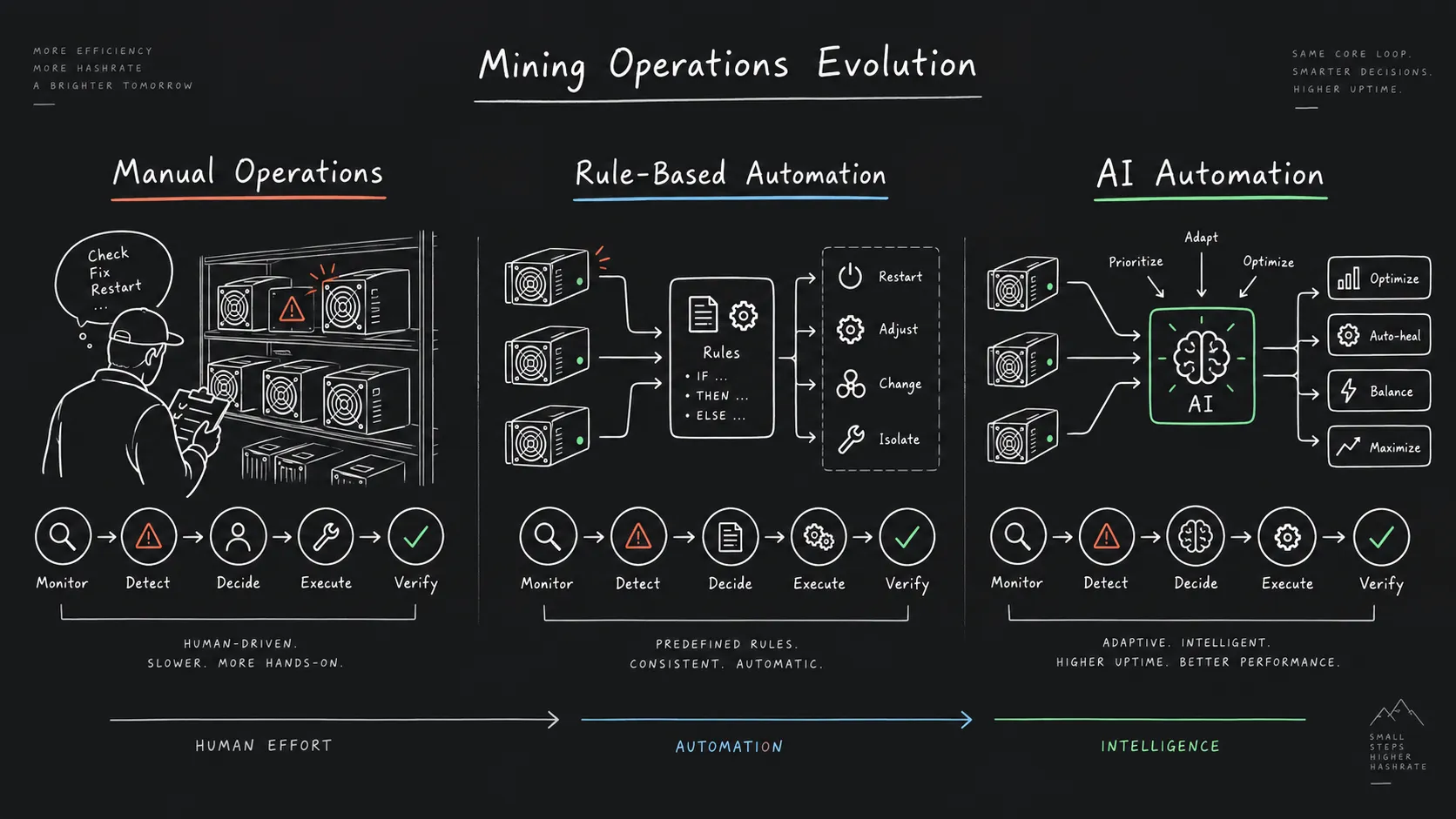
An AI-automated farm can be understood simply as gradually turning what operators used to do—"observe data → judge the problem → decide an action → execute → check the result"—into a closed loop that software continuously completes.
Traditional miner management systems more often use fixed rules. For example, "if average hashrate over the past hour is below 80% of rated hashrate, reboot," or "if temperature exceeds a set value, reduce miner operating intensity." These rules are well suited to repetitive, highly deterministic problems and do not themselves require AI. Nonce's low-hashrate auto reboot is exactly this kind of automation: the system judges from average hashrate over a period whether a miner is persistently below threshold, and when conditions are met it issues a reboot task to the Agent, while setting temperature protection, execution frequency, and reboot-count limits so devices do not fall into infinite reboot loops.
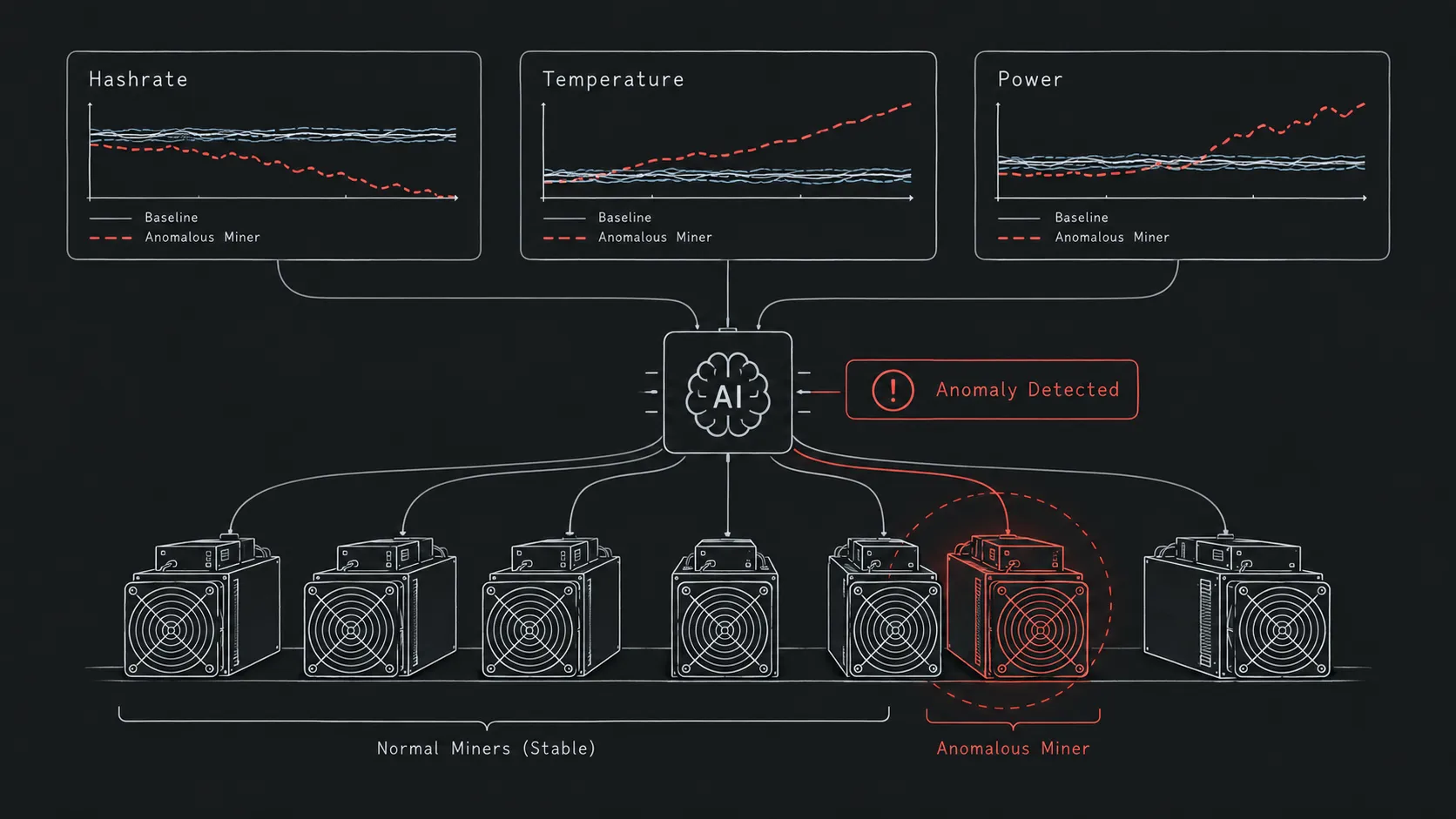
AI automation adds a more complex judgment layer on top of this. For example, a miner's hashrate may still be above the alert threshold, but hashrate volatility has been widening for three days while chip temperature slowly rises and fan speed gradually increases. Observing any single metric alone may not trigger a traditional alert, yet the combination may mean cooling, power delivery, or a hashboard is becoming abnormal. That is exactly where machine learning and anomaly detection are more valuable.
So "automation" and "AI" are not the same concept. Automation is responsible for stable execution; AI is better suited to helping recognize patterns, predict risk, and choose handling strategies.
| Management approach | Judgment method | Typical use cases | Main characteristics |
|---|---|---|---|
| Manual operations | Operators review data and judge | Complex hardware faults, on-site repair | Flexible, but hard to scale to large fleets |
| Rule-based automation | Fixed conditions trigger fixed actions | Low-hashrate reboot, high-temp downclock | Stable, controllable, easy to audit |
| AI-assisted operations | Recognize anomaly patterns from multi-dimensional historical data | Anomaly diagnosis, failure prediction, alert noise reduction | Can handle more complex data relationships |
| AI automation | AI judges, then calls constrained automated actions | Dynamic operating strategies, auto recovery | Higher automation, but needs permissions and safety boundaries |
Why Do Large Bitcoin Farms Increasingly Need AI and Automation?
As farms scale, what truly increases is not only miner count, but the number of "state combinations" that need judgment. A single ASIC may simultaneously have different states across IP, pool connection, hashboards, chip temperature, fans, power, firmware, pool hashrate, and operating mode. Suppose a farm has 5,000 miners: even if only 1% of devices show noteworthy anomalies each day, the ops team still needs to handle about 50 abnormal devices daily—and their causes are not necessarily the same.
More complex still, many farm failures have group characteristics. If twenty miners on the same rack go offline at once, judging device failure one by one is usually not the most efficient approach, because the issue may come from a switch, power distribution, or local network. If the same batch of models repeatedly shows low hashrate during hot afternoon hours, the issue is more likely related to ambient temperature and operating mode. If the miner side shows normal hashrate but pool-side effective hashrate keeps declining, you need to further check network quality, reject rate, or pool connectivity.
This is also why farm management is shifting from "single-miner management" toward "miner fleet management." When Tether opened Mining OS in 2026, it positioned it as a unified operating layer connecting miners, energy, and infrastructure, and emphasized managing large-scale mining facilities through unified data and automation. Bitdeer also noted in its 2026 annual disclosures that its internal software already connects real-time monitoring, miner health, environmental metrics, remote automation, power management, and predictive maintenance workflows.
This shows that software competition among large farms is shifting from "whether you have a device list" to "whether you can turn data into actions."
Nonce's multi-condition filters address exactly this layer. The system can filter devices by combinations of operating status, temperature, hashrate, model, rack, and more, narrowing thousands of miners down to the anomaly set that truly needs handling. Once AI is added, this logic can continue evolving from "users actively set filter conditions" toward "the system actively discovers anomalous combinations."
How Does AI Judge That a Miner Is Becoming Abnormal?
The most valuable place for AI on a farm is not necessarily finding miners that are already fully offline, because "online / offline" itself is easy to judge. The harder problem worth solving is devices that are still working but already starting to deviate from a normal state.
For example, an ASIC's average hashrate over the past seven days may be 99%, 98%, 97%, 95%, 93%, 91%, and 89% of rated hashrate. If the farm's low-hashrate threshold is 80%, traditional rules will take no action for now—but the trend is already very clear. Add temperature, fan speed, hashboard status, and same-model peer performance into the model, and the system has a chance to judge whether this is normal fluctuation or whether device performance is continually deteriorating.
This approach can further form a "peer device baseline." For example, if a farm runs 500 S21 units of the same model, rather than simply declaring every device above some temperature abnormal, it is better to compare miners in the same area, same model, and similar runtime. If the vast majority stay stable under the same conditions while a few start clearly diverging from the cluster in temperature, hashrate volatility, or efficiency, those deserve priority inspection.
Predictive maintenance has become an important direction across broader industrial equipment management. The basic idea is not waiting for a device to cross a fixed alarm threshold, but combining cross-device comparison and historical change to discover anomalies that are forming. For Bitcoin farms, this approach is especially suited to environments with many ASICs, relatively standardized models, and continuous long-running operational data.
From "Finding Low Hashrate" to "Auto Recovery": How Nonce Forms an Automation Closed Loop
Truly valuable farm automation cannot stop at "finding problems." If the system tells on-call staff that 40 miners have low hashrate, but staff still must enter each miner UI one by one to find the IP, read logs, and click reboot, then monitoring has only shortened discovery time—it has not fully solved handling efficiency.
Nonce's management logic connects "discovering anomalies" with "executing actions." Miner filters can first find offline, zero-hashrate, low-hashrate, or high-temperature devices, then handle the same class of devices through bulk actions. For frequent issues with a clear handling method, those can continue to be handed to automation rules.
Take low hashrate as an example: Nonce's auto reboot does not reboot immediately on a momentary hashrate drop. It observes average hashrate over a period, allows different thresholds by miner model, and adds temperature protection, frequency limits, and reboot-count limits. That reduces false triggers from short-term hashrate volatility and avoids repeatedly rebooting a broken miner.
Temperature management can be automated as well. Nonce's operating mode automation can adjust miner operating modes based on average temperature over a period. For example, reduce operating intensity when ambient temperature keeps rising, raise the mode again after conditions recover, and use execution-interval limits to avoid frequent switching.
This already forms a basic closed loop: "continuously collect operating data → judge miner state → conditions met → automatically execute an action → keep collecting data → judge whether recovery occurred."
AI can insert into the "judgment" step so conditions that once depended on fixed thresholds gradually become more dynamic, while the execution layer still needs to remain clear, controllable, and auditable.
AI Automation Should Not Mean "Letting AI Freely Control Miners"
When farms introduce AI, a very important principle is: judgment can become intelligent, but execution permissions must have boundaries.
If a model wrongly judges a temperature anomaly and shuts down thousands of miners at once, the loss may far exceed a few minutes of slower manual handling. Therefore a mature AI farm system should not be designed simply as "AI reaches a conclusion and directly controls every device." Actions should be separated by risk level.
Low-risk, easily reversible tasks—such as re-collecting data, reading logs, or generating an abnormal-device list—can be allowed to run directly. Actions with clear rules and protections—such as rebooting a single low-hashrate miner—can be completed by automation. Operations involving large numbers of devices switching operating modes, bulk pool changes, firmware upgrades, or large-scale shutdowns should require stricter permissions, device-count limits, or human confirmation.
Braiins likewise used a "condition + action + notification" approach in its 2026 automation features, letting farms trigger actions such as pool configuration based on device state. That structure shows the core of an intelligent farm is not pursuing full unmanned operation, but gradually handing repetitive judgments and executions that machines are suited for to the system, while keeping clear control boundaries for high-risk actions.
Even as more mature AI Agents are introduced in the future, this will not change. AI can tell the ops team: "This rack's anomaly is more likely from the network than from 18 miners failing at once," and can suggest checking the switch next—but when executing actions that affect the whole farm, permission systems, operation records, and safety policies are still required.
AI Can Also Extend Automation from Device Health to Mining Profit
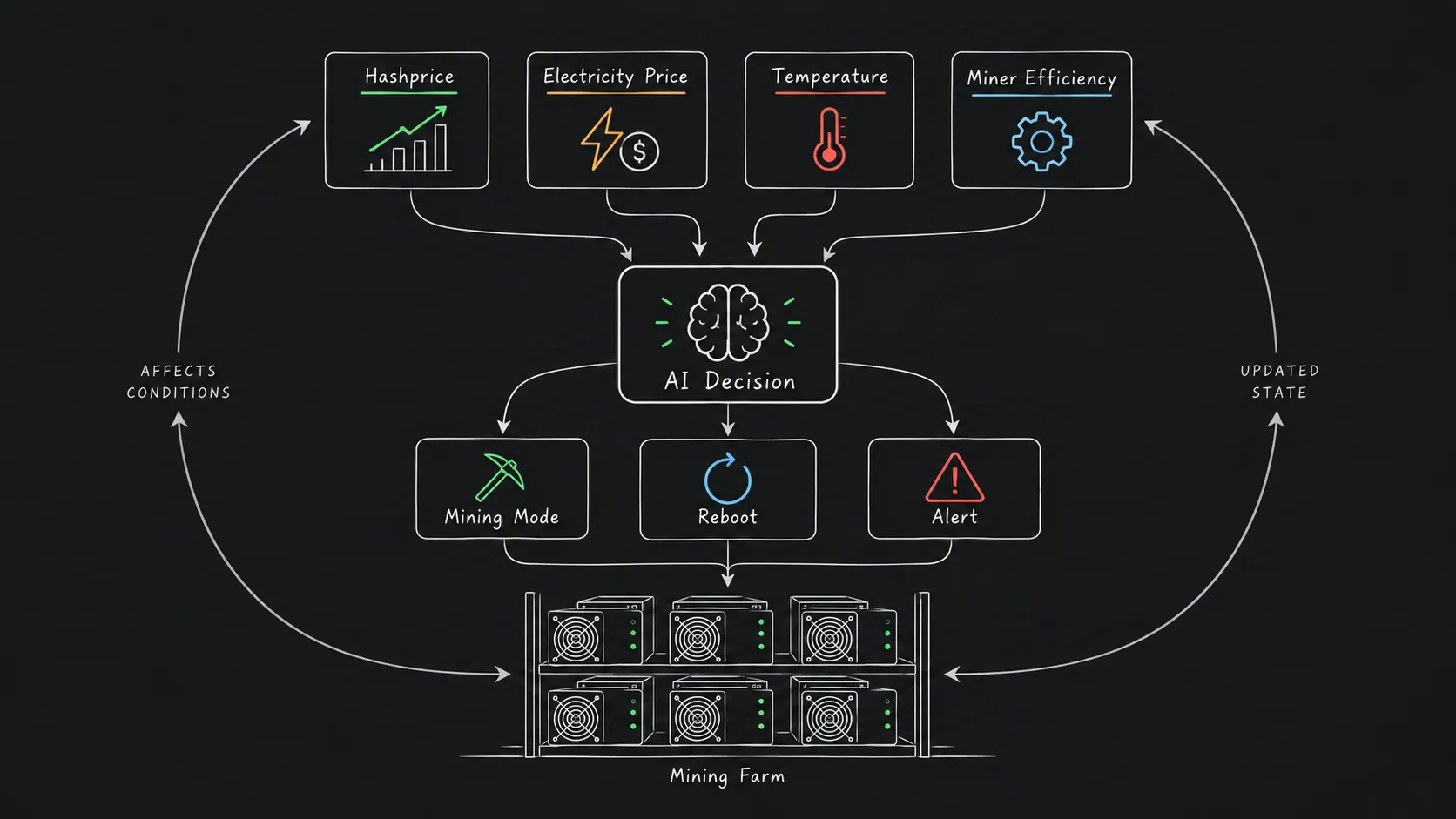
One of the biggest differences between a Bitcoin farm and a typical data center is that both revenue and power cost are highly dynamic. That a given miner is worth running at full load today does not mean the same operating strategy should be kept at every moment. BTC price, network difficulty, transaction fees, Hashprice, electricity price, demand-response subsidies, and device efficiency all jointly affect a miner's marginal profit.
So another important direction for AI automation is gradually expanding from "keep devices online" to "run devices in a more appropriate state."
Luxor's Commander, launched in 2026, already shows this direction: its automation system can adjust miner power strategies by combining real-time hashrate markets, power markets, miner types, and energy costs, and recalculate operating conditions on a fixed cycle. This is completely different from the traditional "shut down at a fixed time every day": the system must continuously judge whether the revenue from producing 1 TH/s of hashrate currently exceeds the corresponding energy and operating cost.
A more complete AI farm in the future may simultaneously observe BTC revenue, electricity price, temperature, miner efficiency, and device health. For example, when electricity price enters a peak and Hashprice is low, the system preferentially reduces power on less efficient miners; when ambient temperature falls and electricity price enters a trough, it raises operating intensity on more efficient devices; if a miner still has positive theoretical profit but its health score keeps deteriorating, it may not continue overclocking—instead reducing load and scheduling maintenance.
So what AI automation ultimately optimizes may not be "maximum hashrate," but "risk-adjusted profit maximization."
How Might AI Agents Change Farm On-Call Work?
Today's farm on-call staff usually need to switch among many pages: review miner lists, judge anomaly counts, read alerts, check miner logs, confirm pool status, then decide whether to reboot or arrange on-site repair. Once device counts reach thousands or even tens of thousands, what truly consumes time is often not clicking "reboot," but judging from large amounts of information "what should be handled right now."
An AI Agent can further compress that information-processing work.
In the future, operators may no longer need to browse data line by line across thousands of devices. They may ask directly: "Which area had the largest drop in effective hashrate over the past two hours?" After reading farm data, the system returns specific racks and further explains that most devices there show low hashrate rather than offline. The operator continues: "What anomalies do these devices share?" The system then combines temperature, model, operating mode, and historical tasks to judge the most likely cause.
If the judgment belongs to an already defined low-risk failure, the AI Agent can even call existing automation capabilities to handle it, then keep observing whether devices recover. If two consecutive operations still fail to recover, it can automatically escalate to a human work order.
What truly changes here is not the chat interface, but the human–machine division of labor on the farm. In the past it was "people find data, people judge, people execute." In the rule-automation stage it becomes "the system finds data, people judge, the system executes."
AI automation further becomes "the system finds data, AI assists judgment, automation executes, people handle exceptions." That is also where AI best fits large farms: it does not replace on-site engineers repairing failed hashboards; it reduces the time engineers spend every day filtering healthy devices, reading duplicate alerts, and performing repetitive actions.
Nonce's AI Automation Should Center on Moving from "Managing Miners" to "Managing Anomalies"
Nonce has already built several foundation layers that AI automation needs. Farm overview continuously aggregates hashrate, efficiency, miner status, and other operating data; multi-condition filters locate abnormal miners among large fleets; auto reboot and operating-mode automation hand some repetitive actions to the system; and task records can continue to be used to check execution results.
Once these layers are connected, the core problem of farm management has already shifted away from "how to remotely control miners."
What is truly worth continuing to optimize is: can the system discover anomalies earlier? Can it judge which anomalies actually share one root cause? Can it reduce duplicate alerts? Can it judge likely device issues from historical miner behavior? Can it automatically choose more reasonable operating strategies when electricity price, temperature, and mining revenue change? These questions are the real direction where AI and Bitcoin farm management come together.
So "Nonce AI Automation for Bitcoin Mining" is not simply adding an AI label to existing miner management features. It is an evolution path from data collection, anomaly recognition, and rule automation toward intelligent decision-making.
The larger the farm, the clearer this path's value. With ten ASICs, an operator can remember each miner's issues; with ten thousand ASICs, no one can continually remember every device's temperature, hashrate, reboot counts, and failure patterns over the past few months—but software can.
What future farms truly need to manage is also no longer every healthy miner, but continuously changing anomalies, risks, and profit opportunities. AI helps the system understand those changes; automation turns judgments into reliable actions; and farm operators concentrate on problems that truly need experience, repair, and decisions.
That may be the greatest meaning of AI automation for Bitcoin mining: not turning farms into "unmanned farms," but gradually turning work that once depended on humans to discover, judge, and repeatedly execute into a continuously running, verifiable, controllable automated operations closed loop.