How Do Time-of-Use Electricity Prices Affect Mining Costs, and When Is It Most Profitable to Mine?
For a Bitcoin mining site, electricity is not a fixed line on the financial statements but a cost curve that shifts with time, region, and market. Profit depends not on how low the average price looks, but on at what price the miners run and for how many hours. This article shows with worked examples how time-of-use pricing affects mining costs and when it is most profitable to mine.
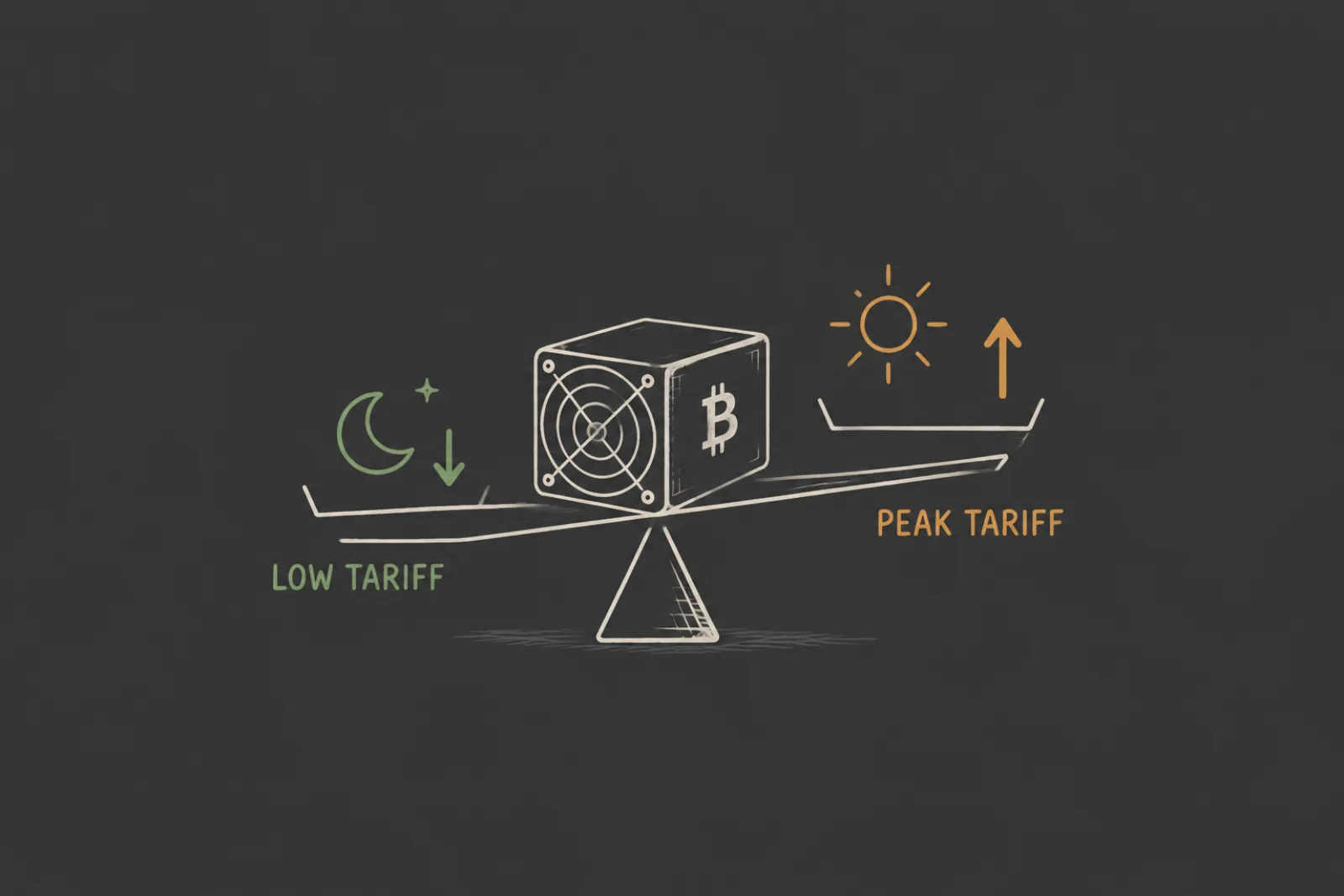
For a Bitcoin mining site, the electricity price is not a fixed, unchanging number on the financial statements but a cost curve that keeps changing with time, region, power contracts, and market conditions. When estimating a project's rate of return, many mining sites use only an average electricity price such as $0.04, $0.05, or $0.06 per kWh, then calculate the electricity bill by multiplying the miner's rated power consumption by 24 hours. This approach can quickly complete an investment model, but it cannot accurately answer a more important question: should the miners keep running every hour?
Two mining sites may both have a monthly average electricity price of $0.05 per kWh, yet their actual operating results can be completely different. The first site runs on a fixed price all day, paying $0.05 every hour; the second site pays only $0.02 to $0.04 most of the time but faces a markedly higher price during a few peak hours. If the second site can throttle down or shut off in time during high-price periods, its effective power cost may be lower than the first site's; if it fails to respond in time, a few extreme high-price hours can also swallow up the profit accumulated earlier.
This is the core of how time-of-use electricity prices affect mining costs: what determines profit is not how low the average price looks, but at what price the miners ran for how many hours, and at what price they reduced their power consumption.
The market price page published by the Electric Reliability Council of Texas, ERCOT, shows that its day-ahead market prices are published daily, while real-time market prices are produced by market interval, and it provides historical settlement point prices for different trading hubs and load zones. ERCOT's real-time settlement point prices are calculated from prices produced by security-constrained economic dispatch and are published at 15-minute settlement intervals; locational marginal prices are typically produced roughly every five minutes. For mining sites directly or indirectly exposed to wholesale market prices, this means that replacing hourly or 15-minute prices with a single monthly average may mask the high-price periods that truly affect profit.
However, what ERCOT publishes are wholesale market prices, which are not the same as the delivered electricity price a site ultimately pays. A site's bill may also include transmission charges, distribution charges, capacity fees, taxes, line losses, retail electricity provider markups, and other fees specified in the contract. Therefore, when analyzing a site's electricity costs, two sets of figures need to be kept at the same time: one is the marginal electricity price used for dispatch decisions, and the other is the all-in power cost used for financial accounting.
What Are Time-of-Use Electricity Prices for a Mining Site
Time-of-use pricing generally means that electricity prices are divided by usage period into peak, mid-peak, and off-peak. Peak hours usually correspond to periods when system load is high, supply is tight, or transmission congestion is more severe; off-peak hours usually correspond to periods when load is low or power supply is relatively abundant; mid-peak prices fall between the two.
But the price structure faced by large Bitcoin mining sites is often more complex than the time-of-use rates of ordinary residential or small commercial users. A mining site may sign a fixed-price power purchase agreement, may settle according to preset peak and off-peak periods, and may also be partly exposed to the day-ahead market or the real-time market. Some mining sites also participate in demand response, actively reducing electricity use when the grid is stressed in exchange for power credits or other compensation.
A fixed price does not mean a mining site never needs to shut down. Some fixed-price power purchase contracts allow a mining site to reduce electricity use during high-price periods, monetizing the originally locked-in power value through power credits, demand response, or market mechanisms specified in the contract. If the value obtained from selling or releasing one MWh of electricity exceeds the marginal profit from using that MWh to mine, then shutting down may be more worthwhile than continuing to mine.
This is also why large mining sites treat electricity as a dispatchable factor of production rather than a simple fixed cost.
How Time-of-Use Pricing Enters the Cost of a Single Miner and the Whole Site
Calculating the electricity bill for a single miner is not complex: daily electricity cost = miner power consumption × operating hours × the price for the corresponding period. If there are three prices — peak, mid-peak, and off-peak — in a day, they should be calculated separately: daily electricity cost = off-peak usage cost + mid-peak usage cost + peak usage cost.
Suppose a miner's actual at-the-wall power consumption is 3.5 kW, with 8 hours each of off-peak, mid-peak, and peak periods per day, at prices of $0.03, $0.05, and $0.09 per kWh respectively; then its electricity costs are as follows:
| Period | Operating time | Price | Electricity used | Cost |
|---|---|---|---|---|
| Off-peak | 8 hours | $0.03/kWh | 28 kWh | $0.84 |
| Mid-peak | 8 hours | $0.05/kWh | 28 kWh | $1.40 |
| Peak | 8 hours | $0.09/kWh | 28 kWh | $2.52 |
| Total | 24 hours | Weighted average ≈ $0.0567/kWh | 84 kWh | $4.76 |
As the table shows, peak hours account for only one-third of the day yet contribute more than half of the miner's electricity cost. If the site shuts down completely during peak hours, a single miner saves $2.52 per day; if throttling during peak hours reduces power consumption by 25%, peak-hour electricity cost can be reduced by $0.63. Whether the site should ultimately execute these strategies also requires comparing the electricity saved against the revenue lost from mining less Bitcoin.
At the site level, the calculation logic is the same, except that the number of miners, auxiliary facility power consumption, and distribution losses must be included in the model. For 1,000 miners each consuming 3.5 kW, the total load of the miners themselves is 3.5 MW. If the site's power usage effectiveness is 1.10 — meaning that for every 1 kWh consumed by the miners, the whole site must draw about 1.10 kWh from the grid — then the actual facility load is about 3.85 MW. Calculating only by the miners' nameplate power consumption underestimates total electricity use by about 10%.
The electricity price also flows into the cost per Bitcoin. Suppose a site's all-in power spending for one month is $600,000 and it mines 10 Bitcoin; then, from the energy perspective alone, the energy cost per Bitcoin is $60,000. If the site reduces net power spending to $500,000 through peak-hour throttling and demand response, then even if output falls to 9 Bitcoin, the energy cost per Bitcoin is still about $55,556. Whether shutting down is worthwhile cannot be judged only by whether the electricity bill fell; it also depends on whether the electricity bill fell faster than output did.
How Much a Single Miner Pays at Different Electricity Prices
Using the uniform assumptions of 3.5 kW at-the-wall power consumption and all-day operation, the following shows how price changes affect a single miner's annual electricity cost.
| Price | Daily electricity used | Daily cost | 30-day cost | 365-day cost |
|---|---|---|---|---|
| $0.03/kWh | 84 kWh | $2.52 | $75.60 | $919.80 |
| $0.04/kWh | 84 kWh | $3.36 | $100.80 | $1,226.40 |
| $0.05/kWh | 84 kWh | $4.20 | $126.00 | $1,533.00 |
| $0.06/kWh | 84 kWh | $5.04 | $151.20 | $1,839.60 |
| $0.08/kWh | 84 kWh | $6.72 | $201.60 | $2,452.80 |
| $0.10/kWh | 84 kWh | $8.40 | $252.00 | $3,066.00 |
This table reflects only the effect of price on the miners' own electricity cost. For 1,000 miners of the same power consumption, every $0.01/kWh increase in price raises the theoretical annual electricity cost by $306,600.
This is why a mining site's electricity cost is highly sensitive to every cent of price change. Even if a site cannot change the contract base price, it can lower its actual weighted price by reducing the amount of operation during high-price periods.
The U.S. Energy Information Administration's Electric Power Monthly provides average electricity price data broken down by end-user type and state, which can be used to compare industrial electricity environments across different regions of the United States. But these data are average retail prices, suitable for macro site selection and trend analysis, and not suitable for directly replacing a specific site's contract price or ERCOT real-time settlement prices.
When Is It Most Profitable to Mine
In regions with a lot of installed solar capacity, midday may see low prices because of abundant solar generation; in the evening, when solar output drops quickly while residential and commercial loads remain high, prices may instead rise. In regions rich in wind resources, strong nighttime winds may bring low prices, but a windless night is not necessarily cheap. Extreme heat, severe cold, generating-unit failures, and transmission-line congestion can also break the usual peak-and-off-peak pattern. Therefore, a mining site needs to calculate a dynamic break-even electricity price.
A 2026 study, Hashprice modulates the electricity demand response of Bitcoin miners, uses the Texas electricity market to study how mining load responds to wholesale electricity prices and transmission costs. The study finds that miners' load response depends on expected mining revenue: when hashprice is high, a site's sensitivity to high electricity prices declines and its shutdown threshold moves toward higher prices; when hashprice is low, the site curtails load earlier. In other words, there is no permanently valid shutdown price for a mining site; the shutdown line should change dynamically with mining revenue.
Full Load, Throttle Down, or Shut Down
When facing time-of-use prices, a mining site should not have only two options — on and off. Full load, standard mode, throttling, and sleep each suit a different profit range.
When the price is clearly below the shutdown line, running at full load is usually the most reasonable choice. If the miners support a high-efficiency power mode, the site can also assess whether moderately raising hashrate can produce positive marginal profit. But overclocking cannot be judged by the hashrate gain alone, because power consumption usually rises faster, and energy efficiency per unit of hashrate may deteriorate.
When the price approaches the break-even line, throttling is often more flexible than shutting down outright. After some miners reduce frequency and voltage, their power consumption may fall by more than their hashrate does, thereby improving efficiency. But the specific effect depends on the miner model, chip quality, firmware, and operating environment; one cannot assume that after a 25% throttle, all miners' hashrate and power consumption fall in the same proportion.
When the all-in marginal electricity price exceeds a miner's hourly revenue, continuing to run merely trades more cash for lower-value Bitcoin output. At this point, if the site can also earn demand-response compensation, power-curtailment credits, or the power resale value in its contract, the economic value of shutting down rises further.
How Public Miners Use Peak Shutdowns to Lower Their Net Electricity Price
Riot Platforms' public disclosures show how demand response enters a mining site's cost. As Riot disclosed in its full-year 2025 results, the company mined 5,686 Bitcoin for the year, with a cost to mine per Bitcoin, excluding miner depreciation, of $49,645 — higher than 2024's $32,216. The company attributed the cost increase mainly to growth in the global average network hashrate, while noting that power credits earned in 2025 grew 68% versus 2024, partly offsetting the cost pressure.
Looking further at its cost table, Riot's 2025 self-mining power cost was $281.396 million and other direct costs were $57.615 million; after deducting $56.729 million of power curtailment credits, its self-mining cost excluding miner depreciation was $282.282 million. The company explains that these power curtailment credits came from temporarily suspending operations and participating in ERCOT's demand-response programs, and that its fixed-price power purchase contracts allow it to curtail mining load at appropriate times.
Based on the above disclosures, the power curtailment credits equal about 16.7% of direct costs before deducting the credits, and about 20.2% of its self-mining power cost. This does not mean every site can achieve the same percentage reduction, because the actual result depends on the power contract, the market, the size of curtailable load, execution capability, and the frequency of high-price events.
Riot's July 2025 monthly operations update further discloses that the company earned about $12.6 million of power credits and about $1.3 million of demand-response credits that month, for total power credits of about $13.9 million; after deducting these credits, the company estimated its all-in power cost at 2.8 cents per kWh. This figure includes transmission and distribution charges, other fees, surcharges, and taxes, and already nets out the total power credits.
This set of data illustrates two important points. First, a site's net electricity price can differ markedly from the contract base price or wholesale market price. Second, shutting down is not simply giving up output; it is a comparison between the return from continuing to mine and the value of curtailing load.
But Riot's business scale, power contracts, and market-participation eligibility are distinctive and cannot be directly copied to an ordinary hosted mining site. Even if small and medium sites cannot directly participate in ancillary services, they can still apply the same operating logic: identify high-price periods, calculate a dynamic shutdown line, prioritize shutting down inefficient equipment, and avoid blindly pursuing uptime in a negative-margin range.
Why Even a Fixed-Price Site May Choose to Shut Down
The main value of a fixed price is reducing price uncertainty, letting a site predict its cash costs more steadily. But a fixed price does not mean electricity has no opportunity cost.
Suppose a site locks in $0.04 per kWh through a long-term contract, while the market value of power rises sharply during a peak period. If the contract allows the site to earn credits or share in the power value by curtailing load, then continuing to consume electricity to mine is equivalent to forgoing the return that shutting down could have earned. What needs to be compared here is not the $0.04 fixed price against mining revenue, but the difference between the profit from continuing to mine and the compensation for shutting down.
Even without demand-response income, a fixed-price site may still shut down in the following situations: miner revenue has already fallen below the contract price; high temperatures significantly raise cooling and failure risks; transmission and distribution capacity charges are tied to peak load; the site is approaching a system peak that could raise the whole year's transmission charges; or continuing to run inefficient miners would raise the whole site's cost per coin.
Therefore, a fixed price solves the problem of procurement price volatility, not automatically the problem of miner dispatch.
How to Optimize a Site's Peak-and-Off-Peak Dispatch with Nonce
To truly put a time-of-use pricing strategy into practice, price judgment must be connected to miner execution. For teams with multiple sites or mixed miner models, Nonce can serve as a unified miner operations platform, helping operators organize miners by site, workspace, device model, and operating status, and bringing querying, batch processing, and task-result tracking into the same workflow.
When prices enter a high range, a site does not necessarily have to shut down all equipment at once. Operators can first filter for low-efficiency, low-hashrate, overheating, or unstable miners and make these devices the first batch to throttle or put to sleep; as prices keep rising, they can then gradually expand the scope of curtailment. Efficient and stable miners can be kept running longer, reducing hashrate loss while lowering load.
Nonce's miner query capability can be used to locate offline, low-hashrate, zero-hashrate, and overheating devices. When prices are high, if a miner is already low-hashrate or overheating, continuing to pay high-price electricity for it usually makes little economic sense. Determining the target devices through status and operating data first, then executing power-mode adjustments, is more precise than switching the whole site on or off uniformly.
On power management, operators can apply the applicable power mode in bulk to selected miners — for example, overclock, standard, throttle, or sleep. The modes supported vary by miner and firmware, so device compatibility and operating results should still be confirmed before actual use. For a time-of-use pricing strategy, throttling can serve as a middle gear: when the price approaches the shutdown line but has not clearly exceeded it, first reduce power consumption and heat; once the price falls back, gradually restore normal operation.
Nonce also supports automatic throttling based on temperature status. Temperature-triggered automation cannot replace an electricity-price market system, nor does it mean the platform can predict ERCOT prices, but it can help a site combine high-temperature protection with power-mode management. High-price periods often coincide with hot weather, when a site faces not only rising prices but also increased cooling power consumption and rising device temperatures. Through status filtering, batch power adjustment, and temperature-trigger rules, a site can reduce the delay caused by operating on each unit manually.
For multi-site teams, what matters more is building a unified dispatch record. After each peak-hour throttle or shutdown, the target site, device scope, start time, end time, curtailed load, lost hashrate, electricity saved, and recovery success rate should all be recorded. Only by continuously accumulating these data can a site judge whether a given time-of-use dispatch strategy actually lowered its cost per coin, or merely lowered the electricity bill while losing even more revenue.