Why Is Bitcoin Mining Getting More Expensive? Where Do Miners Actually Lose Money?
Bitcoin mining keeps getting more expensive because a fixed block reward is split across an ever-larger network hashrate, while electricity, equipment, infrastructure, and operating costs do not fall. This article breaks down halving, hashrate dilution, Hashprice, fees, and four cost layers to show where miners actually lose money.
Why Is Bitcoin Mining Getting More Expensive?
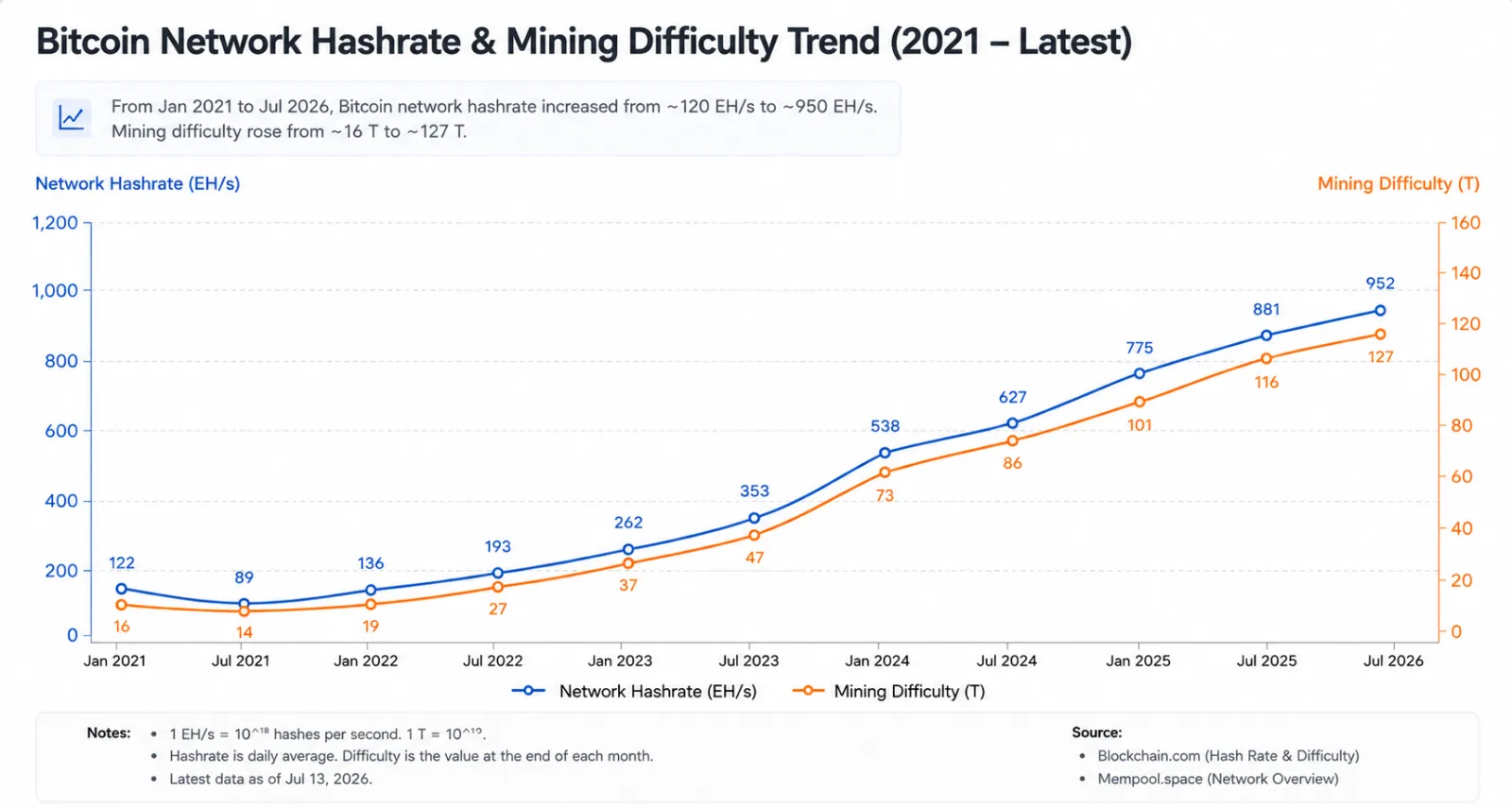
Bitcoin mining is becoming more expensive not only because electricity prices are rising. The more fundamental reason is that a limited block reward is being competed for by an ever-larger total network hashrate, while the electricity, equipment, infrastructure, and operating expenses that miners put in do not automatically fall as a result.
For a mining site, how much electricity a machine consumes each day is usually fairly stable, but the amount of bitcoin that same machine can mine each day changes with the total network hashrate and mining difficulty. When more efficient machines join the network, the share of total hashrate held by existing machines declines, and each machine earns less bitcoin. If bitcoin's price, transaction fees, and electricity prices do not change favorably enough, revenue per unit of hashrate falls, and the electricity and operating expenses required to mine each bitcoin rise accordingly.
The fourth bitcoin halving in April 2024 reduced the block subsidy from 6.25 BTC to 3.125 BTC. In an idealized model where all else is held equal, the amount of new bitcoin added to the entire network each day is cut roughly in half, and the base revenue miners can share falls with it. But miners' machine purchase costs, site rent, transformers, cooling equipment, staff wages, and financing interest do not get halved.
At the same time, competition in the mining industry continues to drive improvements in machine efficiency and expansion of total network hashrate. The Digital Mining Industry Report published by the University of Cambridge shows that the average hardware efficiency of surveyed miners was about 28.2 J/TH as of June 2024, up 24% year over year; yet the estimated annual electricity consumption over the same period still grew 17% to 138 TWh. This shows that more efficient machines have not simply reduced the industry's electricity use, because the scale of newly added hashrate offset the energy savings from improvements in single-machine efficiency.
As a result, rising bitcoin mining costs are usually the combined outcome of many factors: falling block rewards, growth in total network hashrate, rising mining difficulty, declining Hashprice, fluctuating fee revenue, changing electricity prices, rapid iteration of ASIC machines, equipment depreciation, financing costs, and hidden losses caused by offline machines, low hashrate, high temperatures, and incorrect scheduling.
How Halving Raises the Per-Coin Cost of Bitcoin
To understand the impact of the bitcoin halving on miners, it helps to first view a mining site as a factory whose output is not fully within its own control.
An ordinary factory that wants to increase output can add production lines and, if market demand allows, sell more products. But the number of blocks the bitcoin network produces each day and the subsidy per block are determined by the protocol. By adding equipment, a miner can only increase its probability of winning block rewards; it cannot make the entire network increase bitcoin production without limit.
Before the 2024 halving, the base subsidy for a new block was 6.25 BTC; after the halving it dropped to 3.125 BTC. Assuming bitcoin's price, total network hashrate, the site's hashrate, and fees all stay unchanged, a mining site's theoretical base mining revenue would take a hit of close to 50%. The site still has to run the same number of machines for the same amount of time each day and pay similar electricity bills, yet can only earn less bitcoin.
However, it is not a rigorous conclusion that mining costs must double after a halving. If bitcoin's price rises after the halving by more than the decline in output per unit of hashrate, miners' dollar revenue may recover; if a large number of inefficient machines exit and difficulty adjusts downward, the remaining miners may also gain a larger share of hashrate. But if total network hashrate keeps growing while the coin price and fees cannot rise in step, miners' profit margins will continue to be squeezed.
Why Does Rising Total Network Hashrate Reduce Output Per Machine?
The point miners most easily overlook is that a machine's nominal hashrate staying unchanged does not mean the revenue it generates each day stays unchanged.
Suppose a mining site has 100 PH/s of hashrate. When the total network hashrate is 500 EH/s, this site accounts for about 0.02% of total network hashrate; if total network hashrate increases to 1,000 EH/s while the site still has only 100 PH/s, its network share falls to about 0.01%. Even if the machines run perfectly normally, the amount of bitcoin they can theoretically earn is cut in half.
The bitcoin network readjusts mining difficulty every 2,016 blocks, usually about once every two weeks, with the goal of keeping the average block time at about 10 minutes. If a large amount of new hashrate comes online, blocks are produced faster for a while, and difficulty rises at the next adjustment; if a large number of machines shut down, block production slows, and difficulty may fall.
Difficulty adjustment keeps bitcoin's issuance pace relatively stable, but it also means miners cannot jointly expand output by continually adding equipment across the whole industry. The hashrate added across the network ultimately translates into higher difficulty, and what miners compete for is relative share.
This is also why, after a new generation of ASIC machines comes online, older machines become increasingly hard to keep profitable. New machines complete the same number of hash computations with lower power consumption, allowing operators to deploy more hashrate within the same power capacity. When new equipment enters the network, it not only improves the buyer's own competitiveness but also pushes up total network hashrate and difficulty, further compressing the revenue per unit of hashrate for older equipment.
Why Miners Should Watch Hashprice, Not Just the Bitcoin Price
Bitcoin's price is an important variable in miners' revenue, but it cannot on its own answer whether a mining site is making money.
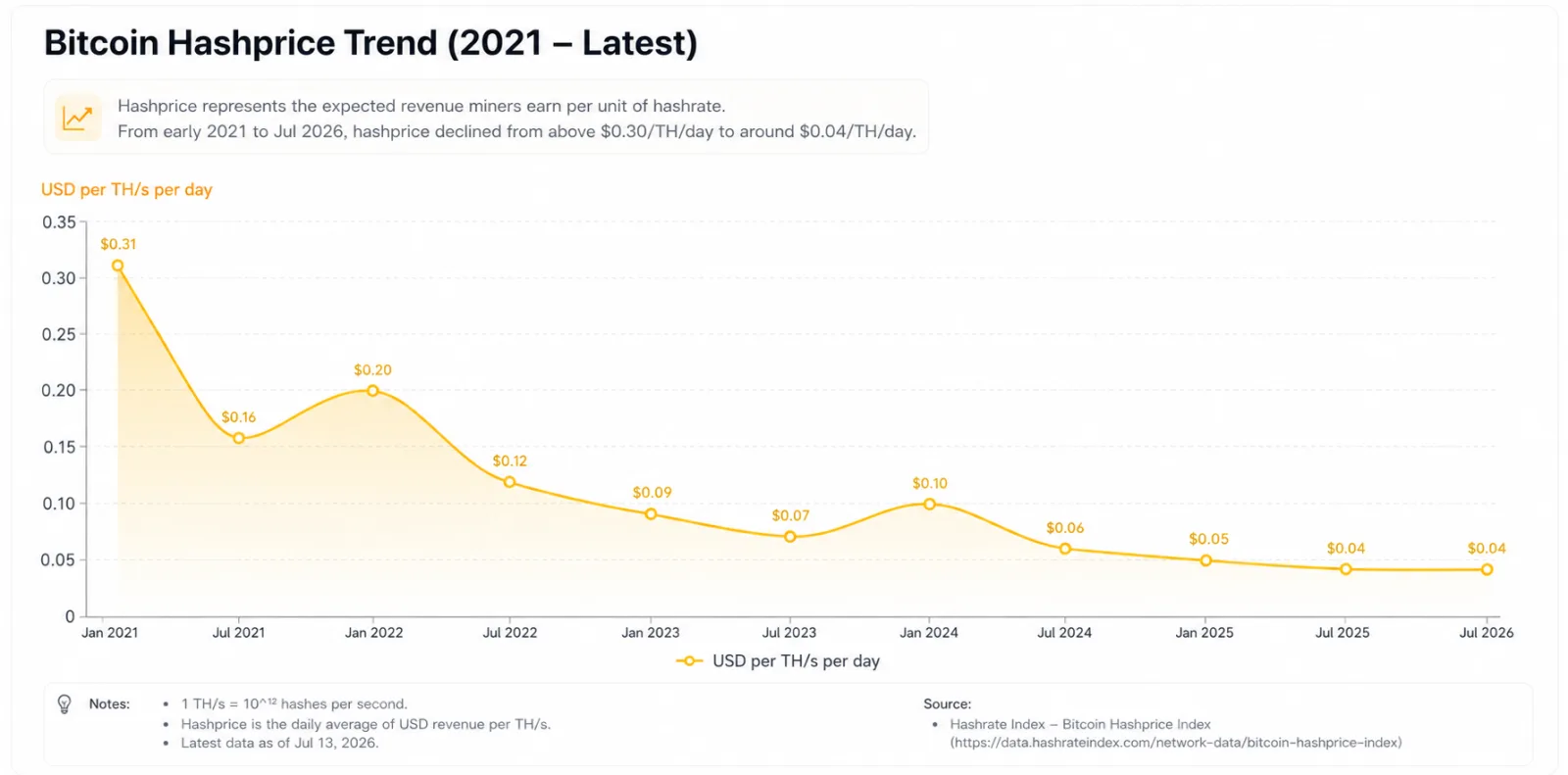
A more direct indicator is Hashprice, the expected revenue that a unit of hashrate can earn over a given period. The industry usually expresses it in USD/PH/s/day, and it can also be expressed in TH units. Hashprice comprehensively reflects bitcoin's price, the block subsidy, transaction fees, total network hashrate, and difficulty changes.
Miners may encounter a situation like this: bitcoin's price has risen, but a large number of new machines come online at the same time; total network hashrate grows faster than the coin price, and mining difficulty rises accordingly; meanwhile, on-chain congestion eases and fee revenue falls. In the end, the dollar revenue generated per unit of hashrate may still decline.
This explains why some miners still lose money in a bull market. Miners pay for electricity, hosting fees, and staff wages, but their revenue is determined by Hashprice. Focusing only on bitcoin's price is like a trucking company looking only at the total freight rate without looking at how many orders each truck can take each day.
A 2026 study further points out that whether a mining site curtails its electricity load depends on the level of electricity cost relative to Hashprice. When Hashprice is high, miners can tolerate higher electricity prices; when Hashprice is low, the site will begin shutting down or reducing load at a lower electricity-price level.
Can Transaction Fees Make Up for Halving Losses?
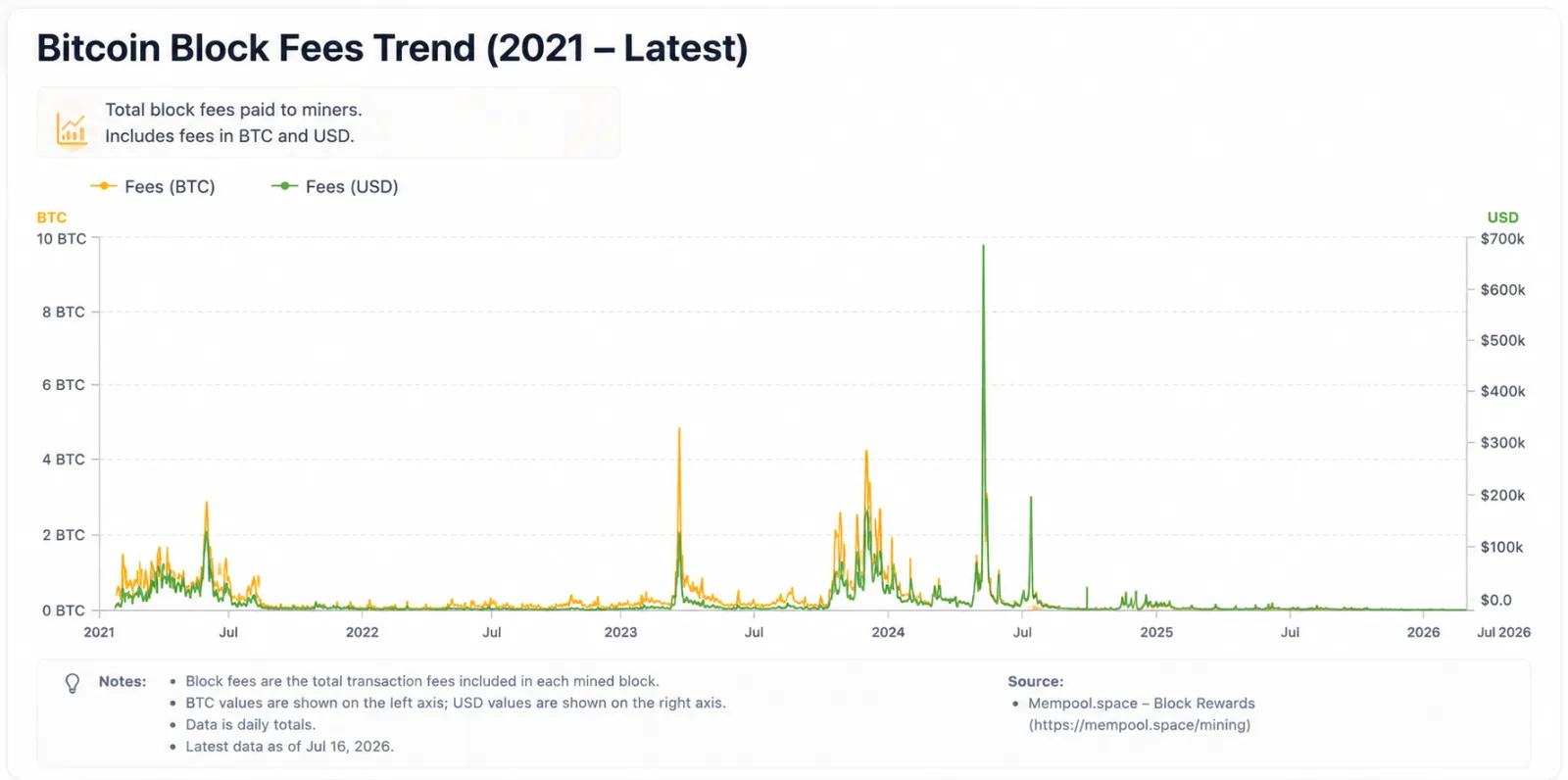
Miner revenue consists of two parts: the block subsidy and transaction fees. The block subsidy halves on a set cycle, while fees are determined by user demand for block space. When on-chain transactions are congested and users compete for limited block space, fees can rise quickly and miner revenue increases in the short term; when network demand falls back, fees can also drop quickly.
Therefore, fees can noticeably improve miner revenue during certain periods, but they cannot be treated as stable, predictable fixed income. When a mining site draws up a long-term budget, treating fee levels during extreme congestion as the norm makes it easy to overestimate future cash flow.
For site managers, a more reasonable approach is to calculate Hashprice and cash flow separately under low, medium, and high fee scenarios, and to use the low-fee scenario as the basis for equipment procurement and debt-servicing capacity tests.
Where Do Miners Actually Lose Money?
Many miners use only one formula when calculating profit: mining revenue minus machine electricity cost. This result can only be called gross electricity margin; it does not represent the money the site actually earns. A complete bitcoin mining cost should be divided into at least four layers: energy cost, operating cost, capital cost, and hidden losses.
Energy Cost
The machines themselves are usually the largest power-consuming equipment at a site, but the total electricity use on the meter is often higher than the sum of the machines' rated power. Fans, pumps, cooling towers, liquid-cooling circulation equipment, network equipment, lighting, and maintenance areas all require power, and there are also losses in transformers and transmission lines.
For example, a machine with a rated power of 3.5 kW does not mean the site only needs to pay for 3.5 kW. If the site's overall PUE is 1.08, that is equivalent to bearing about 8% in auxiliary systems and power losses in order to keep the machines running. For a single machine, this difference looks limited; for thousands of machines, it becomes a significant cost after accumulating over the long term.
A University of Cambridge survey of miners shows that electricity accounts for more than 80% of the cash operating expenses of surveyed companies, with a median electricity cost reported by respondents of $45/MWh and a median all-in electricity-related cost of $55.5/MWh.
But this also means that even though electricity is the largest cash cost, it is still not the entire cost.
Site Operating Cost
A mining site also has to bear costs such as site rent, operations and maintenance staff wages, spare parts, repairs, network, security, insurance, pool fees, and management software.
Among these, repair cost cannot be viewed only as parts procurement. The entire cycle in which a machine goes from failing, being discovered, taken offline, queued for repair, and back online again all generates revenue loss. If a site lacks real-time monitoring and clear repair priorities, a machine with a simple fault may stay offline for days while operations staff do not even know it has stopped generating revenue.
Pool fees are usually charged as a certain percentage of mining revenue. The percentage alone may not seem high, but it is deducted directly from the revenue side. Hosted miners may also need to pay management fees, rack-in fees, repair service fees, or minimum power commitments, and additional fees in contract terms are sometimes more important than the nominal electricity price.
Capital Cost
ASIC machines, transformers, distribution cabinets, containers, buildings, land access, and air-cooling or liquid-cooling equipment all require upfront capital investment. Even if these costs are not paid daily, they must enter the per-coin cost through depreciation, financing costs, and payback period.
Unlike ordinary mechanical equipment, a machine's economic life depends not only on physical wear but also on technological iteration. Even if an old machine can still run normally, it may lose economic value because its J/TH is too high. When Hashprice falls or electricity prices rise, equipment may drop below its break-even line before it has finished depreciating.
If a site procures equipment through loans or debt issuance, the interest must likewise be borne by mining revenue. When bitcoin's price falls, the collateral value of machines and BTC reserves may decline at the same time, further amplifying liquidity pressure.
Hidden Losses
The most easily underestimated cost is the operating losses that do not appear directly on the electricity bill or procurement invoices, including:
- machines going offline without being discovered in time;
- machines whose actual hashrate is lower than their theoretical hashrate;
- high temperatures triggering automatic throttling;
- frequent restarts reducing effective run time;
- unreasonable airflow design causing hot-air recirculation;
- network faults or abnormal pool connections;
- inconsistent firmware versions;
- incorrect power-mode configuration;
- excessively long repair queue times;
- insufficient spare parts causing long-term equipment downtime.
These problems do not raise a single machine's rated electricity cost, but they reduce the effective hashrate the site actually obtains. The result is that the site pays most of its fixed costs but does not get the corresponding BTC output, which ultimately shows up as a rise in per-coin cost.
Why Can a Site Still Lose Money When Gross Electricity Margin Is Positive?
Suppose a machine generates $8 in revenue per day and the machine's own electricity cost is $5, leaving what appears to be $3 in gross electricity margin per day.
But if we go on to deduct $0.40 in auxiliary power, $0.16 in pool fees, $0.60 in hosting or site cost, $0.20 in repair reserve, and $1.50 in equipment depreciation, this machine's complete cost per day already reaches $7.86, leaving only $0.14 in profit. As soon as there are a few hours of downtime, a slight decline in Hashprice, or a rise in electricity prices, profit turns negative.
This is what many miners mean when they say electricity is still covered but the company is still losing money. Gross electricity margin only answers whether turning a machine on is more worthwhile than shutting it down immediately; it cannot answer whether purchasing the machine can pay back, nor whether the entire site is generating positive cash flow and accounting profit.
Where Do Different Types of Miners Mainly Lose Money?
The most common problems for home miners are high electricity prices, noise, and limited cooling capacity. Residential electricity prices are often higher than for large industrial users, and it is also hard to establish efficient hot and cold aisles in a home environment. Even running only a small amount of equipment, the extra air-conditioning and exhaust power can significantly raise total cost. Home miners also lack economies of scale, and a single power failure or fan breakdown can bring an entire machine to a halt.
The risk for small hosted miners mainly comes from the contract. The nominal electricity price may look competitive, but the final expenditure also depends on management fees, repair fees, deposits, minimum hosting terms, downtime liability, and electricity-price adjustment mechanisms. If a miner cannot directly check equipment status, it is hard to tell whether low output comes from changes in network difficulty or from a machine being offline for a long time.
Self-built sites have to bear heavier infrastructure investment. Transformers, distribution, land, grid access, containers, and cooling systems require large amounts of upfront capital. If the build is too large but the actual rack-in rate is insufficient, idle capacity will also generate depreciation and financing costs. If the build is too small, it is hard to spread out fixed labor and management costs.
Large listed miners can usually obtain lower electricity prices and better financing channels, but their cost structure is more complex. In addition to direct energy costs, they also bear high depreciation, equity incentives, administrative expenses, financing costs, expansion projects, and asset impairment. The "per-coin cost" disclosed by different companies may separately refer to energy cost, direct production cost, cash cost, or a fully loaded cost that includes more expenses, so you cannot rank them directly without looking at the definition.
Old Machines Lose Money First
When comparing ASIC machines, one of the most important indicators is J/TH, the amount of energy in joules consumed to generate 1 TH/s of hashrate. The lower the value, the less electricity used per unit of hashrate.
Actual parameters under different batches, operating modes, and environments may differ from the nominal values, so a formal chart should use the official specifications for the corresponding Bitmain model and specific version. Typical air-cooled versions can be understood using the following ranges:
| Machine Model | Typical Efficiency Level | Operating Implication |
|---|---|---|
| Antminer S19 Pro | about 29.5 J/TH | Easily approaches the shutdown line under low Hashprice or higher electricity prices |
| Antminer S19 XP | about 21.5 J/TH | Clearly better than the S19 Pro, but weaker than newer-generation equipment |
| Antminer S21 | about 17.5 J/TH | Electricity consumption per unit of hashrate falls further |
| Antminer S21 Pro | about 15 J/TH | Has more gross-electricity-margin headroom at the same electricity price |
Suppose two machines both provide 100 TH/s of hashrate, one with an efficiency of 30 J/TH and the other 15 J/TH. The former needs about 3 kW of power, the latter only about 1.5 kW. The mining revenue they generate is close, but their electricity costs differ by a factor of two.
When Hashprice is high, both machines may be profitable; when Hashprice falls, revenue declines at the same time, but the high-efficiency machine has lower electricity cost and can keep running. The inefficient machine drops below its break-even line earlier.
This is also the core reason machines depreciate quickly. An old machine is not that it cannot work, but that it consumes too much electricity per unit of hashrate. Even if a miner bought it at a very high price, as long as its future cash flow cannot cover the electricity cost, its market value will decline rapidly.
Why Can't the Per-Coin Costs of Listed Miners Be Ranked Directly?
The financial reports of listed miners provide important data for studying bitcoin mining costs, but the definitions used by different companies are not uniform.
Some companies disclose electricity cost per BTC, counting only mining electricity; some disclose direct production cost, which may add site labor and repairs; some use cash cost per coin, which may include more operating expenses but not depreciation; and others use cost of revenue or fully loaded cost, which includes depreciation, hosting, and other items.
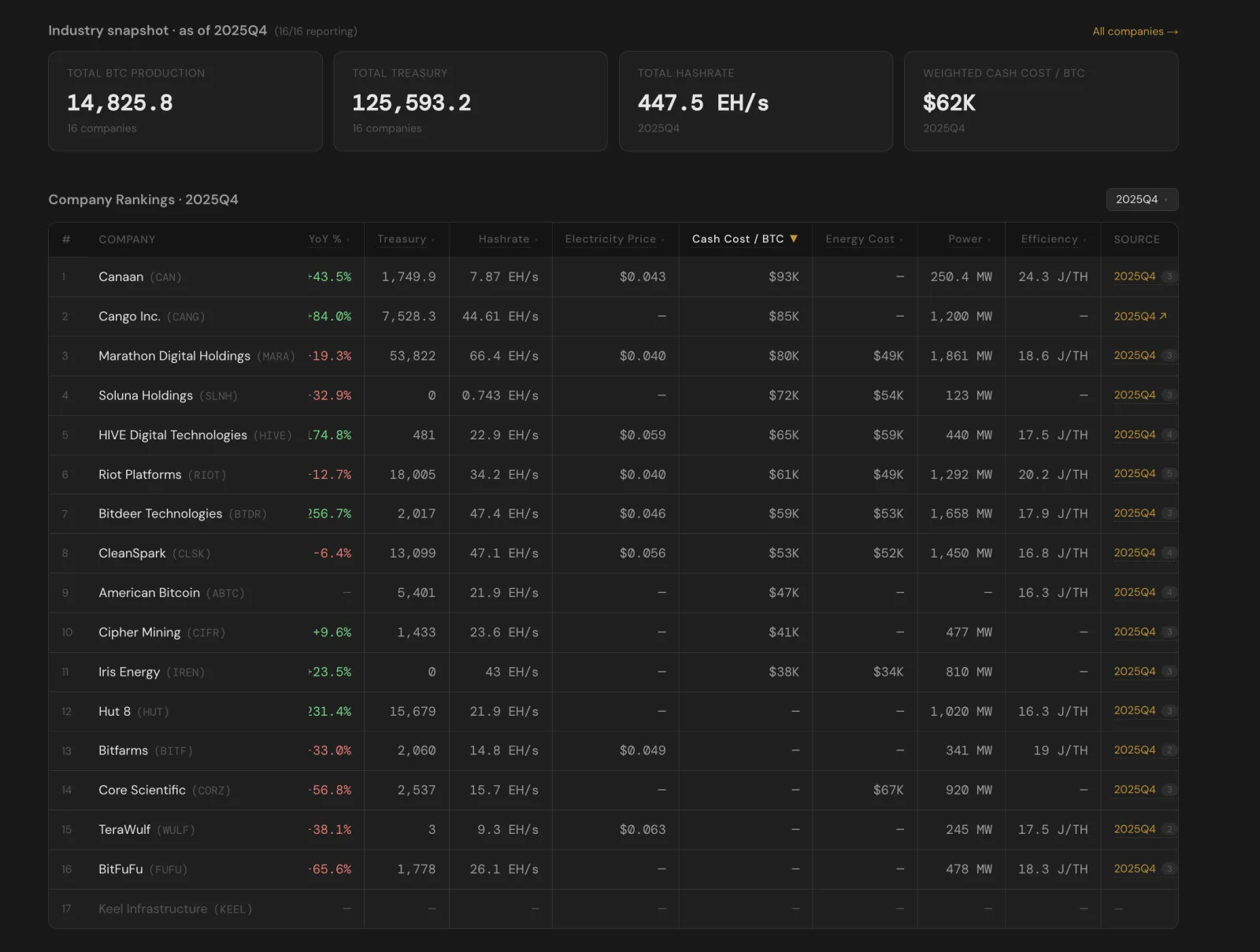
Data source: nonce.app/en/insights
These are data from different dimensions. If you put these figures directly into a single bar chart, readers may mistakenly think the company with the lowest cost must have the highest operating efficiency. In reality, the differences may come from accounting classification, power rebates, hosting business structure, and reporting periods, rather than from pure differences in operating capability.
How Can a Site Lower Its Actual Per-Coin Cost?
A site cannot control bitcoin's price, the block reward, or total network difficulty, but it can control its own equipment mix, energy use, and operating efficiency.
First, equipment should be grouped by machine model, efficiency, electricity-price region, and operating status, rather than treating the whole site as a single average. Average electricity price and average hashrate can mask high-cost regions and inefficient equipment. Each group should calculate its corresponding electricity break-even line, operating cash break-even line, and fully loaded cost break-even line.
Second, a site needs to dynamically adjust power modes based on Hashprice and real-time electricity prices. When electricity is cheap, cooling conditions are good, and Hashprice is high, it can evaluate raising power; during peak electricity prices or when Hashprice is low, it can lower power consumption per unit of hashrate by throttling, or shut down equipment that has already dropped below the marginal-revenue line. Adjustments should not look only at total hashrate but also compare J/TH, stability, and equipment failure risk after adjustment.
Third, offline, low-hashrate, and high-temperature losses should be reduced as a priority. The larger the site, the less feasible it is to inspect machines one by one manually. A site with thousands of machines, even if only 2% of the equipment is abnormal, may mean dozens of machines continuously consuming fixed resources without generating full revenue.
Mining site management platforms such as Nonce can bring scattered machines into a unified status view and operating workflow, helping operations staff screen out high-temperature, low-hashrate, and offline machines, execute batch power modes on equipment, and handle repetitive operations through automated rules. Putting machine status, hashrate, uptime, and per-coin energy cost within the same set of operating data helps determine whether rising costs come from external Hashprice changes or from a decline in the site's internal efficiency.
Fourth, a site needs to optimize its hot and cold aisles and auxiliary power. A large total air volume does not mean the effective air volume passing through the machines is sufficient. Hot-air recirculation, air bypass, clogged filters, and localized negative pressure all raise fan load and trigger high-temperature throttling. For large sites, improving airflow may lower both auxiliary power and abnormality rates at the same time.
Fifth, repair priorities should be established on the basis of revenue loss. A repair team should not simply sort by the time a fault was reported, but should combine machine hashrate, efficiency, electricity price, fault type, and estimated repair time to prioritize the equipment that can most quickly restore effective revenue.
Finally, a site should continuously account for per-coin energy cost by region, machine model, and time period, rather than looking only at a single total electricity bill at the end of the month. A cost metric that is truly usable for decision-making should include actual hashrate, actual power consumption, uptime, Hashprice, pool fees, and operating expenses all at once.
What Miners Truly Lose Is Efficiency Per Unit of Hashrate
The essence of the continuous rise in bitcoin mining costs is that a limited block reward is redistributed among a larger total network hashrate, while miners still have to bear energy, equipment, infrastructure, financing, and operations costs.
The halving reduced base block revenue, growth in total network hashrate and difficulty diluted output per machine, and fees cannot stably make up the revenue gap. While the revenue side is under pressure, a site must also face electricity costs, auxiliary power, repairs, labor, depreciation, financing, and downtime losses. Therefore, even if a machine still has a positive gross electricity margin, the site may still lose money after deducting all costs.
What truly determines whether a site can survive over the long term is not just whether it can obtain a low electricity price, but whether it can continuously lower the comprehensive cost per BTC. More efficient machines, more reasonable power strategies, higher uptime, faster handling of abnormalities, and more accurate cost accounting will all ultimately be reflected in the per-coin cost.
Miners cannot decide the next difficulty adjustment, nor can they control bitcoin's price, but they can decide whether every kilowatt-hour is converted into effective hashrate, and whether every machine runs at the right time and in the right power mode.
Frequently Asked Questions
1. How much does it cost to mine one bitcoin?
There is no single answer. The cost depends on machine efficiency, electricity price, total network difficulty, Hashprice, uptime, pool fees, repairs, infrastructure, and financing structure. The per-coin cost of the same machine model can vary widely across different regions and sites. You can check the mining costs of listed miners at nonce.app/en/insights.
2. Why can miners still lose money when the bitcoin price rises?
Because miner revenue depends not only on the BTC price but also on the block subsidy, fees, total network hashrate, and difficulty. If total network hashrate grows faster than the coin price rises, Hashprice may still fall, and miner profit will be squeezed.
3. Will bitcoin mining costs definitely double after a halving?
Not necessarily. A halving cuts the block subsidy in half, but the actual per-coin cost is also affected by the BTC price, fees, total network difficulty, electricity price, machine efficiency, and uptime. Cost doubling can only serve as a simplified model when all other conditions stay completely unchanged.
4. What is a machine's break-even electricity price?
A machine's break-even electricity price is the electricity price that makes revenue equal to a specific cost. You must be clear whether you are calculating the electricity break-even, the operating cash break-even, or the fully loaded cost break-even that includes depreciation and financing costs.
5. Why are old machines increasingly hard to keep profitable?
Old machines usually have a higher J/TH, meaning more electricity is consumed per unit of hashrate. When Hashprice falls or electricity prices rise, the revenue of old machines is eaten up by electricity costs more quickly, so they reach the shutdown line earlier than new machines.
6. How much money does a site lose in a day of downtime?
You can estimate the gross revenue loss by multiplying the site's hashrate by that day's Hashprice. For example, a 100 PH/s site at a Hashprice of $34/PH/s/day would have a theoretical gross revenue loss of about $3,400, not yet including additional costs such as restarts, repairs, and contract penalties.
7. Does a positive gross electricity margin mean a site is profitable?
No. Gross electricity margin only deducts the electricity cost. A site also has to bear pool fees, auxiliary power, labor, repairs, rent, depreciation, financing, and management expenses. After deducting these, net profit may be negative.
8. What is the most effective way for a site to lower its per-coin bitcoin cost?
It usually requires simultaneously improving machine efficiency, electricity price, uptime, power mode, cooling, and repair efficiency. Simply procuring cheap electricity cannot solve the hidden losses caused by low hashrate, offline machines, and high temperatures.