How to Achieve Automated Bitcoin Mining Management with Nonce
Automated Bitcoin mining with Nonce builds a closed loop of discovery, collection, anomaly identification, rules, execution, and tracking—from Agent data layer and scanning to batch ops and temperature-driven automation.
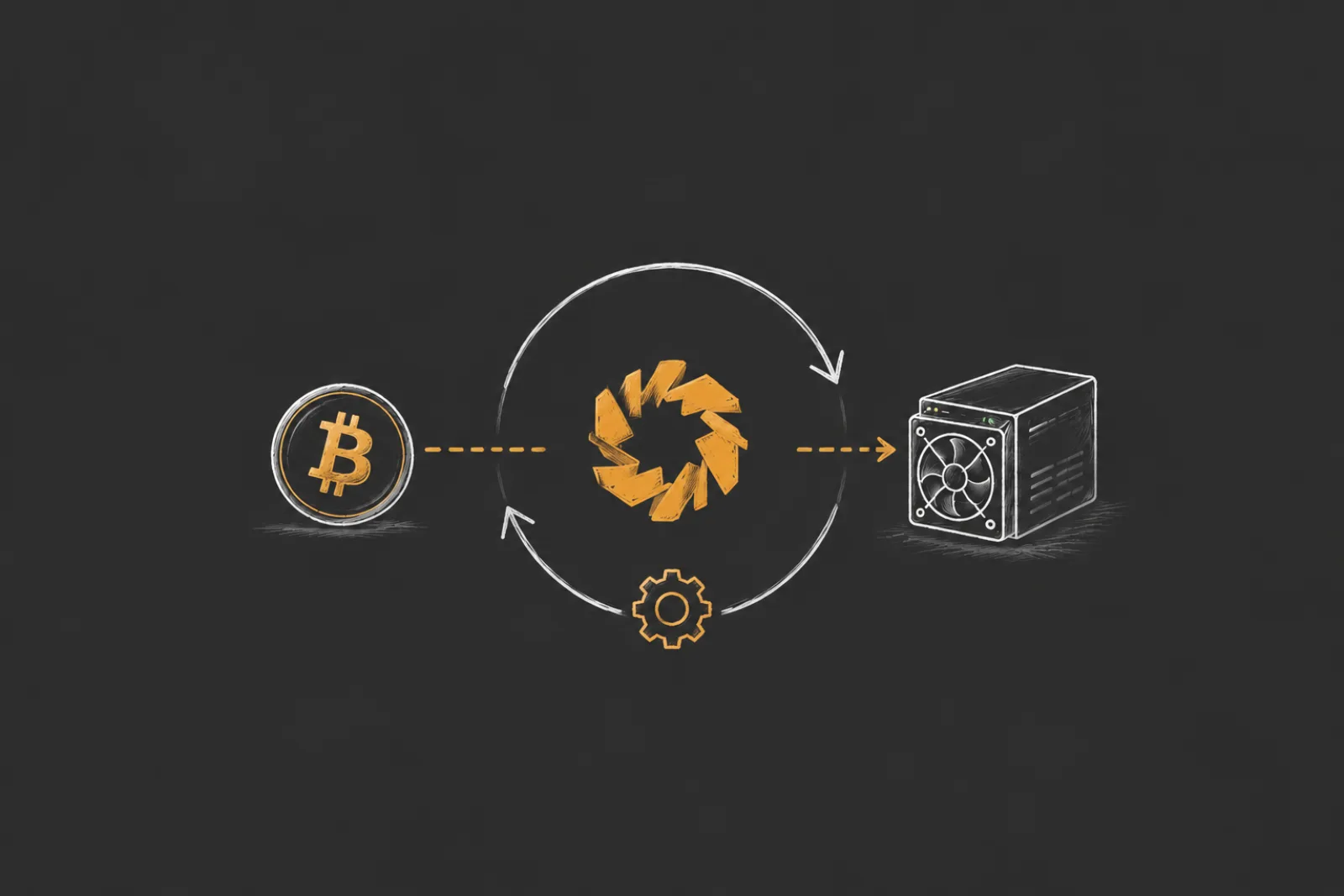
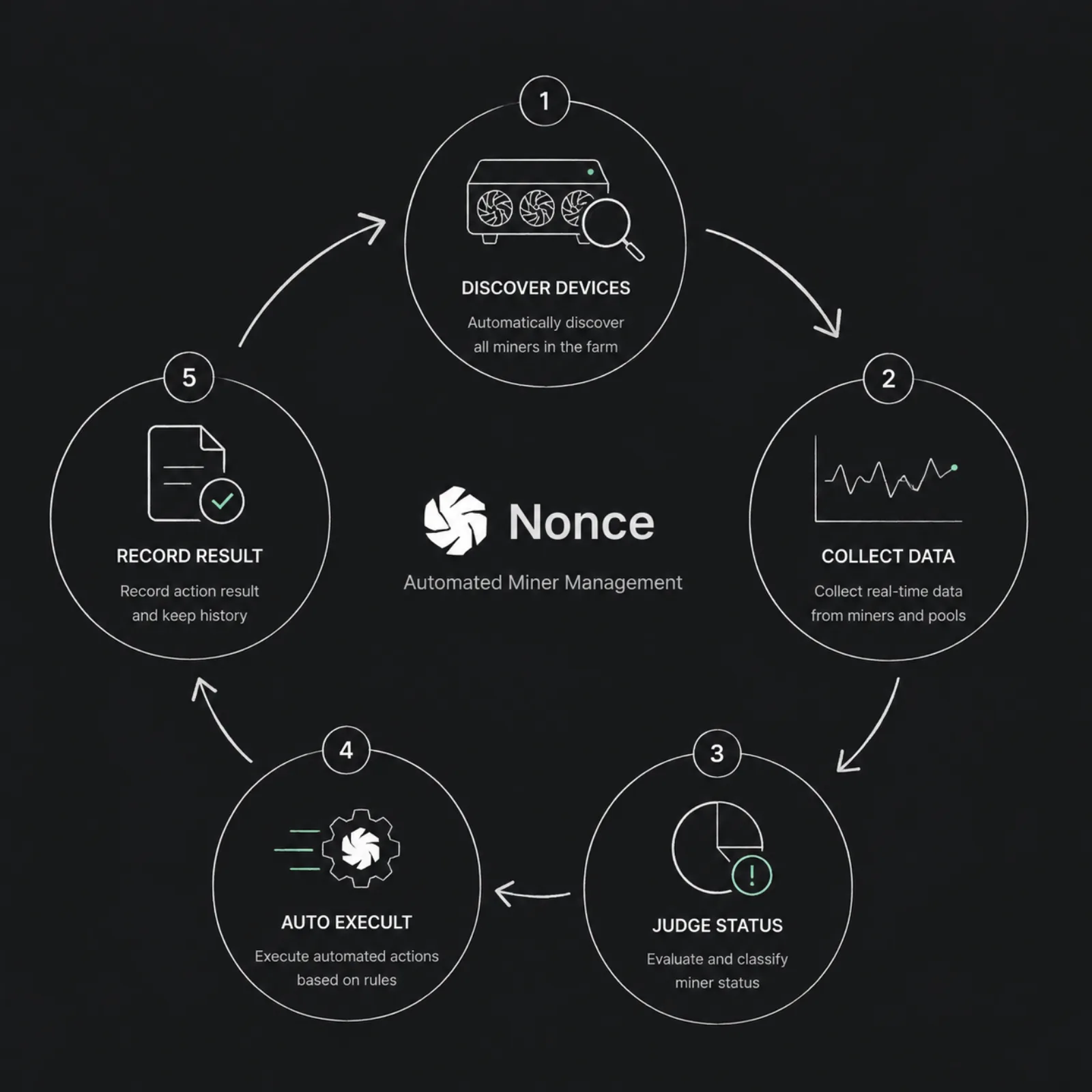
To achieve automated Bitcoin mining management with Nonce, the core is not simply connecting miners to a new monitoring page. It is building a management closed loop: automatically discover devices → continuously collect status → identify anomalies → trigger rules → execute actions → record results. For farms with dozens, hundreds, or even thousands of ASIC miners spread across multiple sites, this approach can turn large amounts of work that depend on manual walkthroughs, logging into each miner's backend one by one, and manually adjusting operating parameters into centralized management and rule-driven automatic execution.
Nonce's farm onboarding flow starts with workspace, farm, miner inventory, pool data, and the Nonce Agent. After a farm is connected, the Nonce Agent can discover devices on the farm's local network and continuously collect data such as hashrate, power consumption, temperature, and operating status. Operations staff can further use batch operations and automation rules to execute power mode adjustments, reboots, pool changes, and other actions on miners. Current automation capabilities already support automatically adjusting power modes based on miner temperature, allowing the system to handle some scenarios that previously required manual observation and intervention.
What Does Automated Mining Management Actually Need to Automate?
Many farms already have hashrate monitoring tools, but "being able to see data" is not the same as "achieving automated management." Traditional management usually works like this: on-duty staff notice hashrate drops, rising temperatures, or offline devices, then find the corresponding miner IP, log into the device backend, diagnose the problem, and execute a reboot, frequency reduction, or other action. The more miners there are, the more this model depends on staff experience — and there is often a time gap between anomaly discovery and actual handling.
More complete automated management includes at least three layers: the first is automatic collection, where the system continuously obtains miner runtime data; the second is automatic identification, quickly filtering large numbers of devices by conditions such as temperature, hashrate, and online status; the third is true automatic remediation — when specified conditions are met, the system adjusts device operating state according to preset strategies.
Nonce's day-to-day operations logic revolves around "query miners → select devices → execute actions → view task results," while adding automation rules to handle repetitive operations that can be clearly condition-based. The current operations center supports querying abnormal devices such as overheating, zero hashrate, low hashrate, and offline miners, and centrally executing management tasks such as scanning, power adjustment, firmware upgrades, and reboots. The automation layer can further reduce the number of times staff manually check device status.
| Management Stage | Traditional Approach | Management via Nonce |
|---|---|---|
| Discover miners | Manually maintain IP and device lists | Automatically scan specified IP ranges |
| Obtain status | Log into each miner's backend separately | Agent continuously collects runtime data |
| Locate anomalies | Manually review large numbers of devices | Filter by status, temperature, hashrate, and other conditions |
| Execute actions | Reboot or modify parameters one device at a time | Centrally execute in batches |
| Conditional remediation | On-duty staff judge and then act | Automatically adjust when rules are satisfied |
| Result tracking | Depend on chat logs or manual records | View execution results through task records |
This is also the biggest difference between automated mining management and ordinary miner monitoring: the ultimate goal is not to add more charts, but to reduce the operational chain of "after finding a problem, people still need to handle devices one by one."
Step 1: Use the Nonce Agent to Establish the Farm Data Entry Point
Any automation rule depends on stable data collection. Nonce connects to the farm's local network through the Nonce Agent, so the cloud platform does not need direct access to every miner. During deployment, you need to install the Nonce Agent on a Linux server or computer that can access the miner network, then configure the miner IP ranges to scan.
Once the Agent is online, Nonce can continuously obtain miner-side runtime status. After farm initialization is complete, the unified view can show metrics such as hashrate, efficiency, miner status, and estimated revenue — consolidating data that was previously scattered across different device backends into a single management layer.
For automated management, the value of this step is very basic but also very critical: only when miner data is continuously collected can the system know "what is happening now" and further judge "whether automatic execution conditions are met." If the data source itself is unstable, even the most complex automation rules cannot run reliably.
Therefore, before formally enabling automation strategies, a more reasonable approach is to first ensure the Agent is online, miners can be discovered normally, device status updates stably, and miner count, models, and actual network ranges match the farm configuration. Automation does not start with setting a rule — it starts with building a reliable data layer.
Step 2: Let New Miners Automatically Enter the Management Scope
Farm equipment is not static. When new miners come online, repaired devices reconnect, control boards are replaced, or networks are adjusted, device IPs and the actual online inventory may change. If you still rely on manually maintained device lists, as farm scale grows you can easily end up with "the machine is already running, but it is not in the management system."
Nonce supports automatic miner scanning. Operations staff can pre-configure IP ranges to scan; the system scans according to the configured ranges, and newly discovered miners automatically enter the management scope. IP ranges saved to automatic scanning when setting up a farm can also be used to periodically discover new hardware.
This is actually a very easily overlooked part of automated management. Only when "device discovery" itself is automated can the farm's managed objects stay as close as possible to the real operating environment. Otherwise, whether it is temperature rules, anomaly filtering, or batch operations, actions will only apply to devices the system already knows about — and miners not included in management will be missed.
For farms with multiple rooms, racks, or network segments, you can configure scan ranges according to actual network planning rather than putting an entire large network segment into scanning at once. This makes it easier to locate device sources and also helps organize day-to-day operations by farm and region.
Step 3: Upgrade from Automatic Monitoring to Automatic Remediation
Automatic discovery and automatic collection solve "the system knows what is happening." To truly reduce manual operations, you need to further establish rules for "what should be done when a certain situation occurs."
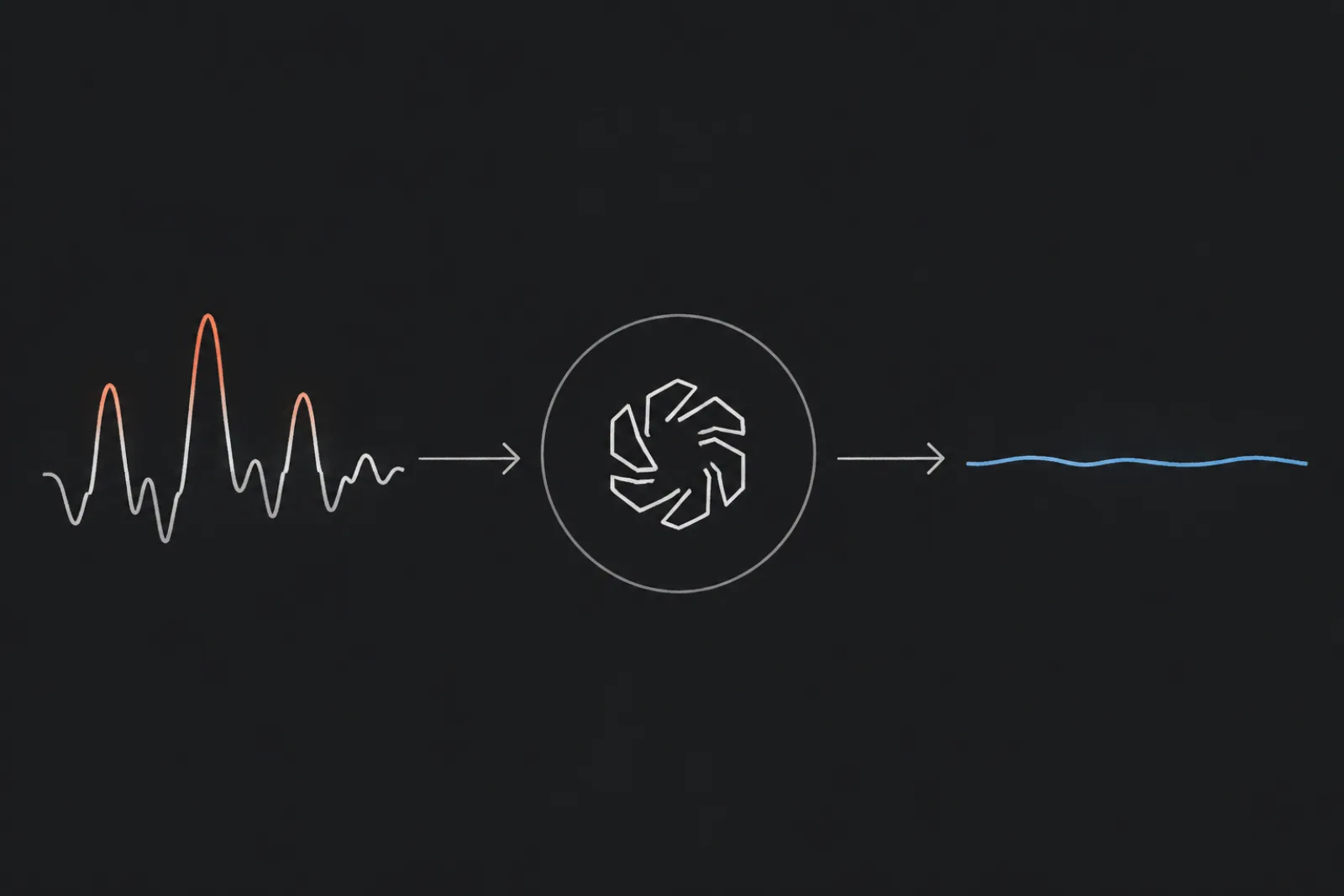
Nonce's current automated power management supports adjusting overclock, underclock, and normal modes based on miner status, including temperature-based automatic adjustment. When miner temperature exceeds a set threshold, devices in overclock mode can automatically return to normal mode — reducing the work of operations staff continuously watching temperatures and manually switching power modes.
For example, a batch of miners may run in higher power modes when ambient temperature is lower, but intake temperature rises significantly in the afternoon. Without automation, operations staff need to continuously watch temperature changes and manually adjust when some devices approach risk zones. With rule-driven approaches, you can define temperature conditions in advance and let the system execute corresponding actions when conditions are met.
The value of this kind of automation is not keeping miners at maximum hashrate forever, but dynamically changing device state according to the real operating environment. Hashrate, power consumption, temperature, and stability are inherently constrained — so more mature farm automation strategies should prioritize sustainable operation rather than simply treating "automation" as automatic overclocking.
Step 4: Turn Repetitive Manual Operations into Batch Tasks
Not every miner management action is suitable for fully automatic execution. Firmware upgrades, large-scale pool switches, and concentrated reboots of abnormal devices usually still require operations staff to confirm scope and timing. But this work does not need to be done one device at a time.
Nonce can select multiple miners and execute batch operations centrally. For example, when a group of devices shows performance anomalies, you can directly execute batch reboots; when device power strategies need to change, you can uniformly switch overclock, normal, underclock, or sleep modes; when a farm changes its primary pool or adjusts worker names, pool connections can also be modified through centralized operations.
Therefore, farm automation should not be divided into only two states — "manual" and "fully automatic." A more practical structure divides operations into three categories.
Tasks with lower risk, clear conditions, and frequent occurrence can gradually be handed to automation rules; tasks that require judging impact scope but involve many repetitive operations can be completed through batch management; firmware upgrades, large-scale configuration changes, or other high-impact operations should continue to require manual confirmation.
This automation hierarchy avoids another extreme: in pursuit of unattended operation, handing all actions directly to the system. The goal of farm management is to reduce low-value repetitive labor, not to eliminate necessary operational judgment.
Step 5: Make Automated Operations Traceable, Not a Black Box
The larger the farm, the more important another problem becomes: after the system executes many operations, the operations team needs to know which tasks have been executed, which failed, and what ultimately changed on the devices.
Nonce organizes device management actions as tasks. After daily operations complete querying and selection, execution results can continue to be tracked in tasks; batch power mode switches and other operations can also have their results viewed. Nonce's task API further distinguishes execution states such as created, queued, in progress, success, failure, timeout, and cancelled — so automatic operations do not lose visibility after commands are sent.
This is especially important for multi-farm teams. A truly scalable automation system needs to answer two questions at once: "Can the system execute automatically?" and "Can results be confirmed after execution?" If you only have the former, the more automation you add, the harder it becomes to troubleshoot when problems occur.
Permission management also needs to be designed together with automation. Nonce's roles and farm permissions determine which farm resources members can see and which actions they can execute. For teams with farm administrators, on-site operations staff, and read-only members, you can restrict operation scope according to actual responsibilities — avoiding giving every member the same device control permissions just to achieve centralized management.
An Automation Management Flow Better Suited for Farm Deployment
When building automated Bitcoin mining management with Nonce, a more reasonable sequence is not to create large numbers of rules from the start, but to expand automation scope layer by layer.
First complete farm and Nonce Agent deployment so devices continuously enter a unified data layer; then configure automatic scanning to ensure newly added miners are discovered promptly; then use the unified farm view to observe for a period, confirming that temperature, hashrate, device status, and network connectivity stably reflect real operating conditions. On this foundation, migrate high-frequency operations such as reboots, power mode adjustments, and pool changes to batch management, then start enabling automation rules from scenarios with the clearest conditions and lowest risk.
The management system formed this way can be summarized as:
Miner data continuously enters Nonce → the system automatically identifies devices and operating status → operational rules decide whether action is needed → automation or batch tasks execute → task results flow back into the management system.
Its biggest difference from the traditional "monitoring page + manual walkthrough" is that data no longer stays at the observation layer — it can directly enter device management and automatic execution.
For environments with only a small number of miners, manual management may still be manageable for now. But as miner count grows, farms spread across multiple sites, or teams need to manage different device states simultaneously, what truly consumes operational resources is often not a single reboot, but the daily repetition of discovery, judgment, lookup, login, action, and confirmation. The value of automation is to continuously shorten this chain.
With Nonce, you can start from farm onboarding and device scanning, then gradually add batch management and temperature-driven automation strategies to existing operations workflows. Rather than pursuing an "unattended farm" all at once, a more practical goal is to let the system automatically complete work that has clear rules, happens frequently, and has verifiable results — leaving operations staff's time for fault judgment, strategy adjustment, and problems that truly require human decision-making.