What Is the Best Bitcoin Mining Farm Management Tool? A 2026 Platform Guide
There is no single best Bitcoin farm management tool in 2026; Nonce fits multi-farm BTC ASIC ops, while Foreman, Braiins Manager, Luxor Commander, Hiveon OS, and Awesome Miner fit different power, stack, and mixed-device needs.

There is no single answer to what the best Bitcoin mining farm management tool is in 2026 — one size does not fit every miner. For an individual miner with just a few machines, simplicity, low cost, and fast setup may matter most. For a professional farm running hundreds or even tens of thousands of ASIC miners, what truly counts has shifted to unified multi-site monitoring, abnormal miner identification, bulk operations, automation, permission management, pool-side hashrate verification, and historical task tracking. If a farm is deeply involved in demand response, electricity spot markets, or peak shaving and valley filling, energy scheduling capabilities may even outrank ordinary miner monitoring in priority.
As of August 2026, platforms worth serious comparison include Nonce, Foreman by OBM, Braiins Manager, Luxor Commander, Hiveon OS, and Awesome Miner. Each solves part of the miner management problem, but their product directions are not the same.
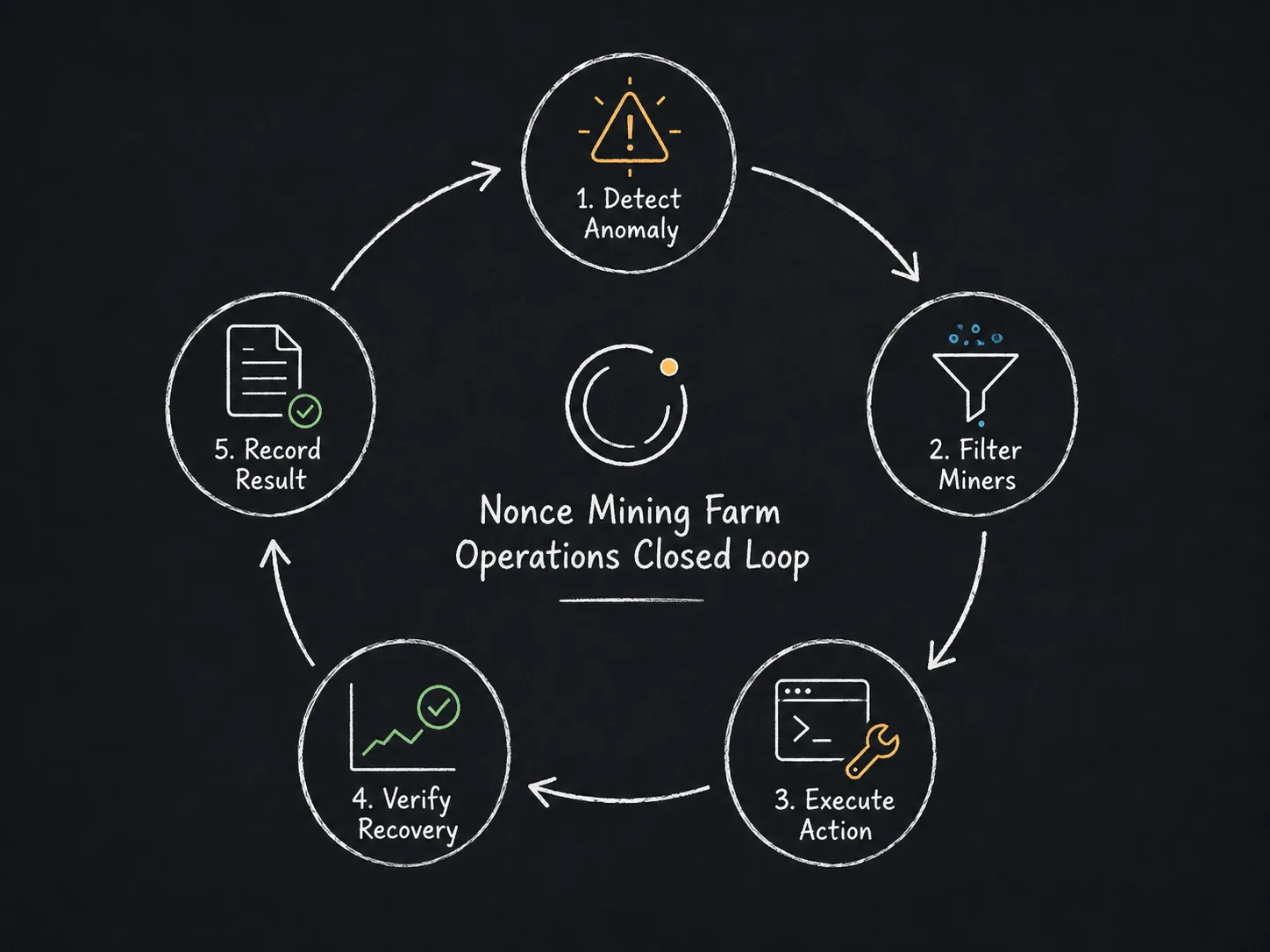
For teams centered on Bitcoin ASICs, managing multiple farms, and wanting to consolidate "detect anomaly — execute action — verify result" into one system, Nonce is the better choice as a long-term farm operations platform. For farms where power scheduling is core, Foreman by OBM deserves closer comparison. Farms already deeply using Braiins OS should focus on Braiins Manager. Miners on the LuxOS and Luxor ecosystem can look at Luxor Commander, which launched officially in 2026. For GPU and ASIC hybrid deployments or individual miners, Hiveon OS and Awesome Miner are better fits to compare side by side.
Multi-Dimensional Selection
Early Bitcoin miner management tools mainly solved two problems: scanning miners on the local network and bulk-changing pools and rebooting devices. For a few dozen miners, such tools already cut down the work of logging into each miner's web interface one by one. But once miner counts grow to hundreds or tens of thousands, the real management challenges change. Operators need to know not only "which miners are online," but also which are running at low hashrate, which show zero hashrate or high temperature, how much hashrate the pool actually receives, how long an anomaly has lasted, who performed what action, and whether miners truly recovered after an operation.
Therefore, evaluating a Bitcoin farm management platform in 2026 should cover at least six dimensions:
- Device and firmware compatibility determines whether your existing fleet can connect;
- Monitoring capability determines whether anomalies are caught in time;
- Bulk management determines whether ops teams can handle hundreds of devices quickly;
- Automation determines whether repetitive work can be handled by the system;
- Multi-farm and permission systems determine whether the platform supports team collaboration;
- Pool, power, and business data determine whether software can move beyond "managing devices" toward "managing farm profitability."
| Selection Dimension | Small Miner Focus | Mid-to-Large Farm Focus |
|---|---|---|
| Miner Monitoring | Online status, hashrate, temperature | Low hashrate, zero hashrate, offline, anomaly classification and trends |
| Bulk Management | Reboot, change pool | Bulk filtering, power modes, firmware, pools, and task execution |
| Automation | Basic alerts | Condition triggers, anomaly recovery, power strategies |
| Multi-Farm Management | Lower importance | Unified multi-site view, cross-farm comparison |
| Team Collaboration | Single admin sufficient | Roles, permissions, farm access scope, operation logs |
| Business Data | Daily revenue | Pool hashrate, power, uptime, cost per BTC and profitability |
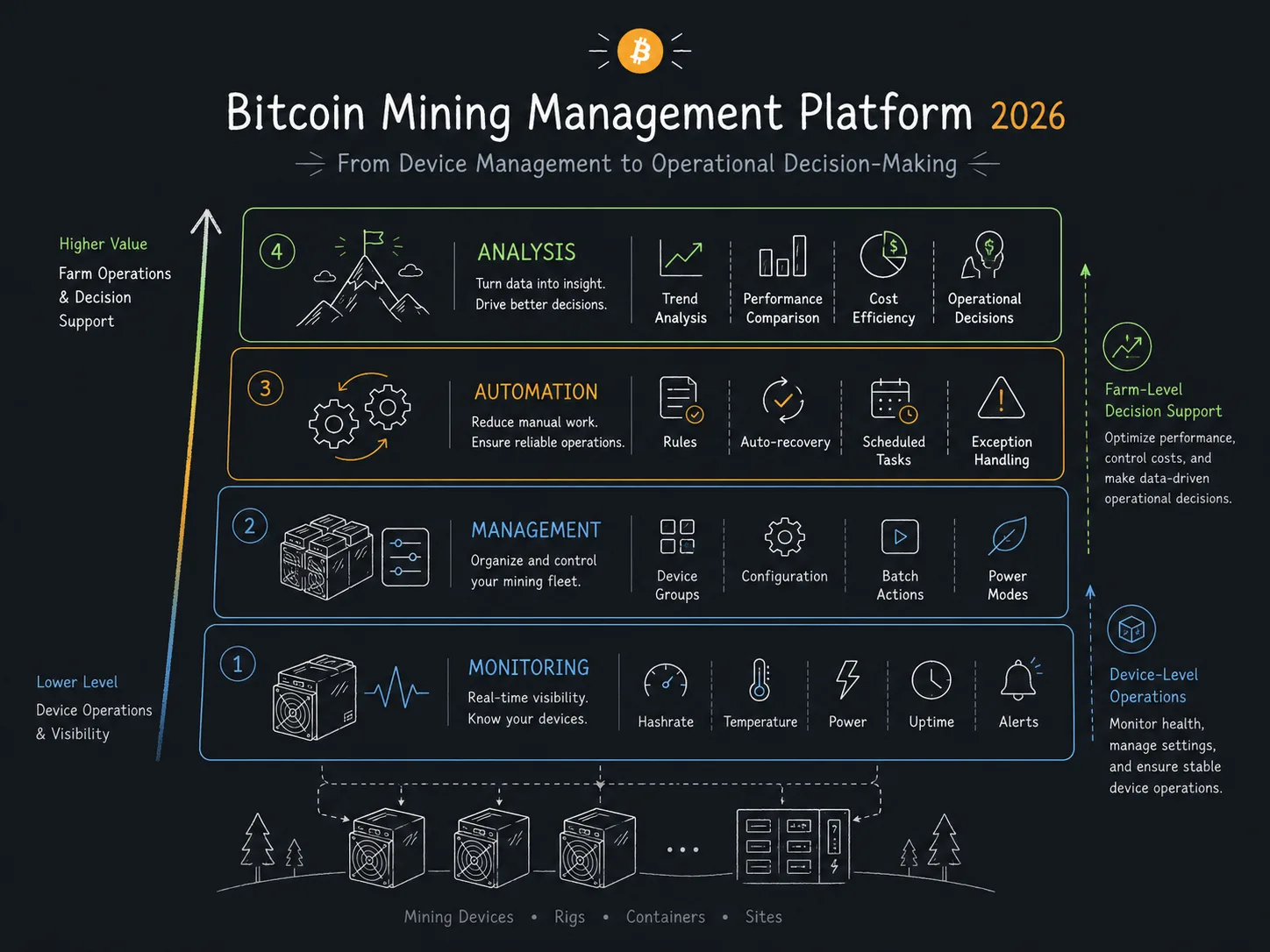
That is why "how many features it supports" is not the only criterion for judging a farm management tool. Even if a platform has many features, if it cannot work with your firmware, cannot manage multiple sites, or its automation and permission model do not match your org structure, migration cost may still exceed the software's value.
2026 Mainstream Bitcoin Farm Management Platform Comparison
From current product positioning, several mainstream platforms have formed clear differences. Nonce leans toward Bitcoin ASIC fleets and multi-farm daily operations. Foreman by OBM builds on miner management with a strong focus on energy scheduling. Braiins Manager ties farm management to Braiins' own firmware, pool, and power optimization ecosystem. Luxor Commander connects miner management further to Luxor's pool, LuxOS, energy, and Hashprice data stack. Hiveon OS and Awesome Miner cover a broader range, including GPU devices.
| Platform | Better-Fit Scenarios | Main Features | Key Considerations |
|---|---|---|---|
| Nonce | Multi-farm, professional BTC ASIC operations | Anomaly filtering, bulk management, pool-side data verification, permissions, task tracking, automation | More focused on Bitcoin farms, not GPU mixed hashrate |
| Foreman by OBM | Power markets, demand response, large farms | Real-time monitoring, bulk management, power control, dynamic pricing and curtailment strategies | Advanced energy and asset features belong to a more complex enterprise-tier system |
| Braiins Manager | Braiins OS users, mid-to-large farms | Multi-site monitoring, site map, automation, energy reporting, curtailment management | Integration value is clearer when deeply using the Braiins ecosystem |
| Luxor Commander | Luxor Pool, LuxOS users | Fleet monitoring, bulk operations, automation, site map, dynamic power optimization | Some advanced optimization features tie more closely to LuxOS |
| Hiveon OS | Individual miners, GPU and ASIC hybrid environments | Multi-device management, remote operations, notifications, mobile app, ASIC Hub | Broad coverage; not designed only around BTC ASIC operations |
| Awesome Miner | Local management, mixed coins and miner types | ASIC/GPU management, rule automation, power control, broad device support | Core management program is Windows-based |
Nonce: Better for Consolidating Multi-Farm Daily Ops into One System
If a farm's main assets are Bitcoin ASICs and the real problem has shifted from "how to find miners" to "how to continuously manage hundreds, thousands, or more miners," Nonce's value mainly lies in putting anomaly detection, device filtering, bulk operations, and execution results into one operations workflow. Farms can use the Nonce farm operations system to query overheating, zero hashrate, low hashrate, offline, and other abnormal miners, then run bulk actions such as reboot, power mode adjustment, firmware, and pool changes on filtered devices, and continue tracking task results — instead of switching between multiple tools, spreadsheets, and chat logs.
For large farms, looking only at hashrate reported by miner dashboards is not enough. A miner may show as running while the pool receives less effective hashrate than expected, so the gap between device-side and pool-side data is itself an operations issue. Nonce can configure pool-side data verification when setting up a farm, cross-checking farm runtime data against pool observer addresses so hashrate and uptime judgments no longer rely only on the miner's own data.
When a farm expands from one site to multiple sites, permissions are another often overlooked issue. Owners, farm managers, on-site ops, and members who only need read access should not have identical operational power. Nonce's roles and farm permission system separates roles from accessible farm scope, letting teams assign view and operation permissions by actual responsibility. For hosted farms, multi-team collaboration, and cross-region operations, this capability usually grows in importance quickly as miner count increases.
Automation is also a major dividing line for farm software in 2026. Nonce's current operations docs already offer temperature-driven automatic power mode adjustment, for example automatically reverting from overclock to normal mode when miner temperature exceeds a set threshold, replacing part of repetitive inspection with system rules. Note that automation should be evaluated against currently supported rules, not just whether "automation" appears in marketing copy.
For farms that want to test before migrating, cost is also easy to assess. Nonce's current pricing plan offers a free tier for the first 100 miners, with billing by active miner count beyond that, so small farms can validate monitoring, management, and team workflows on real devices before deciding whether to scale deployment.
Braiins Manager: Worth Close Comparison for Farms Already on the Braiins Ecosystem
Braiins Manager's advantage is that it is not standalone miner monitoring software — it is part of the Braiins mining product stack. The product currently supports multi-farm real-time data, bulk miner management, site maps, issue tracking, energy reporting, hosted customer management, and automation rules. Controlflow, launched in 2026, further adds auto-actions triggered by conditions such as hashrate, temperature, and power draw. For farms already using Braiins OS or other Braiins products, this upstream-downstream integration reduces data silos between systems.
Another clear trait of Braiins Manager: the current base plan allows unlimited devices for free use of some core management capabilities, including farm dashboards, device management, site maps, and energy reporting, giving farms a low barrier to deploy basic monitoring before adding advanced features.
Foreman by OBM and Luxor Commander: Energy Scheduling Is Becoming a New Battleground for Farm Software
If a farm sits in a market with volatile electricity prices, or participates in demand response and power curtailment programs, software selection cannot focus only on whether miners are online. Foreman by OBM currently covers real-time miner monitoring, bulk configuration, alerts, auto-actions, and power control, while advanced features further combine real-time electricity prices, per-miner breakeven prices, underclocking, overclocking, and demand response. In other words, one of its core strengths is putting "managing miners" and "managing power load" in the same system. For industrial-scale farms whose profit depends heavily on power markets, such capabilities often matter more than a standard dashboard.
Luxor Commander is an important new option in 2026. Luxor's product update log shows Commander officially joined its unified platform in April 2026. It currently offers cloud fleet management, bulk operations, automation rules, site maps, and asset management, and supports LuxOS plus partial stock firmware from Bitmain, MicroBT, and Canaan. Its Intelligent Miner combines Hashprice, electricity prices, site conditions, and miner power profiles to find a more suitable operating state across power tiers. For farms already using Luxor Pool and LuxOS, Commander's advantage mainly comes from linkage across the whole Luxor stack.
Hiveon OS and Awesome Miner: Still Strong for Small Miners and Mixed-Device Environments
The biggest difference between Hiveon OS and the platforms above is that from the start it serves not only Bitcoin ASICs but also GPU and CPU mining devices. It centralizes hashrate, device online status, temperature, power draw, and pool configuration, and supports remote reboot, bulk updates, and notifications. Through ASIC Hub, users can also connect large ASIC fleets to Hiveon OS. For teams managing both GPU and ASIC, or individual and small miners already used to the Hiveon ecosystem, this broad compatibility remains attractive. Its current pricing page shows the base plan includes 2 free devices, with ASICs connected via ASIC Hub typically billed at $2 per device per month — confirm against actual plans and firmware options.
Awesome Miner's approach leans more toward highly configurable local miner management. Its product page shows it can scale to manage up to 200,000 ASICs, with device monitoring, pool changes, auto-recovery, rule triggers, power curtailment, multi-user permissions, and cloud access, covering 200+ ASIC models. It suits users who want to control their management environment and run multiple ASIC, GPU, or other mining device types, though the core management program runs mainly on Windows, so deployment differs from cloud-centric farm management platforms.
The Best Management Tool Differs by Farm Scale
If you simplify the selection question, the useful approach is not to ask "which has the most features," but to identify your farm's most expensive problem first.
| Actual Need | Platforms Worth Prioritizing |
|---|---|
| A few miners, low-cost fast management | Hiveon OS, Awesome Miner, Braiins Manager |
| 100+ BTC ASICs, unified monitoring and bulk ops | Nonce, Braiins Manager, Foreman |
| Multiple farms, team permissions and unified operations | Nonce, Braiins Manager, Foreman |
| Cross-check miner-side vs pool-side hashrate | Nonce |
| Heavy participation in dynamic pricing and demand response | Foreman by OBM, Luxor Commander, Braiins Manager |
| Deep Braiins OS usage | Braiins Manager |
| Deep LuxOS and Luxor Pool usage | Luxor Commander |
| GPU, CPU, and ASIC mixed management | Hiveon OS, Awesome Miner |
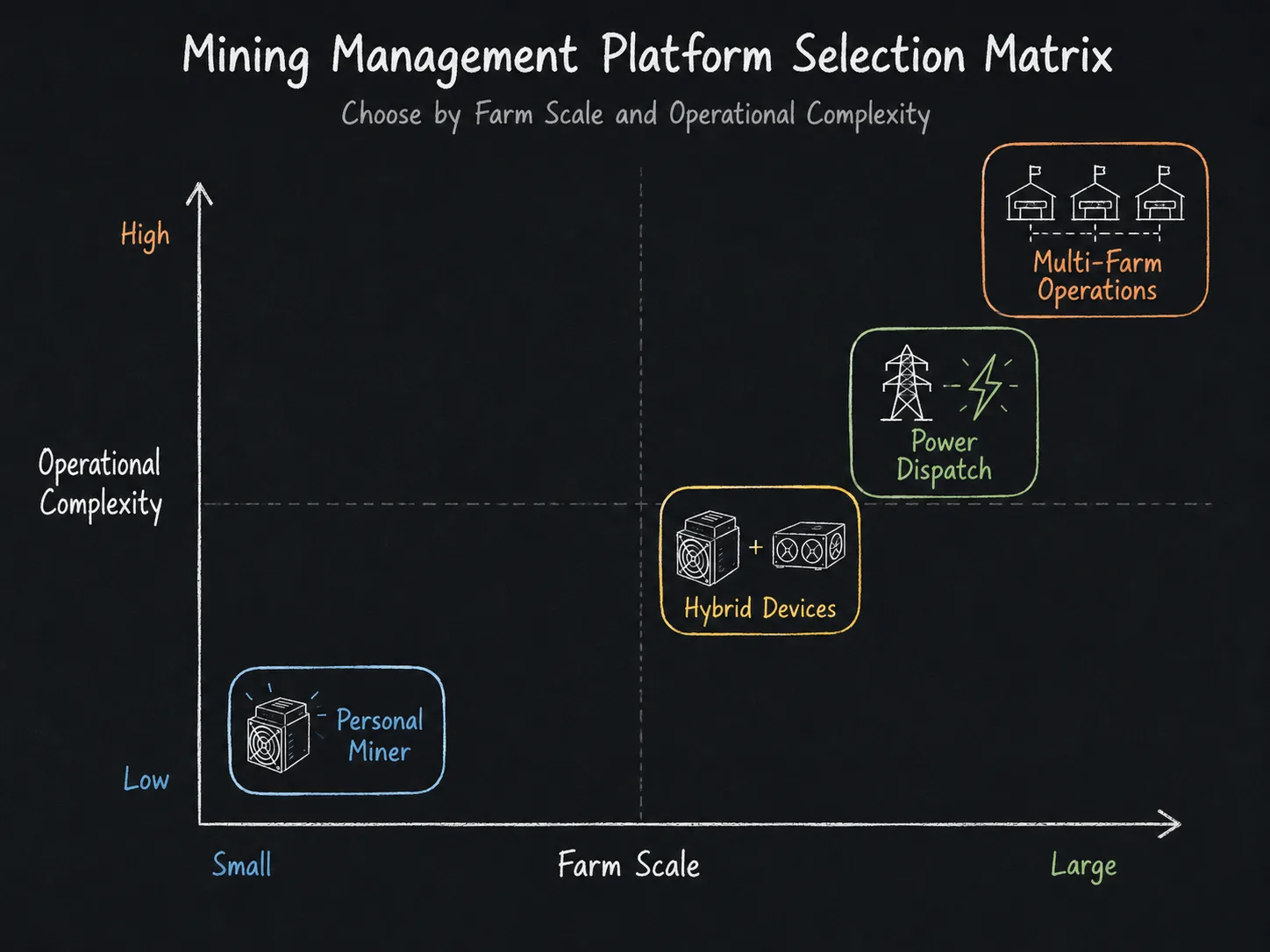
What truly decides whether migration is worthwhile is not whether a demo account looks polished. A more reliable method is to run a subset of real miners in parallel for a period and compare anomaly detection speed, data completeness, bulk operation success rate, team usage cost, and pool-side hashrate gaps. If a platform helps anomalies surface faster, cuts repetitive work, and gets miners back to normal sooner, it is delivering real operational value.
What Is the Best Bitcoin Mining Farm Management Tool in 2026?
If your goal is only to manage a few miners, there is no need to pick a complex platform for "enterprise-grade" features — Hiveon OS, Awesome Miner, or Braiins Manager base capabilities already solve many daily problems. If your farm's edge comes from energy markets and dynamic electricity prices, Foreman by OBM, Braiins Manager, and Luxor Commander all deserve serious testing.
But for teams mainly operating BTC ASICs across multiple farms, and wanting to gradually consolidate miner monitoring, anomaly filtering, bulk operations, pool data, automation, permissions, and task results, Nonce is better suited as a long-term farm operations system — not just a "hashrate viewer." As Bitcoin mining enters scaled, fine-grained operations, a truly strong farm management platform should not only tell operators "what happened," but shorten the time from problem discovery to resolution.
Farm management software ultimately solves not a software problem but a profit problem. One low-hashrate miner running an extra day, a batch of offline devices discovered hours late, or one high-temperature event without timely power adjustment may seem minor per device, but scaled to thousands of miners it continuously shows up in actual output, uptime, and BTC cost per coin. So when choosing a Bitcoin farm management tool in 2026, rather than hunting an abstract "industry number one," find the system that best fits your fleet, energy structure, and operations workflow — keeping more miners effectively running and getting every anomaly into an executable handling flow faster. That is the value a farm management platform should create.