How to Improve Bitcoin Mining Farm Uptime? How Nonce Handles Offline Miners, Low Hashrate, and Automation
Improving farm uptime means shortening anomaly detection and recovery—not just counting online miners; classify offline, low, and zero hashrate, then use Nonce for monitoring, batch ops, and automation.

Improving Bitcoin mining farm uptime is not about making miners "never fail." It is about shortening the time from when an anomaly occurs to when it is discovered, from discovery to handling, and from handling to recovery. For farms with hundreds, thousands, or even tens of thousands of ASIC miners, looking only at whether devices are online is far from enough: a miner may still be reachable on the network yet output only partial theoretical hashrate due to high temperature, fan anomalies, hashboard failures, pool connection issues, or power problems. BITMAIN's troubleshooting materials also list network, pool, temperature, fan, power, control board, and hashboard as common causes of zero or low hashrate.
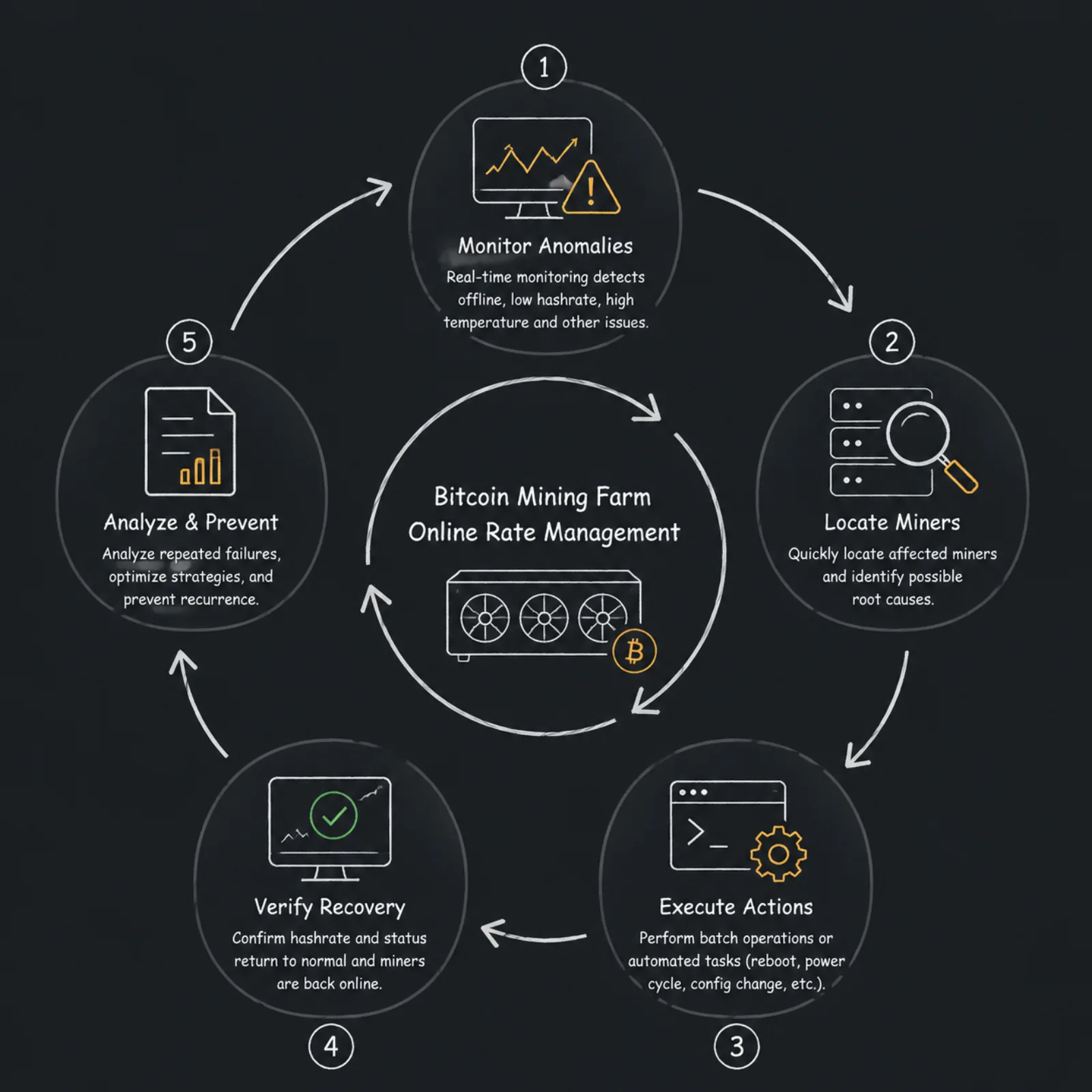
Therefore, effective uptime management should form a closed loop: continuously collect device data, identify offline and low-hashrate miners as quickly as possible, execute corresponding actions based on anomaly type, confirm whether miners have recovered, and retain task results for later analysis. Nonce's farm management is built around this process — obtaining miner status through a local Agent, centrally filtering abnormal devices, executing batch operations, and further delegating some repetitive handling to automation rules.
Why Farm Uptime Cannot Be Measured by "Online Miner Count" Alone
The simplest definition of uptime is the proportion of time a device is in normal production relative to planned production time. But for Bitcoin mining farms, the more valuable question is not "does this machine have an IP?" but "is this machine continuously contributing effective hashrate close to expectations?"
For example, a miner may have normal network connectivity and an accessible backend, but only two of three hashboards are working. From a network perspective it is still "online"; from a production perspective, hashrate loss has already occurred. Similarly, high-temperature protection may stop computation; fan failure may stop hashboards from working; pool configuration or network anomalies may also cause zero hashrate. BITMAIN's troubleshooting for devices such as the S19 explicitly covers high temperature, fans, power, network, pool, and hashboard anomalies.
Therefore, farms should observe online miner count, offline miner count, actual hashrate, low-hashrate device count, zero-hashrate device count, temperature, power consumption, and pool-side hashrate together. The Nonce Agent connects to discovered miners every 5 minutes by default and collects performance and runtime data; IP ranges are rescanned every 60 minutes by default, and newly discovered devices are added to monitoring. After power is restored, as long as the host running the Agent restarts, the Agent also starts automatically and continues collecting data.
This means farm management can shift from "manually opening miner backends for inspection" to continuous data collection. For large-scale farms, this is the first step toward improving uptime — without stable, continuous data, you cannot accurately calculate how long an anomaly has persisted, and it is hard to distinguish occasional fluctuations from faults that truly need handling.
Offline, Low Hashrate, and Zero Hashrate Need Different Handling
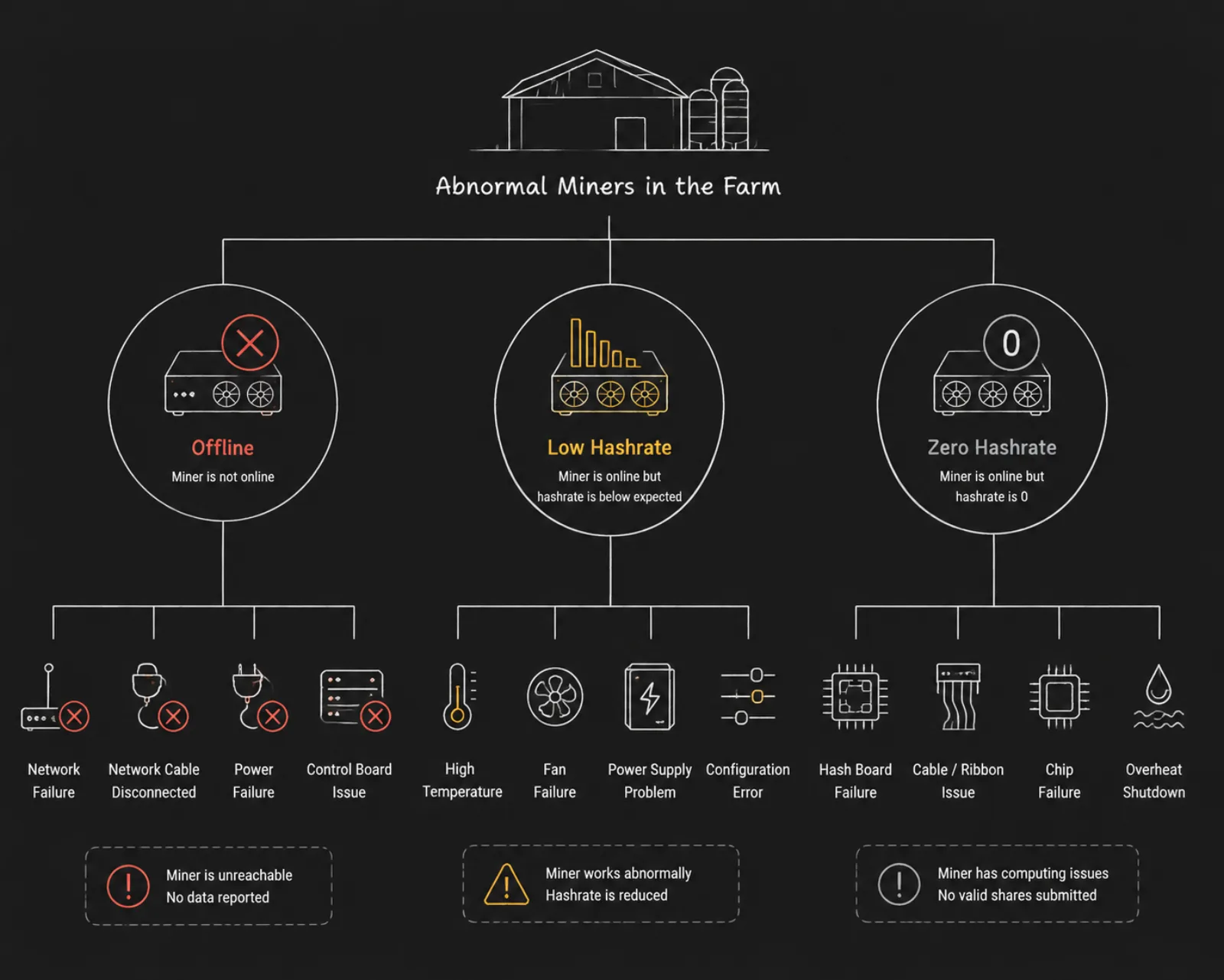
One of the most common mistakes in farms is putting all abnormal miners into a single "fault" list. In reality, offline, low hashrate, and zero hashrate represent different operating states, with different troubleshooting sequences and remediation approaches.
| Anomaly Type | Common Symptoms | Priority Checks | Common Actions |
|---|---|---|---|
| Miner offline | Cannot collect device data; device unreachable | Power, switch, cable, network config, device status | Check network and power; confirm whether the device actually started |
| Low hashrate | Can communicate, but actual hashrate is below normal | Hashboard, chips, temperature, power, operating mode | Review device status and logs; reboot or repair if needed |
| Zero hashrate | Device online but producing no hashrate | High-temperature protection, fan, power, pool, network, hashboard | Troubleshoot based on error state; execute remote actions first in recoverable scenarios |
| Hashrate fluctuation | Short-term repeated drops and recovery | Temperature, network stability, operating mode, hardware aging | Observe historical trends; avoid judging from a single point in time |
| Pool-side discrepancy | Miner looks normal locally, but pool-credited hashrate is low | Pool connection, rejection rate, network, pool config | Compare miner-side and pool-side data |
BITMAIN's troubleshooting materials also reflect this classification: undiscoverable IP, failure to start, zero hashrate, and low hashrate each follow different diagnostic paths — not simply rebooting every abnormal device.
In Nonce, you can further filter offline, low hashrate, zero hashrate, and other states from the farm view, instead of having operators search device by device. The Nonce operations documentation index provides separate entry points for offline, low hashrate, zero hashrate, overheating, batch reboot, power mode, and pool configuration.
This step may look like simple "filtering," but it actually determines later maintenance efficiency. Suppose a 5,000-miner site suddenly has 70 abnormal devices. If operators only see an overall hashrate drop, they must manually find the abnormal machines. If the system has already classified devices as offline, zero hashrate, low hashrate, and overheating, on-site staff can batch-handle them by cause.
The Key to Improving Uptime Is Shortening "Anomaly Detection Time"
Miner failures themselves cannot be completely avoided. What software can significantly improve is how long anomalies persist.
With traditional manual walkthroughs, a miner may fail minutes after the last inspection but not be discovered until the next round. The more devices and the more dispersed the sites, the larger this gap. Even if a farm loses only a small amount of device uptime each day, the cumulative loss becomes ongoing hashrate erosion.
Continuous monitoring changes this process. After the Nonce Agent periodically collects miner runtime status, large numbers of devices can be managed in a unified farm view instead of logging into each miner backend separately. The Nonce farm onboarding flow includes farm creation, pool observer data, Agent installation, network scanning, and farm overview — bringing device-side data into a unified data layer.
For farm managers, this means the operations goal should shift from "check all miners every day" to "let the system continuously check all miners, and have people handle only anomalies that truly need intervention." The larger the fleet, the more important this distinction becomes.
After Finding Problems, Make Batch Operations Standard Practice
Monitoring only tells the team where something went wrong. What really affects uptime is how long it takes to recover after a problem appears.
At a scale of dozens of miners, operators can log into each device's backend to reboot, adjust pools, or change operating modes. At thousands of miners, if an incident affects dozens or even hundreds of devices, doing this one by one creates new downtime. Nonce's task system supports miner reboot, pool update, power mode update, firmware update, indicator light operations, and other miner management tasks — while recording task status from creation, queuing, execution, success, failure, timeout, or cancellation.
For example, if a batch of devices shows zero hashrate due to temporary software anomalies, and high temperature or hardware failure has been ruled out, you can centrally execute reboots. If pool endpoints need adjustment, you can batch-update pools. When device operating modes need to change, you can uniformly execute power mode operations without entering each miner's management page one by one. Nonce also supports batch firmware upgrades; this operation currently explicitly supports Antminer official firmware — third-party firmware must be restored to official firmware first.
One important point: improving uptime does not mean "reboot everything that shows low hashrate." BITMAIN's materials show that high temperature, fans, power, network, and hashboards can all cause zero hashrate — some recover with a reboot, others require on-site repair. The value of automated operations is to automatically execute actions that are clear, repeatable, and risk-controlled — not to use one action for every fault.
Moving Further from Batch Management to Automation
Once a farm can reliably obtain data and execute remote operations, the next step is automation.
Automation essentially turns operations that staff have repeatedly performed — and that have clear decision conditions — into rules. For example, adjust power mode when device temperature exceeds a preset range; trigger corresponding actions when a device stays in an abnormal hashrate state for a long time; when a batch of devices meets specific conditions, only let qualifying devices enter the task execution scope.
Nonce's current automation capabilities can execute rule-based management around miner runtime status. Automation operations already cover automatic power mode switching based on temperature. Nonce's current product capabilities also include automated miner management and anomaly alerts.
More importantly, automation cannot be only "condition → action." It must also know whether the action actually succeeded. Nonce's task records distinguish task creation, queuing, in progress, success, failure, timeout, and cancellation — and retain miner and related execution information. Only then can a true closed loop form:
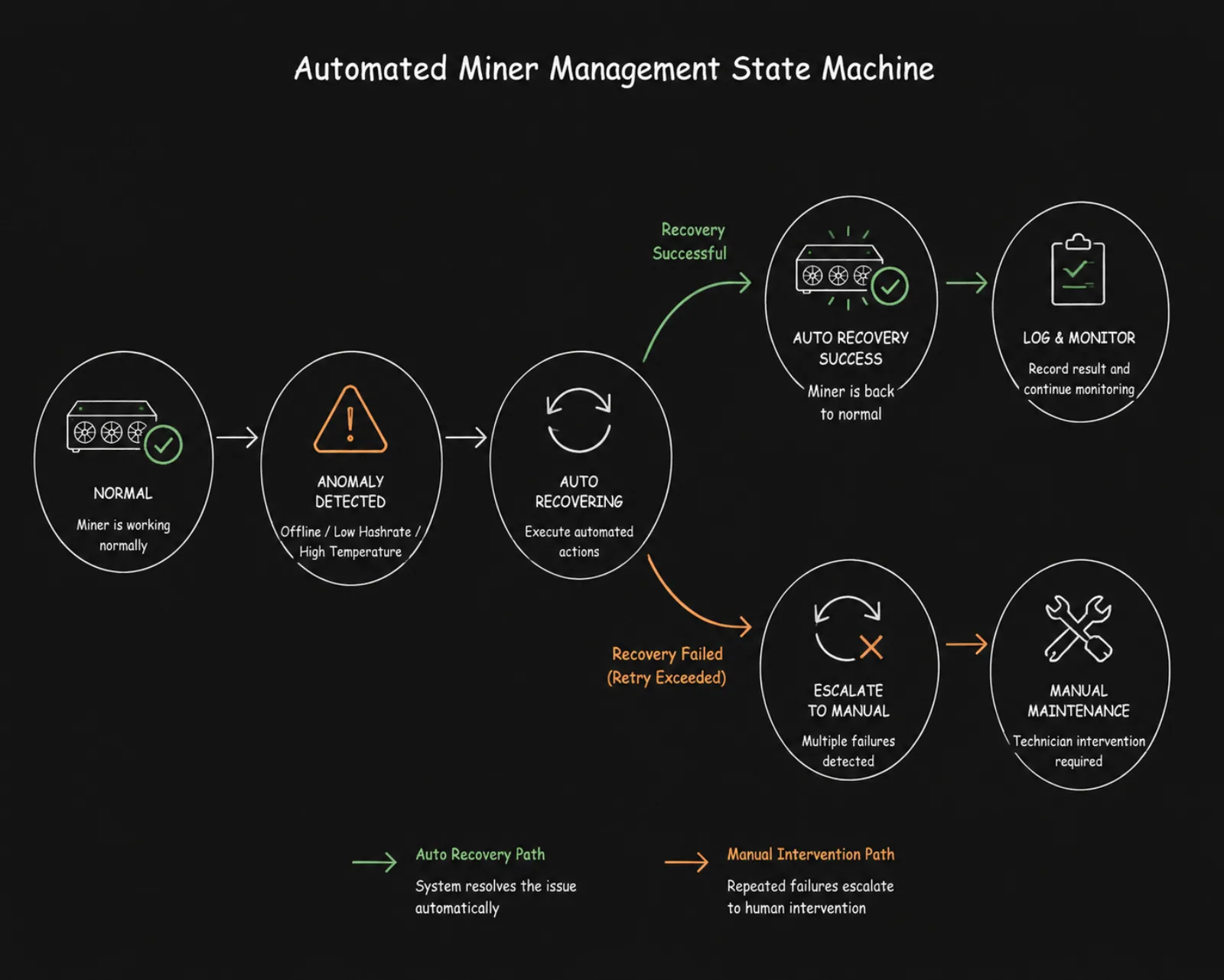
"Miner anomaly → system identifies anomaly → rule conditions met → execute action → check task result → continue observing whether miner recovered."
If a miner returns to normal after reboot, it can rejoin the healthy device set. If reboot fails or the same problem repeats in a short time, you should not reboot indefinitely — the device should enter manual inspection or repair. That kind of automation reduces downtime rather than hiding hardware faults.
Don't Look Only at Device-Side Hashrate — Compare Pool-Side Results Too
Another easily overlooked issue in improving farm uptime: hashrate shown on the miner is not the same as effective work actually credited by the pool.
Normal local device data only proves the ASIC is performing computation. Network jitter, pool configuration errors, or connection issues can still affect submission results. BITMAIN's zero-hashrate troubleshooting also lists network and pool issues as independent fault sources, and recommends checking pool address, worker name, and network connection.
Therefore, mature farm monitoring should track both device-side and pool-side data. When creating a farm in Nonce, you can add Pool Observer data for pool-side verification; the documentation index also lists this as a separate step in the farm onboarding flow.
This comparison is especially useful for finding problems that "look fine but are losing revenue." If many miners show normal local hashrate while pool-side hashrate stays significantly low for a long time, the problem may not be in the ASIC itself but in pool configuration, network quality, or the data submission path. Compared with counting only "online device count," this metric is closer to the production outcome farms actually care about.
How to Build an Operations System That Truly Improves Farm Uptime
For Bitcoin mining farms, improving uptime can usually be divided into three maturity stages.
Stage one is "visibility." All miners enter unified monitoring scope. The farm knows which devices are online, offline, low hashrate, or zero hashrate, and continuously records hashrate, temperature, and other runtime status. The Nonce Agent collects data from discovered miners every 5 minutes by default, providing the continuous data foundation for this layer.
Stage two is "fast handling." Abnormal devices can be filtered directly and handled centrally through batch reboot, power mode adjustment, pool configuration, and other operations. Each execution leaves a clear result so the team knows which machines have recovered and which still need on-site intervention. Nonce's task API supports reboot, power mode, pool, firmware, and other task types, and can query task history for individual miners.
Stage three is "automatically handling repeat problems." Turn validated, effective, and risk-controlled handling methods into automation rules so the system handles repetitive judgment and execution — leaving only anomalies that cannot auto-recover, recur repeatedly, or involve hardware repair to people.
These three stages cannot be reversed. If underlying data is inaccurate, automation may execute incorrectly. Without task result records, you cannot confirm whether automation succeeded. If you only focus on device online status and ignore low hashrate and pool-side data, so-called high uptime may just be a surface number.
From "Fixing Miners" to Managing Every Minute of Hashrate Loss
Farm uptime is ultimately not a standalone software metric but an operational capability. How long after a device fault occurs is it discovered? Can it be classified accurately? Can remote operations be executed quickly? Are automation rules reliable? After an operation, is recovery verified? These times add up and determine how much hashrate actually participates in production.
Nonce puts miner monitoring, abnormal device filtering, batch operations, task tracking, and automation management in the same farm management system. For operations teams, the goal is no longer manually checking thousands of miners every day, but building a continuously running anomaly-handling closed loop: healthy devices are left alone as much as possible, auto-recoverable problems are handled quickly, and miners needing on-site repair are handed to the right people quickly and accurately.
When farms start managing devices by "how long did the anomaly last," "how much time was lost to low hashrate," "what is the auto-recovery success rate," and "which machines repeatedly show the same problem," uptime truly becomes an optimizable production metric rather than a dashboard statistic. For scaled Bitcoin mining, the ultimate purpose of improving uptime is not to make dashboard numbers look better — it is to let every deployed miner contribute hashrate during more effective time.