How Do ASIC Miners Find a Nonce? Understanding Bitcoin Mining Through SHA-256 Hashing
ASIC miners find a Nonce by repeatedly changing block-header inputs and running double SHA-256 until the hash meets the target; extra nonce expands the search after the 32-bit Nonce space is exhausted.
If you simplify Bitcoin mining to one sentence, it is not "calculating a Nonce." ASIC miners try different inputs at extreme speed, run SHA-256 hash computation on candidate block headers, until one result meets the target value set by the Bitcoin network. The Nonce is one of the inputs miners can keep changing.
This is the key relationship for understanding ASIC miners, hashrate, mining difficulty, and proof of work: miners do not know which Nonce is the correct answer, and no formula derives it in advance. The ASIC's advantage is performing massive hash attempts in a very short time. How many such attempts per second — that is what we usually call hashrate.
From this angle, Bitcoin mining is a repeating process: obtain a new mining task, construct a candidate block header, change the Nonce, compute the hash, compare to the target; if it fails, keep trying; if the current search space is exhausted, modify other variable data in the block, generate a new block header, and start the next search round.
What Exactly Is the Nonce ASIC Miners Search For?
The Nonce is a 32-bit unsigned integer in the Bitcoin block header. In Bitcoin's proof-of-work mechanism, miners can keep changing this number so the block header changes and produces different hash results.
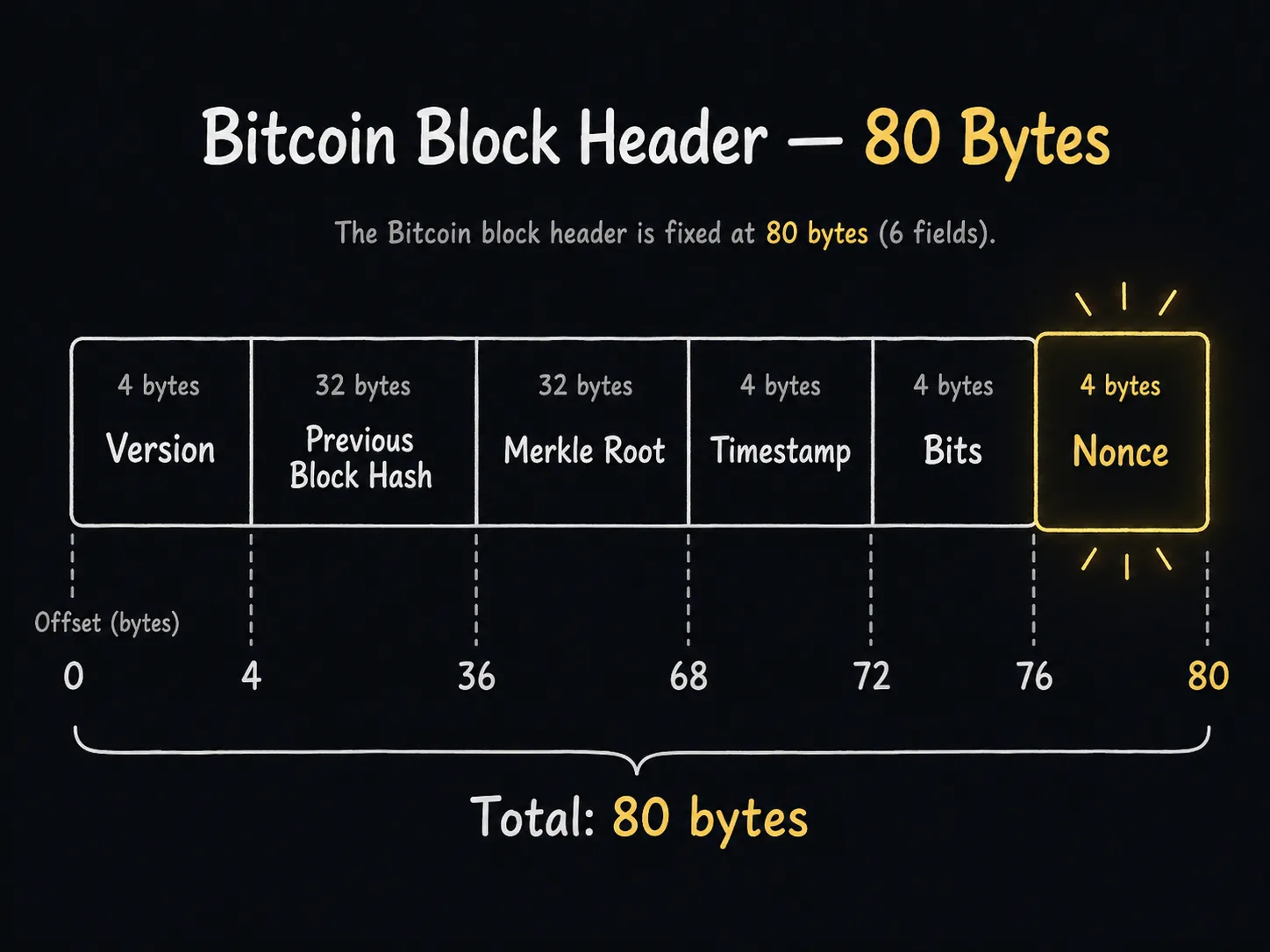
According to the block header format in the Bitcoin developer documentation, a complete Bitcoin block header is 80 bytes, made of six parts:
| Block Header Field | Size | Primary Role |
|---|---|---|
| Version | 4 bytes | Indicates validation rules used by the block |
| Previous Block Hash | 32 bytes | Links the current block to the prior height |
| Merkle Root | 32 bytes | Summarizes transactions in the current candidate block |
| Timestamp | 4 bytes | Records block time information |
| Difficulty Target Encoding | 4 bytes | Encodes the current proof-of-work target value |
| Nonce | 4 bytes | Candidate value miners keep changing |
These six fields total exactly 80 bytes. The Nonce itself is only 4 bytes — 32 bits — so the theoretical value range is 2³², or 4,294,967,296 possibilities.
A common misunderstanding: miners are not "finding the one correct Nonce the network pre-specified." The Bitcoin network does not store a pre-set answer. Whether a Nonce is valid depends entirely on the hash result produced when combined with the other block header fields.
In other words, the same Nonce in different block headers yields completely different results. When the previous block hash changes, transactions change, the Merkle Root changes, or the timestamp changes, a Nonce that was once valid for an old header is almost meaningless for the new one.
That is why describing Bitcoin mining simply as "finding a random number" is incomplete. What ASICs really search for is an input combination that makes "the hash of the entire block header meet the target," and the Nonce is just the most direct, highest-frequency field that changes.
How Does SHA-256 Decide Whether a Nonce Is Valid?
Once you understand the Nonce, the next step is understanding the hash.
SHA-256 is one of the SHA-2 family hash algorithms. It maps input data to a fixed 256-bit hash result. The NIST Secure Hash Standard FIPS 180-4 specifies SHA-256 and other secure hash algorithms. For Bitcoin mining, the more important property is not "encrypting" data but that hash functions are highly unpredictable: a tiny input change usually produces a completely different output.
Bitcoin block header proof of work uses SHA-256 twice. In current Bitcoin Core code, the block header hash is computed through a unified hash function whose underlying implementation explicitly runs two rounds of SHA-256 on the data.
So one mining attempt can be abstracted as:
"80-byte candidate block header → SHA-256 → SHA-256 → 256-bit hash result"
Suppose the ASIC first tries Nonce = 0. It constructs the corresponding block header and computes the hash. If the result does not meet the target, it changes to Nonce = 1 and computes again; if that still fails, it tries the next value.
The "0, 1, 2, 3" here is only for clarity. Real ASIC task scheduling, search-space allocation across chips, and firmware implementation are more complex. The core logic never changes: keep constructing different inputs and hash at high speed.
That is also why you cannot infer from one failed result whether the next Nonce is closer to an answer. The hash for Nonce = 100 may be very large; for Nonce = 101 it may suddenly be very small. The numeric distance between Nonce values has no linear relationship to how close the final hash is to the target.
So the ASIC's core value is not "guessing smarter" but "guessing more times per second."
Why Must the Hash Be Less Than the Target?
After computing a hash, miners must judge whether it meets the current proof-of-work requirement. Bitcoin does not ask miners to find one fixed hash; it requires the result to be less than or equal to a target threshold.
In the Bitcoin block header technical reference, the nBits field in the block header stores a compact representation of the target threshold. Miners change the Nonce so the block header's final hash is less than or equal to that target.
This also explains why many Bitcoin mining diagrams show hashes "starting with many zeros." In hexadecimal, smaller 256-bit integers often show more leading zeros, but the real validation rule is not simply "count leading zeros" — it compares the hash as a numeric value against the target.
The lower the target, the fewer hash results qualify, and the lower the success probability for the same number of attempts. Mining difficulty essentially describes how hard it is to find a hash that satisfies proof of work.
So the mining process does not change SHA-256 itself. When network difficulty rises, the same ASIC still performs a similar order of magnitude of hashes per second; what changes is "the probability one random attempt succeeds."
This is the most basic probabilistic link between hashrate and mining revenue: higher hashrate means more hash attempts per unit time, and under equal conditions, a higher probability of finding a valid result.
After 4.2 Billion Nonces Are Exhausted, How Can ASICs Keep Mining?
If the Nonce is only 32 bits, a natural question arises: modern ASICs perform enormous hash computations per second, so the 2³² Nonces are searched quickly — then what?
The answer: miners are not limited to that 32-bit Nonce space.
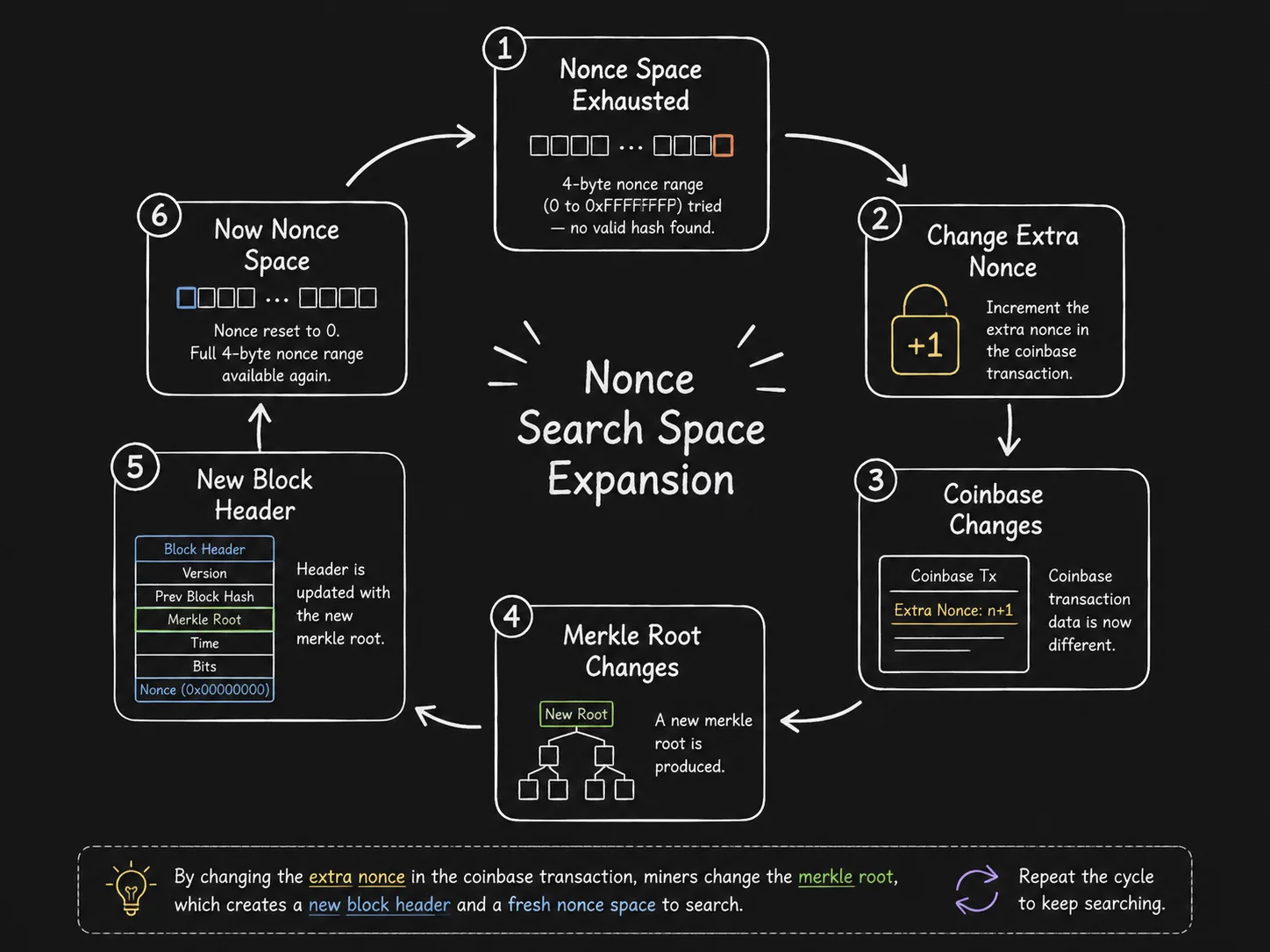
The Bitcoin mining developer guide clearly describes this: mining hardware can iterate through possible Nonce values in the block header; if none produce a hash meeting the target, mining software can modify the extra nonce in the coinbase transaction, producing a new Merkle Root, then hand a new block header to the ASIC to continue. The timestamp field can also be updated within allowed rules.
Two often confused concepts must be distinguished: the Nonce in the block header and the extra nonce in the coinbase transaction are not the same field. The Nonce lives in the fixed 80-byte block header; the extra nonce lives in coinbase transaction data.
They expand the search space together because the coinbase transaction is part of the block's transaction set. When coinbase data changes, the coinbase transaction hash changes; when transaction hashes change, the Merkle Root changes; the Merkle Root is part of the block header, so the 80 bytes fed into SHA-256 become a new combination.
Miners then get a fresh Nonce search space.
This process can be abstracted as:
"One Nonce range exhausted → modify extra nonce in coinbase → recompute Merkle Root → new block header → search Nonces again"
So in strict terms, modern ASIC mining is not repeating the same 32-bit space over and over, but continuously searching hashes in an ever-changing block header space.
How Does a Pool Hand Mining Tasks to ASICs?
In practice, most miners do not search for blocks independently — they join a pool. The pool organizes mining tasks; miners contribute hashrate and submit Shares to prove they completed the corresponding work.
The Bitcoin developer guide explains pool mining logic: the pool provides information needed to construct the block header and sets a pool target easier to reach than the Bitcoin network target. Some ASIC results are not enough to become a real Bitcoin block but meet the pool target; those can be submitted to the pool as Shares proving how much computational work the miner actually contributed.
So one hash attempt can yield three outcomes:
| Hash Result | Meaning | Next Step |
|---|---|---|
| Below pool target | Ordinary failed hash | ASIC continues computing |
| Meets pool target, not network target | Valid Share | Submit to pool as proof of work |
| Meets Bitcoin network target | Valid block candidate | Pool submits to Bitcoin network |
This is key to understanding pool hashrate statistics. The vast majority of ASIC hash results are not uploaded to the pool — otherwise traffic would be enormous. Miners only submit Shares meeting pool difficulty; the pool estimates actual contributed hashrate from valid Shares received over time.
Occasionally, a Share meets not only the pool's target but also falls below the Bitcoin network target — then the pool has truly found a candidate block that satisfies proof-of-work rules.
So "the miner submits many Shares daily" and "the miner finds a Bitcoin block" are concepts at different levels. Shares are the mechanism to measure and allocate pool workload; only hashes meeting the network target qualify as proof of work for a new block.
From Nonce to Hashrate: Why Faster ASICs Raise Block-Finding Probability
After the above, labels like "100 TH/s" and "200 TH/s" are much easier to read.
H/s means hashes per second; TH/s means trillions of hash attempts per second. From a proof-of-work angle, higher ASIC hashrate means more candidate block header combinations tested per unit time.
There is still no process of "the longer you compute, the closer you get to the answer." Each new hash attempt is a fresh probabilistic event. How many attempts came before does not make the next hash inherently easier to succeed.
So Bitcoin mining has an important probabilistic trait: short-term results can fluctuate noticeably, but over longer observation windows, more hashes completed usually better reflect hashrate share.
That is also why farm operations cannot rely on one-second instantaneous hashrate alone. Whether an ASIC runs stably, stays connected to the pool, shows low hashrate, goes offline, overheats, or submits many invalid Shares all affects effective work ultimately contributed.
At the base layer, a nominally high-hashrate ASIC that goes offline frequently is essentially losing time that could have been spent searching Nonces and other candidate inputs. One minute without computing means all the hash attempts that minute could have performed are gone.
So "improving farm uptime" is not an operations metric unrelated to the Bitcoin protocol. It still comes back to the same foundation: getting more ASICs to run valid SHA-256 computation for more time.
After Understanding Nonce, What Does a Farm Actually Need to Manage?
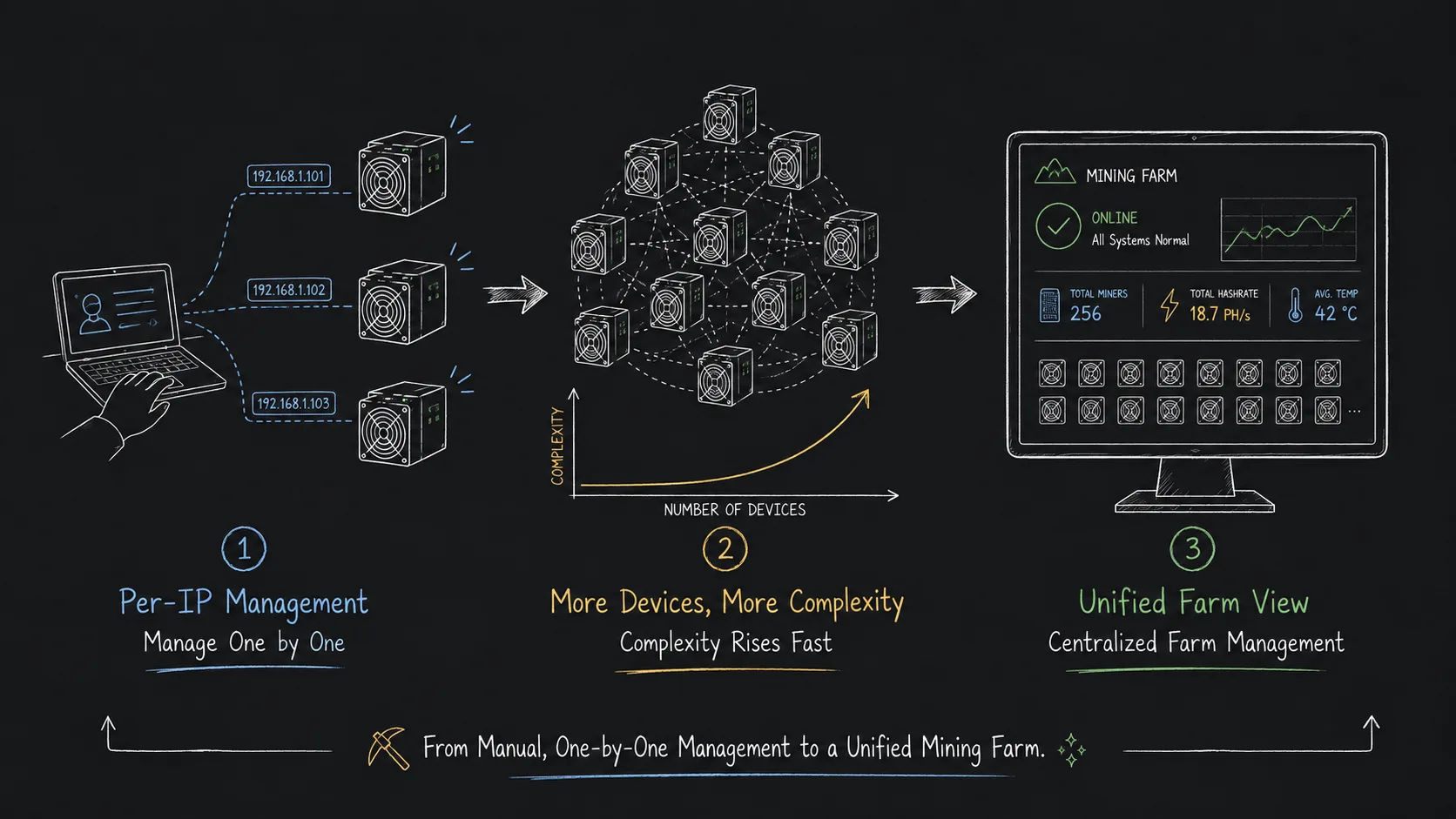
For a single ASIC, searching for a Nonce is high-speed computation inside the chip and firmware; miners do not manually enter Nonces. But when miner count grows from a few to hundreds, thousands, or many farms, what operators really need to watch becomes another layer: how many miners are performing those computations normally?
At that point what matters most is not viewing one particular Nonce, but continuously observing miner hashrate, online status, temperature, power draw, pool connection, and anomaly signals. Nonce's farm onboarding flow can put farms, miners, and pool observer data into a unified management workflow, while the Nonce farm management platform focuses on miner metric monitoring, device management, and automation policies.
That is the real link from "Bitcoin Nonce" to "farm management."
ASIC chips keep searching for hashes that meet conditions without pause; pools assign work to many miners and receive Shares; farm management systems ensure as many ASICs as possible stay in correct, stable, efficient operation for as long as possible.
At the protocol layer, mining competes on SHA-256 hash count; at the farm operations layer, the competition is how to keep more effective hashrate online at lower power and ops cost.
So ASIC miners "finding a Nonce" has no mysterious mathematical shortcut. What they do is very simple, repeated at astonishing scale: change input, run SHA-256 twice, get hash, compare to target, try again.
The Nonce is the most visible variable in that loop, but what truly constitutes Bitcoin proof of work is the massive hash computation global ASIC fleets perform continuously. Understanding that explains why hashrate, difficulty, Shares, uptime, power efficiency, and farm operations all converge on one question: under limited time and energy cost, who can complete more valid hash attempts.