How Nonce Solves Ops Problems for Large Bitcoin Mining Farms
Nonce solves large-farm ops by filtering abnormal miners, bulk reboot/pool/power/firmware actions, low-hashrate and temperature automation, and role permissions—upgrading per-machine backends into a closed-loop fleet workflow.
A single ASIC miner is not hard to manage. Find the miner IP, open the backend, check hashrate and temperature, change the pool address, and reboot when needed—this approach works fine for home miners or environments with only a few machines. BITMAIN miner manuals also reflect this typical single-device management logic: first find the device IP with IP Reporter, then enter the miner backend to configure pools and view runtime status.
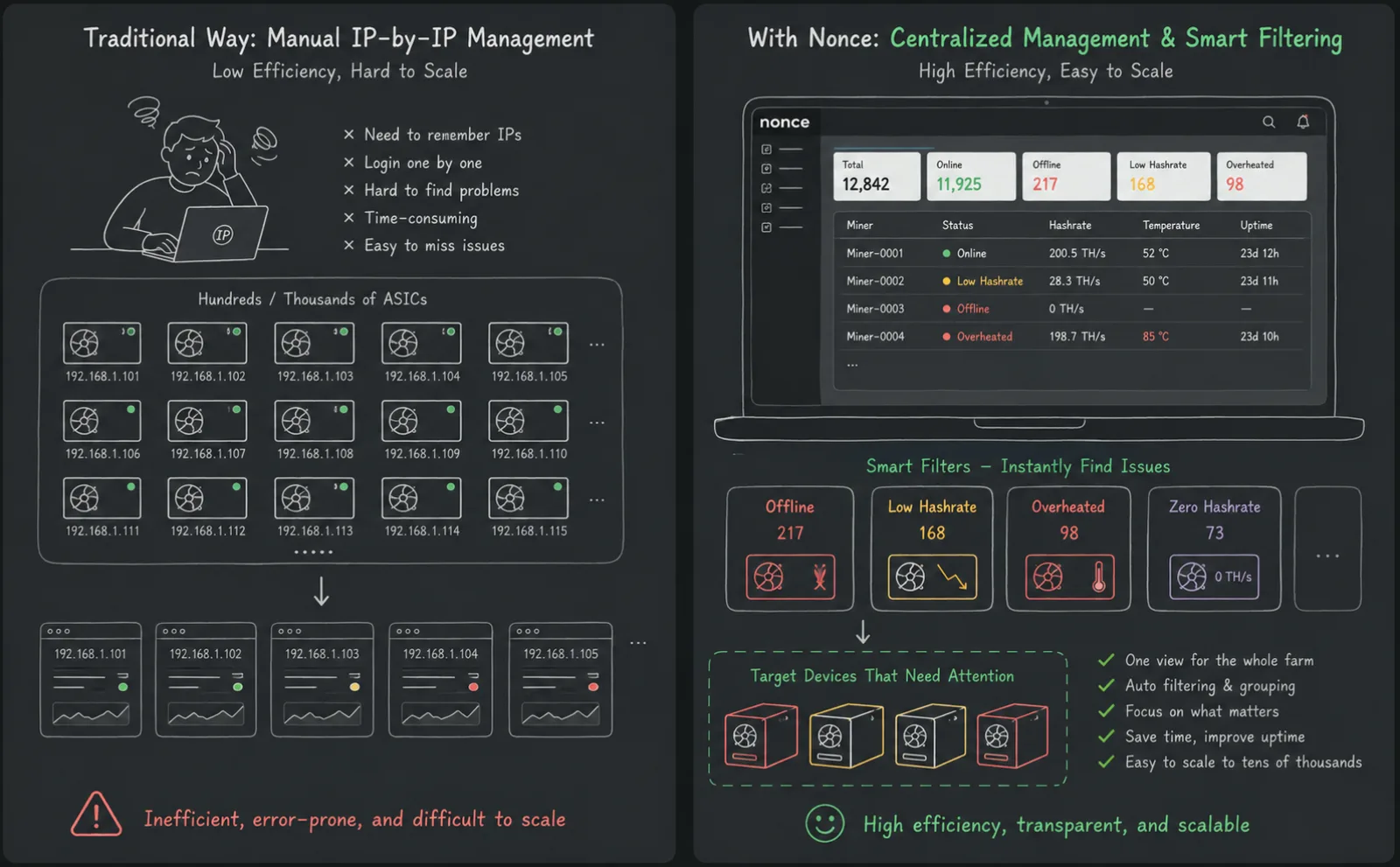
But once miner counts grow from a few to hundreds or thousands—and even span different rooms and farms—the problem changes. What farms truly need to solve is no longer "how to enter one miner backend," but "how to know which miners are losing hashrate," "how to quickly locate a batch of abnormal devices," "how to change configs on many miners at once," "how to auto-handle recurring faults such as high temperature and low hashrate," and "how to let different ops staff safely manage different farms."
That is the fundamental reason large Bitcoin farms need a miner management platform: a miner management platform does not replace ASIC miners or miner firmware—it builds monitoring, filtering, bulk operations, automation, and permission management for the whole miner fleet on top of single devices, upgrading per-machine management into farm-level management.
Nonce is a Bitcoin farm management platform built around this scenario, placing miner discovery, runtime data, abnormal devices, bulk operations, and automation rules into one farm management flow.
The Biggest Ops Problem for Large Farms Is Not Lack of Data, but Inability to Quickly Find "Problem Miners"
ASIC miners themselves produce large amounts of runtime data—realtime hashrate, average hashrate, temperature, fan status, hashboard status, pool connection, device logs, and more. Watching one miner, this information is easy to understand; the problem is that large farms rarely have only one abnormal device.
In real farms, completely offline, zero-hashrate, low-hashrate, high-temperature, network-abnormal, and hashboard-fault states may exist at the same time. If operators still rely on visiting IP addresses one by one, the first problem is not even "how to fix," but "which machines need fixing."
The larger the farm, the clearer this cost of finding abnormal devices becomes. Suppose a room develops local overheating: knowing only that total farm hashrate dropped is not enough. Operators still need to judge which rack the anomaly comes from, which models are affected, which devices already exceed temperature limits, which also show low hashrate, and whether the issue concentrates in the same network or power zone.
Nonce's miner filtering and anomaly location can filter miners by runtime status, temperature, hashrate, and combined conditions. For example, you can directly filter offline, zero-hashrate, low-hashrate, and overheating miners, or combine rack, model, temperature, and hashrate conditions to shrink a large farm quickly to the device set that truly needs handling.
That means farm management thinking changes in a very important way: the old flow was "open one miner → view data → judge anomaly → check the next," while a miner management platform becomes "first define anomaly conditions → filter all abnormal miners → handle them centrally."
From Per-Machine Actions to Bulk Management Is the Second Threshold of Scaled Farm Ops
After finding problem miners, you still need to act.
Under traditional single-device management, changing pools, rebooting, adjusting operating mode, or upgrading firmware usually means entering each device backend. For a few miners that is fine; for large farms, the same action may need to apply to dozens, hundreds, or more devices—per-machine work then burns huge time and easily leaves gaps and inconsistent configs.
That is why "bulk operations" are a core capability of a miner management platform.
Nonce can run bulk actions directly on filtered miners. Current farm ops flows include bulk reboot, bulk power-mode adjustment, bulk pool-connection changes, and bulk firmware upgrades for supported models.
Take pool config: if a farm needs to switch the primary pool or change Worker settings, there is no need to enter each miner backend. Nonce can uniformly set primary pool, backup pool, pool address, and Worker name on selected miners, then submit configs in bulk.
Power management follows similar logic. Nonce supports bulk switching target miners among overclock, normal, underclock, and sleep modes so farms can adjust a group of miners by temperature, power conditions, or operating strategy—not change configs one by one.
| Farm Ops Task | Traditional Single-Device Management | Miner Management Platform |
|---|---|---|
| Find abnormal miners | Check one by one or rely on manual records | Filter by status, temperature, hashrate, and more |
| Reboot devices | Enter each miner backend separately | Bulk-execute on abnormal devices |
| Change pools | Change pool addresses one by one | Bulk-update pool configs |
| Adjust power mode | Modify each device separately | Switch selected miners uniformly |
| Firmware upgrade | Upload and upgrade individually | Bulk-execute on compatible devices |
| Review results | Manually re-check devices | Track results in a unified task flow |
For large farms, bulk management is not only "fewer clicks." More importantly, it turns ops actions from human workflows that depend on personal habits into repeatable standard processes.
Why Offline and Low-Hashrate Miners Especially Need Automation
Farm losses do not always come from one severe fault. What is more often overlooked is low hashrate lasting several hours, miner software anomalies, offline devices, or temperature anomalies.
If one miner drops hashrate briefly, a manual walkthrough may catch it quickly; but with large fleets, operators cannot watch every hashrate curve around the clock. A more realistic problem: miners may go abnormal overnight, or stay low-hashrate for hours between walkthroughs.
So large farms need more than "seeing anomalies"—they need to move from "discover anomaly" to "auto-execute when conditions are met."
Nonce's low-hashrate auto reboot continuously evaluates average miner hashrate. When a miner stays below a set threshold for a set time window, the system can send a reboot task. Thresholds can be set uniformly or per model as fixed hashrate or a percentage of rated hashrate. To avoid crude endless reboots, rules also include temperature protection, reboot-frequency limits, and per-device reboot-count limits.
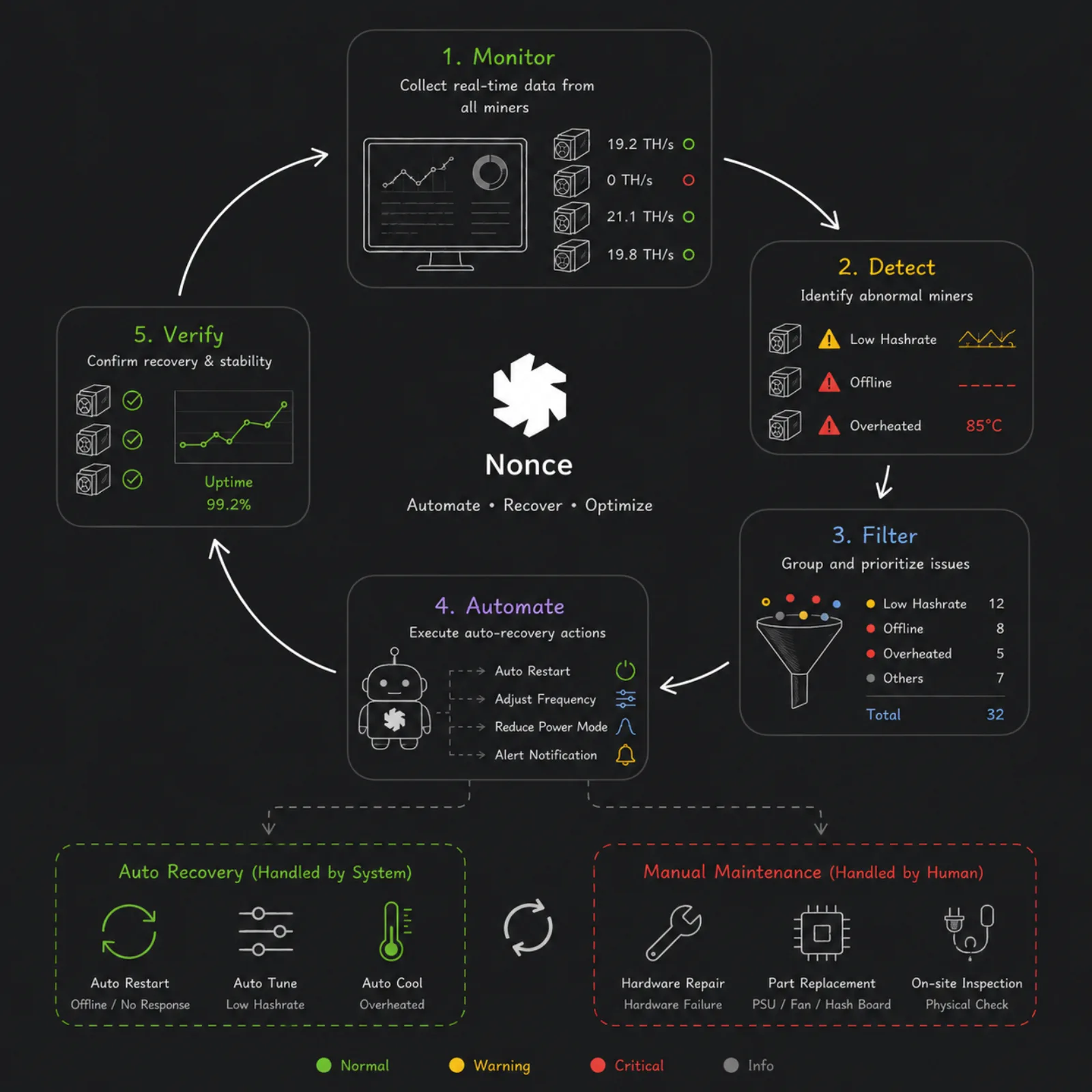
That matters. Valuable farm automation is not "reboot forever on low hashrate," but a complete judgment loop: continuously collect data → judge whether the anomaly persists → check protection conditions → execute recovery → limit repeated actions → keep observing results.
When farms have large fleets, this rule-based handling can take on a large share of repetitive frontline ops. Humans no longer need to handle every brief software anomaly—they can focus on devices where auto-recovery fails and hashboards, power, network, or on-site hardware must be checked.
In High-Temperature Environments, Farms Must Manage Operating Strategy for the Whole Fleet—Not One Miner
Temperature is one of the most common runtime variables in Bitcoin farms.
When miner temperature is too high, staying at high power may worsen cooling pressure; but underclocking the whole farm uniformly may also make many temperature-normal miners lose unnecessary hashrate. A truly reasonable strategy should be based on device data and environmental state—act only on devices that meet conditions, then readjust after the environment recovers.
Nonce's temperature-driven operating-mode automation can trigger mode switches from average miner temperature over a period. For example, when temperature exceeds a set threshold, switch from high-power to normal mode; after temperature drops and conditions are met, adjust operating mode again. The system also sets action intervals to avoid frequent state switching from short temperature swings.
Compared with merely setting a high-temperature alert, this is closer to the operating logic large farms need: monitoring data is not the end—data ultimately needs to become executable farm strategy.
Power conditions are similar. When electricity prices, curtailment requirements, or ambient temperature change, farms may need to rebalance hashrate, power draw, and stability. Nonce's bulk power-mode management lets farms uniformly switch specified devices among overclock, normal, underclock, or sleep, turning configs that once required per-machine edits into farm-level actions.
That is also a key difference between a miner management platform and ordinary monitoring tools: the former should not only tell operators "what happened," but help the farm finish "what to do next."
After Multi-Farm Ops Begin, Unified Views and Permission Management Grow More Important
With only one room, much information can still be maintained by on-site teams and simple spreadsheets. As business expands to multiple farms, different sites may have different models, rack structures, network environments, and ops staff—and data fragments quickly.
Nonce organizes farm assets with Workspace, Farm, and Miner layers. After a farm is connected, you can view hashrate, efficiency, miner runtime status, and estimated revenue in a unified farm view, then enter the miner list to handle offline and other abnormal devices.
Device onboarding also needs to scale. Traditional miner discovery often relies on IP-finding tools; BITMAIN's IP Reporter is a typical example—devices and the computer must be on the same network, then confirm the IP with the miner's IP Report button. Nonce can configure IP ranges for miner scanning and support periodic auto-scan of specified ranges so newly connected miners can be discovered and brought into management automatically.
After scale grows, another often overlooked issue is permissions.
Farm owners, managers, on-site ops, and members who only need to view data clearly should not have identical operation rights. If every account can change pools, delete devices, or adjust farm configs, larger scale means higher mis-operation risk.
Nonce's roles and farm permission management separates admins, managers, members, and read-only users, and further limits which farms different roles can access and what actions they can run. For example, read-only roles can view miner status in authorized scope, while daily ops can run authorized miner tasks; member management and access-boundary actions stay with higher roles.
So a miner management platform is not only managing miners—it is also managing "how people operate miners."
Why Large Farms Ultimately Need a "Monitor — Locate — Act — Automate — Verify" Closed Loop
If you break large-farm daily ops apart, most tasks reduce to a few steps: first observe overall farm runtime status, then find abnormal devices, judge anomaly type, act on targets, and finally confirm recovery.
The problem is that if these steps live in different tools, spreadsheets, and people, the whole flow gets fragmented. Monitors find a problem and send IPs to ops; ops enter device backends; after acting they re-check data and record results in chat or spreadsheets. More devices and larger teams make that handoff cost clearer.
Nonce's ops design consolidates daily actions into "query miners → select devices → execute actions → review task results," then adds automation rules on top.
| Ops Stage | Core Question | Nonce Capability |
|---|---|---|
| Monitor | How is the farm running now? | Unified view of hashrate, efficiency, and device status |
| Locate | Which miners are having problems? | Status, hashrate, temperature, and combined filters |
| Judge | Offline, low hashrate, or high temperature? | Classify anomalies by different runtime metrics |
| Execute | How to handle many devices at once? | Bulk reboot, power mode, pools, firmware, and more |
| Automate | Which recurring problems can auto-recover? | Low-hashrate auto reboot, temperature-driven mode adjustment |
| Manage | Who can view, who can operate? | Workspace, Farm, and role permission controls |
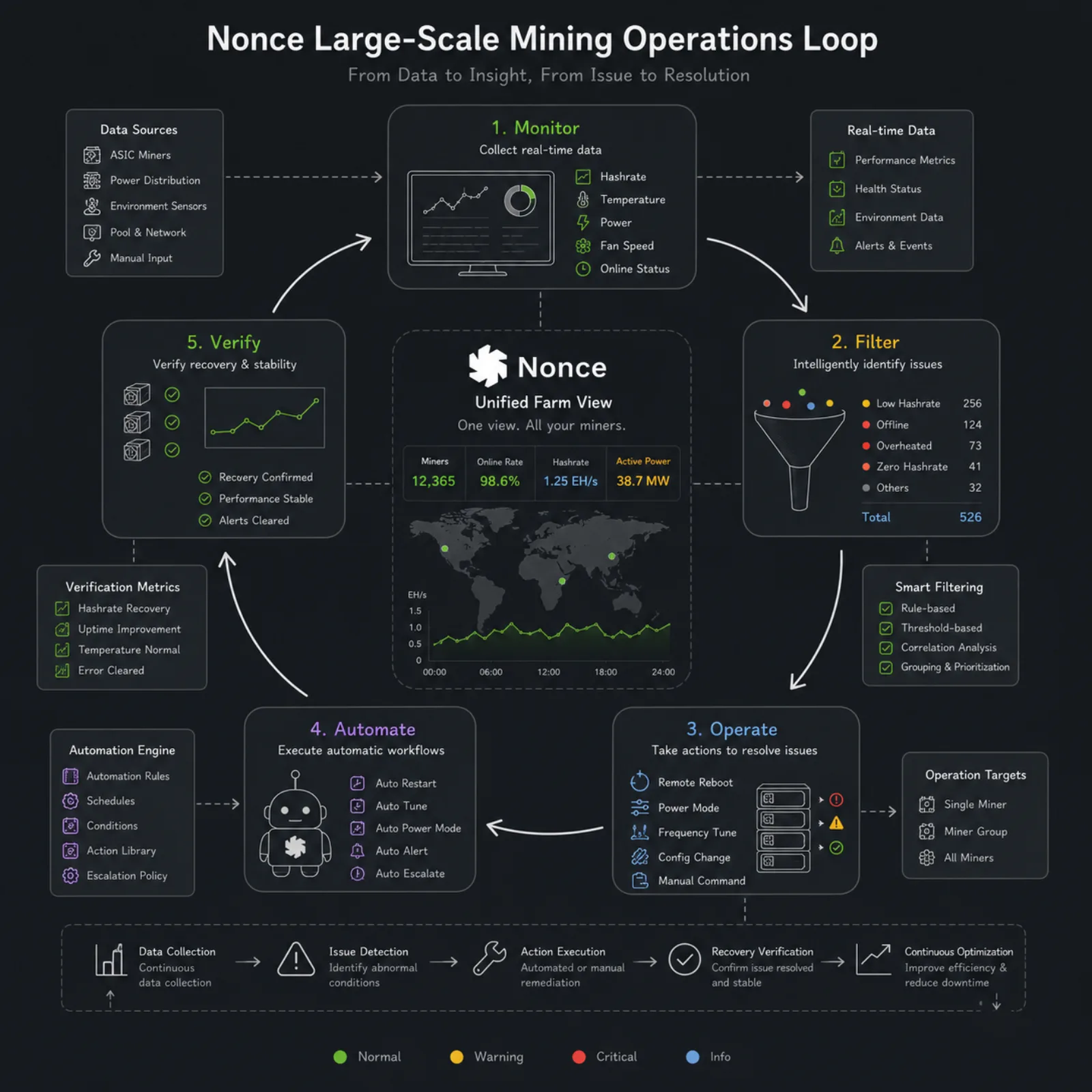
A truly mature farm management system does not aim to make ops teams complete more actions every day—it aims to make fewer actions require humans. Problems that can be auto-discovered should not depend on manual walkthroughs; problems that filters can locate quickly should not be checked one by one; actions that can be bulk-completed should not be done machine by machine; problems rules can recover should not wait for human intervention.
How Nonce Solves Ops Problems for Large Bitcoin Farms
For large Bitcoin farms, whether a miner management platform is needed ultimately depends on one question: can the farm still manage the whole miner fleet with methods meant for managing single miners?
As device count grows, logging into IPs one by one, manual walkthroughs, hand-recording anomalies, and per-machine actions gradually become ops bottlenecks. At the same time, the management focus shifts from "can devices mine" to "how many devices are below expected hashrate," "how long has the anomaly lasted," "can we recover quickly," "what strategy should we use under different temperature and power conditions," and "what operation rights should different people have."
Nonce aims to solve exactly this layer.
It does not replace miners, pools, or miner firmware—it builds a farm-level management layer above ASICs: discover and collect miner status via Agent, observe farm runtime in a unified view, quickly find abnormal devices with filters, run bulk tasks such as reboot, pool config, power mode, and firmware, then handle standardizable scenarios such as high temperature and low hashrate with automation rules.
For miners with only a few ASICs, per-machine management may still be enough; but for large farms continuously pursuing hashrate uptime, device utilization, and ops efficiency, the scarcer resource as miner count grows is often no longer "a tool to view one miner," but the ability to organize large numbers of devices, data, anomalies, actions, and people in one place.
That is why large Bitcoin farms need a miner management platform: from managing miners, to managing the operating efficiency of the whole farm.