How Do Bitcoin Mining Farms Monitor Miner Hashrate and Uptime? How Nonce Helps Farm Operations
Farms must monitor miner-side hashrate, pool-side hashrate, and uptime together—not just a single total number; Nonce links device discovery, status collection, Pool Observer verification, and ops tasks from anomaly detection to remediation.
For Bitcoin mining farms, "a miner is online" does not mean "the miner is producing hashrate normally," and "farm total hashrate looks fine" does not mean every miner is healthy. Effective farm monitoring must answer three questions at once: how many miners should be online, how many are actually online and working, and how much of that hashrate is effectively received by the pool.
Therefore, when monitoring miner hashrate and uptime, farms should not stare at a single total-hashrate number. They should observe miner-side status, pool-side hashrate, device online state, anomaly types, and historical trends in one operating system. Nonce's role is not only to display miner data — it connects miner discovery, status collection, hashrate monitoring, anomaly filtering, pool-side verification, and follow-up ops actions, so farms can move from seeing an anomaly to finding the abnormal devices and handling them.
Why Can't Hashrate Monitoring Rely on a Single Number?
ASIC miners themselves usually provide real-time and average hashrate data. For example, Bitmain's description of the ANTMINER status page shows real-time hashrate separately from average hashrate over the device's runtime; the management UI also includes pool status, hashboard status, fan status, chip status, and logs. In other words, the miner itself can already tell operators whether the machine is computing and some hardware health details.
But miner-side hashrate is only one layer of monitoring. Bitcoin mining ultimately depends on miners submitting valid work to a pool, so the pool side also tracks Worker hashrate and activity. Take Luxor as an example: its pool reporting system provides hashrate time series, active Worker counts, and more; its API also includes Worker hashrate, efficiency, last submission time, and ACTIVE status fields. Braiins also notes that if each device is given a unique Worker name, the pool can track hashrate drops on specific machines.
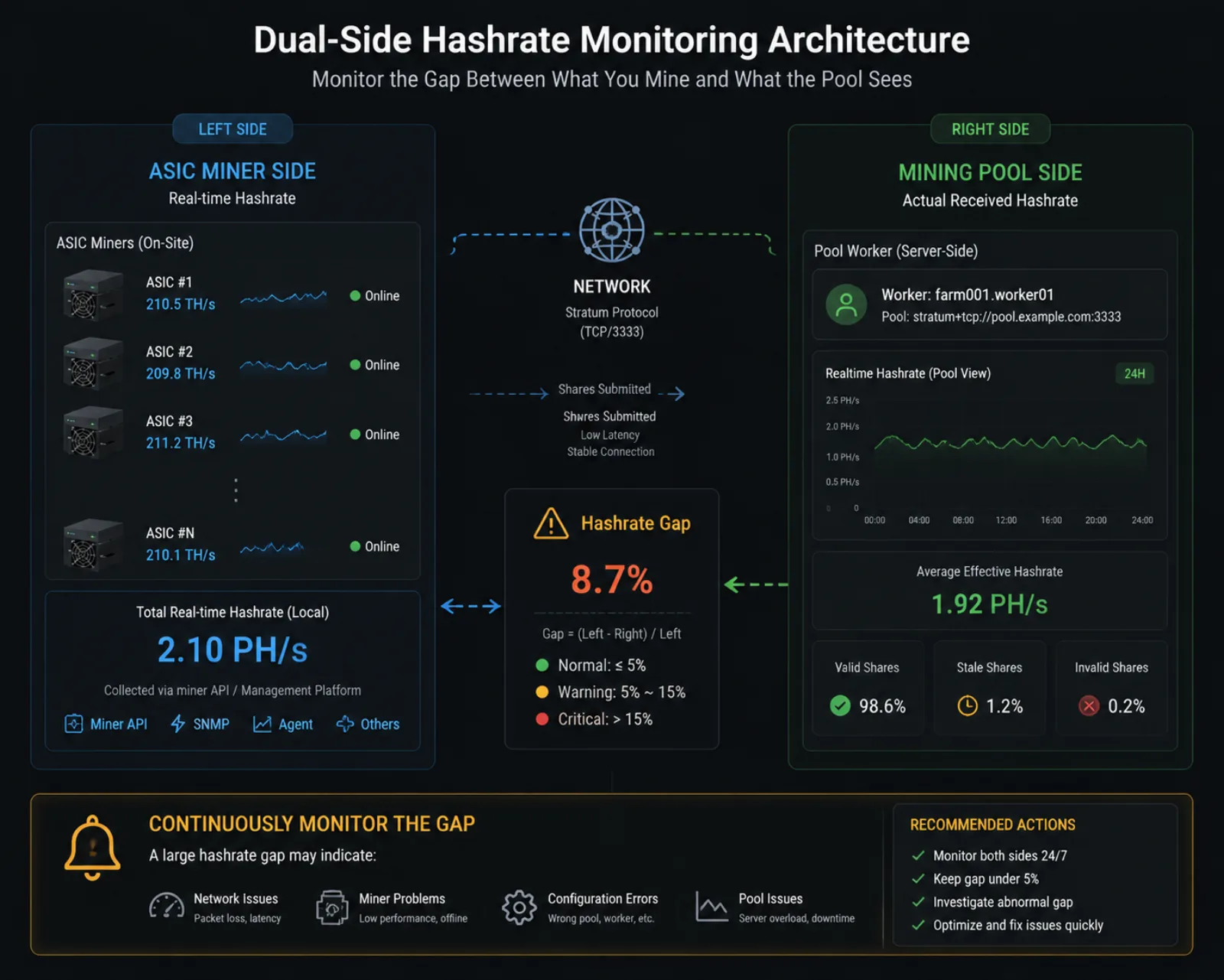
This means farms effectively have two critical hashrate views: how much hashrate the miner reports it produced, and how much hashrate the pool actually observed. Short-term gaps between them do not necessarily mean failure — but if the gap keeps widening, it is worth checking network, pool connectivity, device stability, or specific miner status.
How Should Uptime Be Calculated? The Key Is Defining "Online" First
The simplest miner uptime formula is: uptime = currently online miners ÷ expected online miners × 100%
For example, if a farm theoretically deploys 10,000 miners and 9,700 are currently recognized as online by the monitoring system, device uptime is 97%. For real farm operations, that number is still too coarse — among those 9,700 "online" miners, there may still be zero-hashrate, low-hashrate, overheating, or partially failed hashboard devices. Therefore, a more valuable approach is to observe "uptime" and "effective operating rate" separately.
| Metric | Main question it answers | Typical anomalies |
|---|---|---|
| Asset count | How many miners should theoretically be running | Asset records do not match on-site devices |
| Online miner count | How many devices can currently be discovered or connected | Power outage, network outage, device lost |
| Healthy-hashrate miner count | How many online devices are actually hashing normally | Zero hashrate, low hashrate, dropped boards |
| Miner-side total hashrate | How much hashrate ASICs currently report | Performance decline, partial hashrate loss |
| Pool-side hashrate | How much hashrate the pool actually observes | Network, pool connection, submission anomalies |
| Miner-side vs pool-side gap | Whether produced hashrate matches effectively presented hashrate | Network quality, Worker config, or persistent anomalies |
This breakdown matters. Bitmain treats "IP not found," "cannot power on," "zero hashrate," and "low hashrate" as different problem types, and network disconnects require separate checks of cables, switches, and network connectivity. In other words, why a miner is not contributing hashrate cannot simply be labeled "offline."
For large farms, the metric that matters more is usually not plain "device uptime," but how many miners that should be working are continuously contributing expected effective hashrate.
What Kind of Hashrate and Uptime Monitoring System Should a Farm Build?
A reasonably complete farm monitoring system needs at least four layers of data.
The first layer is device discovery and connection status. The system needs to know which miners should exist in an IP range, how many can currently connect, and which devices suddenly disappeared. If this layer is unstable, later temperature, hashrate, and power metrics lose their foundation. Nonce official docs show that Nonce Agent runs an IP-range miner scan every 60 minutes by default: it scans configured IP ranges, tries to connect and identify miners; newly discovered miners are automatically added to monitoring.
The second layer is miner operating data. This includes hashrate, temperature, power consumption, operating mode, hardware info, and error states. Nonce's current docs say the Agent connects to identified miners every 5 minutes by default, collects performance and status data, and sends it to the platform; miner APIs in the docs index also cover real-time hashrate, power, temperature, mining status, hardware info, and error info.
The third layer is pool-side data. This step checks whether continuous gaps exist between "the miner says it is hashing" and "how much hashrate the pool actually received." Nonce's farm creation flow supports adding Pool Observer data for pool-side verification, and the current official docs index also includes pool observer data as part of farm setup.
The fourth layer is historical trends. A hashrate drop at a single point in time may be normal volatility — but if a rack stays low for hours, a model goes offline frequently, or a batch of devices fails around the same time every day, historical data can reveal the pattern. Nonce's current API docs index includes farm historical metrics endpoints that observe hashrate and online/offline miner counts at different time granularities, plus historical performance data for individual miners.
Once these four layers are connected, what the farm sees is no longer a static "current hashrate" dashboard — it is an operating data chain from asset count and device connectivity through device performance all the way to pool results.
When Hashrate Drops, Check Uptime First or Miners First?
The right response usually depends on the shape of the anomaly. If farm total hashrate suddenly drops a lot and online miner count also falls sharply, the issue is more likely in power, network, or an entire device zone. For example, a switch, PDU, transformer, or rack-level fault can make a batch of miners disappear at once. In that case, the priority is not logging into miners one by one — it is confirming whether anomalies cluster in the same area.
If online miner count is largely unchanged but farm total hashrate drops, dig further into low-hashrate and zero-hashrate miners. Being able to answer network requests does not mean hashboards are working normally. Bitmain's official status docs present real-time hashrate, hashboards, chips, and fans as separate dimensions.
There is also an easier-to-miss case: miner-side total hashrate looks relatively normal, but pool-side hashrate stays low. Then compare device data with pool Worker data instead of blindly digging through miner hardware. Pools can usually observe hashrate and activity at the Worker level, so giving different miners clear Worker identities helps pin pool-side issues to specific devices.
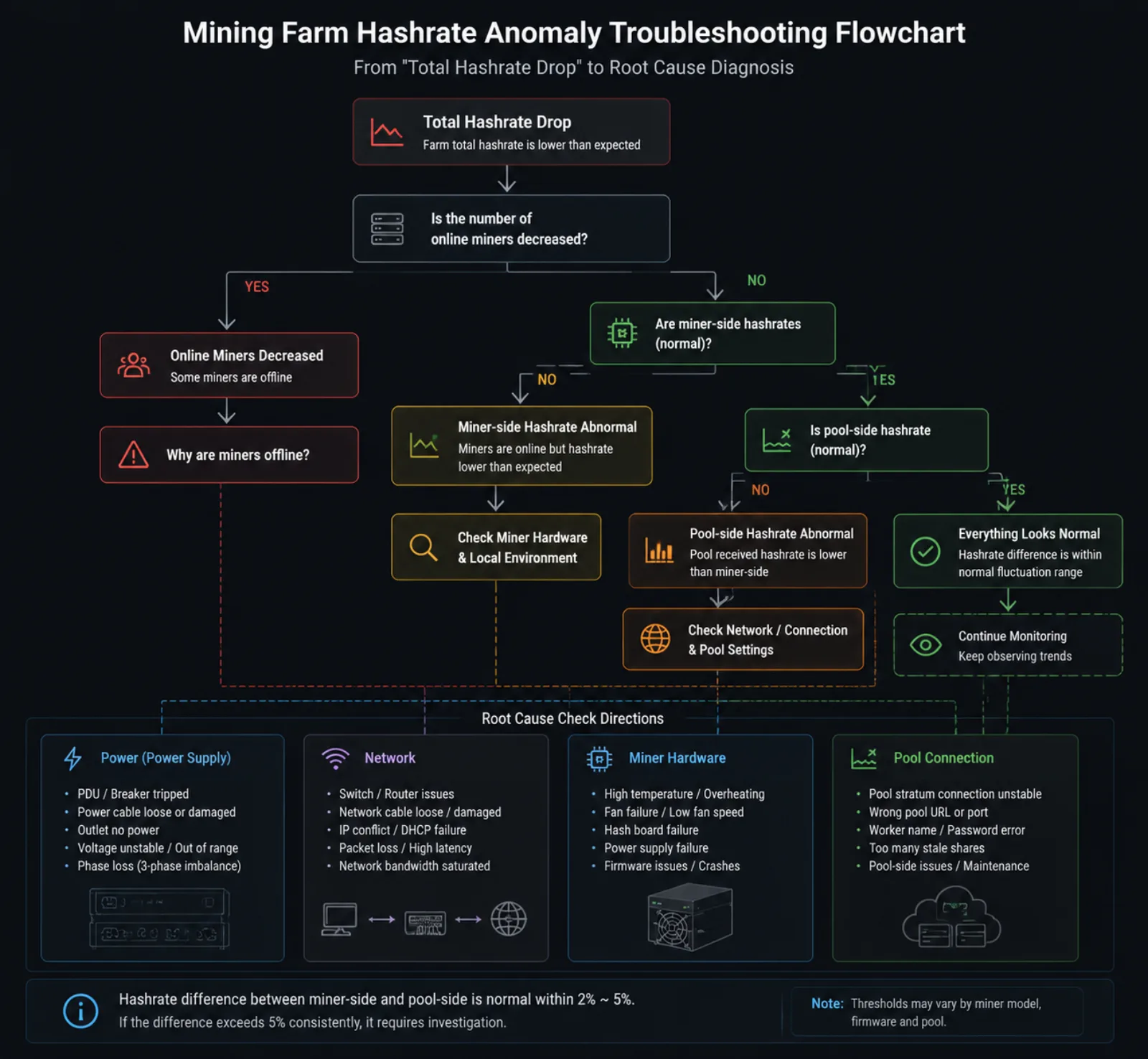
Therefore, what farm operations really need is not just a "red alert dot," but a fast judgment: which layer the anomaly is on, which miners are affected, and which devices should be acted on next.
How Does Nonce Help Farms Monitor Hashrate and Uptime Together?
One of Nonce's core values is putting information scattered across miners, the LAN, and pools into the same farm view.
On the data collection side, Nonce Agent is deployed in the farm network, discovers devices in specified IP ranges, and continuously collects data from identified miners. The default data collection interval is 5 minutes, and the IP-range auto-scan interval is 60 minutes. Farms can therefore continuously know which miners exist, which can still be reached, and what performance state devices currently report.
At the device monitoring layer, the Nonce platform can return real-time miner hashrate, power, temperature, mining status, hardware info, and error data, and aggregate/classify by states such as Healthy, Abnormal, Sleep, and Stale; it also provides query entry points for Low Hashrate, Zero Hashrate, Offline, and Overheated scenarios.
This classification fits real farm ops better than a simple "online / offline" split. For example, two miners may both show online — one with normal hashrate, the other at only a fraction of rated level. From an asset-uptime view they look the same; from a production-efficiency view they are completely different. Farms need to filter out the second type directly instead of manually paging through thousands of miners.
Nonce can also add pool observer data into farm monitoring. Its monitoring scenarios can watch Agent-side and pool-side hashrate together to identify gaps between them; the farm setup flow also includes optional Pool Observer data configuration for pool-side verification.
That lets ops keep asking from "how many miners are online" to "how much hashrate these miners produce" and "how much hashrate the pool actually observes," so uptime and hashrate performance form one judgment system.
From Detecting Anomalies to Handling Them, Monitoring Needs a Closed Loop
Monitoring creates real operating value not when the dashboard turns red, but when anomalies are handled quickly. Suppose a farm with thousands of ASICs finds dozens of miners in a low-hashrate state. Without a centralized management platform, ops may need to open each miner backend by IP, then decide whether to reboot, change operating mode, or edit pool config. The larger the farm, the more obvious that cost becomes.
Nonce's task APIs currently support miner reboot, power-mode changes, pool edits, firmware upgrades, and more, and record task states such as created, queued, running, succeeded, failed, timed out, or canceled. Task data also includes miner identity and timestamps, so device actions leave a clear execution record.
For farms that frequently handle the same kinds of anomalies, the next step is automation. Nonce currently includes automation scenarios that automatically switch miner power modes based on temperature conditions; Nonce also treats metrics monitoring, asset management, and policy automation as core platform capabilities.
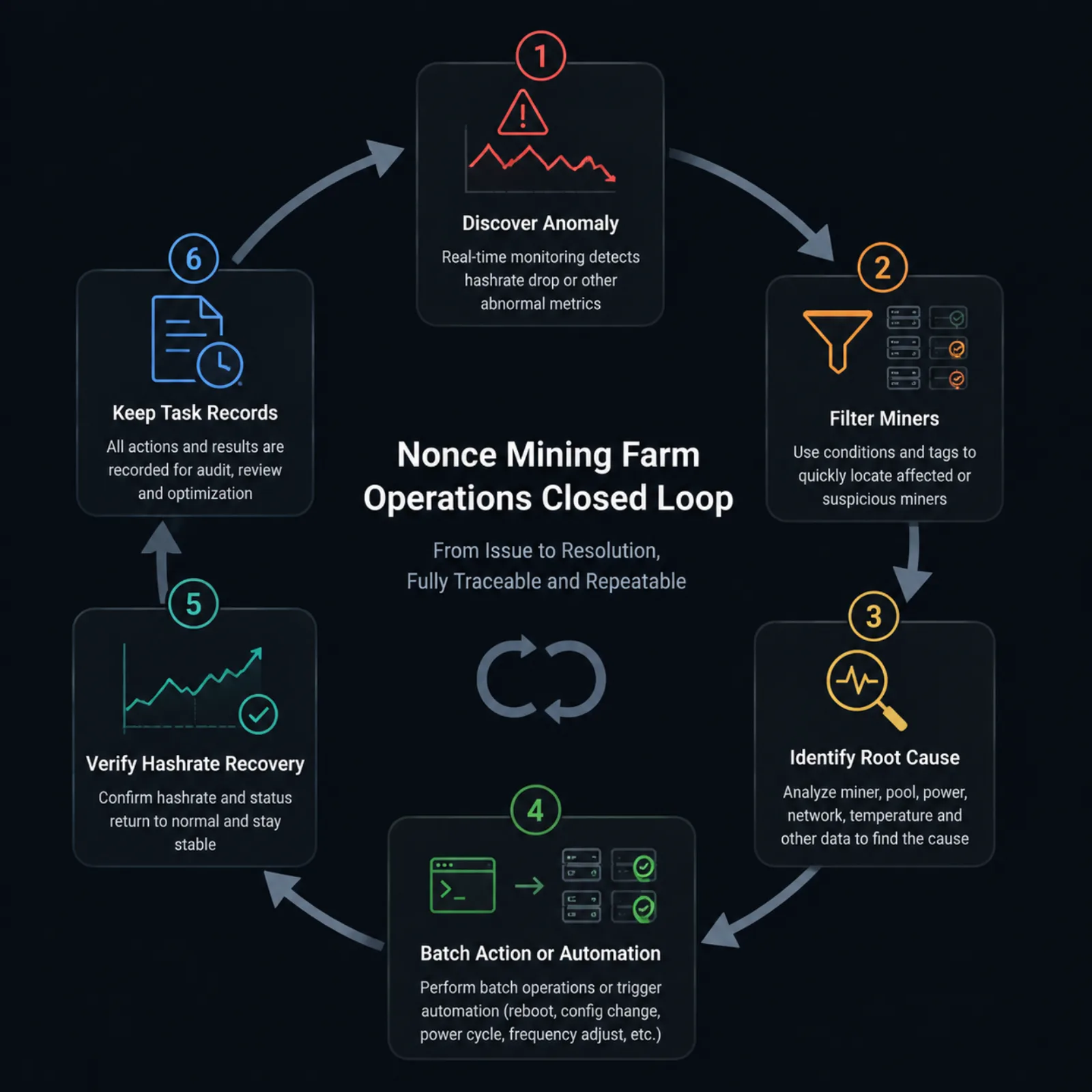
This means farm management can gradually shift from manual walkthroughs to anomaly-driven ops: healthy miners do not need repeated checks; operators focus attention on devices that actually hurt output.
What Really Matters Is Not 100% Uptime, but Continuously Raising Effective Hashrate
Farms naturally want higher miner uptime, but chasing "100% online" alone is not the most accurate operating goal. A miner that can be discovered by the system yet produces very low hashrate still means deployed power, rack space, and equipment assets are not fully converting into Bitcoin output.
Therefore, more mature farm operations should watch three layers at once: whether assets are online, whether online miners are producing hashrate normally, and whether that hashrate ultimately shows up on the pool side.
Nonce connects these links: Agent handles miner discovery and device data collection; the farm view observes miner status and historical metrics; Pool Observer provides pool-side verification; anomaly filters help locate low-hashrate, zero-hashrate, and offline devices; and the task system further supports ops actions and execution records. Nonce currently covers farm, miner, pool, and hashrate-scale management capabilities.
For a small deployment of dozens of miners, an admin may still rely on the pool page and miner backends for one-by-one checks. But once a farm grows to thousands of ASICs — or multi-site / multi-farm environments — what is scarce is often not data, but the ability to quickly judge from large volumes of data which devices are losing hashrate, and turn that into executable ops actions. That is the core value of a miner management platform in farm operations.