What Does "Nonce Bitcoin Mining" Mean? From the Bitcoin Nonce to Farm Management Software
"Nonce Bitcoin Mining" can mean Bitcoin's block-header nonce field or the Nonce farm management platform—protocol-level PoW input vs. operations layer for discovering and managing ASIC fleets.
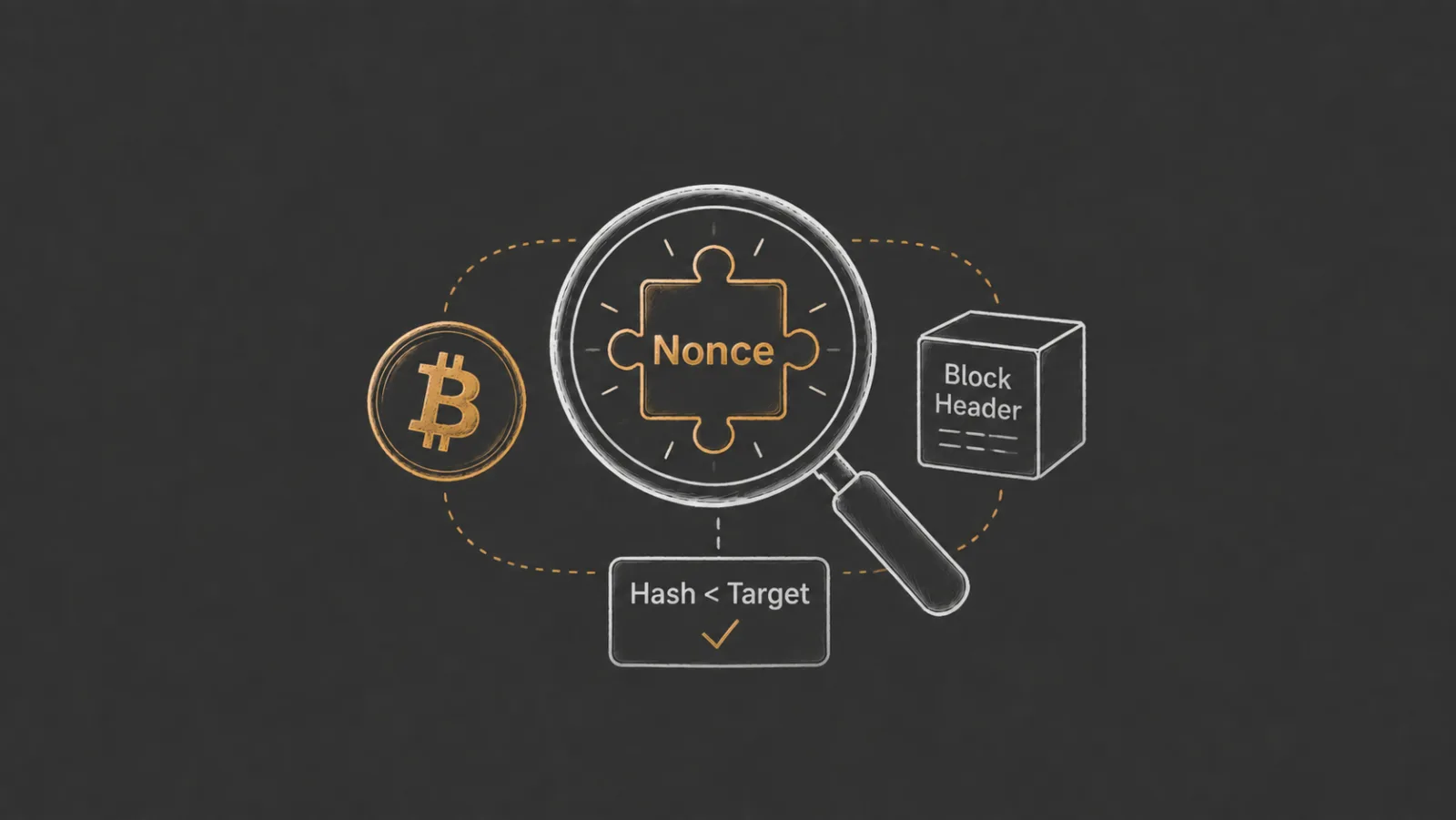
When searching for "Nonce Bitcoin Mining," the most common confusion is: does Nonce here refer to a technical parameter in the Bitcoin protocol, or to a mining farm management platform? The answer is: both are possible.
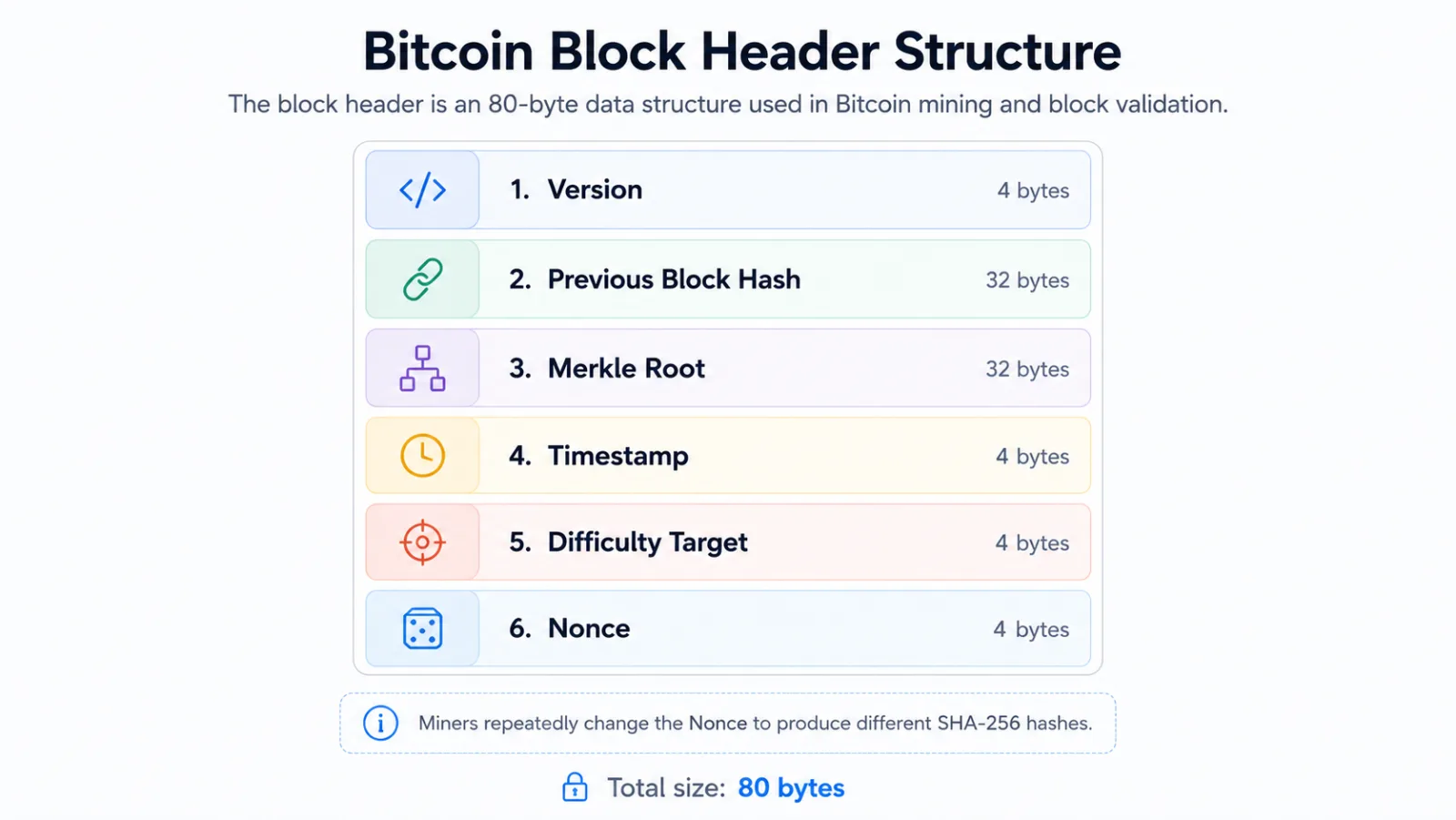
In the Bitcoin protocol, nonce is a 32-bit field in the block header. Miners continuously change the nonce and other mutable data, compute the block header hash, and search for a result that meets the current target — the most basic part of proof-of-work mining. Bitcoin developer documentation clearly defines nonce as a uint32_t field in the block header; miners change it to produce different block header hashes. The entire block header is 80 bytes long.
Nonce can also refer to Nonce, a management platform for Bitcoin mining farms and miner fleets. It is not a "mining program" that replaces ASICs in computing SHA-256 and searching for a valid block nonce. Instead, it sits above the miners as an operations layer — used to organize farms, discover miners, collect runtime data, view device status, and execute miner management tasks. Nonce's current onboarding flow includes creating a Workspace and Farm, installing the Nonce Agent, scanning the network to discover miners, and then viewing miner runtime data in the Farm.
Understanding these two meanings also explains the relationship between "why Bitcoin needs nonce" and "why modern mining farms need management software like Nonce."
What Is Nonce in Bitcoin?
From the protocol perspective, nonce is not mysterious. It is simply a numeric field in the Bitcoin block header that miners are allowed to change.
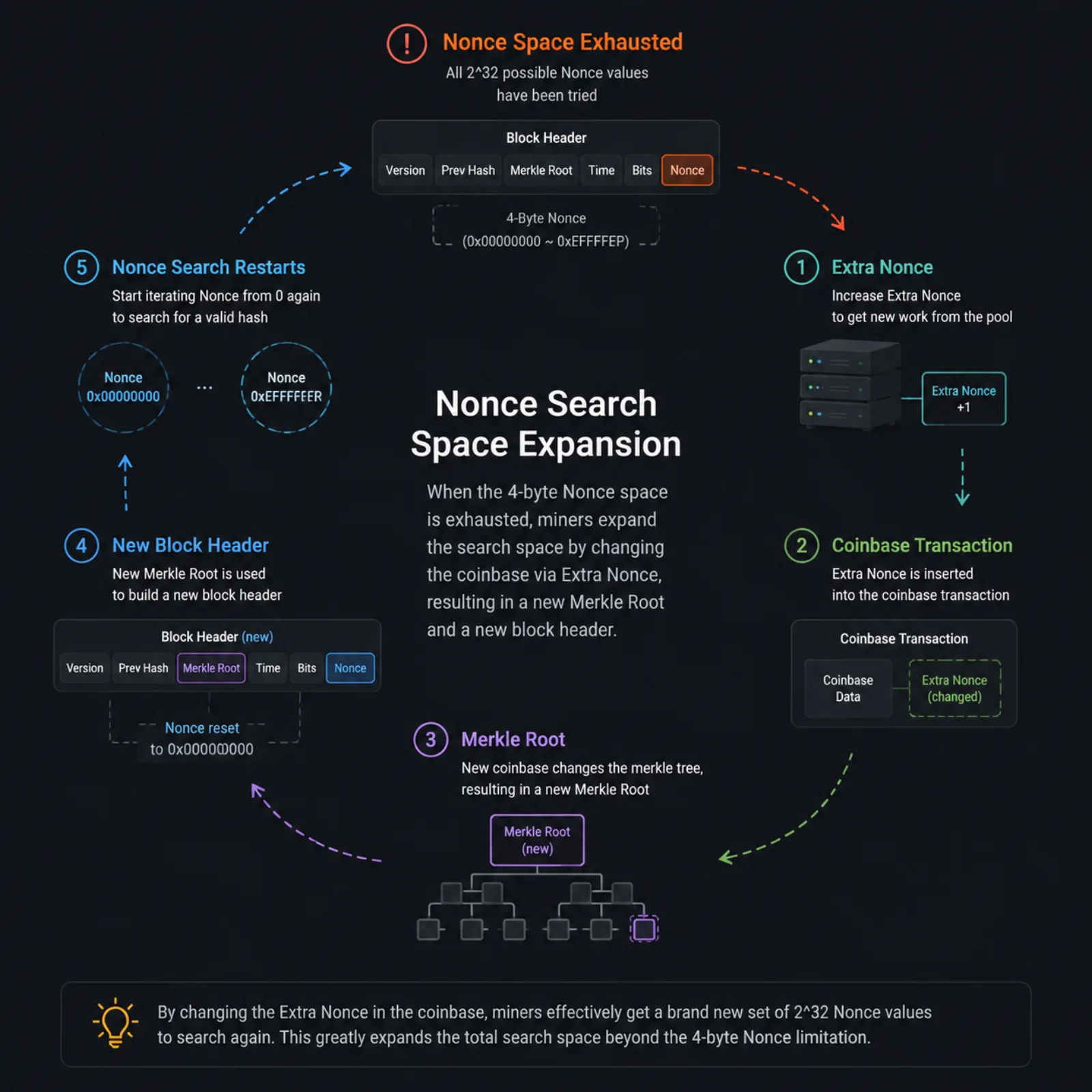
The Bitcoin block header consists of version, previous block hash, Merkle Root, time, nBits, and nonce, among other fields. Nonce occupies 4 bytes — 32 bits. When miners change the nonce, even if the transactions in the block barely change, the hash of the entire block header changes. Bitcoin developer reference documentation explains that when all 32-bit nonce values have been tried, miners can also modify the time, or modify the coinbase transaction and recompute the Merkle Root, to produce a new block header and continue searching.
| Block Header Field | Size | Relationship to Mining |
|---|---|---|
| Version | 4 bytes | Indicates block version |
| Previous Block Hash | 32 bytes | Links the current block to the previous block |
| Merkle Root | 32 bytes | Represents the transaction set in the current block |
| Time | 4 bytes | Block timestamp |
| nBits | 4 bytes | Encodes the current proof-of-work target |
| Nonce | 4 bytes | Miners can continuously change it to produce new hashes |
Because nonce is a uint32_t, there are theoretically 2³² — 4,294,967,296 possible values. That sounds like a lot, but for modern ASICs, this space is not as large as it might seem. So real-world Bitcoin mining does not simply loop from 0 to 4,294,967,295 and stop. Instead, it continuously creates new block header search spaces.
Why Do Miners Keep Changing the Nonce?
Bitcoin proof of work requires miners to find a block header hash that meets the target condition. You can think of it as a massive random search: prepare a candidate block header, compute its hash; if it does not meet the requirement, modify a mutable field and compute again.
Bitcoin's original white paper described this proof-of-work mechanism by continuously changing the nonce. Modern Bitcoin developer documentation further describes the actual mining flow: mining software constructs a candidate block and its 80-byte block header, passes the block header and target to the ASIC; the ASIC tries nonces and computes the corresponding hash. When a hash below the target is found, the result is returned to the mining software and eventually forms a candidate block submitted to the network.
Therefore, "finding a nonce" is often used as a colloquial way of saying "Bitcoin mining."
However, more accurately, miners are not really searching for a nonce with special meaning. They are searching for an input combination that makes the entire block header hash meet the proof-of-work target. Nonce is just one of the most convenient and most frequently changed fields.
This distinction matters.
If you simply think of mining as "guessing a correct number," you might mistakenly believe there is some mathematical shortcut that lets you calculate the correct nonce in advance. In reality, the output of a cryptographic hash function has near-random properties. Change a tiny part of the input, and the resulting hash can be completely different. The core work miners can do is to continuously generate candidate inputs and compute at high speed.
What Happens After the 32-Bit Nonce Is Exhausted?
This involves another concept often confused with nonce: extra nonce.
The nonce in the block header itself is only 32 bits, but additional variable data can be added to the coinbase transaction. When the coinbase transaction changes, its transaction hash changes; this in turn changes the Merkle Root; and because the Merkle Root is inside the block header, miners get a new block header and can rescan the entire nonce space.
Bitcoin's Mining Guide describes this process: if an ASIC tries all nonces for the current block header without finding a result that meets the target, mining software can modify the extra nonce in the coinbase, generate a new Merkle Root, and create a new block header to continue working.
The relationship can be simplified as: extra nonce changes → coinbase transaction changes → Merkle Root changes → block header changes → new hash search space.
This is also why modern Bitcoin mining cannot be understood as a finite game with only 2³² attempts. Real systems continuously update work content, coinbase, Merkle Root, time, and other fields so miners can keep performing massive hash computations.
From One Nonce to an Entire Farm: Where Does Mining Get Complex?
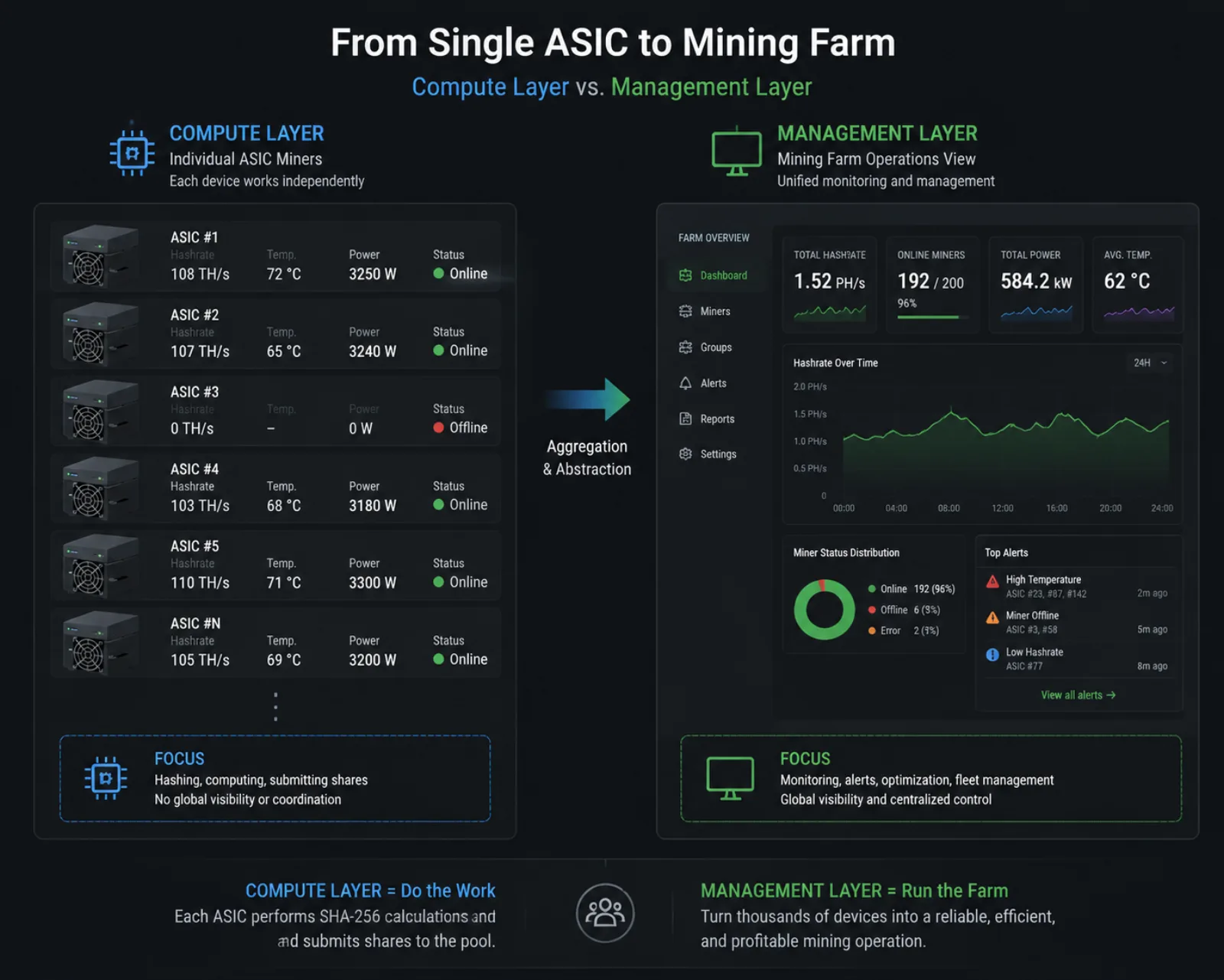
After understanding the protocol, a more practical question arises: if the core of mining is just ASICs continuously computing SHA-256, why do large mining farms need dedicated miner management software? Because "performing hash computation" and "operating an efficiently running farm" are two different things.
A single ASIC's core task is relatively straightforward: receive work, compute hashes, submit results. But when device count grows from a few units to hundreds, thousands, or even across multiple farms, the operations team's problems quickly shift from "is this miner working?" to "is the entire miner fleet working as expected?"
For example, a miner may be online but outputting low hashrate; it may be connected to a pool but configured to the wrong pool account; it may enter an abnormal state due to temperature; it may need a reboot; it may need a power mode change; a batch of devices may need unified pool configuration changes or firmware upgrades.
The larger the fleet, the harder it becomes to log into each device's backend one by one for inspection and changes.
This is why "miner management software" exists: ASICs produce hashes; management software makes large numbers of ASICs run as an observable, manageable miner fleet.
Nonce's official documentation currently shows that the Nonce Agent connects to identified miners by default and periodically collects performance, status, and other data, sending it to the platform for viewing miner health. The default data collection interval is 5 minutes. The Agent can also scan specified IP ranges to discover devices.
How Does Nonce Farm Management Software Relate to the Bitcoin Nonce?
They are not the same thing at the same technical level, but they sit at opposite ends of the Bitcoin mining stack.
| Concept | Layer | Primary Role | Who Handles It |
|---|---|---|---|
| Bitcoin nonce | Bitcoin protocol / proof of work | Change block header input to find a hash that meets the target | ASIC, mining software |
| Extra nonce | Mining work construction | Extend the searchable work space | Mining pool, mining software |
| Miner firmware | Miner device layer | Control ASIC, power, fans, and operating modes | Miner |
| Mining pool | Mining coordination layer | Distribute work and receive miner submissions | Mining pool |
| Nonce management platform | Farm operations layer | Discover, monitor, and manage miner fleets | Farm operations team |
So the Nonce management platform does not "compute nonce" for miners. SHA-256 hash computation is still performed by ASICs.
What Nonce handles is a higher-level problem: which miners are working, which devices are abnormal, what the current device configuration is, whether batch operations need to be executed, and how to track execution results.
For example, Nonce's current API documentation includes miner tasks such as device reboot, log retrieval, indicator light control, power mode changes, pool changes, firmware updates, and other operations — recording task status from creation, queuing, and execution through success, failure, or timeout. Official operations documentation also provides miner maintenance workflows such as batch firmware upgrades.
This actually represents an abstraction upgrade in the Bitcoin mining industry: early discussions focused more on "how to find a valid nonce," while scaled farms must also solve "how to keep tens of thousands of devices continuously searching for nonce running stably."
Why Does Farm Management Increasingly Resemble "Managing Compute Infrastructure"?
With only one miner, finding an anomaly might just mean glancing at the machine's backend. With 10,000 miners, "taking a glance" is no longer a viable management approach.
Large farms are closer to data centers or compute infrastructure: each ASIC is a production unit that continuously consumes power and produces hashrate. What operators really care about is fleet status — uptime, actual hashrate, temperature, power consumption, device anomalies, pool configuration, firmware status, and operation records.
At this point, the basic unit of management changes. The traditional approach asks: "What's wrong with the machine at 192.168.1.87?" Fleet management asks: "Which devices show the same problem? Are they concentrated in a specific area? How much hashrate is affected? What operation should be executed? Did it recover after execution?"
Nonce's current documentation reflects this management approach through objects such as Farm, Miner, Agent, and Task. For example, the official API can return real-time miner status including hashrate, power consumption, temperature, mining status, hardware information, and error information; the task system records operations executed on miners and their results.
"Nonce Bitcoin Mining" Connects Two Eras of Questions
From the protocol perspective, nonce is one of the most classic variables in Bitcoin proof of work. Miners continuously change block header inputs and perform hash computation until they get a result that meets the target. Without this proof-of-work process, there would be no Bitcoin mining as we know it today.
But from a farm operations perspective, what really needs to be managed is no longer just "finding nonce." Farms need to manage hundreds or thousands of machines continuously participating in this hash search: whether they are online, whether hashrate is normal, whether temperature is abnormal, whether the pool is correct, whether firmware is consistent, who executed a given operation, whether it succeeded, and whether affected devices can be quickly identified after a failure.
So you can distinguish the two Nonces in one sentence: the nonce in the Bitcoin protocol is the block header field miners continuously change to find valid proof of work; Nonce farm management software helps operations teams manage the miners that are continuously performing hash computation.
The former belongs to Bitcoin's consensus mechanism; the latter belongs to mining infrastructure operations.
When there is only one ASIC, what people most easily see is "the miner is searching for nonce." When miners become a vast fleet spanning racks and farms, the more important question becomes: how to ensure every machine searching for nonce is in a visible, controllable, and traceable operating state. That is the most natural connection from Bitcoin nonce to Nonce farm management software.