What's the Difference Between Nonce and Nonce.app? From a Bitcoin Tech Concept to a Farm Management Platform
In Bitcoin, a Nonce is a block-header field used for Proof-of-Work hash search; Nonce.app is an ASIC farm management platform for monitoring, filtering, bulk ops, and automation—same name, different layers of compute versus operations.
When searching for "Nonce," users easily encounter two completely different explanations: one is the nonce in Bitcoin's Proof-of-Work mechanism—a technical field in the block header that miners keep changing while computing new hashes; the other is Nonce.app, a management platform for Bitcoin farms and ASIC fleets used to monitor miner status, discover anomalies, run bulk operations, and automate ops.
So although both use the same name, they sit at completely different layers. The Bitcoin nonce belongs to the mining computation process, while Nonce.app belongs to farm operations management. One solves "how to find a block hash that meets the difficulty target"; the other solves "how to keep the large number of miners running those hash computations stable and efficient." Understanding that also explains why the technical concept Nonce became the name of a Bitcoin farm management platform.
What Is a Nonce in Bitcoin?
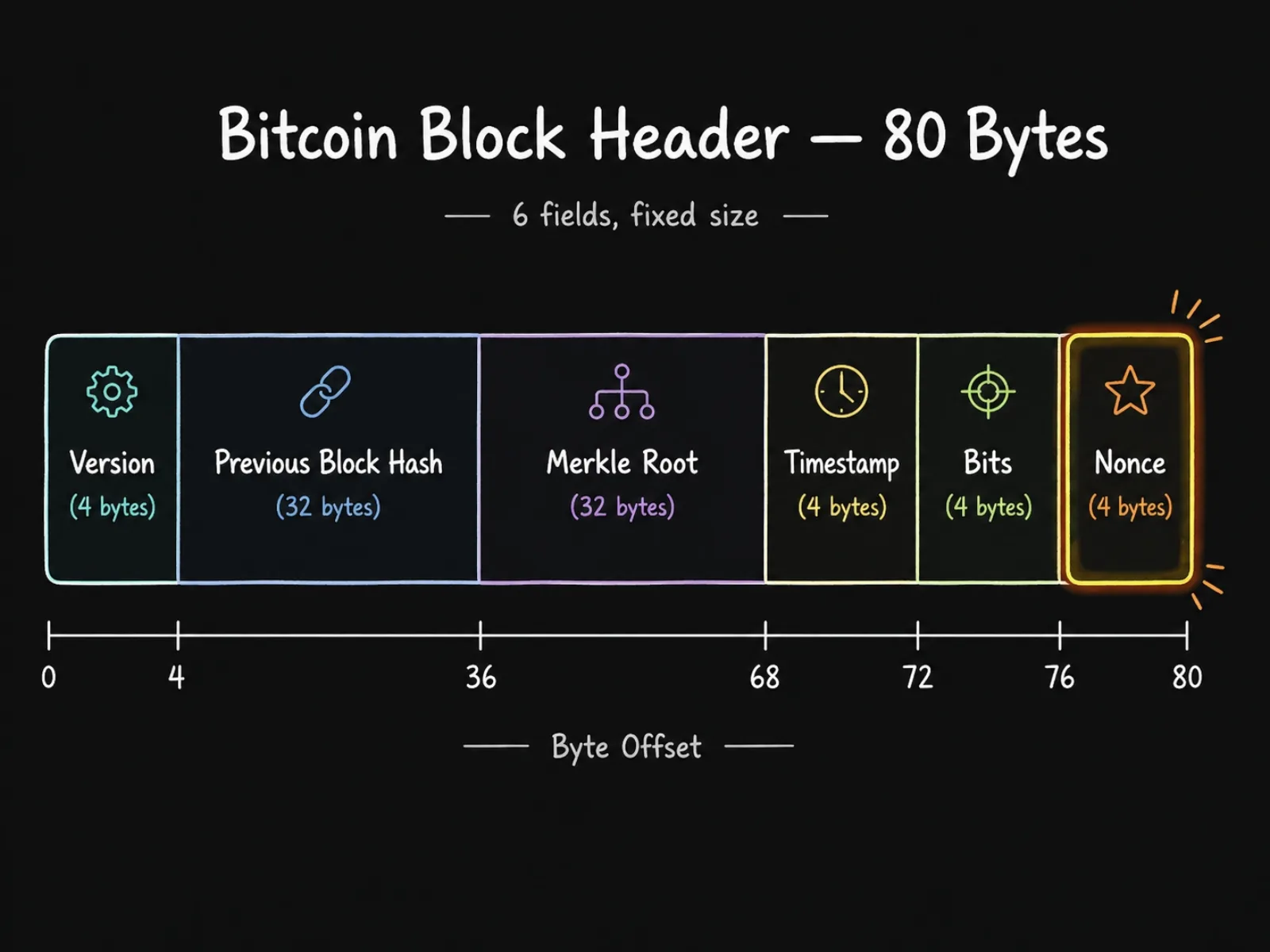
In the Bitcoin protocol, a nonce is part of the block header. A Bitcoin block header is 80 bytes total and includes version, previous block hash, Merkle Root, timestamp, difficulty target, and nonce. The Bitcoin Developer Reference definition of the header structure shows the nonce field is 4 bytes, a 32-bit unsigned integer that miners can modify so the header produces different hashes while trying to find a valid hash less than or equal to the current target.
| Block Header Field | Size | Primary Role |
|---|---|---|
| Version | 4 bytes | Indicates validation rules used by the block |
| Previous block hash | 32 bytes | Connects the current block to the previous block |
| Merkle Root | 32 bytes | Summarizes transaction data in the block |
| Timestamp | 4 bytes | Records the approximate time the miner began computing the header |
| Difficulty target | 4 bytes | Encodes the target the current block hash must meet |
| Nonce | 4 bytes | Value miners keep changing to produce new header hashes |
That is also why nonce is often explained as the "random number" in Bitcoin mining. Strictly speaking, it is more accurate to understand it as a "numeric field that can be continually tried and modified." Miners are not searching for a pre-existing mysterious answer—they keep changing input data, run SHA-256 hash computation, then check whether the result meets network requirements.
The Bitcoin white paper describes this directly in the Proof-of-Work section: by continually changing the nonce in the block until a hash that meets the Proof-of-Work requirement is obtained. In other words, the value of a nonce is not the number itself, but that it lets miners keep creating new block-header inputs and repeatedly attempt hashes.
Why Do ASIC Miners Keep Searching for a Nonce?
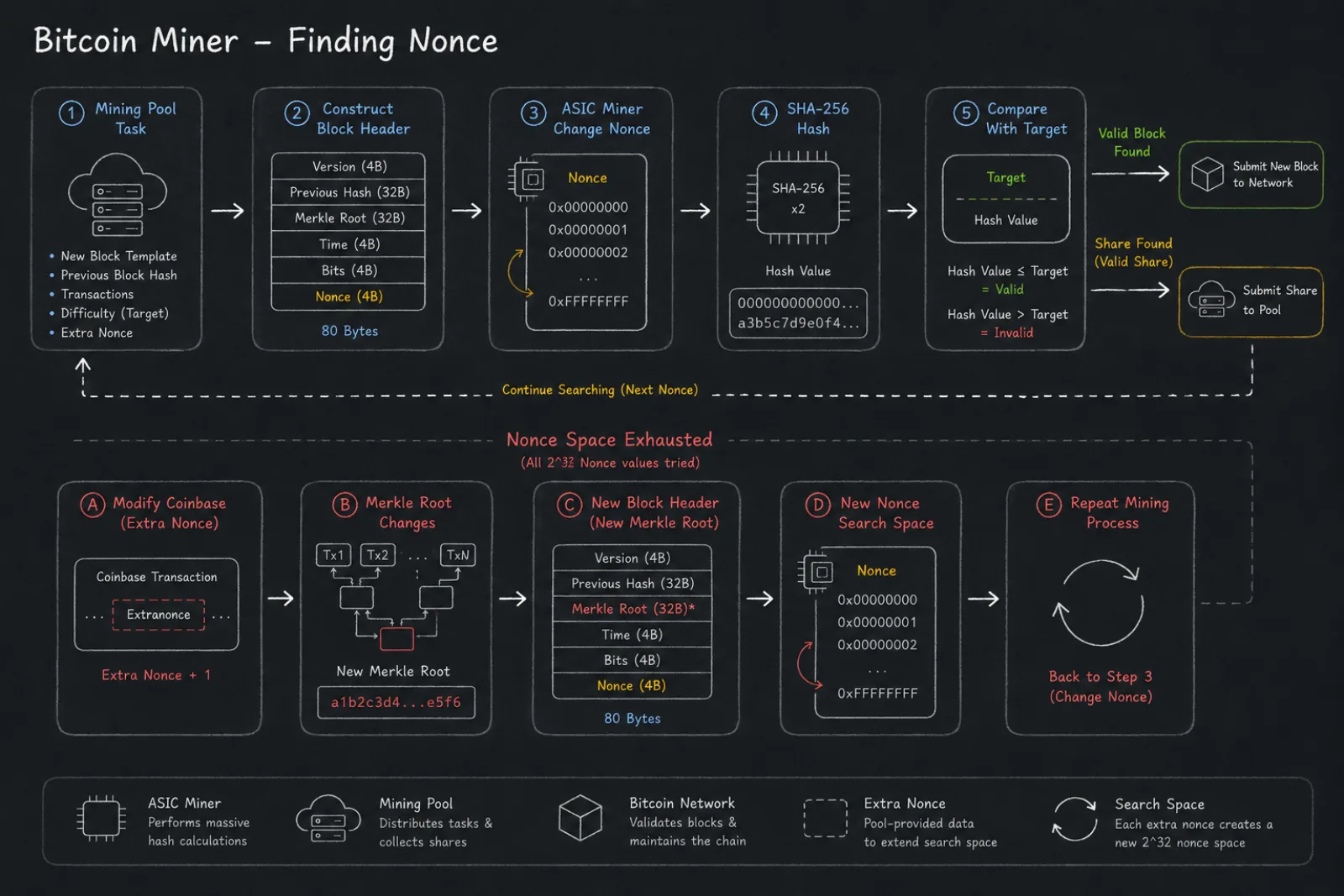
Bitcoin mining is essentially a large-scale hash search. After a pool or mining program prepares candidate block data, it constructs a block header and hands related work to the ASIC. The miner keeps changing the nonce, computes the corresponding header hash, and checks whether the result meets the target.
The Bitcoin Developer Guide describes this process more specifically: mining software constructs the block and the 80-byte header, then sends the header and target to ASIC mining hardware; the hardware traverses possible header nonce values and computes corresponding hashes; if no result meets the target, mining software can change extra-nonce data in the coinbase transaction to generate a new Merkle Root, construct a new header, and continue the next search round.
This also clarifies a common misconception: ASICs do not simply finish one 32-bit nonce space and stop. After the nonce range for the current header is searched, mining software can also modify extra nonce in the coinbase transaction, update time, and more. As long as the Merkle Root or other valid header fields change, a new header is formed—and therefore a new hash search space. The Bitcoin Developer Reference likewise notes that if all 32-bit nonce values have been tested, time can be updated, or the coinbase transaction modified and the Merkle Root recomputed.
So real Bitcoin mining is not as simple as "guessing a number"—ASIC chips continually run header hash computation at extremely high speed. Higher miner hashrate means more hashes attempted per unit time, and—other conditions equal—stronger ability to contribute effective work to the pool.
In pool mining, large numbers of hash results may not meet Bitcoin's true block-finding target, yet may meet a lower difficulty target set by the pool. Such results are usually submitted as Shares to prove the miner contributed compute work, and the pool then allocates rewards under its settlement mechanism.
What Is Nonce.app? It Does Not Search for the Block Nonce
Nonce.app is a management platform for Bitcoin farms and ASIC fleets. It does not replace miner chips trying block-header nonces one by one, and it is not part of Bitcoin's consensus protocol. What it manages are the physical devices that perform mining computation and the runtime data those devices produce, so farm operators can see hashrate, device status, efficiency, and anomalies from a higher management layer, and run unified ops on large fleets. Nonce's product positioning also centers on farm metric monitoring, asset management, and automation strategies.
For example, an ASIC may be searching nonces at high speed inside, but farm managers usually care less about which nonce a miner tried in a given second than whether the machine is online now, whether actual hashrate is normal, whether temperature is abnormal, whether efficiency changed, whether it is connected to the correct pool, and how to recover after a fault.
In Nonce's farm overview, you can centrally view farm hashrate, miner status, efficiency, revenue estimates, and related runtime info; as farms grow from dozens of miners to hundreds or more, that unified view becomes more valuable, because ops shifts from "operating one miner" to "identifying which devices in the whole fleet are reducing effective hashrate."
Nonce's abnormal miner filters can also locate abnormal devices by miner status, temperature, hashrate, and combined conditions—including overheating, zero-hashrate, low-hashrate, and offline miners. After finding abnormal devices, ops enters the corresponding handling flow. For farms of many ASICs, that is already a completely different management method from logging into IP addresses one by one.
One Table to See the Difference Between Nonce and Nonce.app
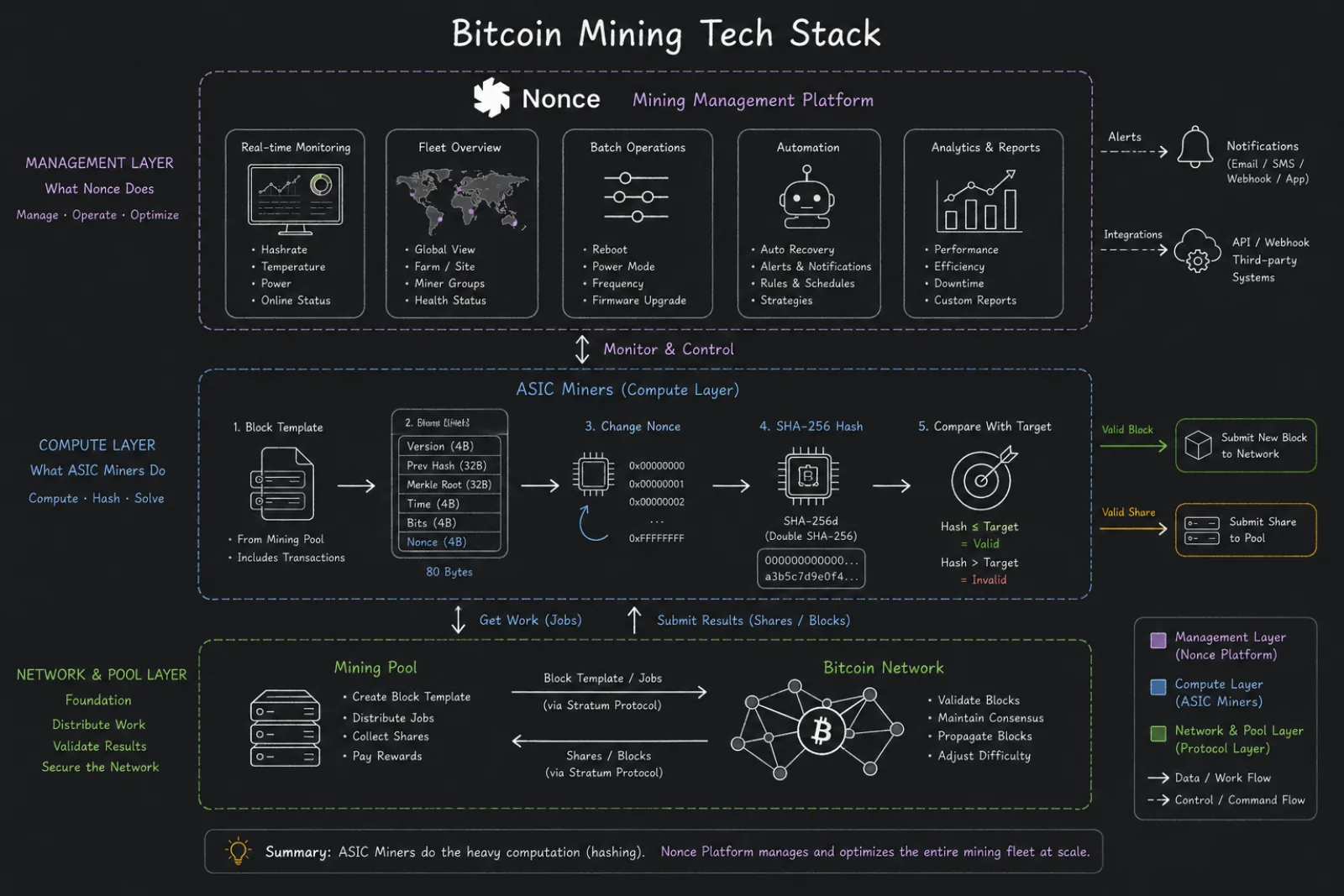
If you split the Bitcoin mining system into layers, nonce sits in the lowest computation logic, while Nonce.app sits in upper farm operations management. The core differences can be summarized as:
| Comparison Dimension | Nonce in Bitcoin | Nonce.app |
|---|---|---|
| Nature | Bitcoin block-header field | Bitcoin farm management platform |
| Layer | Proof of Work and hash computation | Farm operations and device management |
| Primary object | Block-header data | ASIC miners, farms, and runtime data |
| Who uses it | Mining programs and ASIC hardware | Farm operators and ops teams |
| Core role | Change header input to produce new hash results | Monitor, filter, bulk-manage, and automate farm ops |
| Participates in Bitcoin consensus? | Yes—nonce is part of the block header | No—it is farm ops infrastructure |
| Directly produces hashrate? | Nonce itself does not produce hashrate, but ASICs run hash search around the header | Does not execute SHA-256 hash computation on ASIC chips |
| Relationship to pools | One of the data items miners use when executing pool work | Helps operators manage miners and their runtime status |
| Typical question | "How do we find a block hash that meets the target?" | "Which miners are offline, low-hashrate, or need bulk handling?" |
This table also reveals an important relationship: Nonce.app is not unrelated to the technical concept nonce. On the contrary, the two have a clear upstream-downstream link. ASICs in a farm are constantly running hash computation centered on nonce search, while the farm management platform ensures those compute devices keep running as stably as possible.
From Searching for a Nonce to Managing Thousands of ASICs, the Mining Problem Has Changed
At the Bitcoin network layer, miners face a probability problem: how to make more effective hash attempts and earn more work share and block chances in network competition.
At the farm ops layer, the problem becomes devices and efficiency. Suppose a farm has a large ASIC fleet where some miners underclock from overheating, some show low hashrate, some go offline due to network issues, and a few have abnormal software—then theoretical installed hashrate is not equal to effective hashrate continually contributed to the pool.
At that point, discussing how many nonces an ASIC tries per second does not directly solve ops problems. What farms truly need is: how to discover abnormal devices quickly, how to judge impact scope, how to filter the same batch of faulty machines, how to reduce manual per-IP logins, and how to auto-execute recovery when conditions are met.
Nonce's farm operations flow is built around "discover abnormal miners — filter devices — execute actions — track results," and supports bulk operations plus automatic operating-mode adjustment based on conditions such as temperature. For some temporary software-level anomalies, bulk miner reboot can also handle multiple devices uniformly without entering each miner backend one by one.
So modern Bitcoin mining actually has two different problems at once: the compute layer needs to keep searching for new nonces and valid hashes; the ops layer needs to minimize the time miners stop doing that computation.
Why Is the Farm Management Platform Also Called Nonce?
From Bitcoin's technical semantics, Nonce is a highly representative mining word. The core purpose of a miner is to keep running Proof-of-Work computation; and in classic Bitcoin mining explanations, "keep changing the nonce, compute a new hash, check whether it meets the target" is almost the most intuitive entry to understanding mining.
Nonce.app using Nonce as a brand name can also be understood from this relationship: the technical nonce is one of the objects ASICs continually compute against, while the management-layer Nonce focuses on the miner fleets that run those compute tasks.
They are not the same thing, yet belong to the same mining chain. Pools provide miners with new mining work; mining programs and firmware construct required data; ASIC chips continually run SHA-256 hash operations and search for qualifying results; at a higher layer, the farm management system continually watches whether miners are online, hashrate is normal, devices are overheating, and how to bulk-handle anomalies after they appear. The Bitcoin Developer Guide describes the first half of the compute process, while Nonce manages the second half—large-scale device operations.
That is also the simplest way to understand Nonce versus Nonce.app: the former is how Bitcoin is mined; the latter is how farms manage mining devices.
From a 4-Byte Field to a Whole Farm Operations System
In the Bitcoin protocol, a Nonce is only a 4-byte field in an 80-byte block header, but the high-speed hash computation around that field ultimately produced today's large ASIC mining industry. After miners grew from early small-scale devices into professional farms with large ASIC fleets, Bitcoin mining's problems expanded from simply "compute more hashes" into power, cooling, network, device health, firmware, pool connection, uptime, and automated ops.
So when searching "what is a Nonce," you first need to judge which layer is being discussed.
If the discussion is the Bitcoin protocol, Nonce means the nonce field in the block header: miners continually modify it and other mutable data, generate different header hashes, and search for results that meet the Proof-of-Work target.
If the discussion is Nonce.app, it means a management platform for ASIC farms whose goal is not to replace miners searching for some correct nonce, but to make the miners that run those computations easier to monitor continuously, manage uniformly, and operate with automation.
From that angle, one Nonce belongs to the Bitcoin block header, and the other belongs to Bitcoin farm operations; one happens in the massive hash attempts ASICs make every second, and the other happens in the device, hashrate, and ops decisions farm managers face every day. Same name, completely different problems—yet they ultimately connect to the same thing: keeping Bitcoin mining happening continuously.