Can the S19 Still Mine? How to Calculate the 2026 Electricity Cost Line and Shutdown Price for Older Miners
In 2026, whether an S19 can still mine depends not on its age or depreciation but on whether daily revenue covers electricity, pool fees, and operating costs. Efficiency varies widely across the S19 95T, S19 Pro, and S19K Pro, so the shutdown price must be calculated per model, power draw, Hashprice, and all-in electricity price.
In 2026, the Antminer S19 is no longer the most energy-efficient Bitcoin miner on the market, but that does not mean every S19 should be shut down immediately.
Whether an older miner can still mine depends not on how many years ago it was released, nor on whether the equipment has already been fully depreciated, but on whether the mining revenue it generates each day can still cover electricity costs, pool fees, and routine operating expenses.
Even within the same S19 family, the power efficiency of the early S19 95T, the S19 Pro 110T, the S19j Pro, and the S19K Pro varies widely. At the same electricity price, some models may already be running at a loss while others can still operate. For this reason, "Can the S19 still mine?" cannot be answered with a single blanket response; it must be calculated based on the specific model, actual power draw, Hashprice, and the mine's all-in electricity price.
What Types Are There in the S19 Family
Many miners are used to referring to all S19-series equipment simply as "the S19," but the profitability of different models is not the same.
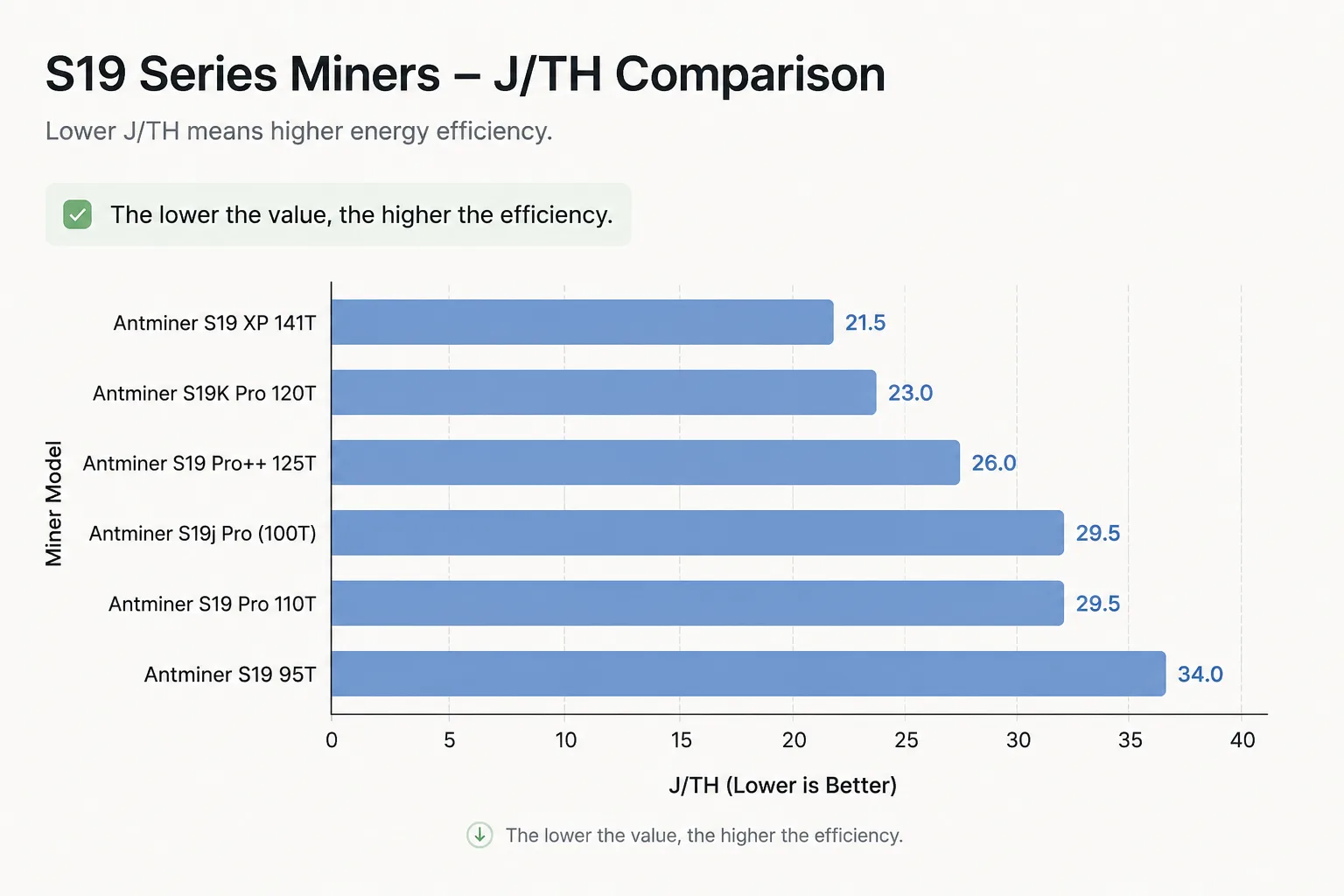
| Model | Rated Hashrate | Rated Power | Rated Efficiency | 2026 Operating Characteristics |
|---|---|---|---|---|
| Antminer S19 95T | 95 TH/s | 3250W | About 34 J/TH | Most sensitive to electricity price; more dependent on extremely low power costs |
| Antminer S19 Pro 110T | 110 TH/s | 3250W | 29.5 J/TH | Can still run at low electricity prices, but with thin profit margins |
| Antminer S19j Pro | 92–104 TH/s | About 2714–3068W | About 29.5 J/TH | Well suited to underclocking optimization and running existing fleets |
| Antminer S19K Pro 120T | 120 TH/s | 2760W | 23 J/TH | Still fairly competitive within the S19 family |
| Antminer S19 Pro++ 125T | 125 TH/s | 3250W | 26 J/TH | Better efficiency than the early S19 Pro |
| Antminer S19 XP 141T | About 141 TH/s | About 3010W | About 21.5 J/TH | Closer to the newer generation of high-efficiency miners |
The lower the J/TH, the less electricity a miner needs to produce the same hashrate, and the higher the electricity price it can withstand. Although the S19 95T and the S19K Pro belong to the same product family, they cannot use the same shutdown electricity price.
What Does the S19 Electricity Cost Line Mean
The S19 electricity cost line can be understood as the highest electricity price at which a miner's daily mining revenue exactly covers its electricity cost. If the mine's electricity price is below this line, the miner can at least cover its own electricity cost; if the price is above this line, the longer the equipment stays on, the greater the electricity loss.
But miners also need to distinguish between two kinds of cost lines.
The first is the theoretical electricity cost line, which counts only the miner's revenue and the miner's own power consumption. This method is suitable for quickly judging whether a piece of equipment has already lost its most basic operating value.
The second is the all-in shutdown price, which also deducts pool fees, maintenance fees, hosting fees, labor, and the power consumed by fans and cooling. The all-in shutdown price is usually lower than the theoretical electricity cost line and is closer to a mine's real operating situation.
Therefore, even if the theoretical electricity line for an S19 Pro is $0.043/kWh, that does not mean the mine is still profitable at an electricity price of $0.043. After deducting other expenses, the real shutdown price may be only $0.038 to $0.041/kWh.
How Much Does an S19 Pro Spend on Electricity per Year at Different Power Prices
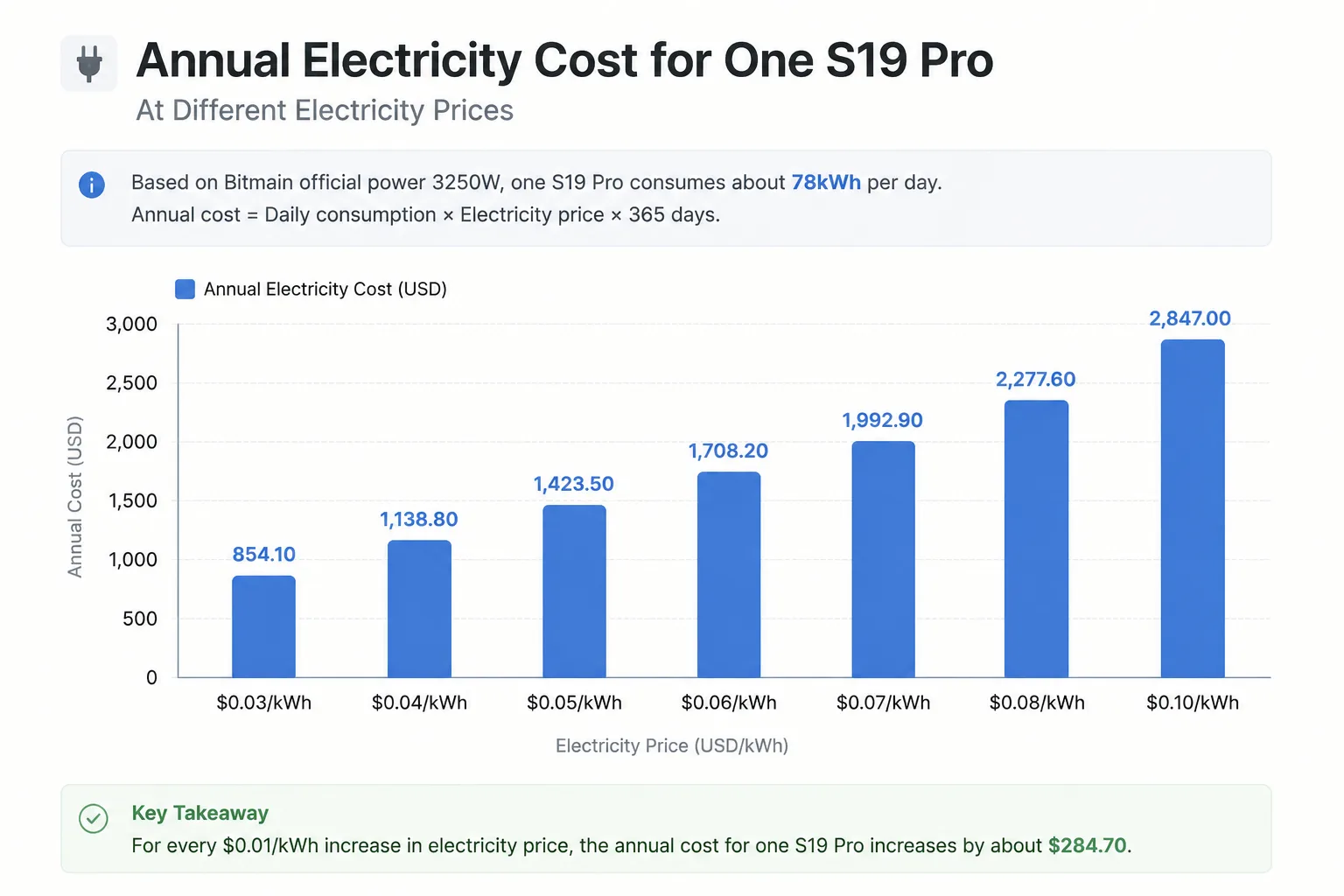
Based on Bitmain's official rated power of 3250W, an S19 Pro consumes about 78kWh per day.
| Electricity Price | Daily Electricity Cost | Monthly Electricity Cost | Annual Electricity Cost |
|---|---|---|---|
| $0.03/kWh | $2.34 | $70.20 | $854.10 |
| $0.04/kWh | $3.12 | $93.60 | $1,138.80 |
| $0.05/kWh | $3.90 | $117.00 | $1,423.50 |
| $0.06/kWh | $4.68 | $140.40 | $1,708.20 |
| $0.07/kWh | $5.46 | $163.80 | $1,992.90 |
| $0.08/kWh | $6.24 | $187.20 | $2,277.60 |
| $0.10/kWh | $7.80 | $234.00 | $2,847.00 |
For every $0.01/kWh increase in the electricity price of an S19 Pro, the annual electricity cost rises by about $284.70. If a mine runs 1,000 S19 Pro units, every 1-cent increase in the electricity price adds roughly $284,700 in electricity costs over the full year. For older miners whose profit margins are already thin, a 1-cent difference in electricity price is enough to change the entire mine's profit-and-loss outcome.
How the S19 Pro Performs at Different Electricity Prices in 2026
The following uses $30.37/PH/s/day as the modeling scenario, sets the pool fee at 2%, and does not account for repair, labor, or hosting costs.
| All-in Electricity Price | Daily Gross Revenue | Daily Electricity Cost | Daily Profit After Pool Fee | Annualized Profit | Result |
|---|---|---|---|---|---|
| $0.03/kWh | $3.34 | $2.34 | $0.93 | $340.87 | Can operate |
| $0.04/kWh | $3.34 | $3.12 | $0.15 | $56.17 | Near break-even |
| $0.05/kWh | $3.34 | $3.90 | -$0.63 | -$228.53 | Loss |
| $0.06/kWh | $3.34 | $4.68 | -$1.41 | -$513.23 | Loss |
| $0.07/kWh | $3.34 | $5.46 | -$2.19 | -$797.93 | Loss |
| $0.08/kWh | $3.34 | $6.24 | -$2.97 | -$1,082.63 | Loss |
| $0.10/kWh | $3.34 | $7.80 | -$4.53 | -$1,652.03 | Severe loss |
This set of data shows that, under this Hashprice scenario, the S19 Pro can retain only a small profit when the all-in electricity price is close to or below $0.04/kWh. But $0.04/kWh is not a safe electricity price, because the table does not yet include repair, labor, hosting, and infrastructure power consumption. Once a unit experiences a hashboard failure, frequent disconnections, or high-temperature throttling, the thin annual profit can easily be entirely wiped out. Therefore, for the S19 Pro there is still some operating room around $0.03/kWh, $0.04/kWh is already close to the real shutdown line, and above $0.05/kWh it is usually very difficult to stay profitable in standard mode.
The conclusion here corresponds only to the Hashprice scenario above. When Hashprice rises, the cost line moves up; when Hashprice falls, the cost line continues to move down as well.
How Much Electricity Price Can Different S19 Models Withstand
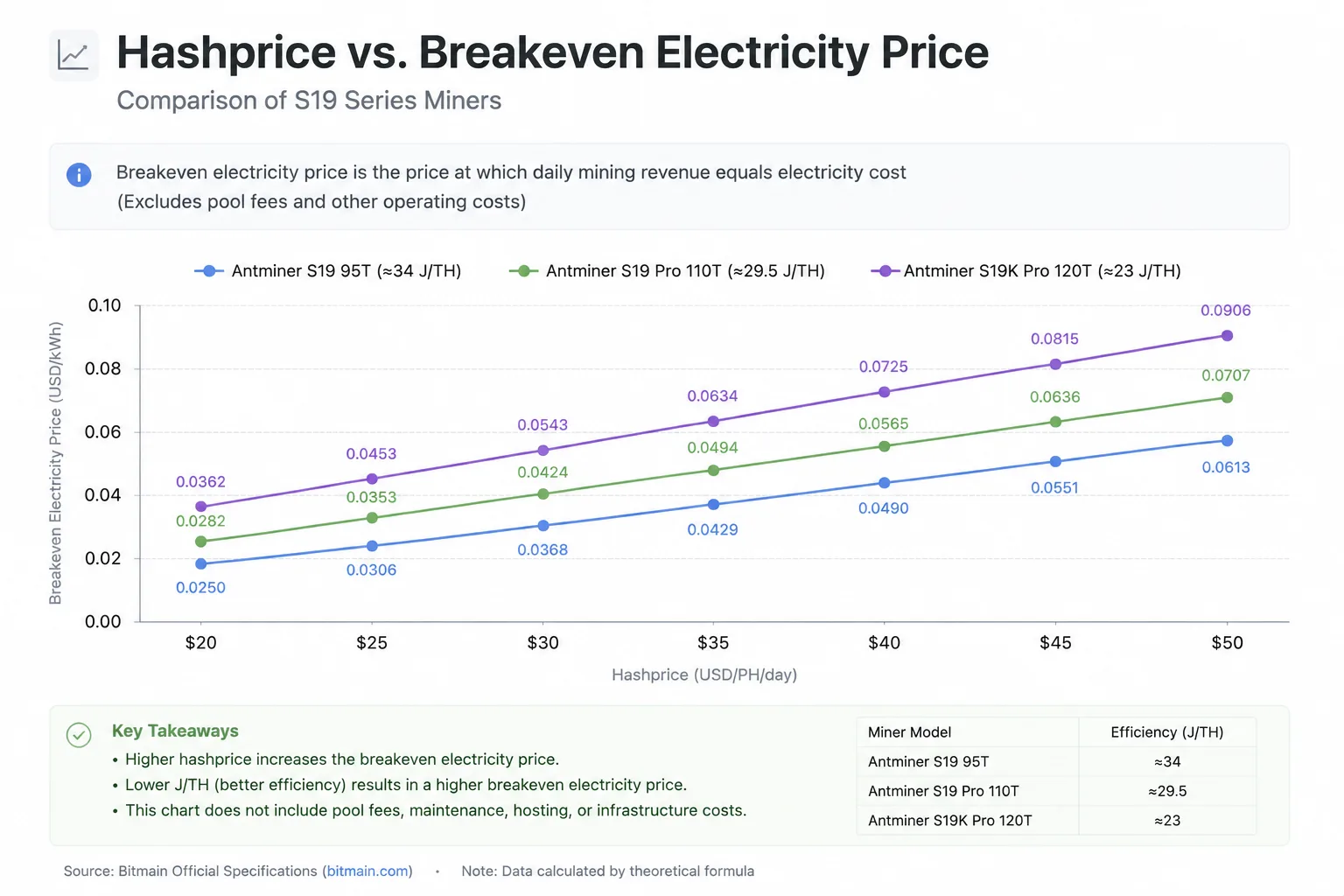
The following uses different Hashprice scenarios to compare the theoretical break-even electricity price of several S19 models. The table does not deduct pool fees or other operating costs, so it can only serve as a theoretical ceiling.
| Hashprice | S19 95T | S19 Pro | S19 Pro++ | S19K Pro |
|---|---|---|---|---|
| $25/PH/s/day | $0.0306 | $0.0353 | $0.0401 | $0.0453 |
| $30/PH/s/day | $0.0368 | $0.0424 | $0.0481 | $0.0543 |
| $35/PH/s/day | $0.0429 | $0.0494 | $0.0561 | $0.0634 |
| $40/PH/s/day | $0.0490 | $0.0565 | $0.0641 | $0.0725 |
| $45/PH/s/day | $0.0551 | $0.0636 | $0.0721 | $0.0815 |
Taking a Hashprice of about $30/PH/s/day as an example:
- The theoretical electricity line for the S19 95T is about $0.037/kWh;
- The S19 Pro is about $0.042/kWh;
- The S19 Pro++ is about $0.048/kWh;
- The S19K Pro is about $0.054/kWh.
This means that in a mine with $0.05/kWh electricity, the early S19 and the S19 Pro are already hard-pressed to be profitable, the S19 Pro++ is near its cost line, and the S19K Pro may still retain some room. A single mine should not set the same start/stop rules for all S19 units. A more reasonable approach is to group equipment by actual J/TH, giving priority power to the more efficient units.
When an S19 Is Unprofitable, Should You Underclock, Repair, or Shut Down
When an older miner approaches its cost line, it does not necessarily have to be retired immediately. A mine can compare options such as standard operation, underclocking, dynamic start/stop, repair, migration, and equipment replacement.
| Actual Situation | Course of Action |
|---|---|
| Actual J/TH is normal, electricity price is clearly below the shutdown line | Keep running in standard mode |
| Electricity price is near the shutdown line, and efficiency improves markedly after underclocking | Run underclocked |
| Electricity price swings significantly over time | Start and stop dynamically based on electricity price |
| A single hashboard has failed, with a short repair payback period | Repair and continue running |
| Electricity price is too high, but a low-price site is stable and reliable | Evaluate migration |
| Repair cost approaches the equipment's residual value | Sell, part out, or retire |
| Electricity savings from new miners can quickly cover the upgrade cost | Replace with high-efficiency equipment |
| Electricity price is already above the gross-revenue cost line | Shut down directly |
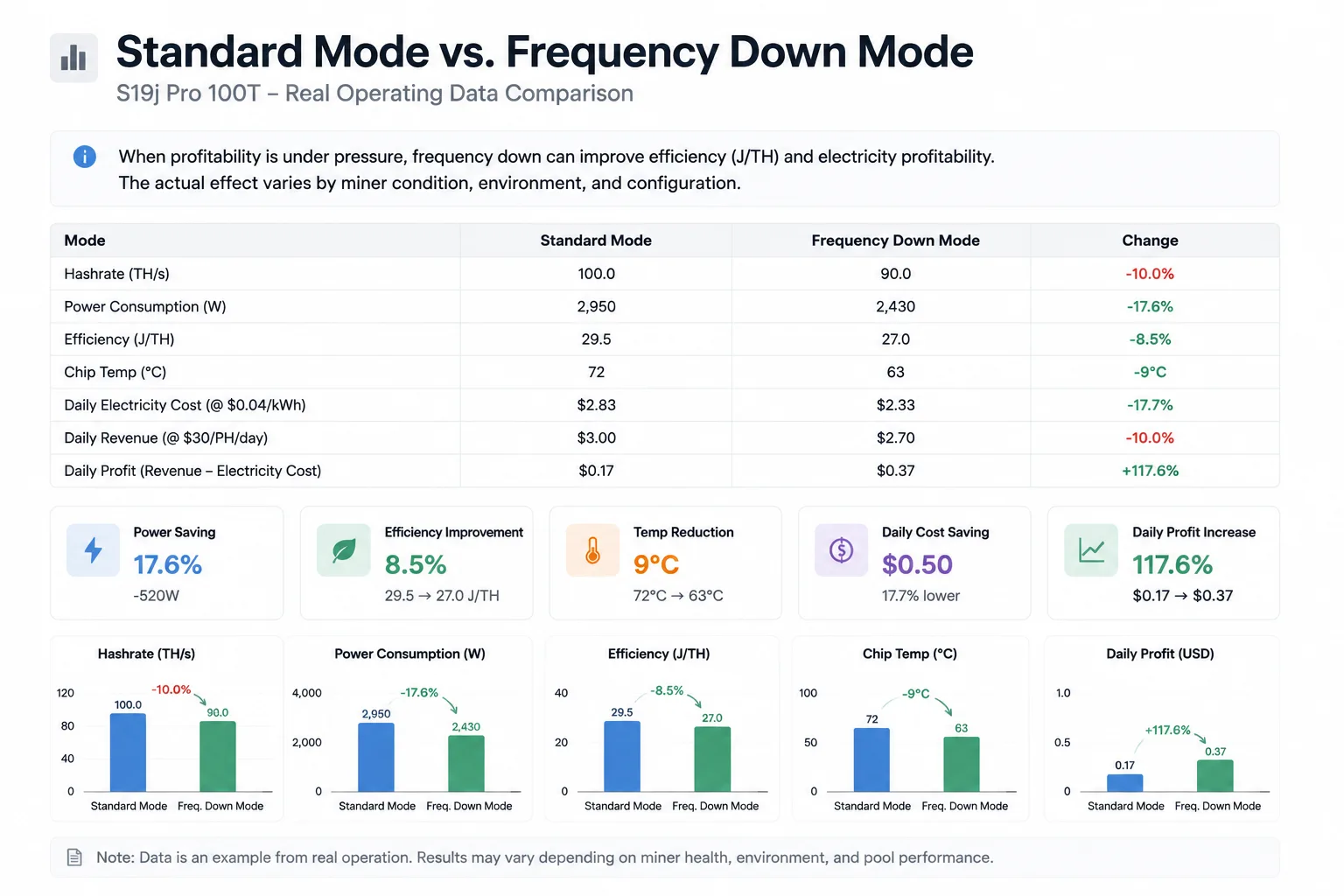
Whether underclocking is effective depends not on whether power consumption drops, but on whether the percentage drop in power is greater than the percentage drop in hashrate. For example, when an S19j Pro is reduced from 100 TH/s, 2950W to 90 TH/s, 2430W, hashrate drops 10% and power drops about 17.6%, and actual efficiency improves from 29.5 J/TH to 27 J/TH. At that point the equipment's absolute revenue decreases, but in a low-Hashprice environment its electricity profit may actually increase. However, because chip quality, power-supply condition, and cooling environment differ between miners, underclocking results cannot rely on theoretical values or manufacturer claims and must be verified with real operating data.
How to Manage a Fleet of S19s
For a mine with hundreds or thousands of S19s, the real difficulty is not calculating the shutdown price of a single miner, but continuously identifying which units are still profitable and which have crossed the cost line because of high temperature, low hashrate, or abnormal power draw.
At a minimum, a mine needs to continuously monitor actual effective hashrate, per-unit power consumption, actual J/TH, high-temperature miners, low-hashrate miners, offline miners, uptime, energy cost per coin, the profit-and-loss status of each unit, and the new shutdown threshold after Hashprice changes.
A more reasonable management approach is to group equipment by actual efficiency. For example, divide the S19 Pro into four groups: below 30 J/TH, 30 to 32 J/TH, 32 to 35 J/TH, and above 35 J/TH.
When Hashprice falls or electricity prices rise, shut down the least efficient group first; when market conditions improve, gradually bring units back online starting with the most efficient. This is more precise than simply shutting down an entire model, and it lets limited power be allocated first to the equipment that generates more revenue.
With a mine management platform like Nonce, operators can view high-temperature, low-hashrate, and offline miners in one place, filter abnormal equipment in bulk, and adjust operating strategies using power modes or automation rules. For an S19 whose profit margin is already thin, promptly detecting a unit degrading from 29.5 J/TH to 34 J/TH is often more important than simply chasing total mine hashrate.
Can the S19 Still Mine at All in 2026
The S19 can still mine in 2026, but the survival space of different models has clearly diverged. The S19 95T has an efficiency of about 34 J/TH and is the most sensitive to electricity price. It is better suited to extremely low electricity prices, off-peak power, interruptible energy, or other special power scenarios, and its room to run around the clock at ordinary hosting rates is now very small.
The S19 Pro and S19j Pro have an efficiency of about 29.5 J/TH and can still run at low electricity prices or after underclocking optimization, but when the all-in electricity price reaches around $0.05/kWh, it is usually hard to maintain a profit in a low-Hashprice environment.
More efficient models such as the S19K Pro still have greater tolerance for high electricity prices, but you cannot look at nameplate specs alone. A unit's real power consumption, pool-side effective hashrate, uptime, and maintenance costs all change the actual shutdown line.
Therefore, judging whether an older miner should keep running ultimately comes down to four data points: pool-side actual effective hashrate, meter-side actual power consumption, the mine's real all-in electricity price, and the latest Hashprice. Whenever Hashprice, network difficulty, electricity price, or equipment status changes, the S19's cost line needs to be recalculated.
The focus of managing older miners in 2026 is no longer simply judging whether a given model is outdated, but identifying the real efficiency of every single unit and letting equipment run only when its revenue exceeds its all-in cost.
FAQ
How much can an S19 earn per day in 2026?
It depends on the specific model and Hashprice. Taking the S19 Pro 110T at a Hashprice of $30.37/PH/s/day as an example, daily theoretical gross revenue is about $3.34; after deducting electricity and pool fees, it may be profitable or may run at a loss.
At what electricity price should an S19 Pro be shut down?
Under the Hashprice scenario above, the S19 Pro's electricity cost line after deducting the 2% pool fee is about $0.042/kWh. After adding repair and other operating expenses, the real shutdown price is usually lower.
Is an S19 always more profitable after underclocking?
Not necessarily. Underclocking can improve profit only when the percentage drop in power consumption is greater than the percentage drop in hashrate and actual J/TH improves.
Is a used S19 still worth buying?
You cannot look at the equipment price alone. You also need to check actual J/TH, repair history, power consumption, the electricity price at its mine, and the expected Hashprice. Even if the equipment price is very low, it is still not worth buying if its operating revenue is below its electricity cost over the long term.
Why can the S19K Pro withstand higher electricity prices than the S19 Pro?
The S19K Pro has an efficiency of about 23 J/TH, lower than the S19 Pro's 29.5 J/TH. It consumes less electricity to produce the same hashrate, so it can withstand a higher electricity price.