How Much Does It Cost to Mine One Bitcoin? BTC Mining Cost and Miner Cost Calculation Methods in 2026
The comprehensive cost to mine one BTC in 2026 varies widely with electricity price, miner efficiency, and operations: roughly $40K–$60K/BTC for low-cost large mining companies, $50K–$80K for ordinary commercial farms, and possibly over $100K for high-cost small miners. True cost is far more than electricity.
How much does it really cost to mine one Bitcoin? It is the question newcomers ask most, yet there is no simple answer. The true cost per BTC varies widely with electricity price, miner efficiency, and operational level: roughly $40K–$60K for low-cost large mining companies, $50K–$80K for ordinary commercial farms, and possibly over $100K for high-cost small miners.
How Much Does It Really Cost to Mine One Bitcoin?
This is the question most people who are new to Bitcoin mining care about most. But for miners who have been operating mining farms for years, there is no simple answer. That is because Bitcoin mining is no longer the simple model of the past—buying a few machines, plugging them in, and waiting for returns. It has become an industrialized business built around energy, hardware, infrastructure, and operational efficiency.
The same ASIC miner, in different regions, at different electricity prices, and under different levels of management, can end up costing tens of thousands of dollars more or less to produce a single BTC. Some may produce one BTC at a cost of around $50,000, while other miners may need more than $100,000 to achieve the same output.
The reason for this difference is not just the electricity price. The true cost of BTC mining usually includes:
- Electricity cost;
- Miner acquisition cost;
- Miner depreciation;
- Hosting or mining farm infrastructure cost;
- Repair and maintenance cost;
- Staffing and operational cost;
- Network and management cost;
- Revenue loss from miner downtime.
Therefore, what professional miners calculate is not "how much is the daily electricity bill?" but rather how much total comprehensive cost is required to produce 1 BTC?
Put simply:
Cost per BTC = Total mining cost ÷ Number of BTC produced
Depending on scale and operating conditions, the cost of mining 1 BTC across the industry in 2026 can be roughly divided into:
| Miner type | BTC production cost |
|---|---|
| Home miners, high-electricity-price regions | Over $100K/BTC |
| Small commercial mining farms | $70K–$100K/BTC |
| Ordinary industrial mining farms | $50K–$80K/BTC |
| Low-cost large mining companies | $40K–$60K/BTC |
However, these figures are only a rough range. To truly assess a mining farm's competitiveness, you need to break down the BTC cost structure further.
What Is the Real BTC Mining Cost of Public Mining Companies?
If you want to understand the true cost level of the Bitcoin mining industry today, the data publicly disclosed by listed mining companies offers strong reference value. Nonce Insights has compiled production cost statistics for public Bitcoin mining companies, showing the cost differences between them.
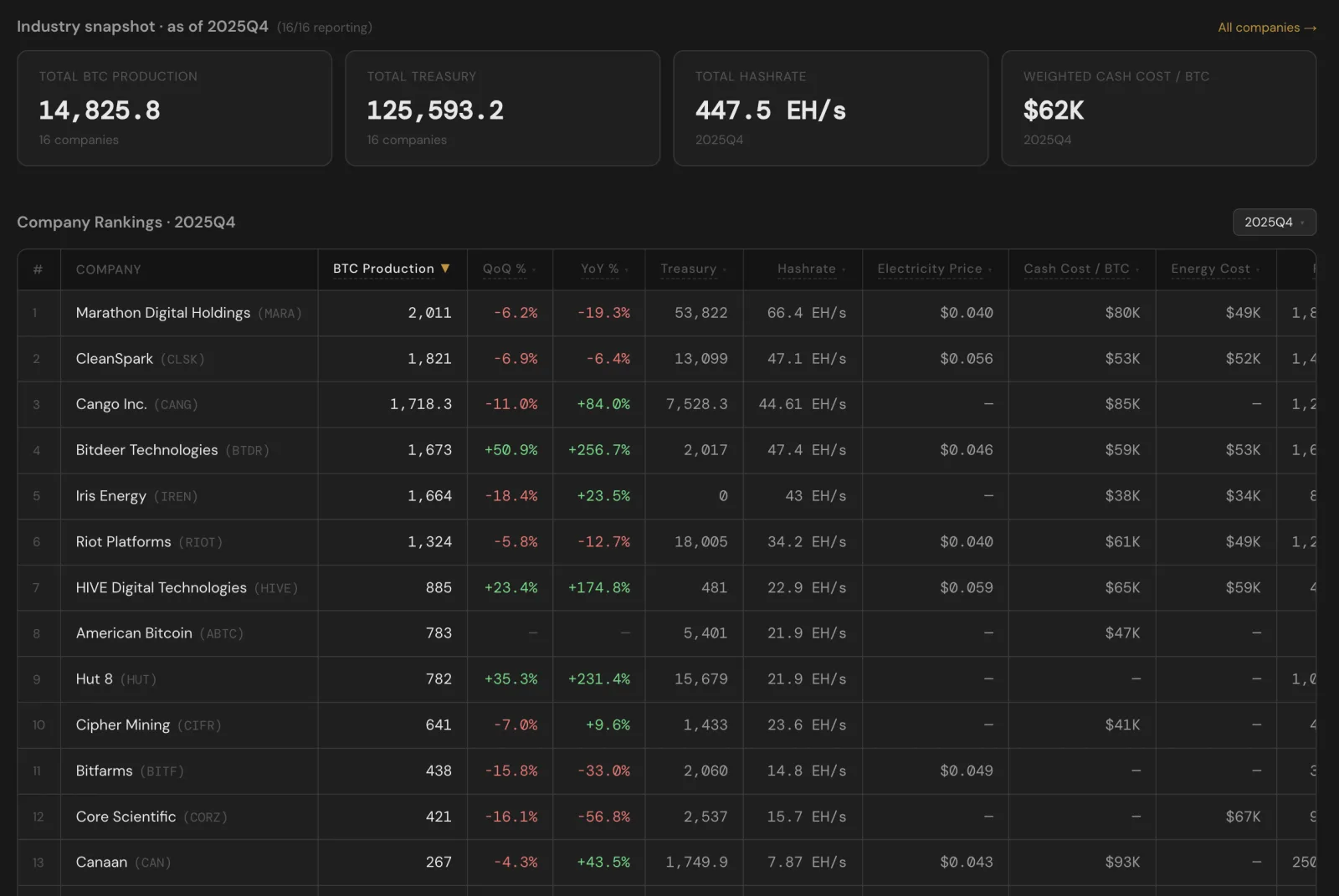
According to Q4 2025 data, the weighted average cash cost of 16 major public mining companies was approximately $62,000/BTC.
| Company | Electricity price | Cash Cost / BTC | Energy Cost / BTC |
|---|---|---|---|
| Marathon Digital | $0.040/kWh | $80K | $49K |
| CleanSpark | $0.056/kWh | $53K | $52K |
| Bitdeer | $0.046/kWh | $59K | $53K |
| Riot Platforms | $0.040/kWh | $61K | $49K |
| HIVE Digital | $0.059/kWh | $65K | $59K |
These figures show that a low electricity price does not necessarily mean the lowest BTC cost. Energy is only part of the cost—miner efficiency, depreciation, maintenance, and operational efficiency all affect the final result.
Changes in BTC Mining Cost in Q1 2026
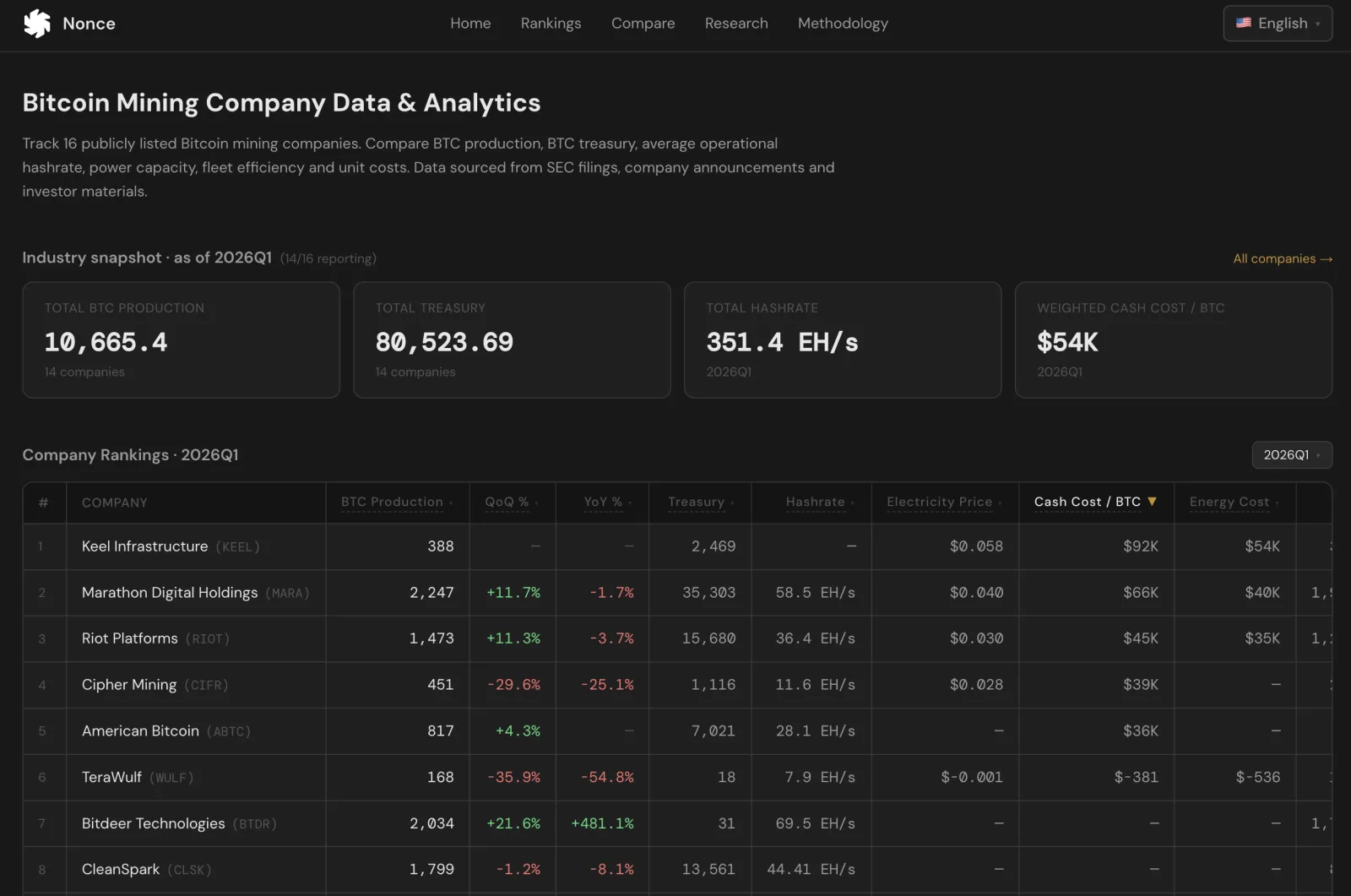
According to the data, in Q1 2026 the weighted average cash cost of 14 major public companies was approximately $54,000/BTC. Compared with Q4 2025, the industry's average cash cost declined, mainly due to the deployment of next-generation ASIC miners, optimization of power sourcing, and improvements in mining farm operational efficiency.
The Main Components of BTC Mining Cost
The cost per BTC is usually composed of energy cost, miner depreciation, hosting cost, repair cost, and operational management cost together. Among these, energy cost typically accounts for the largest share.
Take the Antminer S21 Pro as an example: the miner's power consumption is about 3531W, and running 24 hours a day consumes about 84.7 kWh of electricity. If the electricity price is $0.05/kWh, the daily electricity cost is about $4.24. For large mining farms with thousands or even tens of thousands of miners, differences in electricity price directly affect annual costs by millions of dollars.
Besides electricity price, miner efficiency is also an important factor determining BTC mining cost. An important metric for measuring ASIC miner efficiency is J/TH (joules consumed per terahash). The lower the value, the less energy the miner consumes per unit of hashrate.
| Miner model | Energy efficiency |
|---|---|
| Antminer S19 XP | About 21.5 J/TH |
| Antminer S21 | About 17.5 J/TH |
| Antminer S21 Pro | About 15 J/TH |
| WhatsMiner M60 | About 18 J/TH |
The value of next-generation miners lies not only in providing more hashrate, but in producing more BTC under the same power consumption, thereby lowering the energy cost per BTC.
The BTC Cost Gap Between Small Miners and Large Mining Farms
Small miners usually face higher electricity prices, higher equipment acquisition costs, and lower maintenance efficiency.
Large mining companies, on the other hand, lower costs through long-term power agreements, bulk purchasing of miners, professional operations and maintenance teams, and automated management systems.
Therefore, the core of competition in mining is not simply comparing how many miners one owns, but comparing who can operate those machines more effectively.
Downtime Cost: An Important Factor Affecting Cost per BTC
For a mining farm, when a miner stops working it means the asset cannot generate revenue. In a mining farm with 10,000 miners, if 5% of the machines stop running due to faults, that means 500 units per day are unable to contribute hashrate. Common causes include abnormal temperature, network issues, power failures, hashrate decline, and software configuration problems.
Therefore, improving miner uptime is an important way to reduce BTC production cost.
How Do You Continuously Calculate Your Own BTC Mining Cost?
BTC mining cost is not a fixed number; it changes continuously with network difficulty, electricity price, miner status, and output. Professional mining farms usually continuously monitor each miner's hashrate, actual power consumption, BTC output, energy cost per coin, and the number of abnormal devices.
For example, if the daily electricity cost is $10,000 and 0.15 BTC is produced, then the energy cost is 10,000 ÷ 0.15 = $66,666/BTC.
If this metric keeps rising, it usually means the mining farm is experiencing hashrate decline, reduced equipment efficiency, or operational management problems.
How Can a Mining Farm Management System Help Reduce BTC Cost?
As mining farms grow in scale, relying on manual management of ASIC miners alone becomes increasingly difficult. Operations staff need to know in a timely manner:
- Which miners are running at low hashrate;
- Which miners have abnormal temperatures;
- Which devices are offline;
- Which areas have efficiency problems.
A mining farm management system can help the operations team view equipment status in one place and improve overall operational efficiency through data analysis.
Nonce is a miner management platform built for Bitcoin mining farms, helping farms manage large-scale ASIC equipment more efficiently, and improving miner operational transparency and operational efficiency through centralized data management.
For modern mining farms, reducing BTC mining cost is not just about finding cheaper electricity—more importantly, it is about reducing wasteful losses so that every miner delivers maximum value.
Summary
At the current industry level:
- Low-cost large mining companies: about $40K–$60K/BTC;
- Ordinary commercial mining farms: about $50K–$80K/BTC;
- High-cost small miners: possibly over $100K/BTC.
The core of future Bitcoin mining competition will shift from simply expanding hashrate to reducing the production cost per BTC. Whoever can achieve lower energy cost, higher miner efficiency, less downtime, and more refined operational capability will maintain an advantage in long-term competition.