How to Calculate Bitcoin Mining Profit: How Much Can One Miner Earn Per Day
Bitcoin mining daily net profit = daily mining revenue minus electricity, pool fee, and maintenance cost. Revenue is estimated as hashrate times hashprice, while electricity price is the watershed for whether a miner runs. S19 Pro and S21 examples show how efficiency, power price, and uptime decide daily earnings.
Calculating Bitcoin mining profit is not mysterious. For miners and mining-farm operations teams, what really matters is not how much BTC a machine can theoretically mine, but how much cash profit remains after costs, given the day's market conditions, electricity price, and operating state.
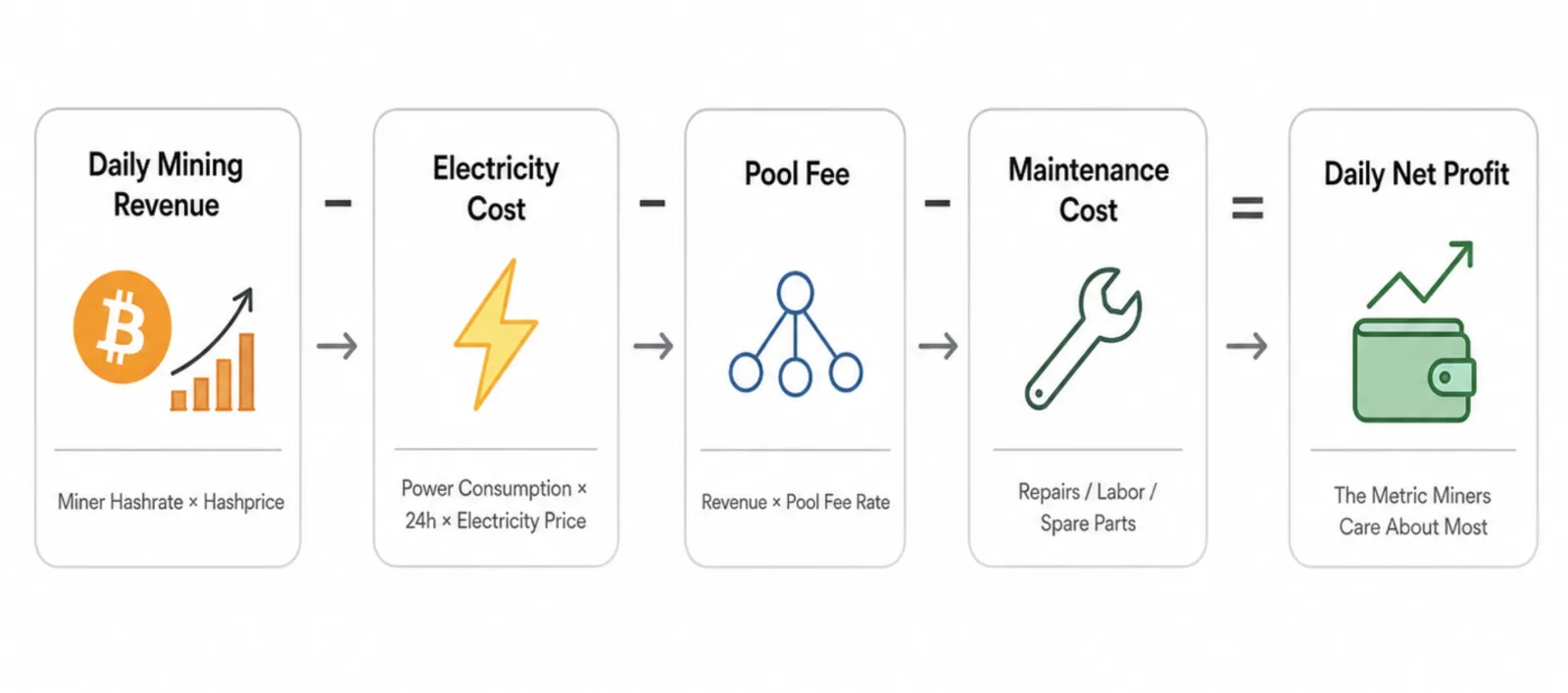
The daily earnings of a single miner can be understood with a very direct logic: Daily net profit = Daily mining revenue − Electricity cost − Pool fee − Maintenance cost
This formula looks simple, but it already covers the core questions most miners care about most. Daily mining revenue sets the revenue ceiling, electricity cost sets the cost floor, and the pool fee and maintenance cost determine the real take-home profit. A complete profit model involves many variables — BTC price, network difficulty, hashrate, power consumption, electricity price, block subsidy, pool fee, transaction fees, operating expenses, equipment depreciation, and more; but in day-to-day operations, the first thing a miner needs to figure out is still the daily cash profit of a single machine or a single farm.
How to Calculate Bitcoin Mining Profit
A miner's daily mining revenue can usually be estimated as "miner hashrate × hashprice." Hashprice is a metric miners often use, indicating how much revenue each 1 TH/s of hashrate can generate per day, commonly expressed in USD/TH/day. In its mining-profit educational content, Basic Mining explains that hashprice reflects the daily revenue per unit of hashrate, not the final profit; a miner must still deduct electricity, hosting, pool fees, and equipment depreciation to arrive at the real profit.
Assuming the day's hashprice is 0.046 USD/TH/day, a 200 TH/s miner's mining revenue for that day is 200 × 0.046 = 9.20 USD/day
This 9.20 USD is only revenue, not profit. It can be understood as the miner's gross revenue, ignoring costs, corresponding to that day's network difficulty, BTC price, block reward, and transaction-fee environment.
Bitcoin mining revenue comes from the block subsidy and transaction fees. After the April 2024 halving, the current block subsidy is 3.125 BTC, and the Bitcoin network produces roughly one block every 10 minutes, so about 144 blocks are produced per day; transaction fees vary with network congestion. This is also why miner earnings are not a fixed value: BTC price, total network hashrate, network difficulty, and fees all affect the day's hashprice.
Electricity Cost Determines Whether a Miner Truly Makes Money
In miner profit calculations, electricity is usually the most important cost item. Electricity cost is calculated as Daily electricity cost = Miner power consumption ÷ 1000 × 24 × electricity price
If a miner's power consumption is 3500W and the electricity price is 0.065 USD/kWh, then its daily electricity consumption is 3.5 kW × 24 = 84 kWh, and the daily electricity cost is 84 × 0.065 = 5.46 USD/day.
For the very same miner, profit is completely different at 0.03 USD/kWh versus 0.10 USD/kWh. Electricity price is not a decimal point in the profit calculation, but the watershed that determines whether a miner can keep running. Braiins likewise lists power consumption and electricity price as key inputs in mining-profit calculations, and notes that electricity prices can differ significantly by region, contract, and time of use.
The impact of the pool fee is relatively small, but it cannot be ignored. If the pool fee rate is 2% and a miner's daily revenue is 9.20 USD, then the pool fee is 9.20 × 2% = 0.18 USD/day
Maintenance cost is more easily underestimated. Fans, power supplies, hashboards, network cables, switches, cooling systems, manual inspection, dust cleaning, and repair spare parts are not one-time issues. Even if no repair happens on a given day, long-term maintenance cost should still be amortized into the daily model. For self-operated farms, maintenance cost can be estimated as total monthly operating cost divided by the number of miners, then divided by 30; for hosted miners, you need to clarify whether the hosting fee already includes repairs, network, site, labor, and power management.
An Example Near the Break-Even Line
Take the Antminer S19 Pro 110T as an example. ASIC Miner Value describes this model's specs as: maximum hashrate 110 TH/s, power consumption 3250W, efficiency about 29.545 J/TH. Assuming the day's hashprice is 0.046 USD/TH/day, electricity price is 0.065 USD/kWh, pool fee rate is 2%, and average daily maintenance cost is 0.50 USD, the S19 Pro's daily earnings can be calculated like this:
| Item | Calculation | Result |
|---|---|---|
| Daily mining revenue | 110 × 0.046 | 5.06 USD |
| Daily electricity cost | 3.25 × 24 × 0.065 | 5.07 USD |
| Pool fee | 5.06 × 2% | 0.10 USD |
| Maintenance cost | Assumed value | 0.50 USD |
| Daily net profit | 5.06 − 5.07 − 0.10 − 0.50 | −0.61 USD |
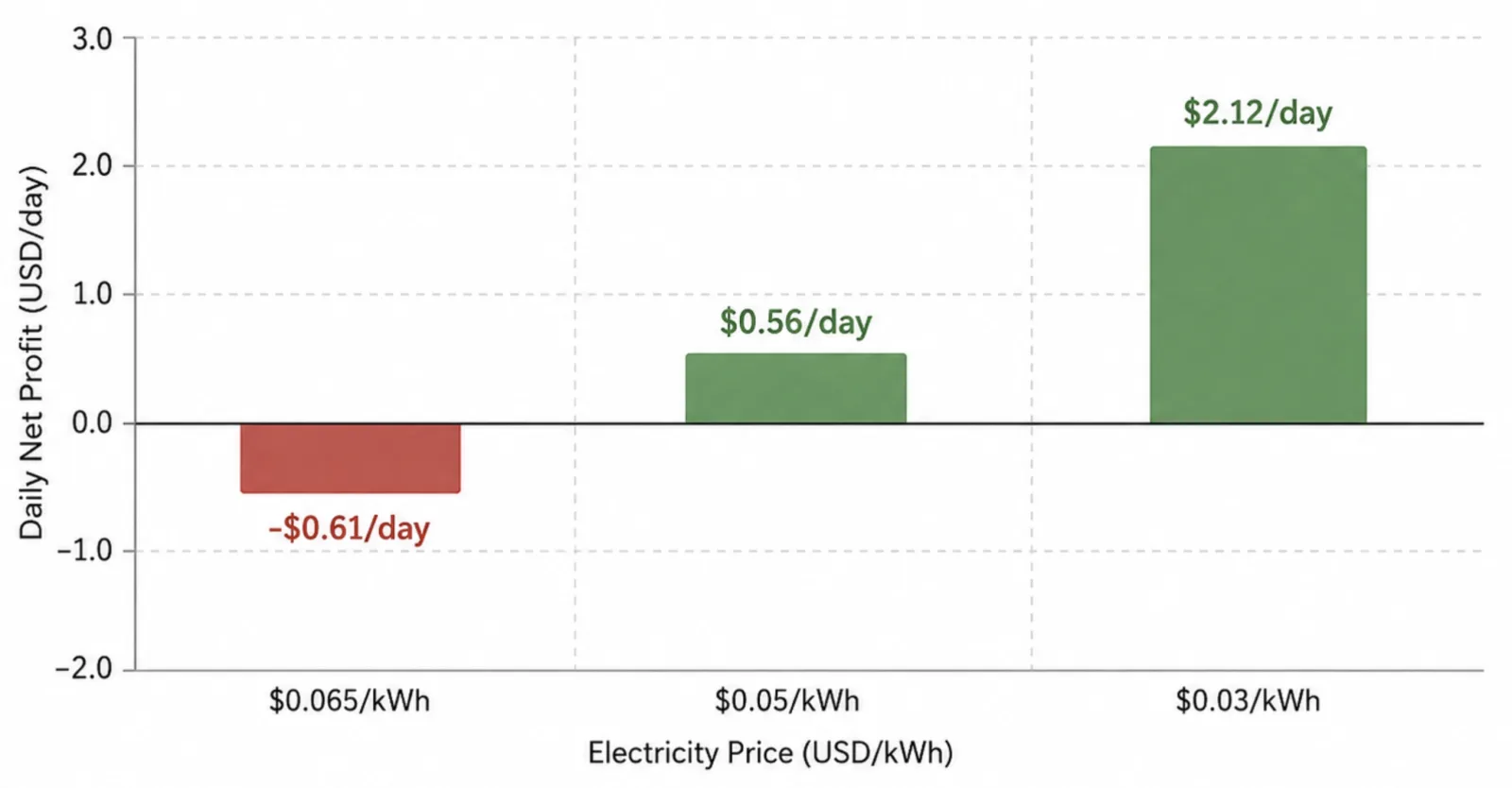
Under this set of assumptions, the S19 Pro's gross revenue is about 5.06 USD per day, but after deducting electricity, pool fee, and maintenance cost, the net profit is about −0.61 USD. This result does not mean the S19 Pro cannot run under any circumstances; rather, it shows that when hashprice is 0.046 USD/TH/day and electricity price is 0.065 USD/kWh, the S19 Pro is already very close to the cash break-even line.
If the electricity price drops to 0.05 USD/kWh, the daily electricity cost becomes 3.90 USD and the daily net profit is about 0.56 USD; if it drops to 0.03 USD/kWh, the daily electricity cost becomes 2.34 USD and the daily net profit is about 2.12 USD. The same miner turning from a loss into a profit under different electricity prices is precisely the most realistic side of Bitcoin mining-profit calculation.
The Advantage of High-Efficiency Miners
Now consider the Antminer S21 200T. ASIC Miner Value describes this model's specs as: maximum hashrate 200 TH/s, power consumption 3500W, efficiency about 17.5 J/TH. Under the same hashprice and electricity-price assumptions, the S21's calculated results are clearly different:
| Item | Calculation | Result |
|---|---|---|
| Daily mining revenue | 200 × 0.046 | 9.20 USD |
| Daily electricity cost | 3.5 × 24 × 0.065 | 5.46 USD |
| Pool fee | 9.20 × 2% | 0.18 USD |
| Maintenance cost | Assumed value | 0.50 USD |
| Daily net profit | 9.20 − 5.46 − 0.18 − 0.50 | 3.06 USD |
The S21's revenue is higher, yet its electricity cost does not increase proportionally — the core reason is efficiency. The S19 Pro's efficiency is about 29.545 J/TH, while the S21's is about 17.5 J/TH, which means the S21 produces more hashrate with less electricity. For a farm, long-term profit does not depend on miner hashrate alone, but more on the electricity cost behind each 1 TH/s of hashrate.
Comparing the S21's earnings under different electricity prices makes the result even clearer:
| Electricity price | Daily revenue | Daily electricity cost | Pool fee | Maintenance cost | Daily net profit |
|---|---|---|---|---|---|
| 0.03 USD/kWh | 9.20 | 2.52 | 0.18 | 0.50 | 6.00 |
| 0.05 USD/kWh | 9.20 | 4.20 | 0.18 | 0.50 | 4.32 |
| 0.065 USD/kWh | 9.20 | 5.46 | 0.18 | 0.50 | 3.06 |
| 0.10 USD/kWh | 9.20 | 8.40 | 0.18 | 0.50 | 0.12 |
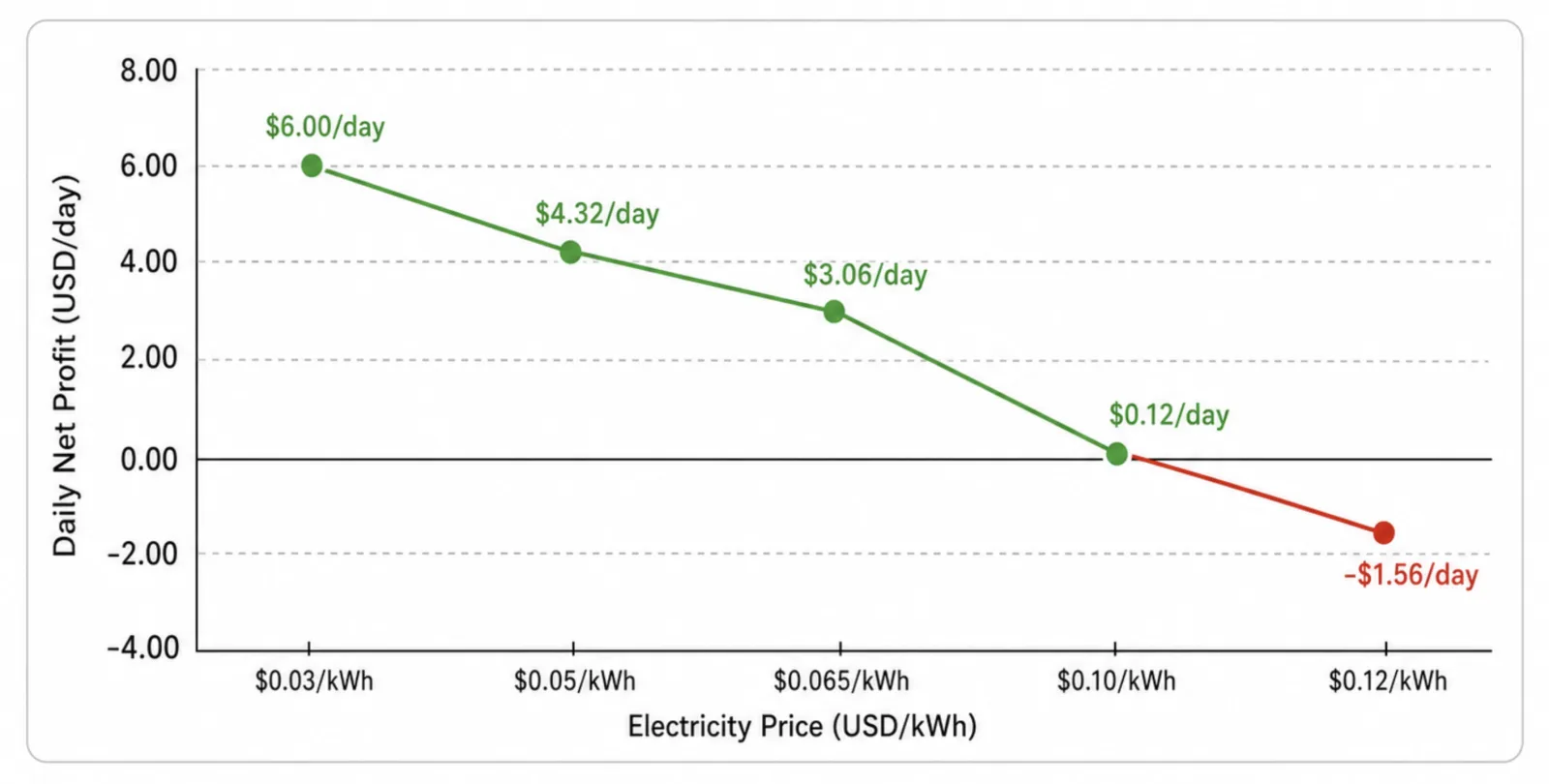
| 0.12 USD/kWh | 9.20 | 10.08 | 0.18 | 0.50 | −1.56 |
This table illustrates a key fact: how much a miner earns per day is not determined by the miner model alone. The S21 still has positive cash profit at 0.065 USD/kWh, but is already near break-even around 0.10 USD/kWh, and may turn into a loss at 0.12 USD/kWh. A high-efficiency miner can raise a farm's margin of safety, but it cannot eliminate the risk from fluctuations in electricity price, difficulty, and hashprice.
Why the Same Miner Earns Differently Every Day
Bitcoin mining is not a fixed-income business. On the revenue side, it is affected by BTC price, total network hashrate, network difficulty, block subsidy, transaction fees, and the pool's settlement method; on the cost side, it is affected by electricity price, hosting fee, repair cost, miner status, cooling environment, and uptime. Basic Mining notes that hashprice fluctuates with BTC price, difficulty, and transaction fees, and that static payback calculations are easily misleading because they assume BTC price, difficulty, hashprice, and hardware condition stay unchanged for years to come.
This is also why the question of how much a miner earns per day can only be answered for current conditions, and cannot be directly extrapolated into a guaranteed return over the next three years. The S21's net profit is 3 USD today, but that does not mean it will earn 3 USD every day going forward; the S19 Pro is near a loss today, but that does not mean it has no value in running when electricity prices are low or hashprice improves. A more reasonable approach is to look at earnings in three layers:
The first layer is daily cash profit, used to judge whether it is worth running today;
The second layer is the payback period, estimated as "total miner investment ÷ daily net profit," but you need to run conservative, baseline, and optimistic scenarios at the same time;
The third layer is cost per coin, used to judge a farm's actual cost to mine each 1 BTC, which is especially suitable for scaled farms doing operational reviews.
Uptime and Abnormal Miners Turn Theoretical Profit Into Actual Losses
Many profit calculations assume a miner runs stably 24 hours a day, but real farms are not always like this. Miners may go offline, run at low hashrate, at zero hashrate, overheat, or have fan anomalies, and actual output can fall below the theoretical value due to network, pool configuration, power mode, or on-site power issues.
Take the S21 as an example: if theoretical daily revenue is 9.20 USD but uptime is only 95%, actual revenue drops to about 8.74 USD. A shortfall of 0.46 USD on a single miner is not obvious, but for 1000 miners it is 460 USD per day, and 13800 USD per month. For a farm, profit calculation is not just a financial spreadsheet, but a reflection of operational efficiency.
A relatively advanced miner-fleet management tool like Nonce polls Agents and backfills real-time metrics, and its farm dashboard can track hashrate, efficiency, miner status, and estimated profit in a single view, with support for expanding the miner table to handle offline devices. The value of such a real-time profit dashboard lies precisely in putting theoretical earnings and on-site operating status side by side: when profit is below expectations, operators can keep drilling down to see whether hashprice has dropped, or whether some batch of miners is offline, at low hashrate, or overheating.
Nonce's operations documentation also breaks daily operations into three parts — problem-miner queries, batch management, and automation — including locating problem miners that are overheating, at zero hashrate, at low hashrate, offline, or with fan anomalies, as well as running batch operations such as scan, overclock/underclock, firmware, and reboot on selected miners; the overall flow is to query miners, select miners, execute operations, and track results within a task. For a farm, these actions all ultimately come back to profit: low hashrate means less revenue, offline means no revenue, and overheating and wrong power modes may worsen both electricity cost and stability at the same time.
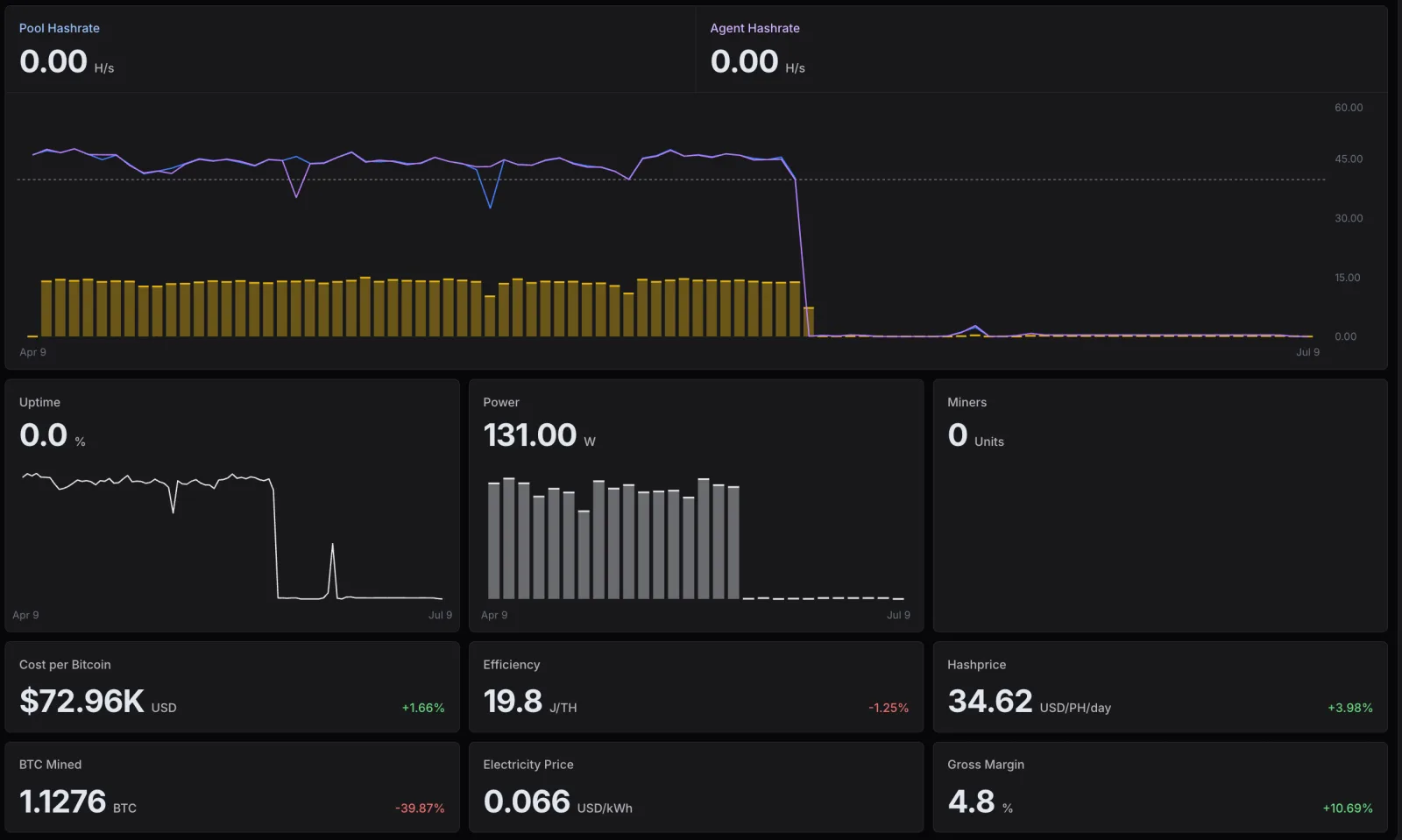
When Electricity Prices Change, a Farm Cannot Rely on Manual Judgment Alone
When electricity prices rise, temperatures increase, or hashprice drops, a farm needs to re-judge which miners should keep running at full power, which should be underclocked, and which need to be temporarily put to sleep. Nonce supports switching power modes such as overclock, underclock, sleep, and normal within batch operations, used to balance hashrate and cost when electricity prices change or temperatures are high; among these, underclock is used to reduce power consumption and heat, and sleep is used for temporary shutdown.
Such features do not change the BTC price, nor the total network difficulty, but they can help a farm execute operational strategy faster. For example, when some older models are already near the break-even line, continuing to run at full power may just be burning electricity; when electricity prices enter peak periods, underclocking or sleeping some miners may be more reasonable than continuing to mine; when temperatures are too high, underclocking in advance may be more favorable to long-term stable operation than waiting to repair after an equipment anomaly.
Therefore, the endpoint of profit calculation should not be a single profit figure computed in a spreadsheet, but the formation of a set of executable operational actions: which miners are worth running all day, which are only suitable for running during low-electricity-price periods, which need repair, and which should be relocated, sold, or retired.
One Table to Determine Whether a Miner Is Worth Running
Miners can use the table below as a daily profit-judgment template. It still uses 0.046 USD/TH/day hashprice, a 2% pool fee, and a 0.50 USD average daily maintenance cost as examples; in actual calculations, replace these with your own electricity price, pool fee rate, and maintenance cost.
| Miner | Hashrate | Power | Electricity price | Daily revenue | Daily electricity cost | Pool fee | Maintenance cost | Daily net profit | Verdict |
|---|---|---|---|---|---|---|---|---|---|
| S19 Pro | 110 TH/s | 3250W | 0.065 | 5.06 | 5.07 | 0.10 | 0.50 | −0.61 | Not suitable for long-term full-load operation |
| S19 Pro | 110 TH/s | 3250W | 0.050 | 5.06 | 3.90 | 0.10 | 0.50 | 0.56 | Near break-even |
| S21 | 200 TH/s | 3500W | 0.065 | 9.20 | 5.46 | 0.18 | 0.50 | 3.06 | Positive cash profit |
| S21 | 200 TH/s | 3500W | 0.100 | 9.20 | 8.40 | 0.18 | 0.50 | 0.12 | Near the shutdown line |
The point of this table is not any fixed conclusion, but the judgment logic. A farm can sort its miners into three categories: the first is core machines that are high-efficiency and still profitable running around the clock; the second is opportunistic machines sensitive to electricity price and hashprice; the third is low-efficiency machines that already lose money in most scenarios. In scaled operations, what truly needs optimizing is not the nominal revenue of a single miner, but the average efficiency, uptime, and cost per coin of the entire miner fleet.
The Payback Period Cannot Be Estimated From a Single Day's Profit
Once daily net profit is calculated, the payback period can be estimated as "total miner investment ÷ daily net profit." Assuming an S21's total investment is 2500 USD and daily net profit is 3.06 USD, the static payback period is about 817 days, or about 2.24 years.
But the static payback period can only serve as a reference. Static ROI calculations assume the same BTC price, difficulty, and hashprice are maintained over the long term, which is not realistic; it is recommended to evaluate returns through different scenarios such as bull market, baseline, and bear market.
For someone investing in miners, the truly prudent way to judge is not to ask "how many months to break even," but to look at three things: whether cash flow will keep bleeding in the conservative scenario, whether there is a reasonable payback period in the baseline scenario, and whether there is enough return elasticity in the optimistic scenario. If a miner only makes money in the extremely optimistic scenario, it is closer to a speculative asset than a stable operating asset.
How Much a Miner Earns Per Day Depends on Revenue, and Even More on Operations
The entry point for calculating Bitcoin mining profit is simple: daily revenue minus electricity, pool fee, and maintenance cost is the daily net profit. What really opens up the gap is the operational capability behind these numbers.
The S19 Pro and S21 examples show that high-efficiency miners can provide a larger profit margin of safety, but rising electricity prices, falling hashprice, declining uptime, and increasing maintenance cost will all quickly compress profit. For a single miner, profit calculation can help decide whether to run; for a farm, a real-time profit dashboard, abnormal-miner location, batch processing, and power-mode management are the keys to turning theoretical earnings into actual profit.
Mining is not simply buying hashrate, but continuously managing power, equipment, environment, and operating efficiency. How much a miner earns per day is ultimately written not only in the calculation formula, but also in the farm's daily uptime, efficiency, speed of anomaly response, and cost per coin.