What Is Bitcoin Mining Software? Differences Between Miners, Pools, Firmware, and Farm Management Platforms
Bitcoin mining software is a full stack — miners, firmware, pools, and farm platforms — not one app. Pools settle rewards; firmware runs each machine; management platforms operate the ASIC fleet.
In the modern Bitcoin Mining ecosystem, Bitcoin mining software is not a single application — it is a multi-layer software stack. For early users mining with CPUs or GPUs, mining software usually meant programs that directly invoked compute devices for hash calculation. But as the Bitcoin network evolved, mainstream mining has entered the ASIC era, where miners use hardware purpose-built for SHA-256 computation.
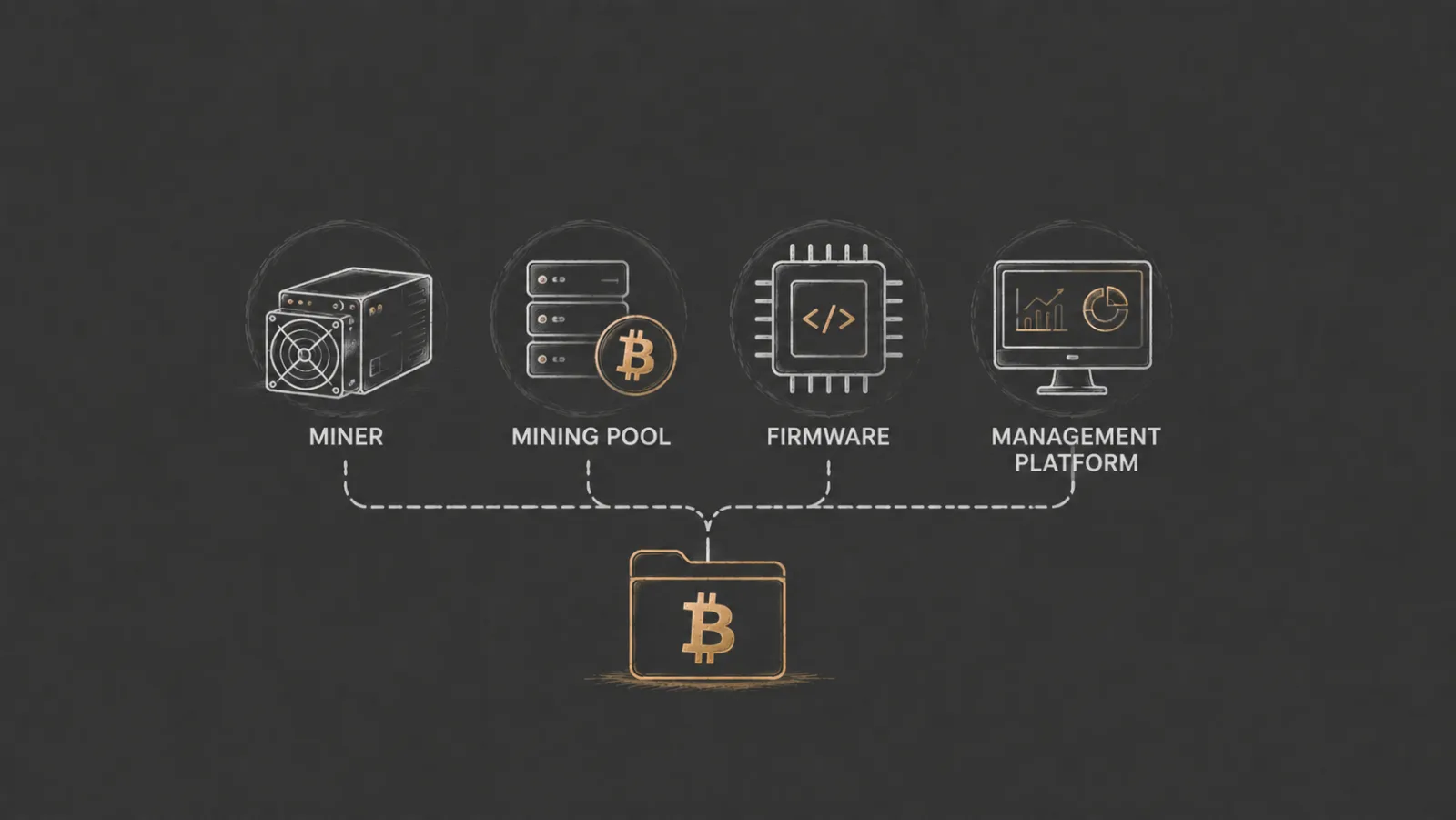
A modern ASIC mining system is typically composed of several parts: ASIC miners, miner firmware, mining pools, and farm management platforms.
Among them, ASIC miners execute hash calculations; miner firmware controls hardware operation; mining pools assign mining tasks, track Shares, and settle rewards; farm management platforms monitor, manage, and operate large fleets of miners. These components are not substitutes for one another — they each play a different role in the Bitcoin Mining process.
Understanding the differences between them is the foundation for understanding Bitcoin miner software, farm monitoring systems, and ASIC fleet management.
How Does an ASIC Miner Complete a Bitcoin Mining Task?
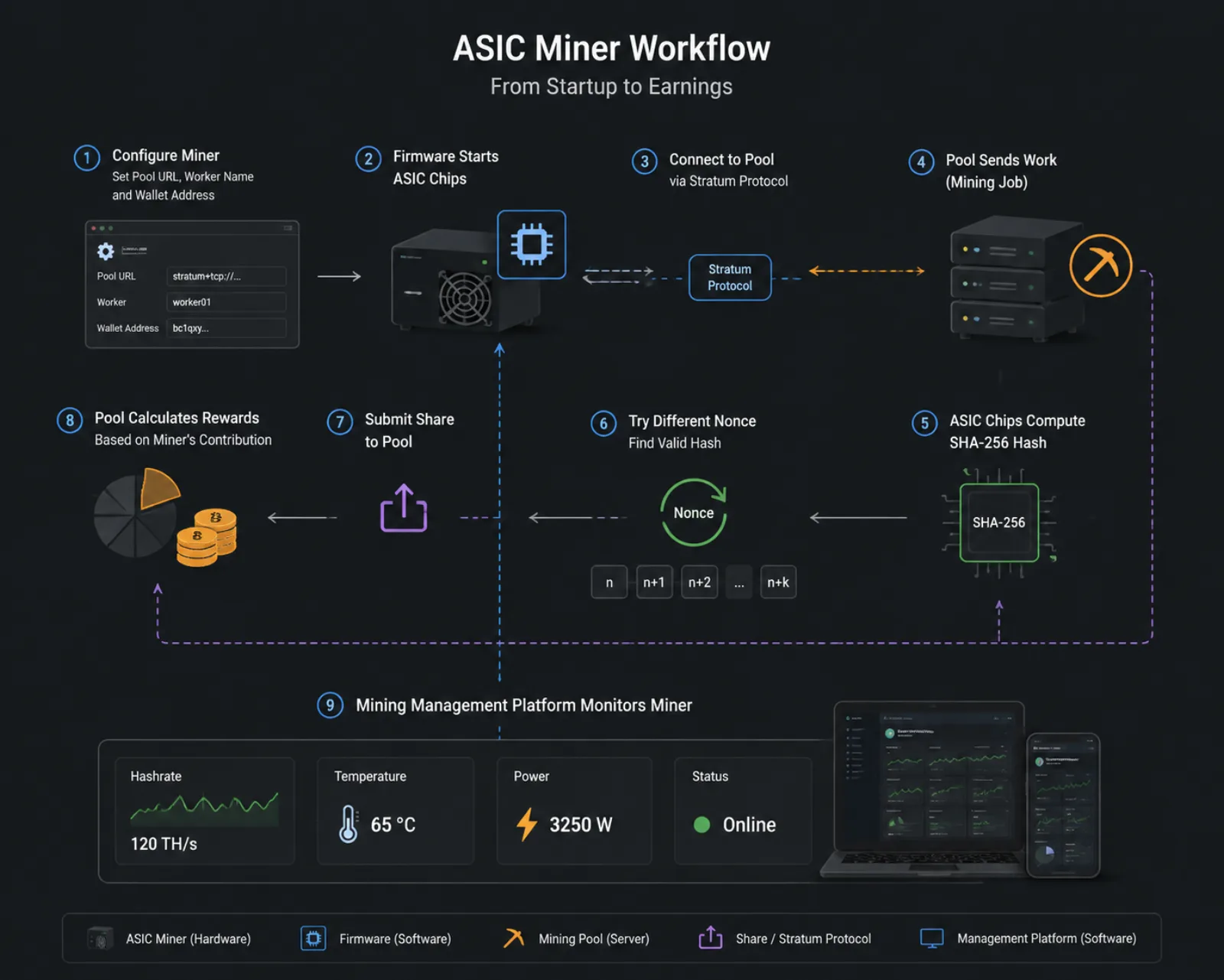
To understand what each piece of software does, start with the full flow from powering on an ASIC miner to earning rewards.
After purchasing an ASIC miner, the miner first configures the pool address (Pool URL), Worker name, and wallet address in the miner backend. The miner firmware then starts the ASIC chips. The chips continuously execute SHA-256 hash calculations. The miner connects to a pool via the Stratum protocol. The pool sends work tasks to the miner. The miner keeps trying different Nonce values to find a Hash that meets the difficulty requirement. The miner submits calculation results to the pool as Shares. The pool calculates rewards based on the miner's contributed hashrate. The farm management platform reads miner status and monitors hashrate, temperature, power consumption, and online status.
Throughout this process, no single piece of software does everything. Miner hardware, firmware, pools, and management platforms together form a complete Bitcoin mining software and hardware stack.
What Is Bitcoin Mining Software?
Bitcoin mining software is usually a broad term describing the various software systems that help miners participate in Bitcoin Mining. In the ASIC era, Bitcoin mining software mainly includes the following categories:
- Firmware running inside ASIC miners.
- Mining pool systems that connect miners to the Bitcoin network.
- Farm management platforms that help miners manage large numbers of ASIC devices.
Therefore, Bitcoin mining software should be understood as complete software infrastructure — not a single application.
What Is an ASIC Miner?
In the modern Bitcoin Mining industry, "miner" usually refers to the device that actually performs mining calculations — the ASIC miner. ASIC stands for Application-Specific Integrated Circuit. Unlike general-purpose CPUs or GPUs, ASIC miners are hardware-optimized for specific algorithms. Bitcoin uses the SHA-256 Proof of Work mechanism, so ASIC miners are designed specifically for SHA-256 hash computation. A typical ASIC miner includes:
- ASIC chips;
- Control board;
- Multiple hashboards;
- Fan system;
- Power supply module;
- Firmware system.
Miner performance is usually measured by:
- Hashrate: How many hash calculations the miner can perform per second, e.g. TH/s.
- Power Consumption: Electricity consumed during operation.
- Efficiency: Often expressed as J/TH (joules per terahash). Lower efficiency means less power is needed per unit of hashrate.
Note that an ASIC Miner is a hardware device, not farm management software. Brands such as Antminer and WhatsMiner are ASIC miner manufacturers, not Bitcoin miner management platforms. The miner itself performs calculations but does not help operators manage an entire farm.
What Is a Bitcoin Mining Pool? Why Do ASIC Miners Need to Connect to a Pool?
Because a single ASIC miner has a very low probability of finding a Bitcoin block, most miners join a Mining Pool. A pool aggregates hashrate from many miners to participate in Bitcoin mining together. Pools are mainly responsible for:
- Assigning mining tasks;
- Receiving Shares submitted by miners;
- Tracking each miner's contributed hashrate;
- Calculating rewards;
- Processing reward payouts.
Miners typically connect to pools via the Stratum protocol. Simply put, the pool tells the miner what task to compute. After the miner completes the work, it returns a message that effectively says: "I completed a valid portion of the work." That submission is a Share.
Note that although both pool dashboards and farm management platforms display hashrate data, they focus on different questions. Pools ask: How much hashrate did this miner contribute? How many Shares did this Worker produce? How much reward should they receive?
Farm management platforms ask: Which miner went offline? Which machine has abnormal temperature? Which rack has abnormal power draw? Which miners show hashrate drops? How can we change configuration on hundreds of miners at once?
Therefore, pools handle mining reward calculation; farm management platforms handle miner operations management. They are complementary, not competitors.
What Is Miner Firmware?
Miner firmware is the low-level software running on an ASIC miner's control board. If the ASIC miner is the body, firmware is the brain that controls how it runs. Miner firmware is mainly responsible for:
- Starting the miner system;
- Controlling ASIC chip operation;
- Managing hashboards;
- Controlling fan speed;
- Reading temperature data;
- Configuring pool connections;
- Adjusting frequency and voltage;
- Managing power modes.
Miners usually access the firmware management interface through the miner's web page to set pools, view real-time hashrate, change network settings, and adjust performance parameters. Different ASIC brands typically ship with their own default firmware.
Third-party ASIC firmware also exists on the market, offering more control — such as overclock/underclock modes, auto-tuning, and finer-grained power control. But firmware manages how a single miner runs; a farm management platform manages how a large fleet is operated. They solve different problems.
What Is a Bitcoin Mining Farm Management Platform?
When a miner has only one or two ASIC units, logging into each miner's backend may be enough. But as scale grows to dozens, hundreds, or even thousands of machines, managing devices one by one becomes very inefficient. That is why Bitcoin farm management platforms exist. Also called an ASIC Fleet Management Platform, these tools centrally manage large numbers of ASIC miners. Problems they address include:
- Miner monitoring: Real-time hashrate status, online status, temperature, fan speed, power consumption, and efficiency performance.
- Fault detection: Offline miners, abnormal hashrate drops, hashboard failures, temperature above thresholds, fan anomalies. Automated alerts help operations staff quickly locate issues.
- Batch management: Large farms have many ASICs. If every machine must be logged into separately, operational cost becomes huge. Farm management platforms help operators batch-change pool configuration, batch-upgrade firmware, batch-adjust parameters, and manage devices by farm, rack, or zone.
- Fleet data analysis: Large farms care about overall operating efficiency — which devices are least efficient, which zones have the highest failure rates, which miners need maintenance, and whether actual operating efficiency meets expectations.
This data cannot be obtained from a pool dashboard alone. Farm management software does not help miners compute Hashes — it helps miners operate an ASIC fleet.
How Does the Bitcoin Mining Software Ecosystem Work Together?
The most important thing in understanding Bitcoin mining software is the hierarchical relationship between different software and hardware. A complete Bitcoin Mining Software Stack can be understood as the following structure:
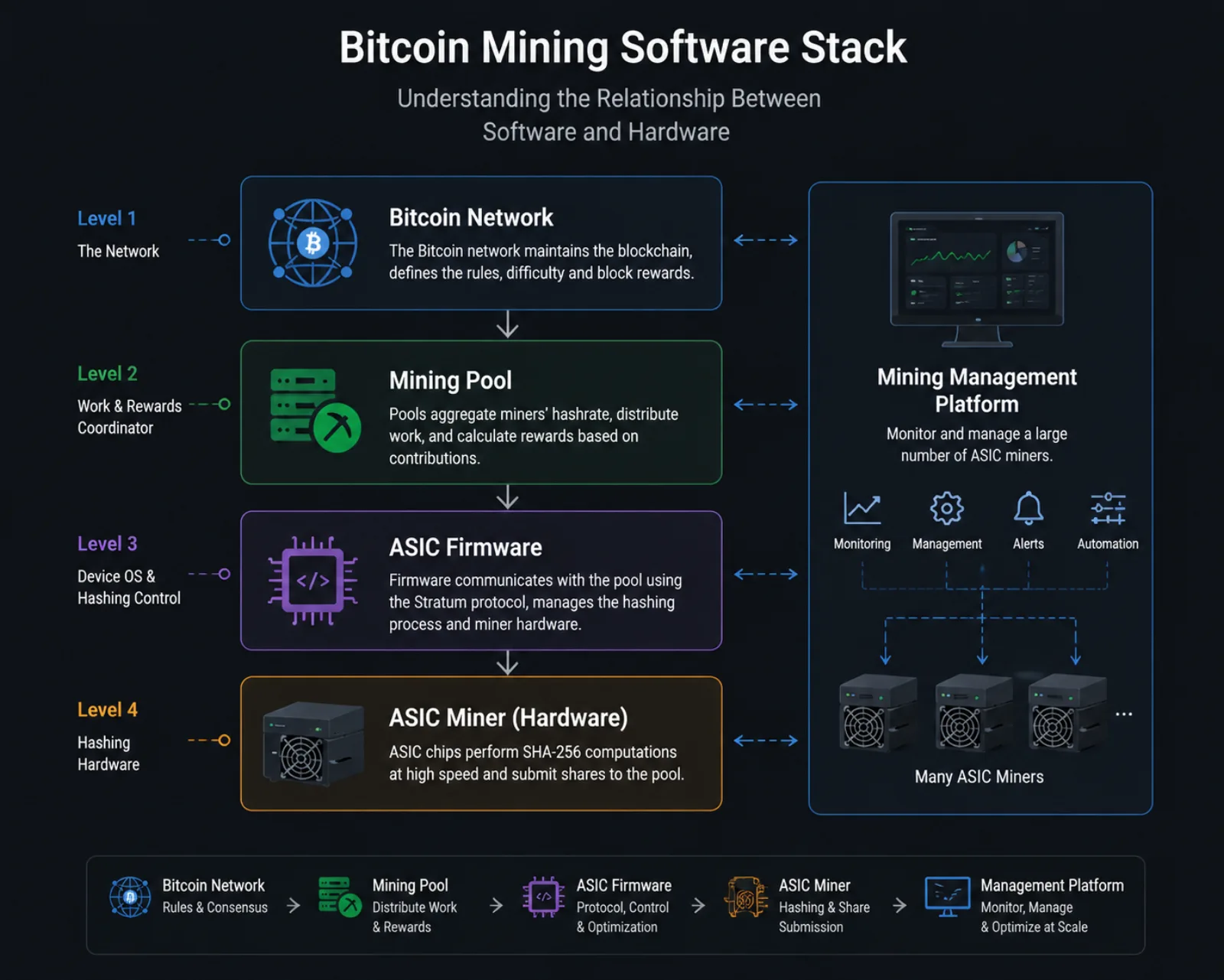
Pools, firmware, and farm management platforms are not serial substitutes — they coexist throughout the mining system. ASIC miners produce hashrate and are the devices that actually execute SHA-256 hash calculations. Miner firmware keeps ASIC hardware running normally and provides pool connectivity, parameter configuration, and hardware control. Pools connect miner hashrate to the Bitcoin network and handle task assignment, Share tracking, and reward settlement. Farm management platforms sit at the operations layer, providing centralized monitoring and management of large miner fleets.
Why Can't a Pool Dashboard Replace Farm Management Software?
Many new miners assume that since a pool can show miner Hashrate, online status, and earnings, extra miner management software is unnecessary. The reason is that they serve different audiences. Pools mainly serve reward tracking and mining collaboration.
Farm management platforms serve device operations and maintenance management. They focus on:
- Whether devices are running normally;
- Whether hashrate has dropped;
- Whether temperature is abnormal;
- Whether fans have failed;
- Whether power consumption has deviated;
- How to handle devices in batch.
For large Bitcoin Mining Operations, this kind of fine-grained management capability directly affects operating efficiency.
Where Does Nonce Fit in the Bitcoin Mining Software Ecosystem?
Across the Bitcoin Mining software stack, Nonce (nonce.app) belongs to the Bitcoin farm management platform and ASIC fleet management category. It helps miners and farm operators manage ASIC miner infrastructure more efficiently.
Which Type of Bitcoin Mining Software Do Different Users Actually Need?
Software needs differ completely by miner scale. For users just starting with Bitcoin Mining: if the goal is to mine Bitcoin, you need to buy an ASIC Miner. If you want to participate in pooled mining, you need to choose a Mining Pool. If you need to adjust how a miner runs, you need to understand ASIC firmware. If you only have one or two devices, the miner backend alone may be enough. But as machine count grows, management needs rise quickly. At that point, the importance of an ASIC fleet management platform becomes clear.
Bitcoin Mining Software: Miner, Pool, Firmware, and Management Platform Compared
| Type | Primary Role | What It Manages | Directly Computes Hash? | Typical Use Case |
|---|---|---|---|---|
| Miner | Executes SHA-256 hash calculations | Hardware device | Yes | Bitcoin Mining |
| Pool | Assigns tasks, tracks Shares, calculates rewards | Miner hashrate | No | Pooled mining |
| Miner firmware | Controls miner operation, manages hardware parameters | Single ASIC | No (controls the compute process) | Miner configuration, performance tuning |
| Farm management platform | Monitors, manages, and operates an ASIC fleet | Multiple ASIC miners | No | Large-scale farm operations |
FAQ
Do you need to install software to mine Bitcoin?
Modern Bitcoin Mining usually does not require installing a separate mining program the way early CPU mining did. ASIC miners typically ship with built-in firmware. Users only need to configure the pool address and Worker information to start running. When managing multiple ASICs, miners usually also need miner monitoring software or a farm management platform.
Does an ASIC miner have mining software built in?
ASIC miners run miner firmware (ASIC Firmware) internally. It controls hardware operation, including hashboard management, fan control, temperature monitoring, and pool connectivity. But an ASIC miner itself is not the same as Bitcoin mining software, and it does not manage an entire farm.
Is a Bitcoin mining pool considered mining software?
Pools are usually not considered mining software in the traditional sense — they are part of Bitcoin Mining infrastructure. Pools coordinate miner hashrate, assign tasks, track Shares, and settle rewards. A pool dashboard can show earnings data but cannot fully replace farm management software.
What is the difference between miner firmware and farm management software?
Miner firmware mainly controls how a single ASIC runs — for example adjusting frequency, managing temperature, and connecting to a pool. Farm management software mainly manages large numbers of miners, including monitoring, alerts, batch operations, and fleet data analysis.
Does a single miner need a farm management platform?
If you only have one or two ASIC miners, a professional farm management platform is usually not necessary. But once device count grows to dozens or even hundreds, manual management efficiency drops sharply. At that point, a miner management platform can help reduce operational cost and improve device uptime.
What is ASIC Fleet Management?
ASIC Fleet Management refers to the technical system for centrally managing large numbers of ASIC miners. It typically includes miner monitoring, hashrate analysis, temperature management, fault detection, batch configuration, and remote operations. Large Bitcoin Mining companies usually rely on fleet management software to operate thousands of ASICs.
Is Nonce a mining pool or miner management software?
Nonce.app is not a mining pool and is not an ASIC miner. It belongs to the Bitcoin farm management platform category, mainly helping miners and farm operators manage ASIC miner devices. It focuses on miner operations, monitoring, and management efficiency — not on Bitcoin mining reward settlement.