What Is a Nonce in Bitcoin Mining? Why Miners Keep Searching for the Right Nonce
A Nonce is a numeric field in the Bitcoin block header that miners keep changing so the SHA-256 hash meets the network difficulty target. Because hashes are unpredictable, mining is probabilistic trial-and-error; modern farms also focus on keeping ASICs stably searching for Nonces.
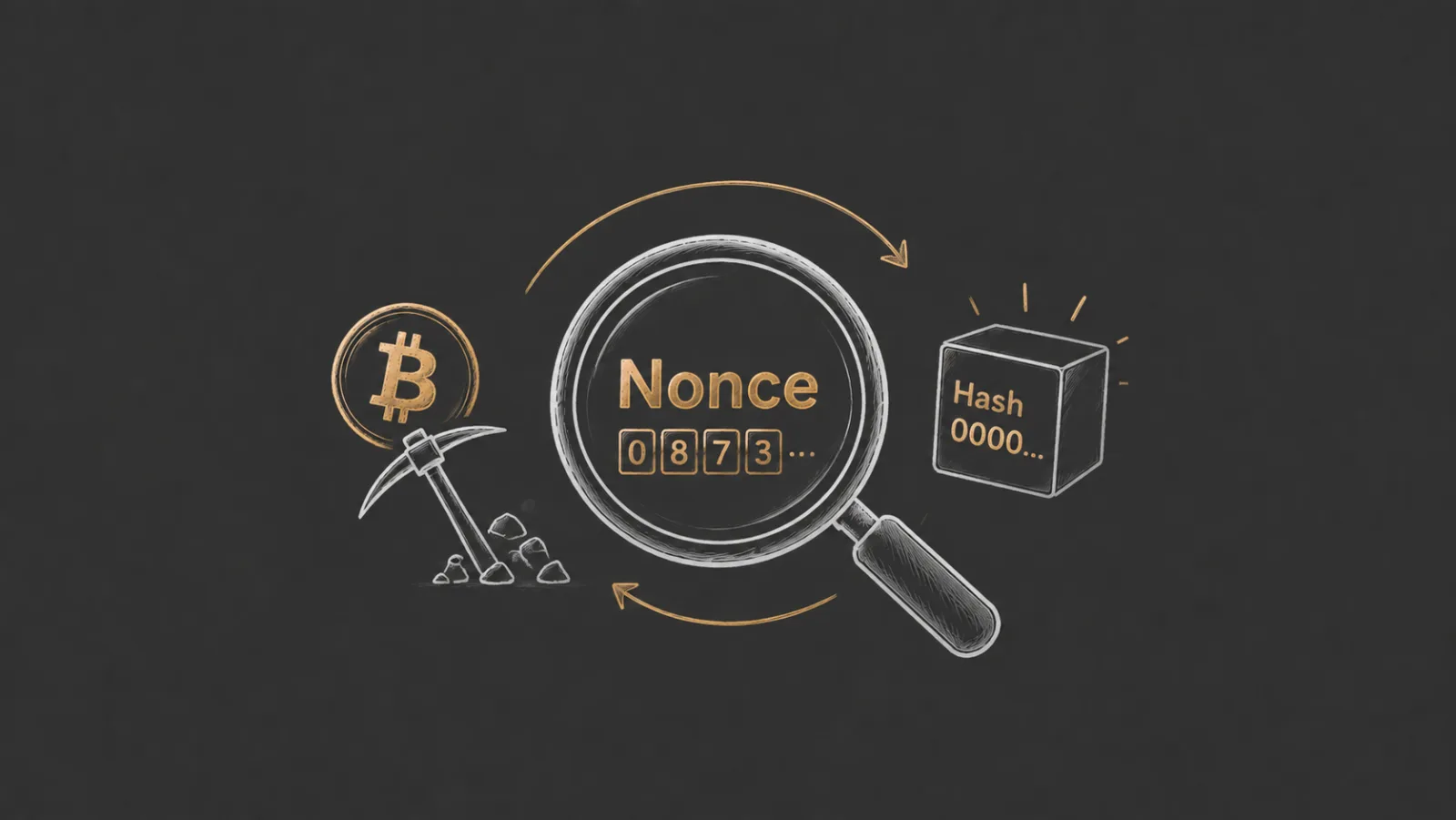
When learning about Bitcoin Mining, many people run into a key concept that is easy to overlook: Nonce. For ordinary users, Bitcoin mining may seem like miners run machines and then receive BTC rewards. But at the protocol layer of Bitcoin, what miners are really doing is repeatedly trying different Nonces and using large amounts of computation to find a Hash that meets network requirements, so they can earn the right to create a new block.
So what exactly is a Nonce? Why do miners need to keep searching for the correct Nonce? Why can a modern ASIC miner perform tens of billions or even trillions of calculations per second, yet still not find the answer directly? Understanding Nonce helps us understand how Bitcoin Proof of Work works, and also why modern Bitcoin Mining has moved from personal-computer mining into large-scale ASIC farm competition.
Simply put, Nonce is a numeric field in the Bitcoin block header. Miners keep changing the Nonce value so that after the block header is hashed with SHA-256, the result meets Bitcoin's network Difficulty Target. There is no shortcut. Miners cannot predict which Nonce will produce a valid Hash; they can only rely on higher compute capacity to make more attempts. So Bitcoin mining is essentially a probability-based compute competition.
What Is a Nonce, and Why Does Bitcoin Need This Number?
Nonce is short for Number Used Once. In the Bitcoin protocol, Nonce is a field in the block header. It takes 4 bytes, meaning a 32-bit integer ranging from 0 to 4,294,967,295.
Every Bitcoin block has a fixed structure, and the most important part is the Block Header. The block header contains several key fields, including:
- Version
- Previous Block Hash
- Merkle Root
- Timestamp
- Difficulty Target
- Nonce
When miners run Proof of Work calculations, they do not hash all transaction data directly. They run SHA-256 over the block header.
The role of Nonce is to provide a variable that can be adjusted continuously.
If a miner builds a candidate block and hashes the block header, and the result does not meet Bitcoin network requirements, the miner changes the Nonce and hashes again. If it still fails, the miner keeps changing the Nonce until a result meets the target set by the network.
The Bitcoin Developer Documentation explains the mining process in detail: miners keep adjusting parameters in the block header so the final Hash is below the target value. That is the core of Proof of Work. So Nonce is not a reward number, and it is not a hidden password in Bitcoin. It is the compute variable miners keep adjusting while searching for a valid block.
Why Do Miners Need to Keep Searching for the Correct Nonce?
The most important point in understanding Nonce is understanding how SHA-256 works. Bitcoin uses SHA-256 as its core hash algorithm. Hash functions have several important properties:
- The same input always produces the same output;
- Even a tiny change in the input completely changes the output;
- You cannot reverse a Hash result to recover the input;
That means miners cannot use a math formula to calculate which Nonce will definitely produce a valid Hash. They can only keep trying.
For example, a block header hashed with SHA-256 might produce 0000000000000000000abc123……. The Bitcoin network requires the current Hash to be below a certain target. If a miner gets 00001234abcd……, that result is invalid. The miner must keep trying. This is the core idea of Proof of Work: by consuming real compute resources, miners prove they have done a large amount of work.
The Proof of Work mechanism proposed in the Bitcoin whitepaper is essentially about finding a Hash that meets the conditions, and that process requires massive trial and error. So Bitcoin mining is not like a traditional compute task that calculates one answer. It is more like repeatedly trying across a huge random space until a result that meets the conditions is found by chance.
Nonce Has Only About 4.2 Billion Possibilities. Why Don't Miners Find the Answer Quickly?
After learning about Nonce, many people ask: Nonce is a 32-bit number with a maximum of 4,294,967,295, so do miners finish after at most about 4.2 billion tries? In practice, no.
The reason is that the search space in Bitcoin mining is far larger than Nonce alone. After miners traverse all Nonce values, if they still have not found a valid Hash, they can change other block data, such as the ExtraNonce in the Coinbase Transaction.
ExtraNonce sits in the Coinbase transaction, and the Coinbase transaction affects the Merkle Root. Once the Merkle Root changes, the whole Block Header changes, and miners get a new search space.
Miners can also adjust the timestamp, transaction selection, and transaction ordering.
So real Bitcoin Mining is not simply trying from Nonce = 0 all the way to Nonce = 4294967295. It is a loop of changing block data, generating a new block header, searching a new Nonce range, and continuing to compute. That is why modern ASIC miners can run for years and keep producing new Hash calculations.
How Do ASIC Miners Help Miners Search for Nonces?
Early Bitcoin mining could use ordinary CPUs. As the Bitcoin network grew and competition intensified, miners moved to GPUs, then FPGAs, and finally today's ASIC miners.
An ASIC (Application-Specific Integrated Circuit) is a chip designed for a specific compute task. A Bitcoin ASIC has a very clear goal: run SHA-256 hashing at high speed. It does not understand Nonce the way a person does, and it does not predict which Nonce is correct. What an ASIC does is very simple: keep changing the input, keep computing Hash, check the result, and submit a valid result.
Modern ASIC miners have two main advantages:
- Higher Hashrate. Hashrate means how many Hash calculations a miner can run per second. For example, a 200 TH/s miner can theoretically make about 200 trillion Hash attempts per second.
- Higher energy efficiency. Bitcoin Mining is a long-term competition, so miners care not only about speed, but also about how much compute they get per unit of electricity. That is why newer ASIC generations keep improving J/TH (energy use per unit of hashrate).
How Are Hashrate, Difficulty, and Nonce Search Related?
Nonce search is essentially a probability problem. Miners cannot guarantee that joining the computation will find the answer. They can only increase the number of attempts to raise the probability of finding it. That is the meaning of Hashrate.
But the Bitcoin network uses Difficulty adjustments to keep block production stable. Bitcoin aims to produce a new block about every 10 minutes on average. If miners worldwide add large numbers of ASICs, network Hashrate rises, blocks arrive faster, and Bitcoin raises Difficulty.
When Difficulty rises, fewer Hashes meet the requirement, so miners need more computation to find a valid result. Miners therefore face a dynamic competitive environment. Buying stronger miners can raise your own compute, but global competition changes at the same time. That is why Bitcoin Mining is not as simple as buying more machines and automatically making money. Miners also need to consider Bitcoin price, network Difficulty, Hashprice, electricity cost, miner efficiency, and device uptime.
From Searching for Nonces to Managing Mining Farms: How Modern Bitcoin Mining Has Changed
From the Bitcoin protocol's point of view, whether you have one miner or a large farm with tens of thousands of ASICs, the task is the same: search for a Hash that meets the conditions. But the problems modern farms face have changed.
Today, large farms care more about whether all their miners keep contributing effective hashrate. In large-scale operations, any device anomaly directly affects revenue. Farm competition is no longer only hardware competition; it is also competition in infrastructure management.
As ASIC counts rise, manual management becomes harder and harder. A large farm may have thousands or even tens of thousands of miners. Operators need real-time visibility into which miners are online, which have low hashrate, which have abnormal temperatures, and more.
The value of farm management software is not helping ASICs find Nonces. Finding Nonces is what ASIC chips do. Management software solves a different problem: how to keep more ASICs participating in Nonce search stably for long periods. That is an important part of modern Bitcoin Mining infrastructure.
The Nonce Mining Farm Management Platform
Nonce is a core technical concept in the Bitcoin protocol. It represents the process of miners repeatedly trying, computing, and searching for an answer that meets network rules. The name Nonce (nonce.app) comes from the Nonce concept in Bitcoin Mining. A modern farm management platform focuses on helping every ASIC contribute effective hashrate stably, so farm operators can manage expanding Bitcoin Mining infrastructure more efficiently.
From a simple numeric field in the Bitcoin protocol to the operating challenges of large farms worldwide today, Nonce connects Bitcoin's underlying technology with real-world Mining infrastructure.
Nonce may look like just a number in the Bitcoin block header, but it is actually an important entry point for understanding how Bitcoin mining works.
Miners keep searching for Nonces because Bitcoin uses Proof of Work to secure the network. Because SHA-256 hash results cannot be predicted, miners can only rely on the large-scale compute of ASICs, keep trying different inputs, and search for a Hash that meets Difficulty requirements.
As Bitcoin Mining enters an industrial stage, the competition behind Nonce has also moved from pure compute competition into a combined contest of hashrate efficiency, power management, and farm operations capability.
Understanding Nonce helps you understand not only why Bitcoin needs mining, but also why modern farms increasingly rely on specialized software and infrastructure management.