What Is Nonce Mining Software? From Miner Programs to Farm Management Platforms
Nonce mining software is a farm management platform above ASIC firmware and pools: it monitors, filters, bulk-controls, and automates miner fleets rather than computing SHA-256 hashes itself.
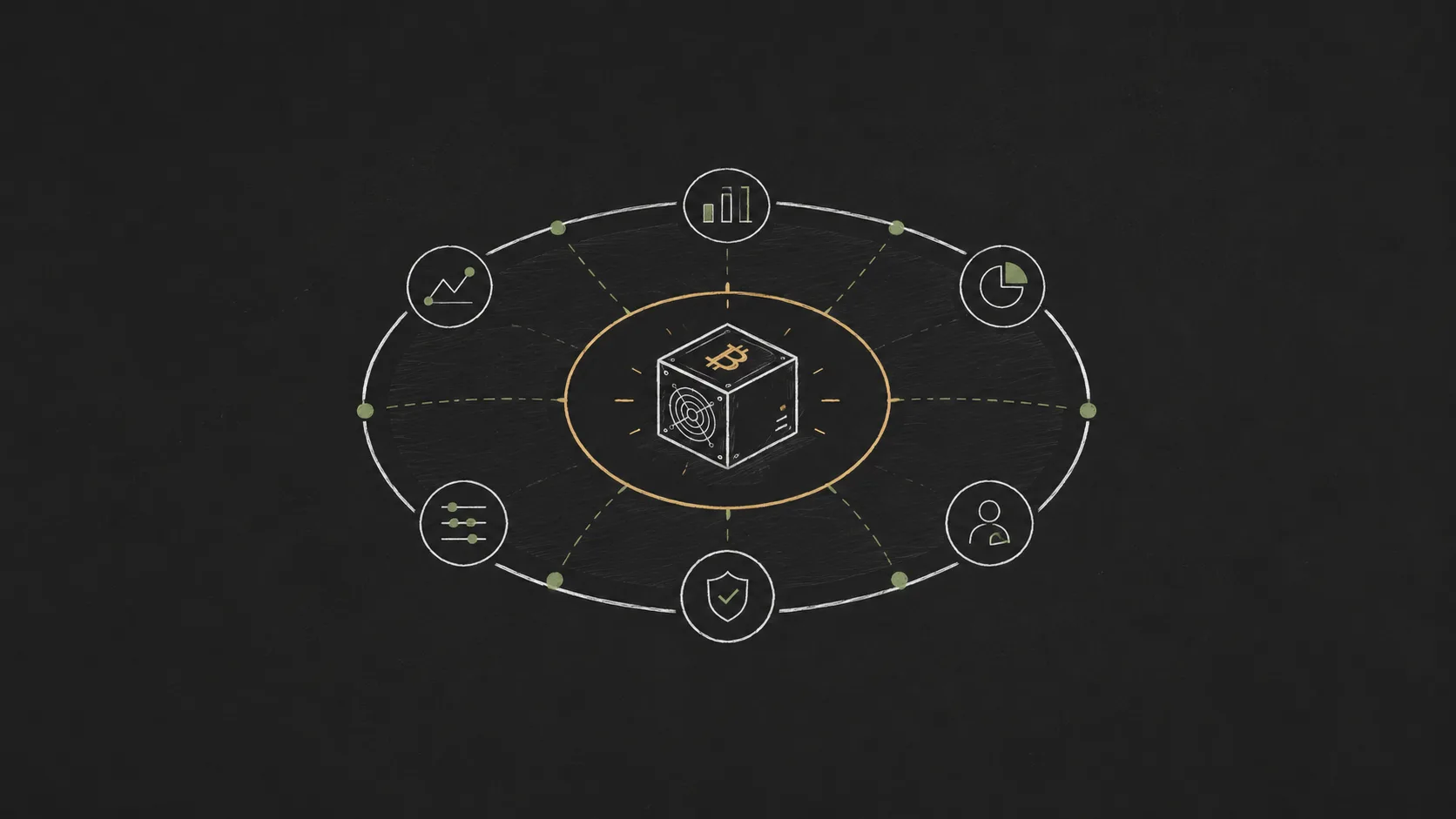
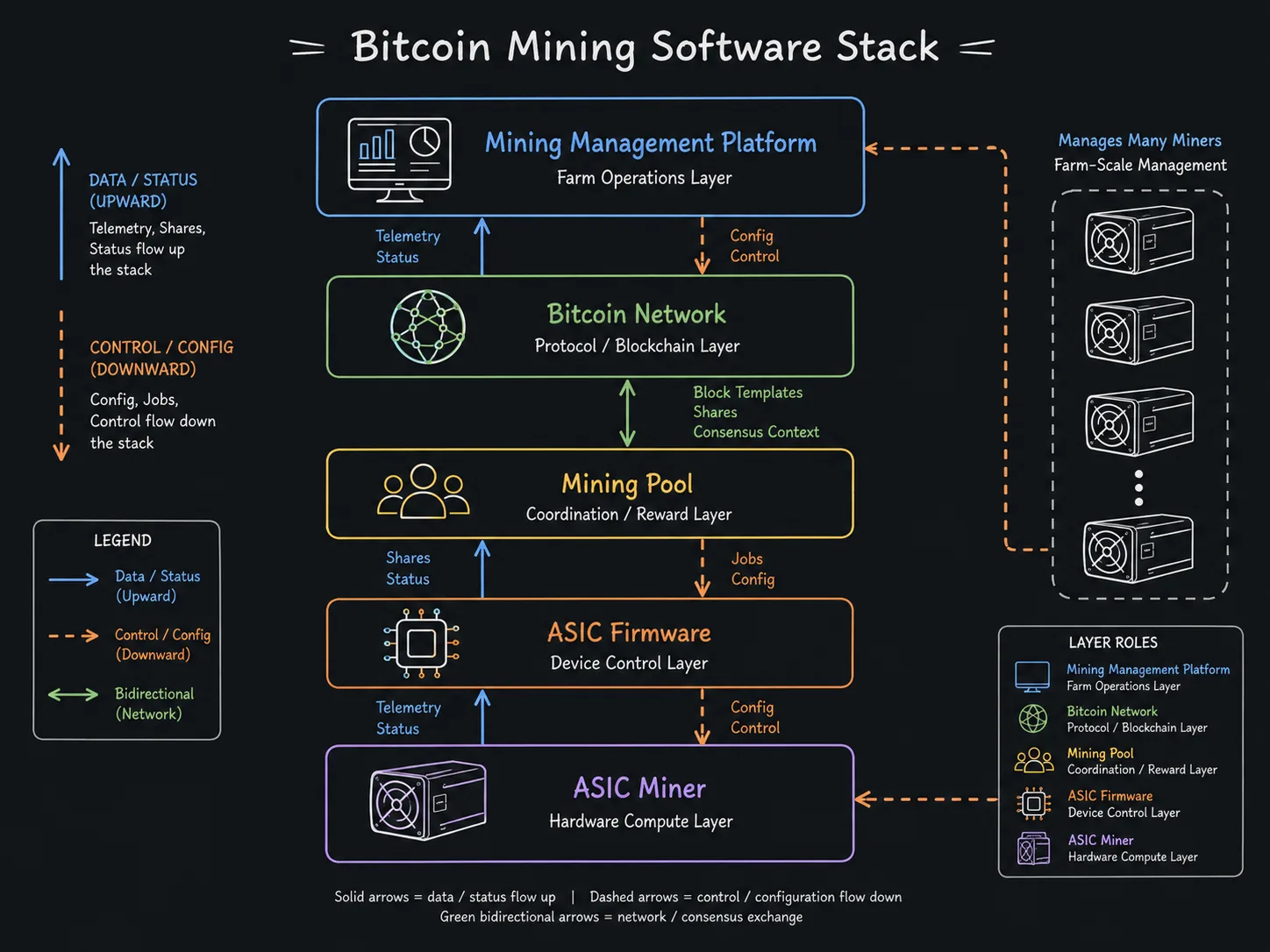
Miner firmware, mining programs, pools, miner management tools, and farm management platforms are often lumped together as "mining software," but they sit at completely different technical layers. In simple terms, SHA-256 hash computation is performed by chips inside ASIC miners; low-level miner programs and firmware make those chips work and communicate with pools; pools assign mining tasks, receive proof of work, and settle rewards; and farm management platforms like Nonce sit higher up, connecting large numbers of miners for ongoing monitoring, bulk management, anomaly handling, and automated operations.
So a more accurate view of mining software is not a single program that replaces miner firmware and computes hashes itself, but management software aimed at Bitcoin farms and ASIC device clusters. To understand this, you first need to break apart the full Bitcoin mining software stack.
What Is Bitcoin Mining Software?
In the broad sense, "Bitcoin mining software" is not one application but a set of programs that work together to mine. From ASIC chips performing SHA-256, to miners receiving pool tasks, to farm managers monitoring thousands of devices, there are multiple software layers in between.
The Bitcoin developer documentation on the mining process describes this relationship clearly: mining software obtains the information needed to build a block header, then passes work to mining hardware; the ASIC repeatedly tries variable data such as the Nonce in the block header and computes hashes. If a result meets the target condition, the data is returned and submitted further. Pool mining works similarly, except miners usually receive work from the pool via a mining protocol and submit Shares — results that prove they completed part of the computational work.
That is why you cannot simply say buying a miner equals having a complete mining software stack. A real ASIC mining environment typically includes at least miner hardware, miner firmware, pool connection, and a farm management platform — and the larger the scale, the more important upper-layer software management becomes.
| Layer | Primary Role | Directly Performs Hash Computation | Common Examples |
|---|---|---|---|
| ASIC Hardware | Executes SHA-256 operations | Yes | S19, S21, and other miners |
| Miner Firmware and Low-Level Programs | Controls chips, fans, power, and mining connection | Indirect control | Stock firmware, third-party firmware |
| Mining Protocol | Passes mining tasks and results between pool and miner | No | Stratum |
| Mining Pool | Assigns tasks, validates Shares, tracks contribution and settles rewards | No | Bitcoin mining pools |
| Farm Management Platform | Monitors, filters, bulk-controls, and automates miner management | No | Nonce |
Why Do ASIC Miners Still Need Software?
ASIC chips are designed for specific computational tasks; the core job of a Bitcoin ASIC miner is to perform SHA-256 hash operations continuously. But chips do not on their own know which pool to connect to, what task to compute, how fast fans should spin, how much power to draw, or how to submit results — miner-internal software handles all of that.
Take common Antminer units as an example: miners typically have their own management interface where you configure pool addresses, worker names, and related runtime parameters. Bitmain miner manuals show a similar structure — for instance, the S21 XP Hydro can configure multiple prioritized pool addresses and corresponding worker information. In other words, a modern ASIC is already a compute device with a control board, operating software, network connection, and dedicated hash chips — not just a bare hash chip.
The most common confusion is between "miner firmware" and "farm management software." Firmware runs directly on the miner's control board and governs how one miner operates internally — frequency, voltage, fans, power modes, pool configuration, and so on. Some third-party firmware also adds auto-tuning, such as Braiins' description of adjusting frequency and voltage based on chip performance to optimize efficiency under different power limits.
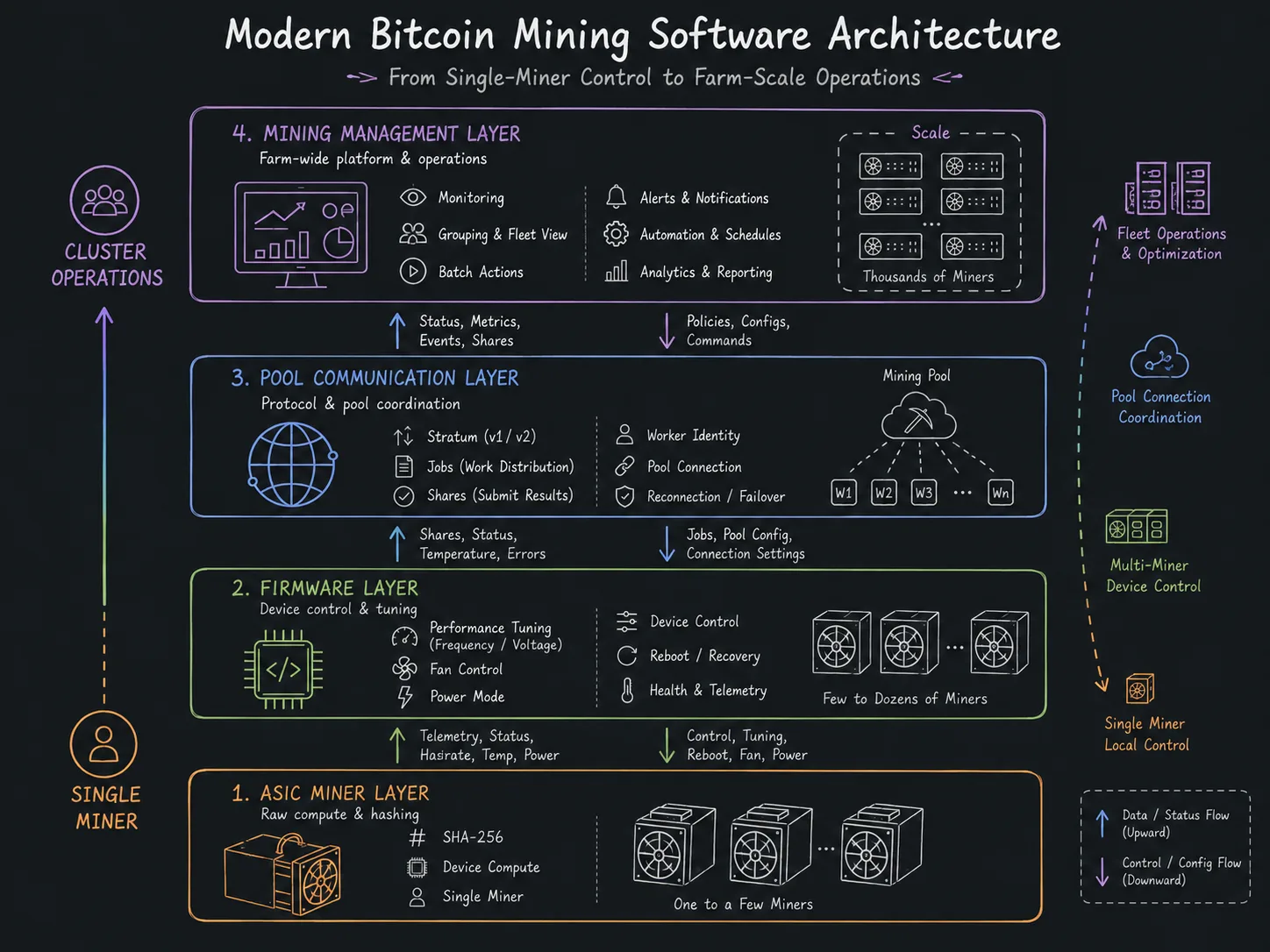
So firmware answers "how should this miner run," while a farm management platform answers "how should hundreds, thousands, or more miners across the farm run together."
What Does Pool Software Do? Why Can't Miners Just Compute on Their Own?
Bitcoin mining results are highly random. A solo miner can mine independently, but with today's enormous network hashrate, the time to find a block alone is highly uncertain for most miners, so large amounts of hashrate mine through pools.
In pool mode, miners do not simply "connect to the internet and start guessing Nonces." The pool sends mining tasks; miner software and hardware search for valid hashes based on those tasks and submit Shares that meet the pool's difficulty back to the pool. The pool uses Shares to estimate each miner's contributed compute and distributes rewards under the relevant payout model. The Bitcoin developer documentation also explains this: pools typically set a Share difficulty easier than the Bitcoin network target, using those results to prove miners actually did the work.
Miners and pools communicate via mining protocols. Early and current pool infrastructure widely uses Stratum, while the next generation Stratum V2 further defines how pools, proxies, and miners assign mining tasks and submit proof of work. Its mining protocol spec defines a Job as a set of work information covering a specific hash search space, which miners compute against.
So a pool is not a miner, and a mining protocol is not miner firmware. One organizes hashrate, one handles communication, and the ASIC chip still performs tens of trillions or even quadrillions of hash attempts per second.
From One Miner to Thousands: Why Do You Need a Farm Management Platform?
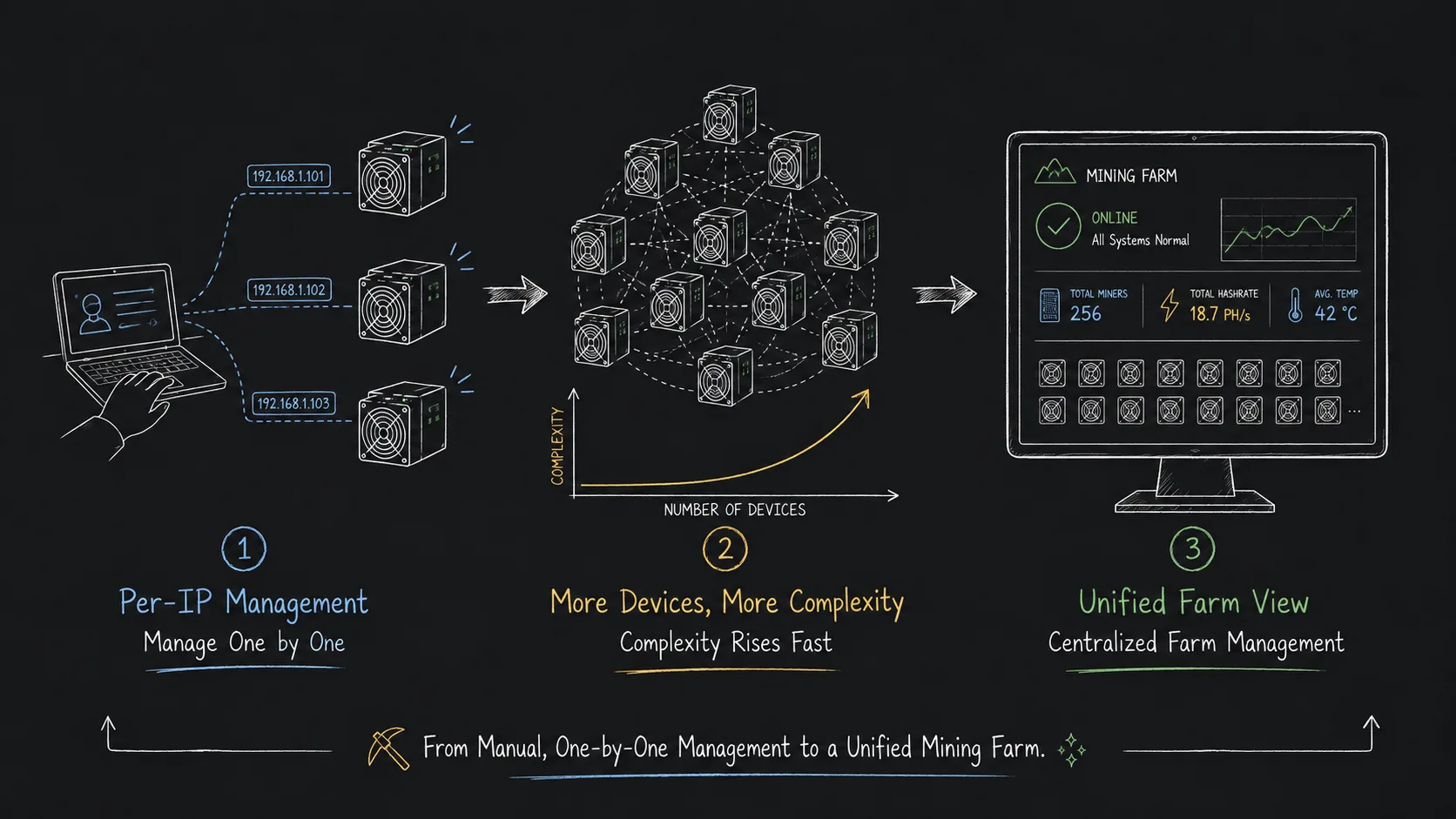
With a single miner, opening the miner dashboard may be enough. You can check hashrate, temperature, fan status, change pool addresses, and reboot when needed. But when a farm grows to 100, 1,000, or more devices, that approach breaks down quickly.
Suppose a farm with 3,000 ASICs has 80 low-hashrate miners. If ops staff can only visit IP addresses one by one, they must find abnormal devices, log into each miner's backend, diagnose, reboot or adjust operating mode, then recheck whether hashrate recovered. If the same issue repeats daily, the real operating cost is not just electricity but the people and time spent finding and fixing anomalies.
That is why farm management software exists. It does not replace ASIC computation or the pool; it builds a unified control layer above miners, turning devices scattered behind hundreds or thousands of IP addresses into a searchable, filterable, bulk-manageable, policy-automatable miner cluster.
Nonce farm operations management centers on three core steps: locating abnormal miners, bulk executing miner management actions, and automated handling. Farms can filter offline, zero-hashrate, low-hashrate, overheating, and other devices from the whole cluster, then run corresponding actions on targeted equipment.
This means the development logic of Bitcoin mining software has shifted: early software focused on "getting compute devices to start mining," while modern large-farm software increasingly focuses on "keeping large fleets mining steadily."
Which Layer Does Nonce Mining Software Belong To?
Nonce is a Bitcoin farm management platform, not a low-level mining program that runs SHA-256 hash tasks directly.
After deploying a farm, you can use Nonce miner scan and discovery to identify ASICs on the network and bring devices into a unified farm view. The current scan mechanism supports both manual discovery and automatic scanning over configured IP ranges; new devices entering the network can be discovered and added to management scope.
At the management layer, the problems software handles are no longer just "is the miner running," but which miners are offline, which have abnormal hashrate, which are overheating, which need power mode changes, and how many miners a single action actually affected.
For example, through miner power mode management, selected miners can be bulk-switched among overclock, normal, underclock, or sleep modes. Under high electricity prices or high temperatures, power and heat can be reduced; where conditions allow, other suitable operating modes can be selected.
Pool configuration is similar. For one device, changing a pool means opening the miner backend; for a whole farm, changing pool by pool creates massive repetition. Nonce bulk pool configuration lets you uniformly change primary pool, backup pool, and worker settings for a group of miners.
Firmware management can enter the same unified workflow. Nonce supports bulk firmware upgrades on target devices, but firmware still runs inside the miner — so "software that manages firmware" and "firmware itself" remain two different layers.
This is the most important point for understanding Nonce mining software: Nonce does not replace ASICs, does not replace pools, and does not require moving "mining" to the cloud — it connects existing infrastructure so farm operators can manage it at a higher layer.
Miner Programs, Firmware, and Farm Management Platforms: What's the Difference?
The simplest test is what the software controls. If software mainly decides frequency, voltage, and operating mode on hash boards, it is firmware layer. If it mainly handles task communication between pool and miner, it is mining protocol layer. If a system can see many miners at once and run filtering, bulk operations, and automation rules around device state, it is farm management layer.
| Comparison | Miner Low-Level Program / Firmware | Mining Pool | Nonce-Class Farm Management Platform |
|---|---|---|---|
| Managed Object | Internal hardware of a single ASIC | Hashrate connected to the pool | Miners across one or many farms |
| Primary Task | Control chips, power, fans, and runtime parameters | Distribute mining tasks, receive Shares, settle rewards | Monitoring, anomaly filtering, bulk management, automation |
| Runs on Miner | Usually yes | No | No — mainly an upper-layer management system |
| Directly Controls Hash Chips | Yes | No | Executes management actions via miner interfaces |
| Handles Reward Settlement | No | Yes | No |
| Problems It Fits | Single-machine efficiency and runtime state | Hashrate access and reward distribution | Large-scale device operations efficiency |
So if a user asks "can Nonce make my PC start mining BTC directly," the answer is usually no — Nonce's core purpose is not turning a general computer into a Bitcoin miner. Professional Bitcoin mining today relies mainly on ASICs, and Nonce's use case is bringing those already-running ASICs under unified management.
If the question becomes "I have hundreds of S19, S21, or other ASICs — how do I know which are low hashrate, how do I bulk-switch power modes, how do I change pools uniformly, how do I cut manual per-device work," that enters the problem space Nonce-class Bitcoin farm management software actually solves.
Bitcoin Mining Software Is Shifting from "Making Miners Work" to "Managing the Whole Farm"
Early Bitcoin mining software was closer to a technical tool: get mining tasks, construct block headers, drive hardware to search Nonces, submit results. As ASICs replaced general-purpose devices, these capabilities were increasingly integrated into miner firmware and pool infrastructure; miners no longer need, as in the early GPU era, to install a separate mining program on a PC and manually control hardware.
Meanwhile, as farm scale grew, the truly complex software problems moved up the stack. Managers care not only "can this miner hash," but how much effective hashrate the whole farm has, what uptime is, how many devices are abnormal, whether temperature is affecting stability, whether a bulk action succeeded, and how different operating strategies affect power draw and device state.
That is why miner firmware and farm management platforms will coexist long term: the former goes deeper inside devices to improve single-miner efficiency; the latter moves upward to improve whole-farm operations efficiency. They are not substitutes but software infrastructure at different layers.
How to Understand the "Nonce Mining Software" Keyword?
If you put the full Bitcoin mining flow together, "mining software" has evolved from a single program into a complete software stack. ASICs perform hash computation, firmware controls device operation, Stratum and other protocols connect pools, pools organize hashrate and settle rewards, and farm management platforms manage large device fleets and operations workflows.
Nonce sits in the management layer of this architecture. Through farm onboarding and device access, farms can set up workspaces and farms, install Agent, scan and discover miners, and continuously view device status and operations data. On that foundation, miner filtering, bulk reboot, power mode adjustment, pool changes, firmware upgrades, and automation policies can form a unified farm ops workflow.
So the most accurate definition of "Nonce mining software" is not "a program that helps one computer compute Bitcoin," but "a software platform for managing Bitcoin ASIC miner clusters and farm operations." For home miners, a single miner's built-in dashboard may already handle most basics; as miner count, farm count, and ops complexity grow, upper-layer management software becomes increasingly important.
From miner programs to firmware, from pool protocols to farm management platforms, the real direction of Bitcoin mining software is not one program doing everything, but different layers each solving what they fit best. ASICs compute, firmware controls devices, pools organize hashrate, and Nonce keeps those distributed miners running as an observable, manageable, automatable farm.