What Is a Nonce? Two Key Concepts of Nonce in Bitcoin Mining Explained
Nonce in Bitcoin mining has two layers: the 32-bit block-header Nonce ASICs change to try hashes quickly, and Extra Nonce, which alters Coinbase and the Merkle Root to create new headers and expand search space.

If you are just starting to learn Bitcoin mining, "Nonce" may be one of the easiest terms to explain simply—and also one of the easiest to misunderstand. Many articles translate Nonce directly as "random number," then summarize the whole mining process as "miners keep searching for the correct Nonce." That statement is not wrong, but it only explains a small part of Bitcoin Proof of Work.
In a real Bitcoin mining system, understanding Nonce requires distinguishing at least two important concepts: the first is the Nonce written in the Bitcoin block header—the field miners change most directly during hash computation; the second is data usually called Extra Nonce, which is not the formal Nonce field in the block header. Instead, miners change the Coinbase transaction to change the Merkle Root, thereby obtaining a new block header and a new hash search space.
Simply put, Nonce solves "how to try different block headers quickly," while Extra Nonce solves "when one Nonce search space is not enough, how to keep creating new search space." Understanding these two layers basically explains why modern ASICs can keep running massive SHA-256 hash computation, and what pools, miner firmware, and ASIC chips are coordinating to accomplish.
The First Nonce: The Real 32-bit Nonce in the Block Header
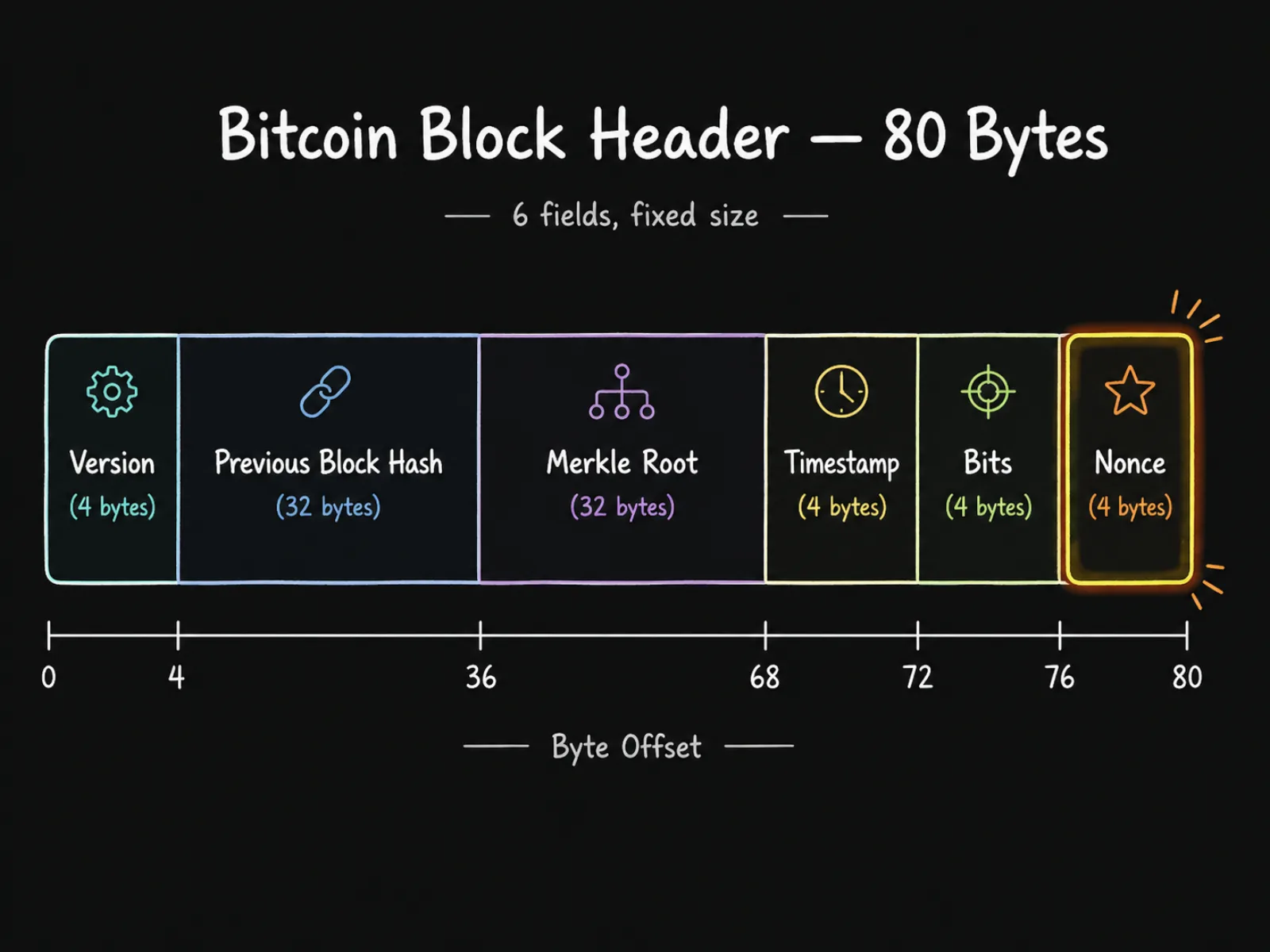
Bitcoin mining does not keep hashing the entire block. What actually participates in Proof-of-Work computation is a fixed-length 80-byte block header. Bitcoin developer reference materials split the header into Version, Previous Block Hash, Merkle Root, Timestamp, nBits, and Nonce, where the final Nonce is 4 bytes, a 32-bit unsigned integer.
| Block Header Field | Length | Primary Role |
|---|---|---|
| Version | 4 bytes | Indicates block version and related rules |
| Previous Block Hash | 32 bytes | Points to the previous block |
| Merkle Root | 32 bytes | Summarizes transactions in the current block |
| Timestamp | 4 bytes | Block time |
| nBits | 4 bytes | Encoded target threshold |
| Nonce | 4 bytes | Repeatedly changed by miners to produce different hash results |
The block header totals 80 bytes, and the Nonce occupies only the last 4 bytes.
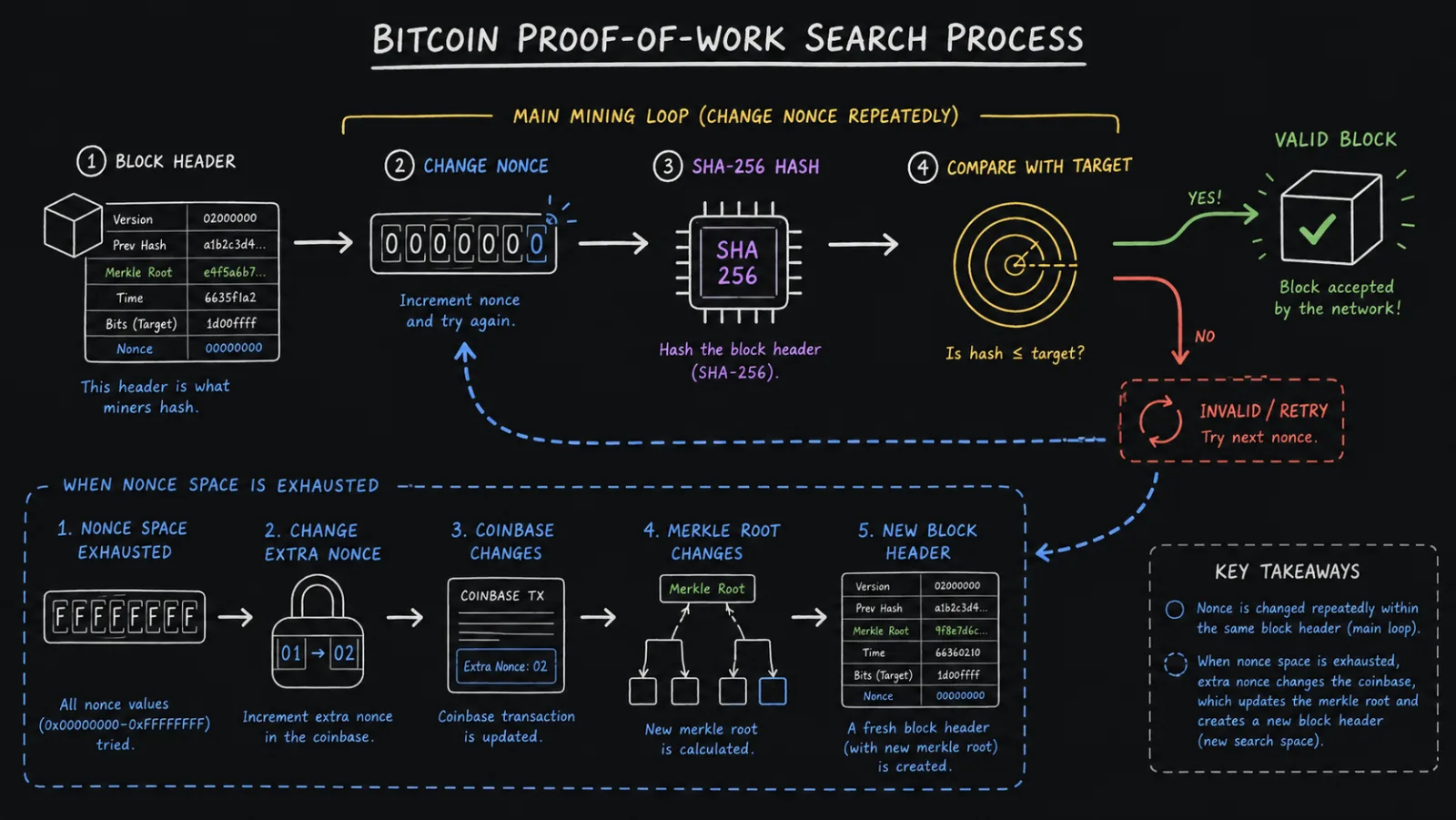
The Nonce's core role is not storing a pre-existing "answer," but giving miners a variable they can modify quickly. After obtaining a candidate block header, a miner can change the Nonce and re-run SHA-256 Proof-of-Work computation on the header. As long as the Nonce changes, even if every other field is identical, the final hash is completely different. Miners thus keep changing Nonces, computing new hashes, and checking whether results are less than or equal to the current target. Bitcoin developer docs describe this directly: the miner receives an 80-byte block header and target threshold, then traverses possible Nonces and computes corresponding hashes; if a result meets the target, it returns the successful header to mining software.
That is also why translating Nonce simply as "random number" is not very accurate. The Nonce does not need to be truly random—it is only a value miners are allowed to modify. Miners can search different values in some order, or assign different ranges to different chips. What truly matters is not "randomness," but not repeatedly computing an identical block header, which would only produce an identical hash.
A 32-bit field has 2³², or 4,294,967,296 possible values. In the early CPU/GPU mining era, that was already a large space; after ASICs arrived, several billion hash computations were nowhere near enough to keep miners working continuously. Bitcoin developer docs also state clearly that after all 32-bit Nonces are tested, miners can update the time field, or modify the Coinbase transaction and update the Merkle Root, thereby producing a new block header.
That leads to the second Nonce in Bitcoin mining that is equally important but often overlooked.
The Second Nonce: How Extra Nonce Creates New Search Space
The biggest difference between Extra Nonce and the block-header Nonce is this: Extra Nonce is not an independent field defined in the Bitcoin block header.
Every block contains a special Coinbase transaction—the first transaction in the block, and where miners claim the block subsidy and fees. The Coinbase input script may contain a range of arbitrary data, and miners usually use part of it for Extra Nonce. Bitcoin developer reference materials explicitly note that miners typically add Extra Nonce to the Coinbase field and change it to update the Merkle Root in the block header.
The key is a very important causal chain: Extra Nonce changes → Coinbase transaction changes → Coinbase transaction hash changes → Merkle Root changes → block header changes → an entirely new Nonce search space appears.
So Extra Nonce is not the 32-bit field used directly for SHA-256 search. It is more like a "block-header generator": after a miner finishes the Nonce space of one set of headers, mining software changes Extra Nonce, recomputes the Coinbase transaction and corresponding Merkle Root, and obtains another different 80-byte header. The new header again has a full 2³² Nonces to try. Bitcoin mining developer docs describe exactly this: when the current header finds no hash meeting the target, mining software adds new Extra Nonce data to the Coinbase to generate a new Merkle Root, then hands the updated header to mining hardware to continue.
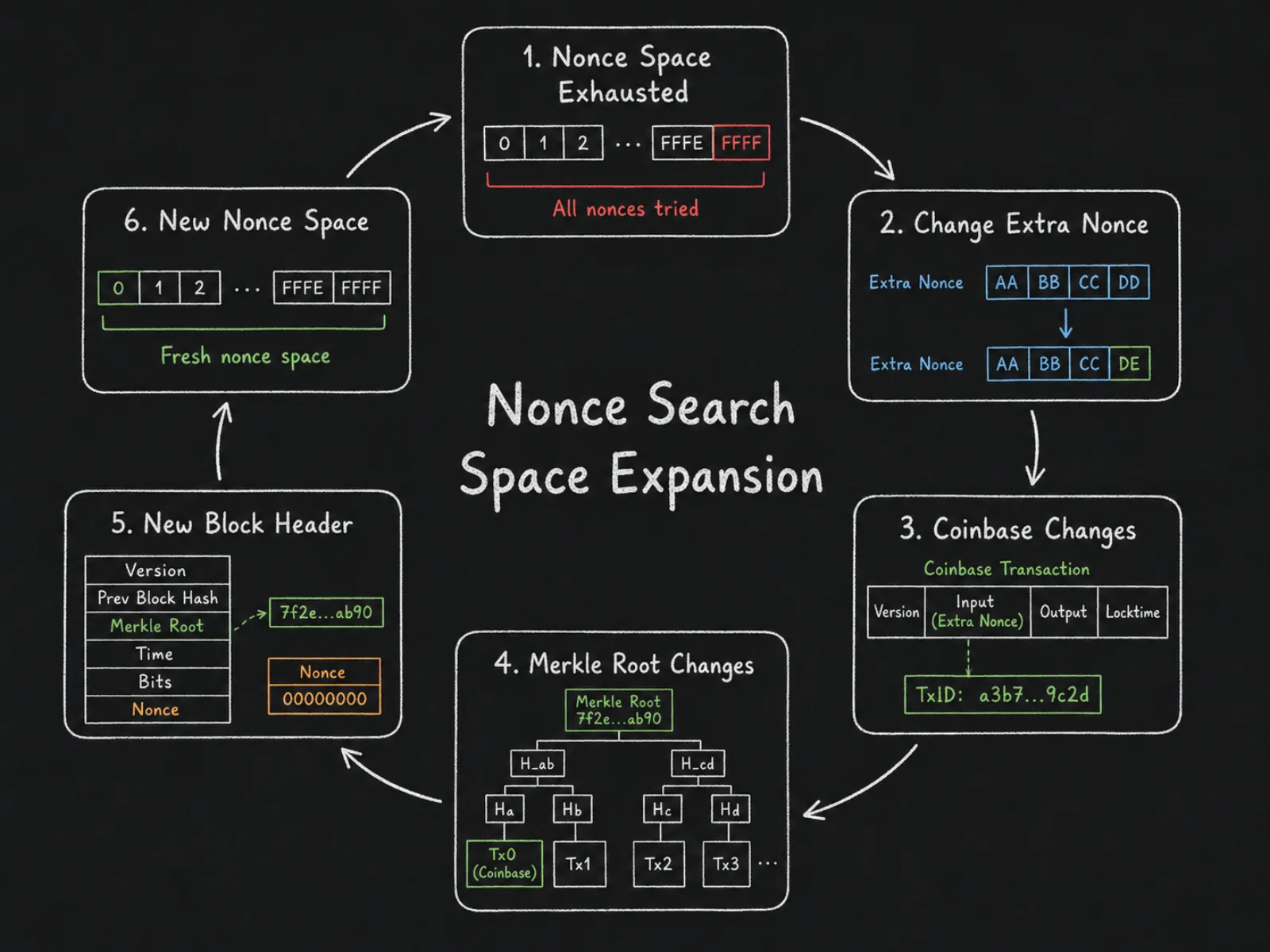
So understanding the process as "the ASIC counts from 0 to 4,294,967,295, then starts over from 0" is still inaccurate. What really happens is: the mining system keeps constructing different valid block headers, then searches for a qualifying hash on each header. Nonce is the most direct, lowest-cost mutable field, while Extra Nonce lets miners keep generating different Merkle Roots and headers.
What Is the Difference Between Nonce and Extra Nonce?
For general readers, think of them as "the search variable inside the block header" versus "the way to expand search space outside the header."
| Comparison | Nonce | Extra Nonce |
|---|---|---|
| Location | Block header | Mutable data in the Coinbase transaction input script |
| Fixed block-header field? | Yes | No |
| Participates directly in header hash? | Yes | Indirectly |
| How it affects the hash | Directly changes the last 4 bytes of the header | Changes the Coinbase transaction, then the Merkle Root |
| Primary role | Try different hashes quickly | Generate new block-header search space |
| Search space | 32 bits, i.e. 2³² values | Depends on the specific pool and mining-protocol implementation |
This table also shows that "searching for a Nonce" actually has two layers. One happens inside ASIC chips—extremely high-speed hash computation; the other happens in the pool, mining software, or miner control system—continuously preparing new work.
That also explains why modern Bitcoin mining cannot be simplified to "the miner keeps guessing a random number." The real process is closer to a layered system: the pool or node prepares candidate block work; mining software constructs the Coinbase transaction and Merkle Root and generates the header; the ASIC receives the header, changes Nonces at high speed, and computes hashes. If the current search space cannot produce a valid result, upper-layer software keeps changing Extra Nonce, time, or other adjustable data to generate new work for the ASIC.
BIP 23 further specifies work templates in pool mining and even provides noncerange to represent the Nonce range a miner may search. That shows that in real pool architecture, the Nonce is not isolated—it is one component of a full "assign work — search — submit" system.
Why Has Rising Hashrate Not Made the 32-bit Nonce a Bottleneck?
If there were only the 32-bit Nonce in the block header, modern ASICs clearly could not get a large enough independent search space. So modern mining systems do not rely on that field alone.
Besides changing Coinbase and Merkle Root via Extra Nonce, miners can also change other header data within protocol limits. An important example is Version Rolling. BIP 310 defines a Version Rolling extension for the Stratum mining protocol so miners can change header Version bits within a pool-allowed range, further expanding header space that can be searched directly on hardware.
This issue continues to evolve in the high-hashrate ASIC era. The BIP 323 draft proposed in April 2026 further suggests reserving 24 bits of block-header nVersion as general Nonce space. The motivation is that modern devices already need larger header-level search space than the traditional 32-bit Nonce, reducing how often miner controllers must generate new work. Note that BIP 323 is still a draft, not consensus rules that have fully replaced existing mining methods—but it clearly shows that as ASIC hashrate keeps rising, how to expand Nonce search space efficiently is itself an important problem in modern Bitcoin mining protocol design.
So when people say "miners search for a Nonce" today, a more accurate understanding is: miners keep creating and searching large numbers of different block-header combinations—not searching for a unique answer inside one 32-bit number range.
What Does Finding the "Correct Nonce" Actually Mean?
The Bitcoin network does not store a pre-existing "correct Nonce." For every different candidate block header, miners face a new hash-search problem.
After modifying the Nonce, miners hash the header and compare the result with the current target threshold. If the hash is above the target, the attempt fails; if the hash is less than or equal to the target, the header meets Bitcoin Proof of Work. Bitcoin block-header reference materials state clearly that the Nonce's purpose is to change the header hash in an attempt to produce a result less than or equal to the target.
That means a billion failed attempts in a row do not make the next computation "closer" to success. SHA-256 output cannot be predicted from the previous result. The most direct way to raise mining success probability is not finding a math shortcut, but trying more valid, non-repeating block headers per unit time. That is the meaning of hashrate: higher Hashrate means more hash attempts per second, and a higher probability of finding a valid block under the same network difficulty and time window.
So Nonce, Hashrate, and Difficulty describe different parts of the same Proof-of-Work mechanism: Nonce provides mutable data, Hashrate is search speed, and the target corresponding to Difficulty decides how strict a hash result must be.
From One Nonce to Tens of Thousands of ASICs: The Hard Part of Mining Has Already Changed
At the protocol layer, Bitcoin mining's core action is very pure: keep creating new block headers, compute hashes, and find results that meet the target. But once this process scales to real farms, operators no longer face "how to search Nonces by hand."
ASIC chips finish low-level hash search, pools keep providing mining tasks, and what farms truly must manage is whether hundreds, thousands, or tens of thousands of devices can keep participating in that search stably. If a miner underclocks from heat, has a hashboard fault, network anomaly, pool-connection failure, or goes offline and stops computing, the problem is not "Nonce not found"—it is that the miner can no longer join the Nonce search process at the speed it should.
That is why large farms increasingly need an independent miner management layer. Nonce can continuously observe hashrate, efficiency, miner status, and related metrics in a unified farm overview, and quickly locate overheating, zero-hashrate, low-hashrate, and offline devices through miner filters. For problem miners already identified, farms can continue bulk operations and automation through the farm operations flow.
From this angle, the name Nonce.app has a very direct semantic link to Bitcoin mining itself. The protocol Nonce represents miners continually trying new block-header combinations and searching for results that meet the target through massive computation; farm ops must do the higher-layer work of continually optimizing the devices participating in that computation—keeping as many ASICs online as possible, maintaining normal hashrate, and reducing invalid runtime.
Understanding Nonce Means Understanding How Bitcoin Mining Keeps Creating "New Attempts"
If you remember only one sentence: the Nonce in the Bitcoin block header is the 32-bit variable ASICs search most directly; Extra Nonce creates new block headers and new search space by changing the Coinbase transaction and Merkle Root.
The Nonce is only 4 bytes, but modern Bitcoin miners are not limited to about 4.295 billion computations. Through Extra Nonce, the time field, Version Rolling, and related methods, mining systems keep constructing new headers so ASICs continuously receive new hash work.
So "miners keep searching for the correct Nonce" is only a simplified description of Proof of Work. What truly happens is a highly coordinated search: pools and mining software keep generating new work, ASIC chips keep scanning enormous block-header search spaces, and hundreds of millions of hash results are computed, checked, and discarded until one computation produces a valid hash below the network target.
Once you understand block-header Nonce and Extra Nonce, Nonce is no longer just a "random number." It is a key to understanding Bitcoin Proof of Work, ASIC hashrate, pool work assignment, and how modern farms operate.