Why Do Bitcoin Miners Need a Nonce? Understanding the Random-Number Mechanism in PoW Mining
Bitcoin miners need a Nonce because Proof of Work requires repeatedly changing this 32-bit block-header field and hashing until the result meets the target; when that space is exhausted, Extra Nonce and related fields create new search space.

If Bitcoin mining is simplified to one sentence, it means this: miners keep changing certain data in the block header, repeatedly run SHA-256 hash computation on the header, until they get a hash result less than or equal to the current target. The Nonce is one of the most important—and most easily modified—fields in that process. It is not a hidden "correct answer," nor a number miners derive through mathematical deduction. It is a 32-bit value miners can keep changing. Each time the Nonce changes, the block header changes, producing a completely different hash that is almost impossible to predict in advance. What miners do, in essence, is repeat this process at extremely high speed and search among massive hash results for one that meets Bitcoin's Proof-of-Work requirement.
That is also why understanding the Nonce is almost equivalent to understanding the core layer of Bitcoin Proof of Work. Hashrate, mining difficulty, ASIC miners, pools, and block rewards look like different concepts, but they all revolve around the same thing: whoever can try more candidate block headers in limited time has a higher probability of finding a valid hash.
What Is a Nonce? It Is Not a "Random Number" in the Traditional Sense
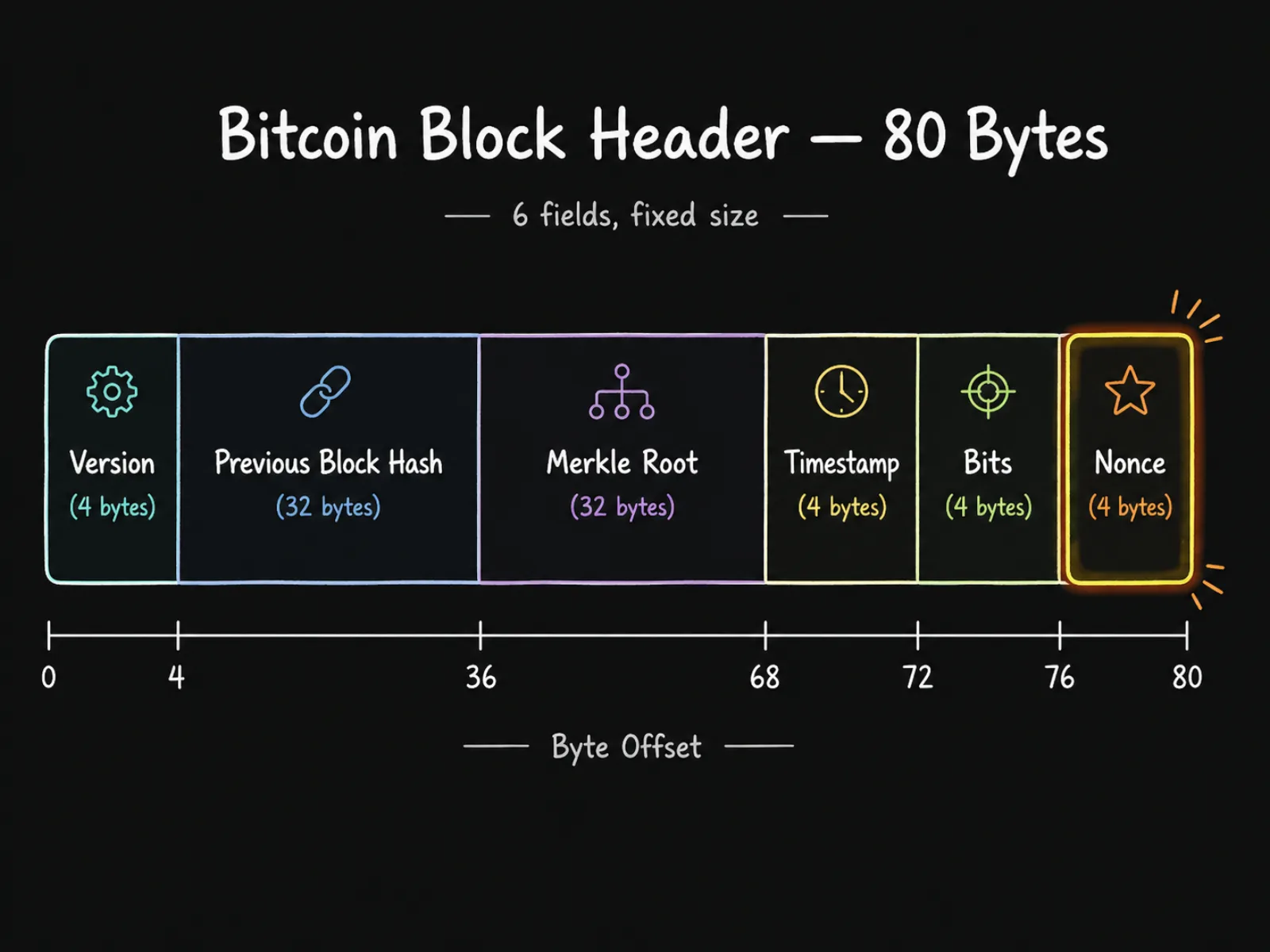
A Nonce can usually be understood as a "number used only once." In the Bitcoin block header, it occupies 4 bytes, or 32 bits. Per the Bitcoin block header structure, a full block header is 80 bytes and consists of version, previous block hash, Merkle Root, timestamp, difficulty-target encoding, and Nonce, where Nonce is a uint32_t value.
| Block Header Field | Size | Role in Mining |
|---|---|---|
| Version | 4 bytes | Indicates the validation-rule version used by the block |
| Previous block hash | 32 bytes | Connects the current block to the previous block |
| Merkle Root | 32 bytes | Represents the set of transactions in the current block |
| Timestamp | 4 bytes | Records block-related time information |
| Difficulty-target encoding | 4 bytes | Represents the target the block hash must meet |
| Nonce | 4 bytes | Continuously modified by miners to produce different hash results |
Because the Nonce is 32 bits, the Nonce in a single block header can in theory traverse from 0 to 2³²−1, about 4.295 billion possible values. A common misunderstanding is translating Nonce directly as "random number," but modern ASICs do not need to truly guess numbers at random. They can traverse these values at high speed in a specific order. What truly has a "random effect" is the SHA-256 hash output—any small input change produces a completely different hash, and the next result cannot be predicted from the previous one. Bitcoin developer documentation on PoW also stresses that cryptographic hash functions map different inputs to seemingly random numbers, so miners cannot adjust inputs to directly predict a result that meets the target.
So more accurately, a Nonce is a "variable search parameter," not a number miners must generate randomly.
Why Does Changing One Nonce Produce a Completely Different Block Hash?
Bitcoin mining does not hash the entire block—it hashes the 80-byte block header. Miners take the header as input for hash computation, and the Nonce sits inside that header. As soon as the Nonce changes from one value to another, even if every other field stays identical, the hash input is already different, so the final output changes too.
Bitcoin Proof of Work requires that the block-header hash not exceed the current target. Bitcoin Core's PoW validation logic also compares the block hash directly with the target decoded from nBits: if the hash is greater than the target, validation fails; only a hash less than or equal to the target meets the PoW requirement.
You can imagine this as an enormous lottery space. Each hash computation is like drawing a new number approximately randomly distributed between 0 and 2²⁵⁶−1. If the target requires the result to fall in an extremely small region, most attempts fail. Miners cannot know in advance which Nonce will succeed, so the only reliable method is continuous trying.
This also explains why a "correct Nonce" is not a fixed answer. The same Nonce in two different block headers—because previous block hash, Merkle Root, timestamp, and other data differ—produces completely different hashes. Whether a Nonce is "correct" depends only on whether the hash produced with the current block header meets the current target.
So the core of Bitcoin mining is not finding a Nonce with special mathematical regularity—it is continuously creating new block-header inputs and checking whether the corresponding hash is small enough.
Why Must PoW Mining Keep Trying Nonces?
The key of Proof of Work is that producing a valid block must consume real compute resources. Bitcoin does not ask miners to solve a math equation that a clever algorithm can finish quickly; it asks them to find a block-header hash that meets the target. Because hash output is unpredictable, miners can only run large amounts of repeated computation.
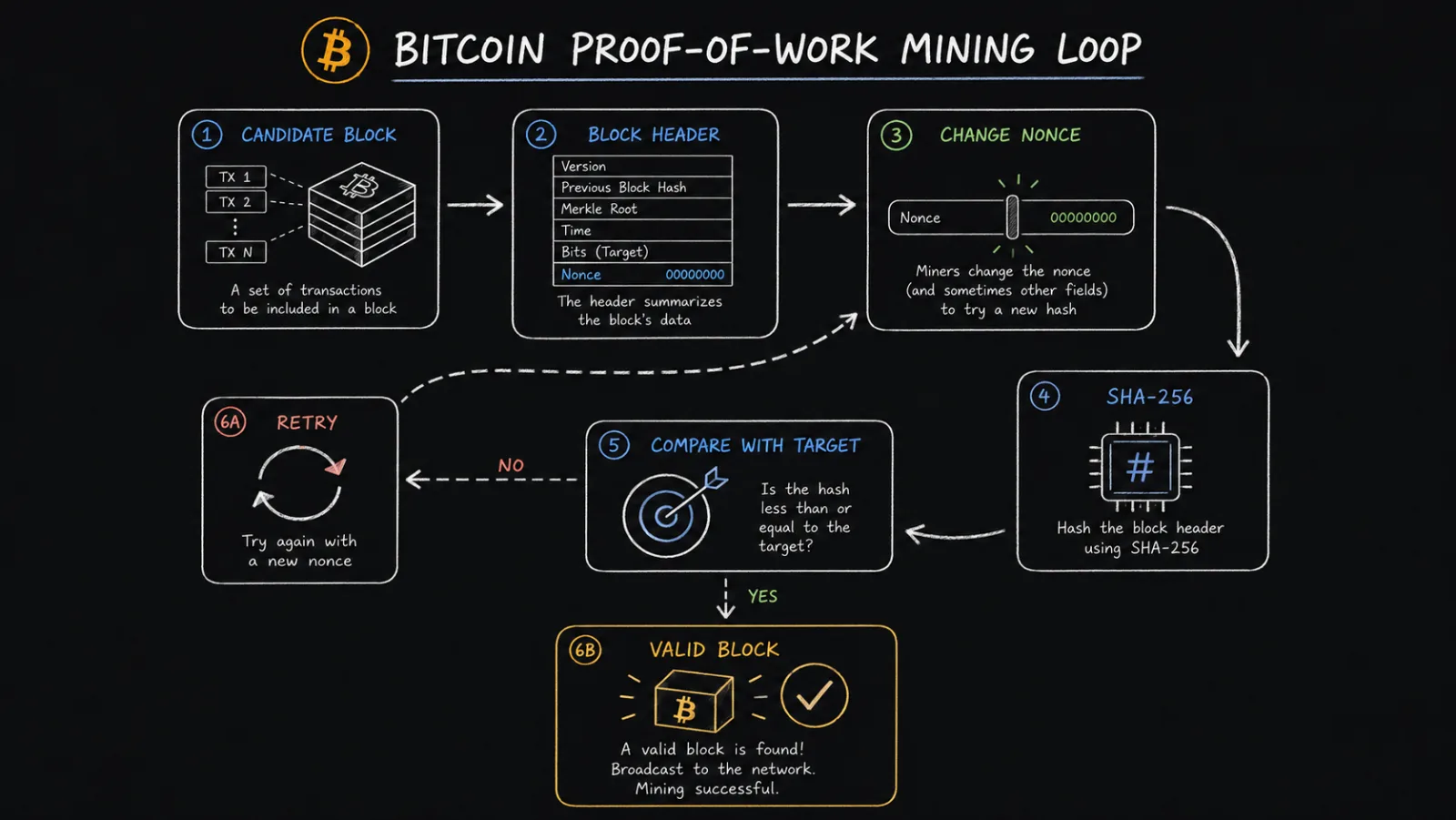
Per the Bitcoin mining process, mining software first constructs a candidate block and generates an 80-byte block header, then sends the header and target to ASIC hardware. The ASIC then traverses possible Nonces and computes corresponding hashes for different headers. If a result is below the target, the miner has found a candidate that meets the PoW condition.
The whole process can be simplified as:
Candidate block data → construct block header → modify Nonce → compute hash → compare with target → if not met, keep modifying Nonce → if met, submit the block.
That is also what "hashrate" truly means. 100 TH/s is not how many bitcoins a miner can find per second—it is roughly 100 trillion hash computations per second in theory. Higher hashrate means more candidate results checked per unit time, and thus a higher probability of finding a hash that meets the network target.
No miner knows how far it is from the answer. It may succeed on the next hash, or run a very long time without directly finding a new block. The probabilistic nature of PoW is one reason Bitcoin can convert block-production competition into real compute cost.
After 4.295 Billion Nonces Are Exhausted, Do Miners Run Out of Numbers to Try?
This is a critical point for understanding modern ASIC mining. The Nonce is only 32 bits, so a fixed block header indeed has only about 4.295 billion Nonce combinations. For today's ASIC hashrate, that space is actually very small.
Early miners had lower hashrate, so traversing a 32-bit Nonce took longer; modern ASICs can complete tens of trillions or more hash operations per second. If they could only use the 32-bit Nonce space of one fixed block header, they would exhaust all possible values very quickly.
So real mining is not: "search through 4.295 billion Nonces, then stop." It is: "search one Nonce set → change other data in the block header → obtain an entirely new search space → keep searching."
Bitcoin developer docs specifically describe this mechanism: if a miner finishes the Nonces in one block header without finding a hash below the target, mining software can change extra-nonce data in the coinbase transaction, which changes the coinbase transaction hash, then the Merkle Root, and finally generates a new block header so the ASIC gets a new Nonce search space.
That means the actual mining search space is far larger than 2³². The Nonce is only one of the fields ASICs modify most directly and at highest speed. When that layer is swept, mining software changes other mutable data in the block template and generates new work.
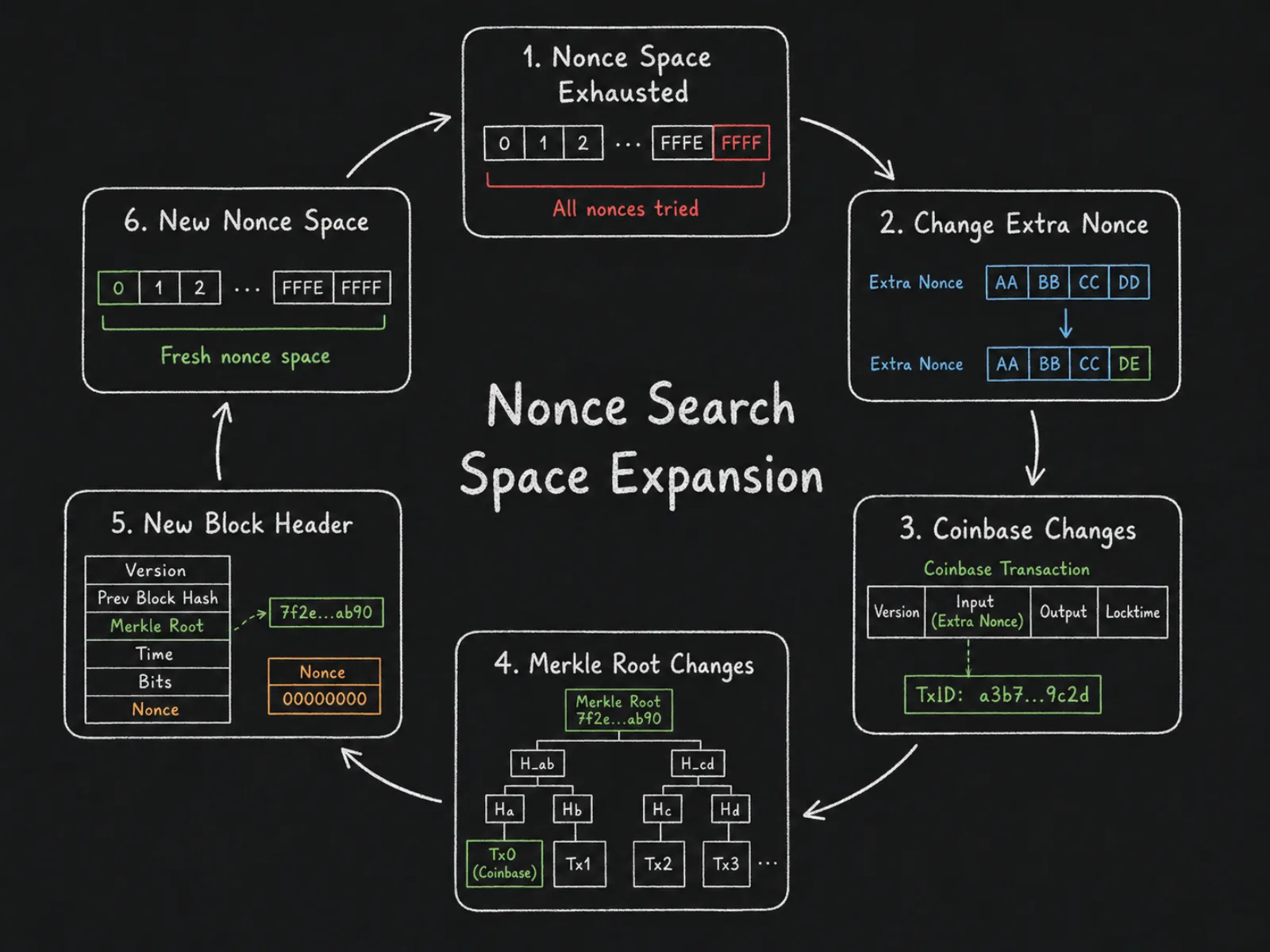
You can understand the whole mechanism as a continuously expanding loop.
What Is the Relationship Among Nonce, Hashrate, and Difficulty?
Nonce, hashrate, and mining difficulty are often discussed together because they correspond to three different parts of the PoW search: Nonce provides mutable input, hashrate determines try speed, and difficulty determines the success condition.
| Concept | Essence | Impact on Miners |
|---|---|---|
| Nonce | Mutable value in the block header | Used to keep generating new candidate hashes |
| Hashrate | Hash-computation capacity per unit time | Determines how many attempts a miner can make per second |
| Target | The value a hash must be below | Determines whether one hash is valid |
| Difficulty | Network mining difficulty | Higher difficulty means more hash attempts needed on average |
Bitcoin developer documentation notes that only a block-header hash meeting the protocol target can be accepted by the network; Bitcoin also periodically adjusts mining difficulty so block production stays near the target pace over the long term.
So rising difficulty does not make the "correct Nonce" itself more complex—it makes qualifying hashes rarer across the entire 256-bit hash space. Miners then need more hash attempts on average.
That is also why, after network hashrate rises, even if a single miner's hashrate does not fall, its share of global hashrate may fall and long-run expected output changes. What miners truly compete on is not "who finds Nonces more cleverly," but who can sustain more effective hash computation at lower cost.
After Pools Appear, Do Miners Still Need to Search for a Nonce?
Yes. Joining a pool does not change the basic principle that ASICs compute PoW. Miners still must keep changing block-header data, run hashes, and search for results that meet a target. What mainly changes is work assignment and payout settlement.
In pool mode, the pool usually sets miners a Share target easier than the Bitcoin network target. After finding a hash that meets the pool target, the miner can submit it to prove how much compute work it actually completed. These submissions are called Shares. Occasionally, a Share meets not only the pool target but also the Bitcoin network's stricter target—then it may become a truly valid block.
So ASICs are doing similar work from start to finish: receive work, search the Nonce and other mutable spaces, compute large numbers of hashes, and submit results that meet the target. The difference is that most results prove contributed hashrate, while a tiny fraction meet full-network difficulty and produce a new block.
Modern pool protocols also need to solve task assignment for large farms and many ASICs working at once. Different miners must receive large enough, preferably non-overlapping search spaces; otherwise two miners computing the same data only waste electricity. Extra Nonce, different coinbase data, and different work templates are important ways to expand search space.
From Searching for a Nonce to Managing Quadrillions of Hashes: What Do Modern Farms Truly Manage?
From a protocol view, mining can be condensed to "keep computing hashes." From a farm-ops view, what truly affects revenue is not only theoretical ASIC hashrate, but how much hashrate can keep participating in that search stably.
If a miner is rated 200 TH/s but stays at 160 TH/s for long periods due to overheating, the number of Nonce searches and block-header hashes it participates in each second drops. If a miner is offline for an hour, actual hashes in that hour are zero. If pool connection fails, firmware is abnormal, a hashboard fails, or the network breaks, an ASIC may still be powered on yet unable to mine effectively.
So large-farm ops ultimately care about a very practical question: how to keep as many ASICs as possible, for as long as possible, running effective hash computation at reasonable power and temperature.
That is where Bitcoin mining changes after moving from the protocol layer into the farm management layer. At the technical layer the core is Nonce, block header, SHA-256, and target; at the ops layer the core becomes hashrate, uptime, temperature, power draw, pool connection, and anomaly recovery.
In Nonce, miner anomaly filters can centrally locate low-hashrate, zero-hashrate, offline, and high-temperature devices, and combine bulk operations to handle large fleets instead of logging into each IP backend one by one. For persistently low-hashrate devices, you can also set low-hashrate auto reboot to run recovery after duration, temperature-protection, and reboot-frequency conditions are met.
A farm management platform does not replace ASICs searching for Nonces, and does not change Bitcoin's PoW algorithm. It solves a higher-layer problem: keep as much hashrate as possible continuously online for hash search. When farms grow from dozens of ASICs to thousands or tens of thousands, that difference directly affects effective hashrate and farm operating efficiency.
Understanding the Nonce Means Understanding the Core Logic of Bitcoin Mining
The importance of the Nonce is not that the number itself has special meaning—it embodies Bitcoin Proof of Work's basic mechanism: miners cannot compute in advance which input yields a valid hash; they can only spend real hashrate and keep trying.
Change the Nonce once, and the block header changes once; change the block header once, and you get one new hash opportunity. After the 32-bit Nonce space is exhausted, miners can still change extra Nonce, coinbase transaction, Merkle Root, time, and other fields to generate new block headers and keep creating new search space. ASIC high-speed hashrate essentially pushes this process to tens of trillions of attempts per second or higher.
So "searching for a Nonce" is not searching for a pre-existing password—it is a probability search with no shortcuts. Mining difficulty determines how rare success is, hashrate determines how many "try chances" a miner can buy per second, and electricity is the real cost behind those tries.
The name Nonce also comes from this native Bitcoin concept. For today's large farms, a single ASIC is still searching Nonces at high speed, while farm management faces another scale of problem: how to keep hundreds, thousands, or more ASICs online, stably outputting hashrate, and reducing invalid time from heat, hashrate drops, offline events, and device anomalies. What Nonce connects is exactly these two layers of logic—from the most basic Nonce search in the Bitcoin protocol to large-scale hashrate management in real-world ASIC farms.