Why Do Large Bitcoin Mining Farms Need a Miner Management Platform?
Large Bitcoin farms need a miner management platform because once fleets grow to hundreds or thousands of ASICs, operators must centrally find offline, low-hashrate, and overheating issues, then bulk-handle and auto-recover—per-IP logins cannot keep up.
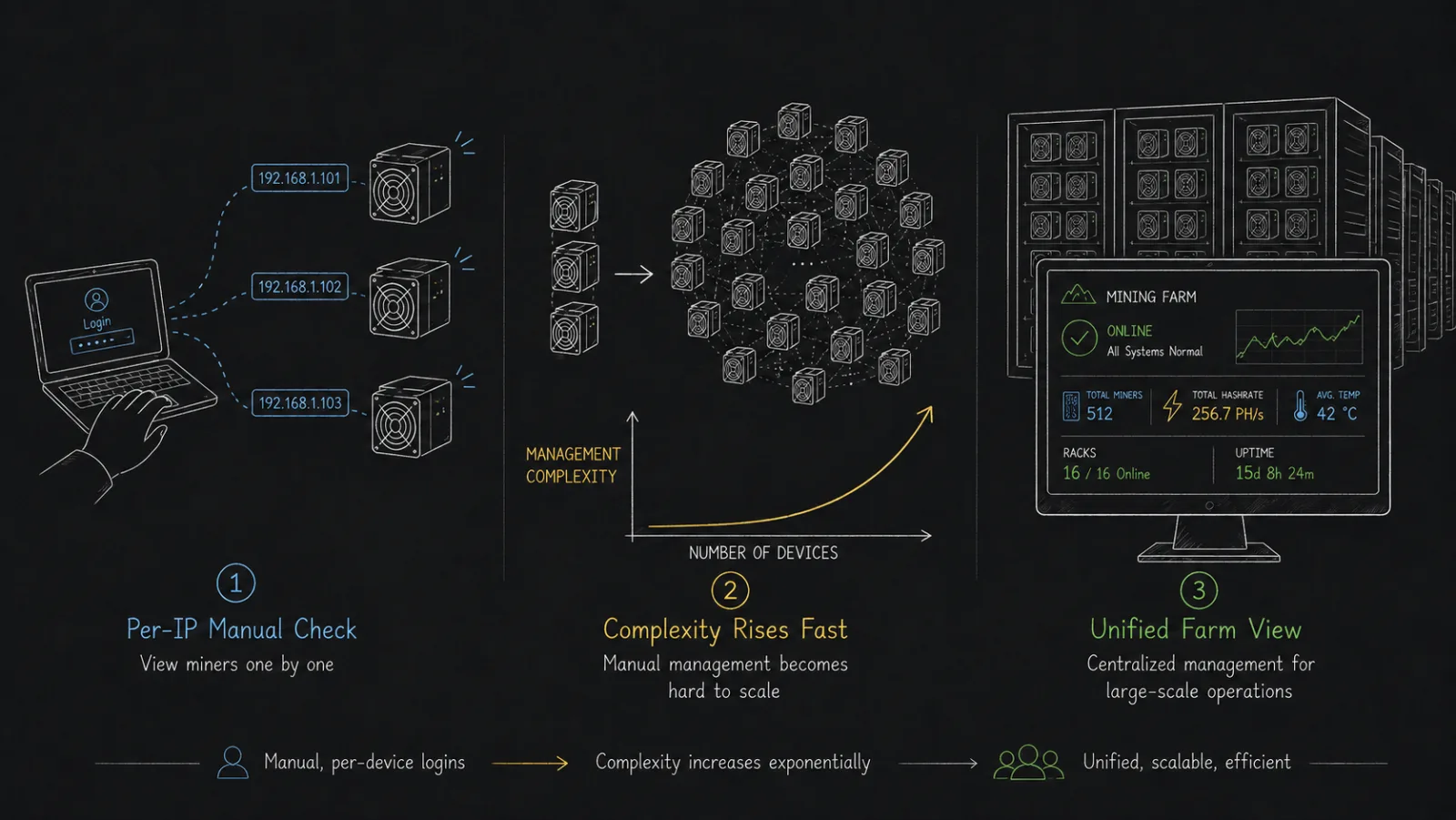
Large Bitcoin mining farms need a miner management platform not because a single ASIC cannot run on its own, but because once miner counts grow from a few machines to hundreds or thousands, what the farm truly must manage shifts from "individual devices" to "the entire miner fleet." Whether hashrate is stable, how many miners are offline, which devices are at low hashrate, which racks show abnormal temperature, whether pool configs are correct, whether power modes need adjustment, and whether devices recover after fault handling—all of these must be continuously discovered, judged, and handled. Relying only on logging into miner IPs one by one, manually reading logs, and on-site walkthroughs makes it hard to sustain the response speed and operating efficiency a large farm needs over the long term.
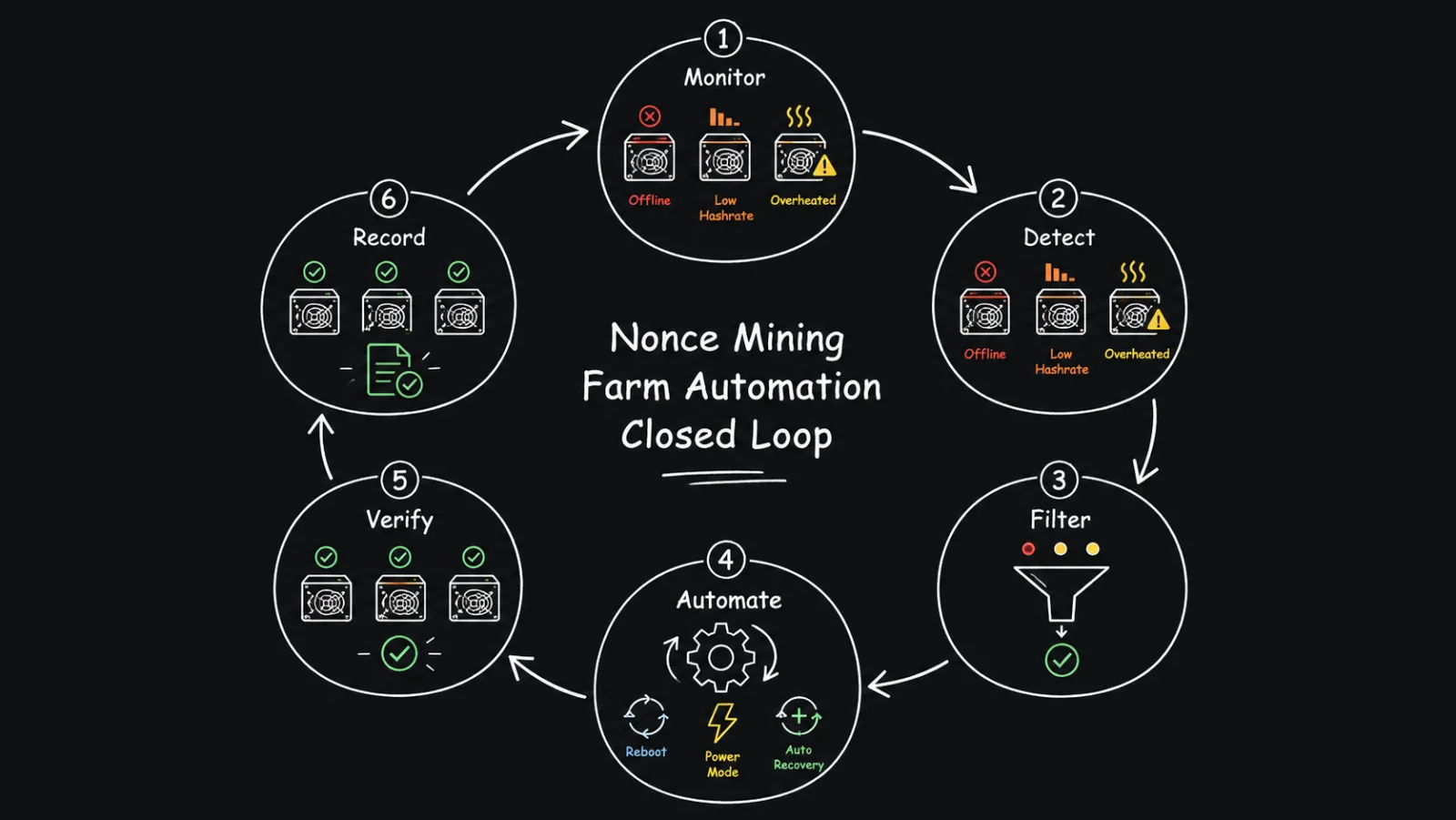
The value of a miner management platform is essentially to centralize data and actions that were scattered across hundreds or thousands of ASICs, so the farm can form an ops closed loop of "discover anomaly — locate device — bulk handle — auto recover — verify result." Nonce is designed around this process: it brings farms, miners, hashrate, temperature, runtime status, and tasks into one management system, then reduces repetitive manual work through filtering, bulk operations, and automation. For large farms, this change is not just a more convenient UI—it changes how the whole farm discovers and handles problems.
Why Does Traditional Per-Machine Management Get Harder as Miner Count Grows?
An ASIC miner is already an independent computing device, with its own IP, firmware, pool config, hashboards, fans, power supply, and runtime logs. With a few miners, operators can enter each miner's backend to check hashrate, temperature, and logs, then reboot or change config when something is wrong. But when the same method is applied to hundreds or even thousands of devices, management cost does not simply scale with device count, because the farm also faces linked issues across racks, switches, power systems, ambient temperature, network, pools, and different miner models.
For example, low hashrate on one miner may come from a hashboard fault, or from high temperature, firmware, network, or power; if a dozen miners on the same rack go offline together, the cause is more likely a switch, power supply, or local infrastructure. In its miner troubleshooting materials, Bitmain groups common anomalies into types such as cannot obtain IP, cannot power on, zero hashrate, and low hashrate, involving network, power, firmware, temperature, control board, and hashboard causes. That means the real hard part for large farms is not "will miners break," but how to quickly find abnormal miners among a large fleet and judge which layer the problem actually sits on.
Bitmain's HOST ANTMINER FAQ also lists many offline causes such as fans, control boards, hashboards, power supplies, high/low temperature, power-distribution maintenance, curtailment, and network faults. For large farms, if anomalies can only be found after manual inspection, user reports, or daily reports, what truly causes loss is often not the fault itself, but the time between when it happens and when it is discovered.
What Large Bitcoin Farms Truly Need to Manage Is Not Just "Whether Miners Are Online"
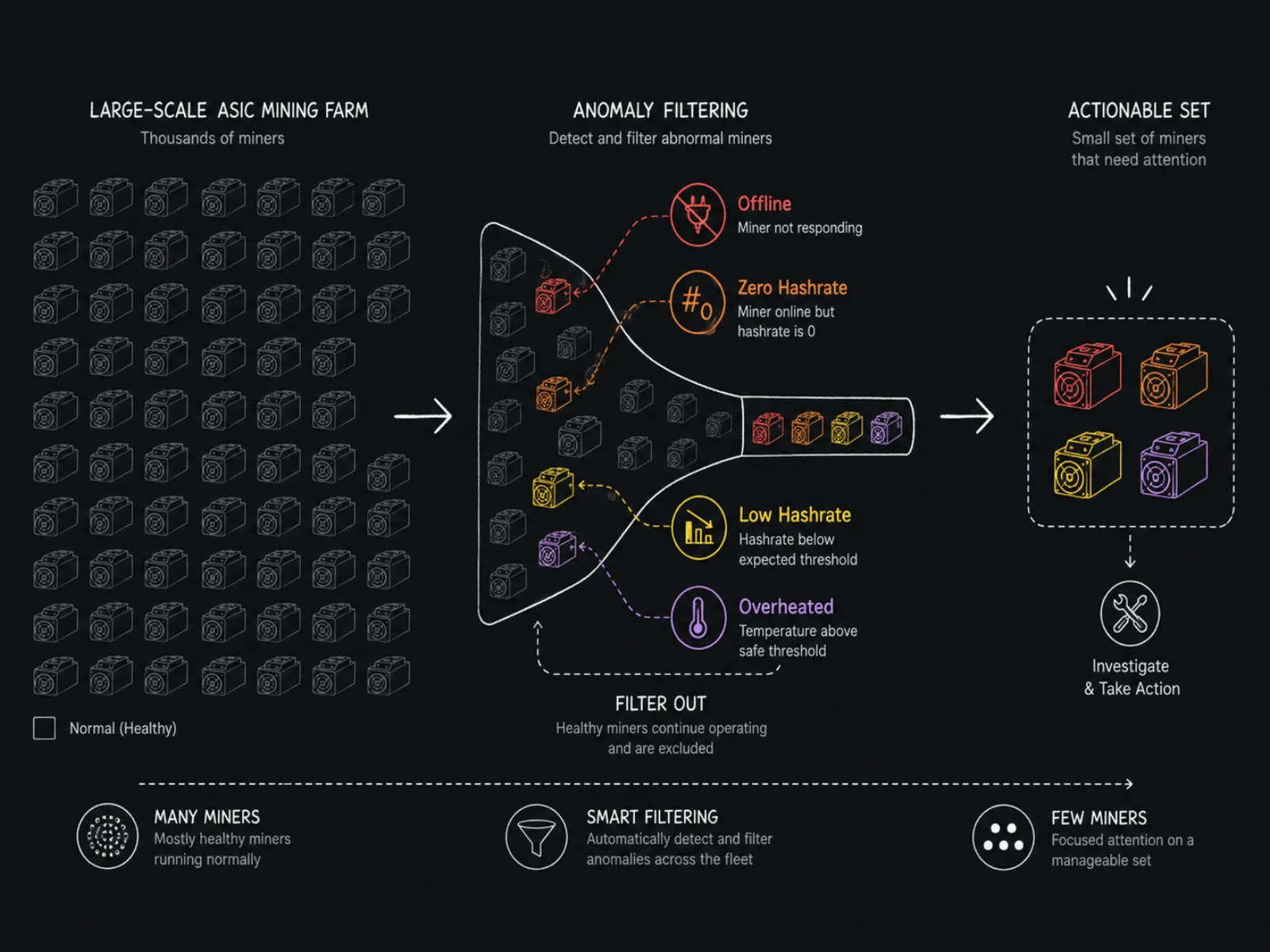
A common ops misconception is that if a miner is still reachable, the device is healthy. In reality, "online" does not equal "producing effective hashrate normally." A miner may respond to network requests while sitting at zero or low hashrate due to abnormal pool connection, hashboard failure, thermal protection, or software faults. So large farms need to watch device connectivity, realtime hashrate, temperature, power draw, pool connection, and hardware anomalies together—not only count online miners.
The core problems a miner management platform must solve can be summarized as:
| Ops Problem | Difficulty of Traditional Per-Machine Management | What a Miner Management Platform Must Solve |
|---|---|---|
| Miner offline | Must check one by one or wait for on-site discovery | Centrally identify offline devices and anomaly scope |
| Zero / low hashrate | Miner may still be online; hard to catch immediately | Filter abnormal devices by hashrate and runtime status |
| High temperature | Cannot continuously check temperature on large fleets manually | Identify abnormal miners by temperature conditions |
| Bulk configuration | Reboot, pools, and power modes must be changed one by one | Run unified tasks on target devices |
| Multi-model fleets | Different miners have different standards and rated hashrate | Set different filter and handling conditions by model |
| Multi-farm operations | Data is scattered across sites and teams | Manage multiple farms and devices in one place |
| Team collaboration | Shared full permissions raise mis-operation risk | Control permissions by role and farm scope |
| Recurring faults | Humans keep repeating the same actions | Auto-execute handling actions that match conditions |
So what large farms need is not a bigger miner list, but an ops system that links "data, anomalies, devices, and actions." As miner count grows, what operators should really watch is no longer "what temperature is miner #382 right now," but "how many abnormal devices are there now, where are anomalies concentrated, which problems can be recovered remotely, and which need on-site handling."
How Does Nonce Shift Farms from "Finding Miners" to "Finding Problems"?
Large farms produce huge amounts of device data every day, but data alone does not automatically raise ops efficiency. What matters is whether operators can quickly find the miners that truly need handling among healthy ones. Nonce's farm overview consolidates hashrate, miner runtime status, efficiency, and revenue-related info into one view, so operators can first judge whether something is wrong from overall farm status, then locate specific devices—without checking from the first miner onward one by one.
For daily troubleshooting, Nonce multi-condition filters can find devices by runtime status, temperature, hashrate, and combined conditions. For example, operators can directly filter offline, zero-hashrate, low-hashrate, or high-temperature miners, and further narrow by model, rack, and hashrate range. This logic matters especially for large farms, because as device count grows, "abnormal devices as a share of total devices" usually matters more than "total device count."
For example, when only a small share of devices at a large site show low hashrate, operators do not need to review every healthy miner—they should get that abnormal batch directly; if multiple miners on the same rack suddenly go offline, shared network or power infrastructure should be checked first; if one model keeps showing low hashrate, temperature, firmware, or device status can be compared further. The point of a miner management platform is to move the ops team's attention from "reviewing all devices" to "handling devices that are actually problematic."
Why Are Bulk Operations the Most Basic Ops Capability for Large Farms?
After finding problems, the second challenge is how to handle them. Suppose dozens of miners need reboot due to the same software anomaly: if operators still must enter each device backend one by one, the farm can discover anomalies but has not truly improved fault-handling efficiency. Centralized monitoring and bulk control are therefore inseparable parts of a miner management platform.
Nonce can run bulk power-mode adjustment on filtered target miners, switching uniformly among normal, overclock, underclock, or sleep modes under different environments and operating conditions. For example, when ambient temperature keeps rising, operators can first filter high-temperature devices in a specific zone or model, then lower power draw together; when some devices must be paused, there is also no need to shut them down one by one on site. The same bulk-management idea applies to common actions such as miner reboot, firmware updates, and pool configuration.
This pattern forms a critical ops path for large farms: "discover abnormal devices → filter target miners with conditions → run unified actions → review task results → check whether devices recovered."
Compared with per-machine management, the biggest meaning of bulk operations is not saving one mouse click—it is letting the farm take unified action on "a group of miners that share common traits." The larger the farm, the clearer this difference becomes, because large-farm faults are usually not isolated events: heat, network, power, firmware, and config issues often affect a rack, a batch of devices, or even an entire site at once.
Automation Moves Farms from "Handle After Discovery" to "Handle When Conditions Match"
If a problem repeats every day, even if each instance can be bulk-solved, operators still spend continuous time. The next efficiency step for large farms is turning repetitive, clearly rule-based actions into automation.
For example, when miner hashrate stays below a reasonable range for long periods, a common first step is reboot. If operators must manually filter low-hashrate miners and reboot every day, that flow itself can be turned into rules. Nonce's low-hashrate auto reboot can judge from average hashrate over a period whether a device stays below a set threshold, then send a reboot task when conditions are met. Different miner models can use different hashrate standards, with temperature protection, execution-frequency limits, and reboot-count limits so "automation" does not become endless reboot loops.
Temperature changes are also a good fit for automation. Nonce's temperature-driven operating modes can adjust miner power modes based on average temperature over a period—for example lowering operating intensity when temperature exceeds the set condition, then restoring a higher mode after ambient temperature drops. For large farms, the importance of this automation is shifting miner management from fixed configuration to dynamic operations: devices no longer stay in one power state forever, but adjust based on site environment and runtime data.
Automation is not meant to fully replace farm operators. What truly fits automation is repetitive work with clear conditions, controllable actions, and verifiable results; hashboard damage, power failures, and network-device faults may still need on-site engineers. A more reasonable farm ops structure lets the system auto-solve problems that can be recovered remotely, and leaves human time for devices that truly need diagnosis and repair.
Multi-Farm Ops Also Needs Permissions, Responsibility, and Action Boundaries
As farm scale grows, another often overlooked question is "who can operate what." A small farm may have only one or two people managing all miners, but large ops teams usually include owners, site managers, on-duty staff, on-site engineers, partners, or people who only need to view data. If every account has identical full permissions, an otherwise ordinary daily action can affect a large number of devices.
Nonce's roles and permissions separate team management, farm configuration, daily miner operations, and read-only viewing, and can further limit which resources people can access and operate by specific farm scope. That way, people responsible for the whole workspace can manage teams and multiple farms, site leads can manage assigned farms, daily ops staff only run miner actions within authorized scope, and external partners or observers can view data only.
For large farms, this permission design is not an add-on—it is part of scaled operations. The more miners you have, the larger the hashrate impact of one mistaken action; the more farms you have, the clearer team responsibility boundaries need to be. A truly mature miner management platform must answer not only "what happened to the miner," but also "who can handle it, what was handled, and what was the result," gradually moving farm ops from reliance on personal experience toward manageable, reusable processes.
Large Farms Need Not More People Watching Miners, but a More Efficient Ops Closed Loop
From a single ASIC to a large Bitcoin farm, the biggest change is not only miner count—it is system complexity. Network, power, temperature, pools, firmware, hashboards, and device config jointly determine the effective hashrate that can be output stably. When these problems hit large fleets at once, continuing to rely on manual per-machine checks is essentially running large infrastructure with small-miner management methods.
What a miner management platform should truly solve are three questions: can anomalies be discovered ASAP, can it quickly determine which miners need handling, and can devices be restored with the least manual work. Nonce centrally manages farm and miner data, then connects anomaly filtering, bulk operations, automation, and team permissions into a continuously running farm ops flow.
For large Bitcoin farms, the metrics that ultimately matter remain stably produced effective hashrate and device uptime. A miner management platform cannot eliminate hardware failures or replace on-site engineers, but it can shorten the time anomalies go unnoticed, cut repetitive actions, and help limited ops staff focus on problems that truly need human intervention.
As farm scale keeps growing, management efficiency ultimately becomes part of mining efficiency. Buying miners only obtains theoretical hashrate; only when those devices stay stably online for long periods, keep outputting hashrate, and recover quickly after anomalies does that hashrate truly convert into farm revenue. That is the irreplaceable value of a miner management platform as large Bitcoin farms move from "managing miners" to "managing the entire miner fleet."