How Bitcoin Mining Farms Can Batch Overclock and Underclock ASIC Miners: A Complete Guide to Improving ROI
Overclocking and underclocking ASIC miners is never about raw hashrate; the goal is to maximize farm ROI under a given electricity price, temperature, and market conditions. This guide gives per-model and per-electricity-price strategies and shows how large farms use Nonce to batch-locate overheated, low-hashrate, and offline miners and automate dynamic power management.
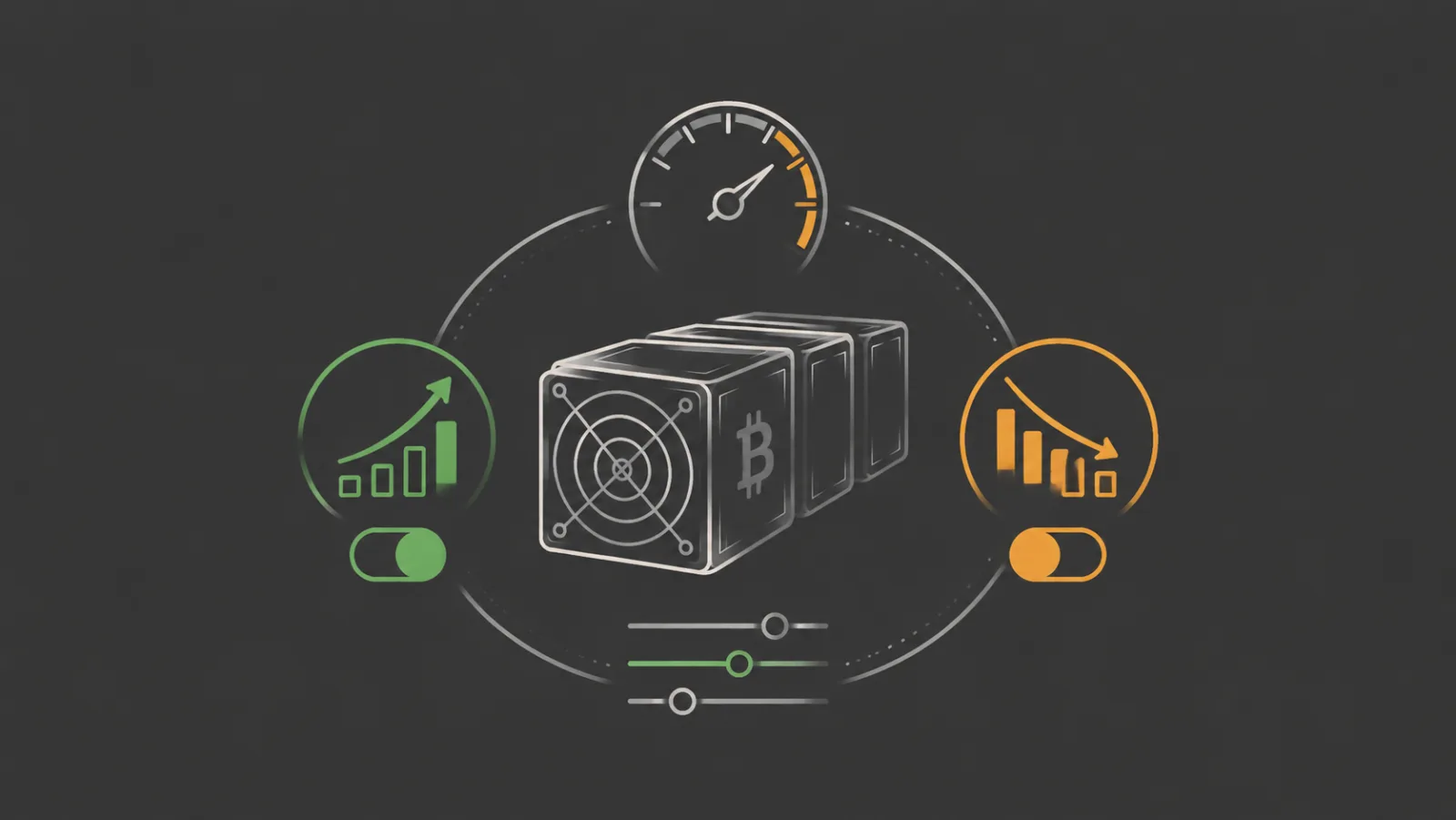
Why Are ASIC Overclocking and Underclocking Becoming More Important?
Over the past few years, the Bitcoin mining industry has gone through two major changes. First, ASIC miner efficiency has continued to improve: from about 29.5 J/TH for the Antminer S19j Pro, to 21.5 J/TH for the S19 XP, and then to 15 J/TH for the S21 Pro. The amount of energy required per unit of hashrate keeps falling. Second, miners now face a much more complex operating environment. Profitability is no longer affected only by the Bitcoin price, but also by electricity price fluctuations, hashprice volatility, differences in miner efficiency, ambient temperature changes, cooling capacity, and firmware capabilities. More and more, miners can no longer rely on default settings for every machine. They need to dynamically adjust miner performance modes based on market conditions.
For mining farms with hundreds or even tens of thousands of ASICs, power management has evolved from simple miner tuning into a core part of mining farm operations.
What Are ASIC Overclocking and Underclocking?
ASIC overclocking means increasing the operating frequency of miner chips to achieve higher hashrate. ASIC underclocking means lowering chip frequency to reduce power consumption and improve energy efficiency. However, there is one issue many miners overlook: more hashrate does not necessarily mean more profit. The relationship between miner power consumption, frequency, and voltage can be approximated as:
$W = a \times F \times V^2$
Where W = power consumption, F = frequency, and V = voltage.
This means power consumption is proportional to the square of voltage. As a result, even a small increase in voltage can lead to a significant increase in power consumption.
The Revenue Logic Behind Overclocking
For example, an S21 Pro miner may run at 234 TH/s and 3510W in standard mode. When overclocked, its hashrate may increase to 260 TH/s, while power consumption may rise to 4200W. Hashrate increases by 11%, but power consumption increases by about 20%. If electricity prices are high, the additional revenue may not cover the additional electricity cost.
Therefore, whether overclocking is worthwhile must be evaluated based on ASIC model, electricity price, temperature, and hashprice. Not every ASIC is suitable for overclocking, and this is a common mistake among mining farms. Different generations of ASICs require completely different operating strategies.
Overclocking and Underclocking Strategies for Different Miner Models
For example, the Antminer S19j Pro is better suited for underclocking than overclocking. Its official efficiency is about 29.5 J/TH. Although the S19j Pro is still one of the most widely deployed miners globally, its efficiency is clearly behind newer-generation ASICs in today’s market environment. The recommended strategy is as follows:
| Electricity Price | Recommendation |
|---|---|
| <$0.04/kWh | Standard mode |
| $0.04-$0.07/kWh | Underclock |
| >$0.07/kWh | Strongly recommended to underclock |
The reason is simple: the cost of additional hashrate on the S19j Pro is relatively high. Continued overclocking usually causes J/TH to deteriorate quickly. For older miners, improving efficiency is often more important than increasing hashrate.
By contrast, the Antminer S19 XP has a clear advantage over the S19j Pro. For many mining farms, the S19 XP is the most typical mid-generation miner today. It is neither as old as the S19j Pro nor as extremely efficient as the S21 Pro. Therefore, the best strategy often depends on the specific electricity price. The recommended strategy is as follows:
| Electricity Price | Recommendation |
|---|---|
| <$0.04/kWh | Evaluate overclocking |
| $0.04-$0.08/kWh | Standard mode |
| >$0.08/kWh | Underclock |
As a core model for modern mainstream mining farms, the Antminer S21 has changed the operating logic for many operators. It combines high efficiency, high hashrate, and strong overclocking potential. For low-electricity-cost mining farms, the S21 is usually one of the most worthwhile machines for power optimization. The recommended strategy is as follows:
| Electricity Price | Recommendation |
|---|---|
| <$0.04/kWh | Overclock |
| $0.04-$0.10/kWh | Standard mode |
| >$0.10/kWh | Evaluate cautiously |
Compared with the models above, the Antminer S21 Pro is one of the ASICs with the highest overclocking value. With official efficiency of 15 J/TH, it is also one of the most efficient mainstream mass-produced ASIC models. The recommended strategy is as follows:
| Electricity Price | Recommendation |
|---|---|
| <$0.05/kWh | Overclocking recommended |
| $0.05-$0.12/kWh | Standard mode |
| >$0.12/kWh | Depends on hashprice |
For large mining farms, the S21 Pro is often the first machine to receive additional power allocation. The reason is that each additional 1 kW of power can generate more valuable effective hashrate.
As a representative model from MicroBT, the WhatsMiner M60 has official efficiency of about 19.9 J/TH. Similar to the S19 XP, it belongs to the mid-to-high-efficiency miner category. The recommended strategy is as follows:
| Electricity Price | Recommendation |
|---|---|
| <$0.04/kWh | Overclock |
| $0.04-$0.08/kWh | Standard mode |
| >$0.08/kWh | Underclock |
Summary table of mainstream ASIC overclocking and underclocking strategies:
| ASIC Model | Low Electricity Price | Medium Electricity Price | High Electricity Price |
|---|---|---|---|
| S21 Pro | Overclock | Standard mode | Standard mode |
| S21 | Overclock | Standard mode | Standard mode |
| M60 | Overclock | Standard mode | Underclock |
| S19 XP | Standard mode | Standard mode | Underclock |
| S19j Pro | Standard mode | Underclock | Strongly recommended to underclock |
The Real Key to ROI Decisions: Temperature
Many miners focus only on electricity price. But in real-world operations, temperature often causes revenue loss more easily than electricity price. A miner being online does not necessarily mean it is operating normally. High temperature may cause automatic underclocking, fans running at full speed, hashrate drops, chip aging, and ultimately a direct impact on ROI.
The previous section discussed which ASICs are better suited for overclocking or underclocking and the operating strategies under different electricity price environments. But real mining farm operations involve an even more important question: how do you know which miners need adjustment? In many farms, the problem is not that all miners are unhealthy, but that a small number of miners are continuously losing revenue. If these machines cannot be identified quickly, even the best overclocking strategy cannot be executed effectively.
So how can a large mining farm locate these machines? Suppose you operate 2,000 S21 miners, 3,000 S19 XP miners, and 1,000 M60 miners, for a total of 6,000 ASICs.
Among them, there may be only 50 overheated miners, 80 low-hashrate miners, and 20 offline miners, accounting for less than 3%. But these devices often contribute the majority of revenue loss. This is why modern mining farms increasingly rely on fast filtering, locating, and resolving issues instead of manually inspecting and handling problems.
How to Use Nonce to Find Overheated Miners
High temperature is one of the most common causes of ASIC revenue decline. Overheated miners often experience automatic underclocking, hashrate fluctuations, fans running at full speed, increased power consumption, and reduced hardware lifespan.
With the Nonce mining farm management platform, you can use Miner Management → Miner Query → Temperature Filter to find overheated miners.
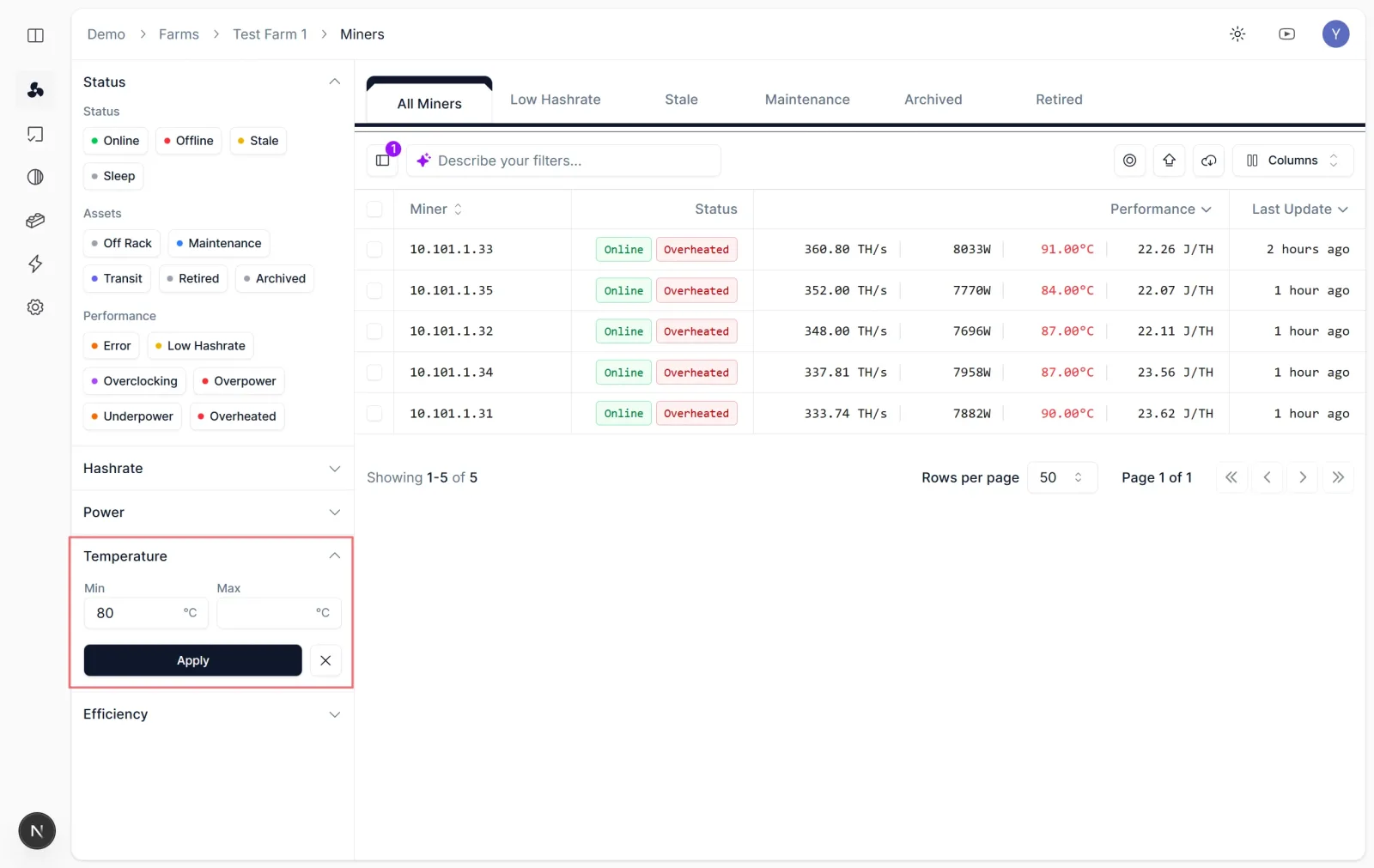
Recommended actions for overheated miners:
| Temperature | Recommendation |
|---|---|
| <75℃ | Normal operation |
| 75℃-80℃ | Monitor |
| 80℃-85℃ | Recommended to return to standard mode |
| >85℃ | Recommended to underclock |
| >90℃ | Prioritize cooling inspection |
Why should overheated miners be prioritized? Because many miners focus only on TH/s and ignore J/TH. Under high-temperature conditions, a miner may maintain hashrate while its energy efficiency has already deteriorated significantly. This means each 1 TH of hashrate consumes more electricity, ultimately eroding profit.
How to Use Nonce to Find Low-Hashrate Miners
Low-hashrate miners are often more dangerous than overheated miners. The reason is simple: they appear to be online, but their actual hashrate is extremely low. At this point, the miner is continuously losing revenue, while the operations team may not notice in time.
Through the Nonce mining farm management platform, the system can automatically filter miners in Low Hashrate status. These miners are online but are not producing normal hashrate.
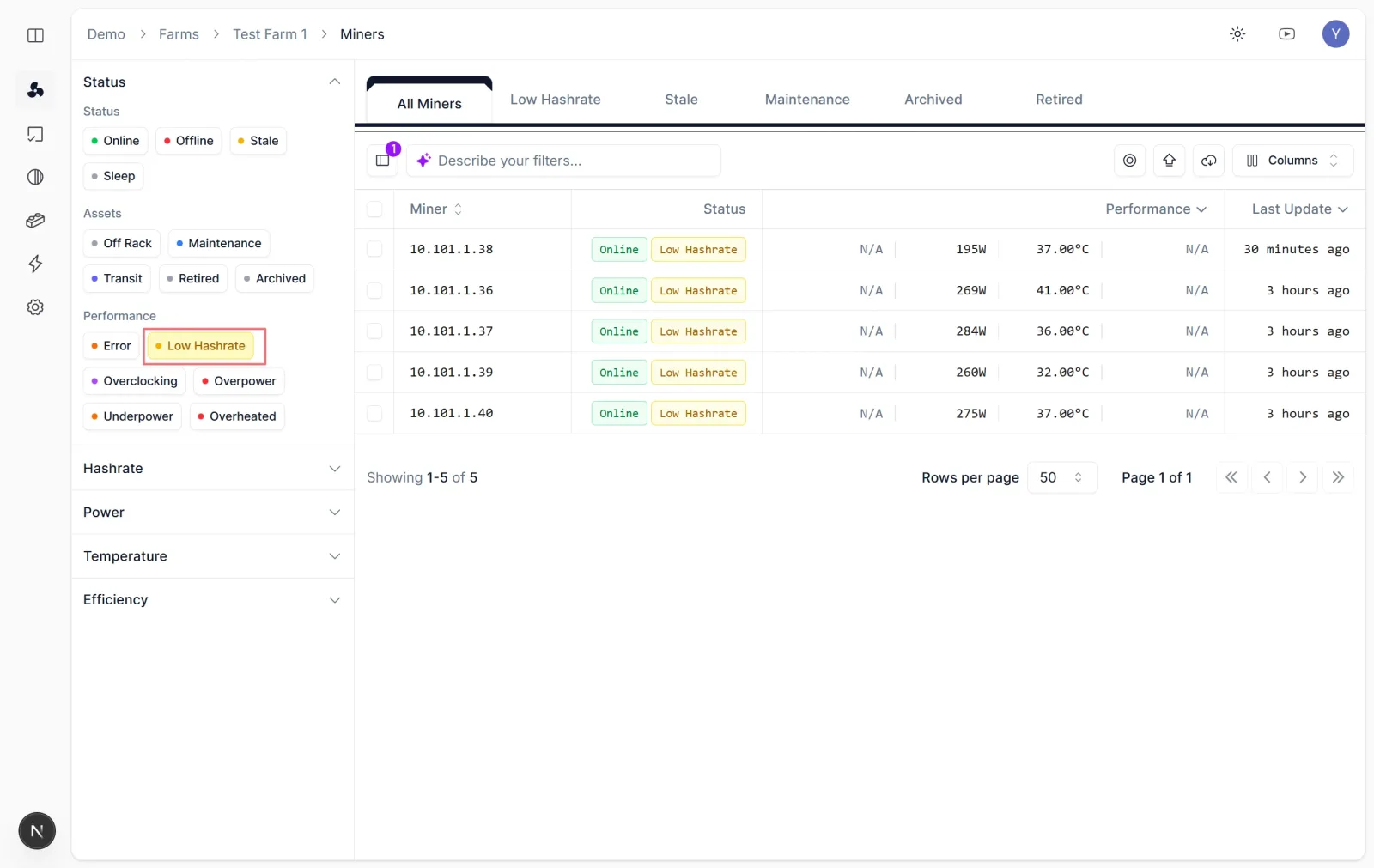
Common causes of low-hashrate miners:
| Cause | Symptom |
|---|---|
| Temperature too high | Hashrate fluctuation |
| Excessive overclocking | Instability |
| Fan failure | Hashrate drop |
| Network issue | Lost shares |
| Hashboard issue | Long-term low hashrate |
The recommended troubleshooting flow is: find low-hashrate miners → check temperature → check power mode → inspect fans → restore standard mode if necessary.
How to Use Nonce to Find Offline Miners
Offline miners are the easiest case for calculating losses: electricity consumption = 0, revenue = 0. The problem is that many mining farms are extremely large, and operations teams may not discover offline miners immediately. In the Nonce mining farm management platform, you can use the Offline status filter, and the system will immediately return a list of all offline miners.
The offline miner handling flow is: query Offline → confirm offline duration → attempt reboot → recheck → manual troubleshooting.
How to Use Nonce to Filter Multiple Conditions at Once
A single condition often cannot locate the real issue in large mining farms. For example, you may want to find devices with temperature > 80℃ + model = S21 + currently in overclocking mode. Or you may want to locate devices that are low hashrate + online + abnormal in the past 24 hours. These are difficult to identify manually. This is where a mining farm management platform like Nonce is needed. Through multi-filtering, operators can quickly locate target machines.
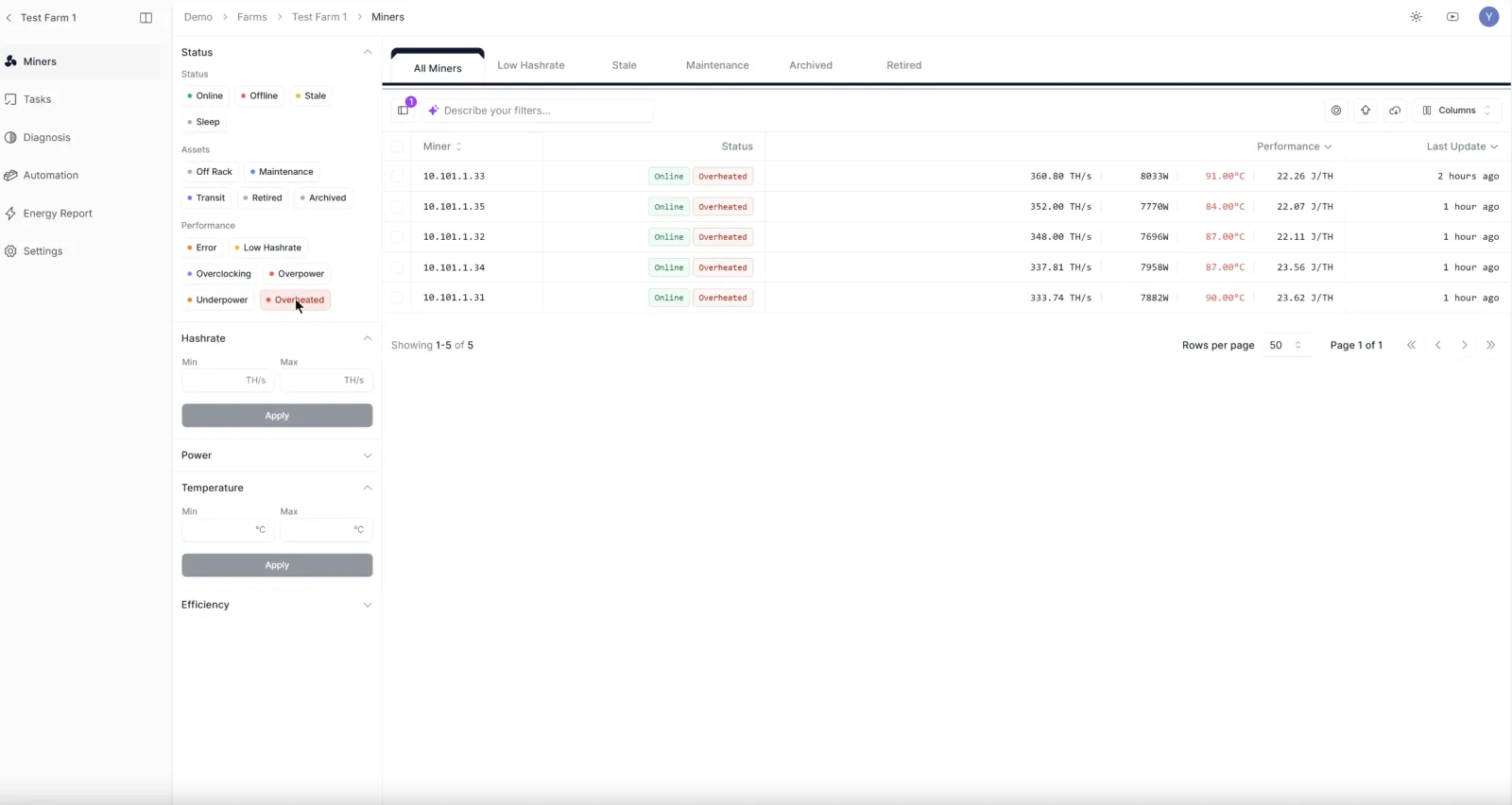
Nonce supports combined-condition queries across status, hashrate, power consumption, temperature, energy efficiency, asset status, and more. This capability is especially important in environments with thousands of ASICs. The operations team does not need to inspect every device; it can directly locate the problem machines.
How to Batch Overclock and Underclock ASIC Miners: From Manual Tuning to Automated Operations
For mining farms with thousands of ASICs, the real challenge is never changing the settings on one miner. It is managing thousands of miners at the same time.
Why is farm-level overclocking more complex than single-machine overclocking? For an individual miner, the overclocking process is usually: log in to the miner → change settings → save. For a mining farm, the process is closer to: query target miners → filter eligible devices → execute in batch → verify results → continuously optimize.
This is also Nonce’s core view: excellent mining farms no longer rely on default configurations for long-term operation. Instead, they continuously adjust performance modes according to market conditions.
But the question is: when should each mode be used? Most mining farms effectively have only three choices: overclocking, underclocking, and standard mode. The following ROI decision matrix shows the logic used by most mature mining farms.
| Electricity Price | Temperature | Recommendation |
|---|---|---|
| Low | Low | Overclock |
| Low | High | Standard mode |
| Medium | Low | Standard mode |
| Medium | High | Underclock |
| High | Low | Underclock |
| High | High | Underclock or shut down |
Why Is Overclocking Unsuitable in High-Temperature Environments?
If a device temperature is too high, continued overclocking can cause fans to run at full load, increase power consumption, accelerate chip aging, increase failure rates, cause unstable reboots, and lead to revenue loss. Therefore, the first goal for overheated miners should be restoring stability, not chasing higher hashrate.
How to Use Nonce to Batch Locate Overclocking Targets
This is one of the biggest differences between Nonce and traditional miner backends. The traditional approach is to inspect and modify miners one by one. Nonce’s approach is: filter → select → execute. For example, if you want to find miners suitable for overclocking, you can use multi-filtering and set status = Online + temperature < 70℃ + model = S21. The result is a group of healthy miners. Then you can select them in batch and execute a power strategy to complete overclocking across the mining farm.
Using Nonce to Automatically Execute Overclocking and Underclocking
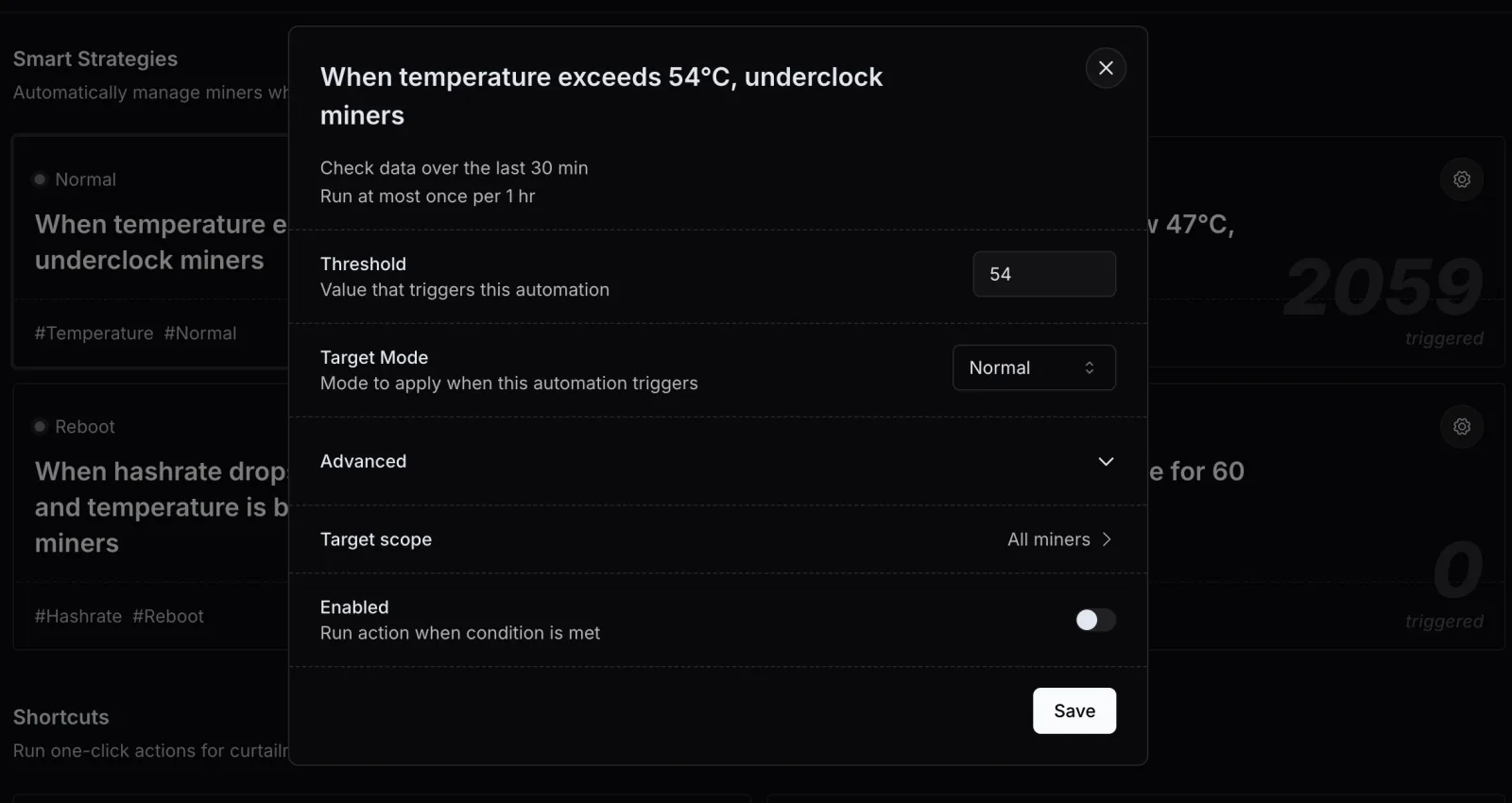
Nonce has automation capabilities that can trigger actions automatically based on temperature and hashrate. For example, you can set a rule so that when temperature > 52℃, the miner switches from overclocking mode back to standard mode. This helps prevent chip overheating, hashrate fluctuation, and manual intervention.
At the same time, automation can help miners automatically return to overclocking after temperature recovers. For example, when temperature < 45℃, the miner can switch from standard mode back to overclocking mode, greatly improving efficiency.
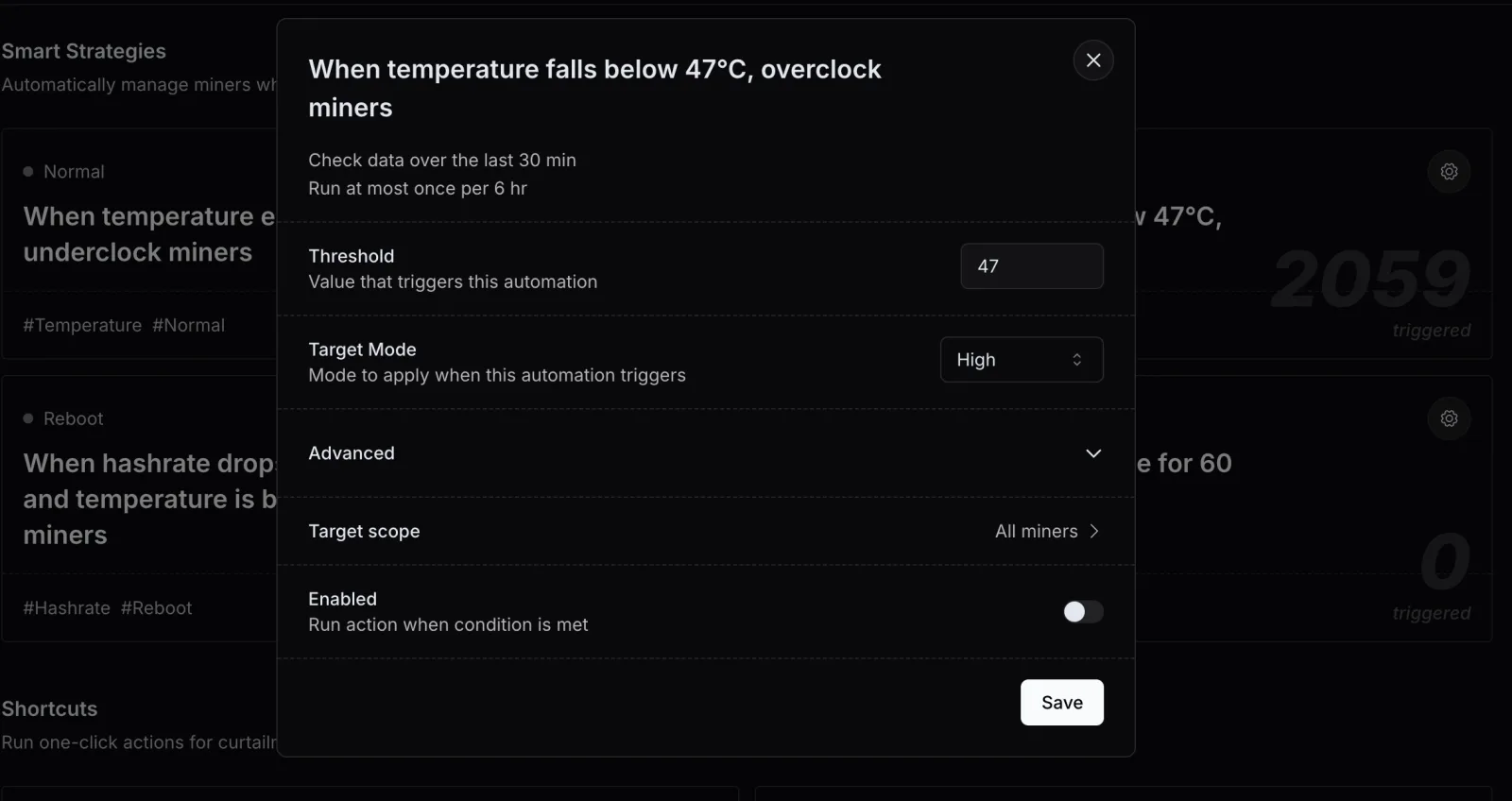
This creates a complete closed loop: low temperature → overclock → temperature rises → return to standard mode → temperature falls → overclock again. In this way, automated dynamic power management becomes possible.
Using Nonce to Automatically Reboot Low-Hashrate Miners
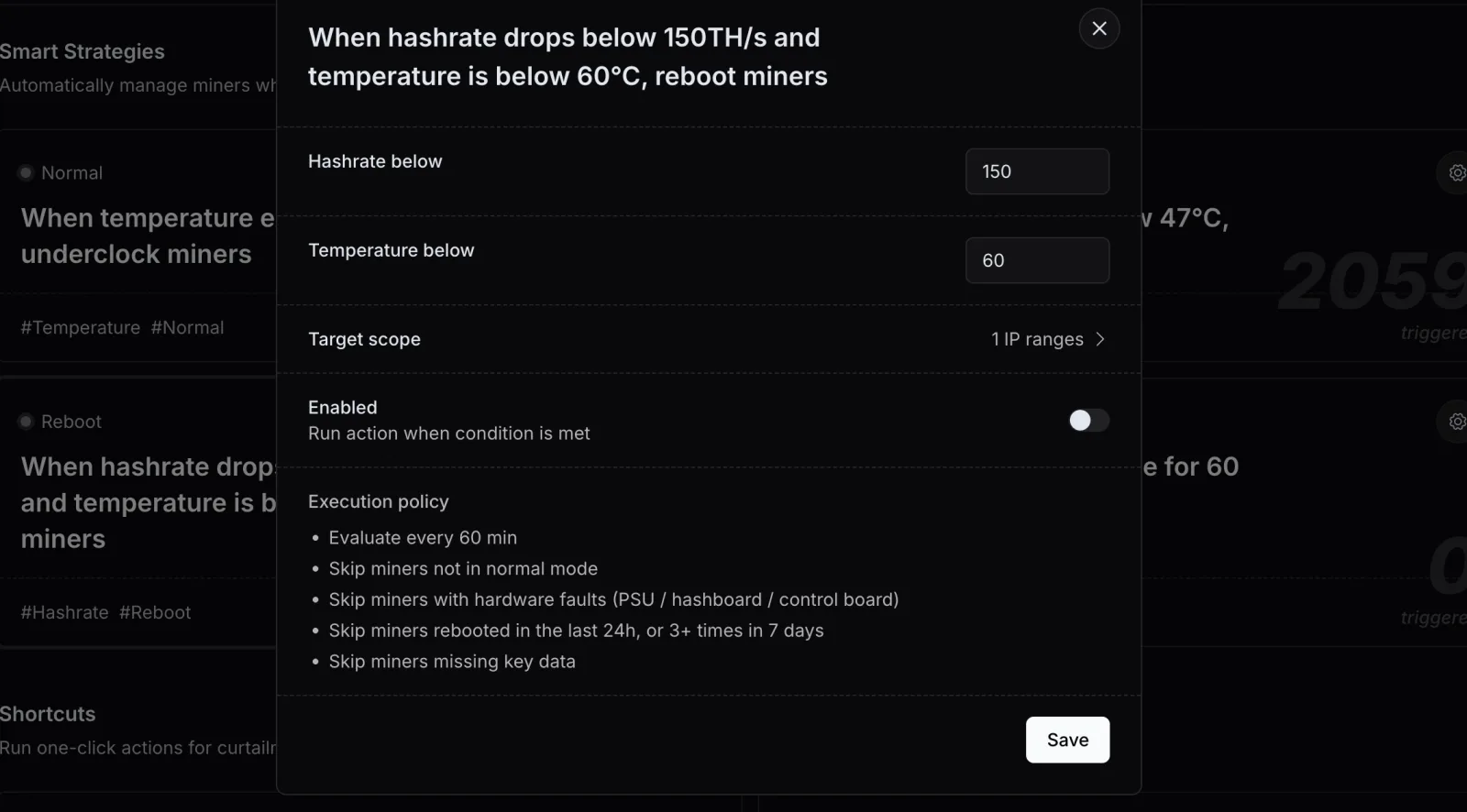
Nonce also supports low-hashrate monitoring alerts and automatic reboot. For example, when hashrate < 150 TH/s + temperature < 60℃, Nonce can automatically reboot the miner. This solves a very typical problem: many miners are online but not producing hashrate.
If the development of Bitcoin mining over the past decade had to be summarized in one sentence, it might be this: competition is shifting from hardware to operations. In the past, miners focused on which machines to buy. Today, more and more mining farms focus on how to operate those machines.
Overclocking and underclocking are never the end goal. They are only tools. The true objective is always to maximize mining farm ROI under given electricity price, temperature, and market conditions.
For a small number of ASICs, this may be a one-time setting. For thousands or even tens of thousands of ASICs, it is a complete operating system. Therefore, the real questions are no longer “Can my miner be overclocked?” but “Which miners should be overclocked?”, “When should miners be overclocked or underclocked?”, “How can execution be automated?”, and “How can optimization continue over time?”
Mining farms that can answer these questions often have stronger long-term competitiveness than farms that simply chase higher hashrate.