What Is Bitcoin Hashrate? How to Monitor Miner Hashrate and Improve Mining Site Operational Efficiency
Bitcoin hashrate measures how many hash calculations a miner or the entire network can perform per second; a higher hashrate raises the probability of finding a new block. This article explains how hashrate is calculated, what factors affect it, and how miners improve operational efficiency through monitoring and unified management.

Introduction
Whether you are looking at a miner specification page, a mining pool dashboard, or Bitcoin industry news, you will frequently see one term: hashrate. For example:
- Bitcoin network hashrate reaches a new all-time high;
- A certain ASIC miner has 250 TH/s of hashrate;
- A mining site reaches a total hashrate of 20 PH/s.
For people who are new to Bitcoin mining, these numbers are often confusing.
- What exactly is hashrate?
- Why does a higher hashrate increase a miner's probability of earning block rewards?
- Does a miner rated at 250 TH/s mean it will always run stably at that level?
More importantly, when the number of miners grows from a few units to dozens, hundreds, or even thousands, how can operators continuously monitor that hashrate and ensure it actually turns into mining revenue?
This article starts with the basic concept of Bitcoin hashrate, then systematically explains how hashrate is calculated, what factors affect it, and how miners can improve mining site operational efficiency through effective monitoring and management.
What Is Bitcoin Hashrate?
Bitcoin hashrate is a core metric for measuring the computing power of the Bitcoin network. Simply put, hashrate represents how many hash calculations a miner, or the entire Bitcoin network, can perform per second.
Bitcoin uses the SHA-256 hash algorithm to run its proof-of-work mechanism. Miners continuously try different nonces, calculate the corresponding hash values, and search for a result that satisfies the current difficulty target. Each attempt requires one hash calculation. Therefore, the higher the hashrate, the more attempts can be made per unit of time, and the higher the probability of finding a new block.
According to the design proposed by Satoshi Nakamoto in Bitcoin: A Peer-to-Peer Electronic Cash System, the proof-of-work mechanism protects network security through this continuous consumption of computing resources.
How Is Bitcoin Hashrate Calculated?
Because the Bitcoin network performs an extremely large number of hash calculations every second, people usually do not describe hashrate directly in H/s. Instead, they use larger units of measurement. Common units include:
| Unit | Meaning |
|---|---|
| KH/s | Thousand hashes per second |
| MH/s | Million hashes per second |
| GH/s | Billion hashes per second |
| TH/s | Trillion hashes per second |
| PH/s | Quadrillion hashes per second |
| EH/s | Quintillion hashes per second |
Today, a single ASIC miner is usually measured in TH/s. For example, the Bitmain Antminer S21 series has a hashrate of roughly 200 to 300 TH/s. Mining site scale is usually measured in PH/s. The entire Bitcoin network, meanwhile, has already entered the EH/s era. According to statistics from Nonce and Hashrate Index, Bitcoin's network hashrate has remained at the level of hundreds of EH/s in recent years and has continued to set new historical records.
It is important to note that hashrate itself is not a kind of "speed." It is actually the number of hash calculations that can be completed per second. Therefore, a 250 TH/s miner means it can perform approximately 250 trillion SHA-256 hash calculations per second.
Why Is Bitcoin Hashrate So Important?
For miners, hashrate directly affects the probability of earning block rewards. For the overall network, hashrate determines the security of the Bitcoin system. Under the proof-of-work mechanism, miners continuously compete for new blocks. If a miner has higher hashrate, it can complete more calculations in the same amount of time, so it has a greater chance of earning new block rewards.
At the same time, the higher the total network hashrate, the higher the cost required to attack the Bitcoin network. This is why the industry often treats hashrate as an important indicator of network health.
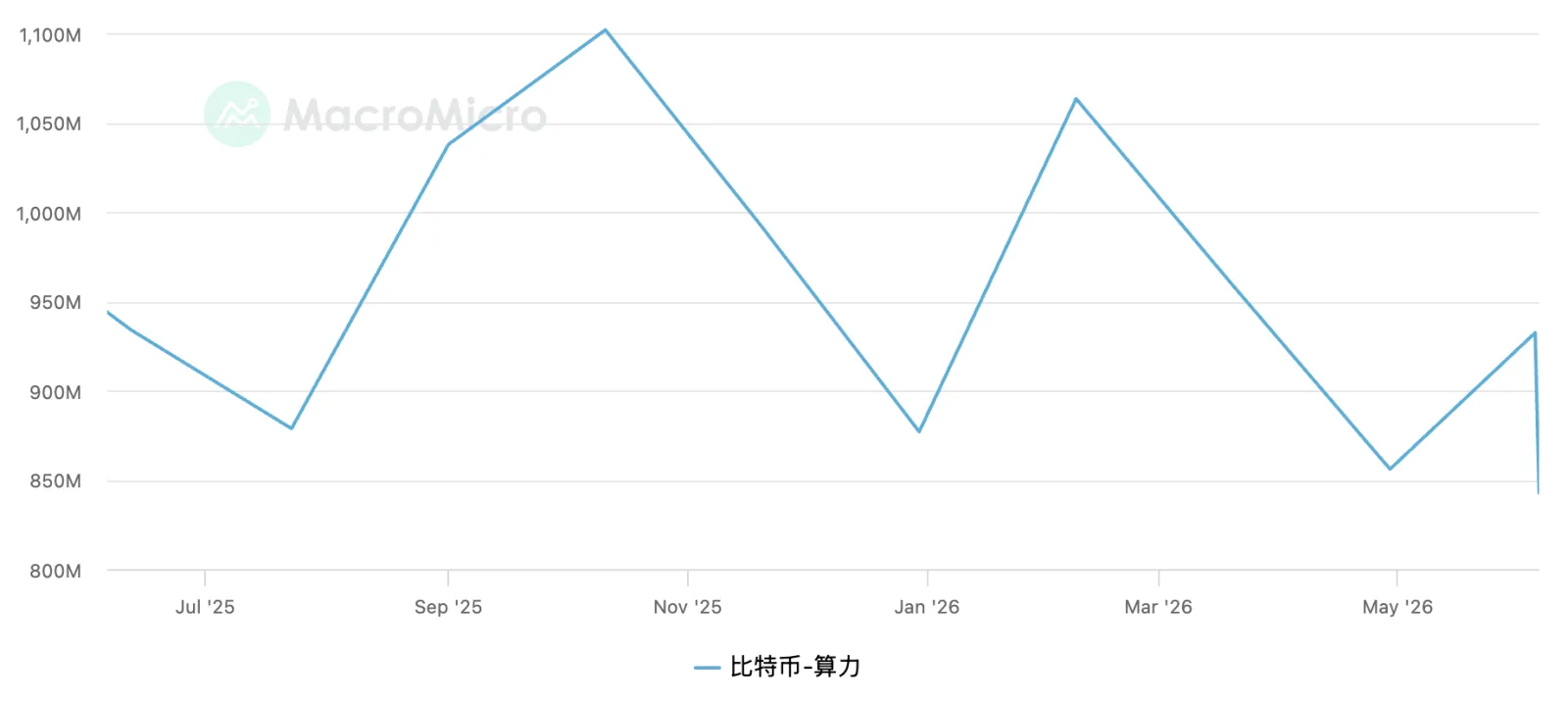
When news media report that Bitcoin hashrate has reached a new all-time high, it actually means more miners are investing resources to participate in network operations. Over the long term, this usually reflects miners' continued investment in and confidence in the Bitcoin ecosystem. According to data from Macromicro, Bitcoin network hashrate reached an all-time high of 1,102,245,923.98T on October 11, 2025. As of the time of writing, network hashrate was 842,716,008.15T, a decline of approximately 23.5%. This is directly related to the decline in Bitcoin price and also reflects that market confidence has weakened as Bitcoin has fallen.
Hashrate is not only related to miner revenue. It is also an important part of Bitcoin's security model. In theory, if an entity controls more than half of the network's total hashrate, it would be capable of launching a so-called 51% attack. In that scenario, the attacker could potentially reorganize some blocks, prevent some transactions from being confirmed, or carry out double-spending attacks. In reality, however, acquiring enough hashrate to attack the Bitcoin network requires an extremely large investment in hardware and energy.
Today, the Bitcoin network has one of the world's largest decentralized computing networks. Any attempt to obtain enough hashrate to launch an attack would require extremely high economic costs. At the same time, a successful attack could also damage market confidence and push down the Bitcoin price. Therefore, for the vast majority of participants, honest mining is far more economically rational than attacking the network. This is one of the fundamental reasons why proof of work has been able to maintain long-term security.
What Factors Affect Miner Hashrate?
Many new miners believe that miner hashrate is fixed, but this is not the case. A miner's rated hashrate is only a reference value under laboratory conditions. In real operating environments, hashrate is affected by many factors. The most common factors include:
- Bitcoin price
- Mining difficulty
- Hashprice
- ASIC hardware performance
- Electricity cost
- Network connection quality
- Temperature and cooling environment
- Firmware configuration
For a single miner, temperature, network quality, and device status are often the most direct factors. For an entire mining site, Bitcoin price and mining difficulty determine overall profitability. Understanding these factors is the first step toward understanding mining site operations.
Why Are Rated Miner Hashrate and Actual Hashrate Different?
Many miners encounter the same problem after buying an ASIC miner: the official specifications clearly say 250 TH/s, but the actual hashrate shown in the mining pool dashboard is only 230 TH/s or even lower. Does this mean the miner is faulty?
The answer is: not necessarily. In fact, a certain difference between rated hashrate and actual hashrate is normal in the industry, because miners are affected by many factors during operation.
Excessive Temperature Causes Frequency Reduction
Temperature is one of the most common factors affecting ASIC performance. To protect chip safety, most ASIC miners automatically reduce frequency when temperatures become too high. This mechanism is usually called thermal throttling. When chip temperature continues to rise, the miner actively reduces hashrate output to lower power consumption and heat generation. For miners, the result is usually lower hashrate, lower revenue, and lower energy efficiency. Therefore, temperature monitoring is always one of the core tasks in mining site operations.
Network Quality Affects Effective Hashrate
Mining pools do not count the theoretical hashrate displayed locally by the miner. They count the effective work actually submitted by the miner. Therefore, even if a miner locally displays 250 TH/s, the effective hashrate seen by the mining pool may be lower. Common causes include:
- Network latency;
- Packet loss;
- DNS issues;
- Abnormal routing configuration;
- Unstable mining pool connection.
In large mining sites, network issues are often easier to overlook than hardware issues.
Firmware Configuration Issues
Modern ASIC miners usually support standard mode, power-saving mode, and overclocking mode. Hashrate performance can vary significantly across different modes. In addition, incorrect mining pool configuration, abnormal frequency parameters, or the wrong firmware version can all prevent a miner from performing normally.
Miner Aging and Hardware Failure
As operating time increases, ASIC devices inevitably age. For example, hashboard failures, fan damage, power supply abnormalities, and chip failures may occur. These issues usually do not immediately take a miner offline. More commonly, the miner remains online while hashrate continues to decline. Without a monitoring system, operations teams often find it difficult to detect these problems in time.
How to Monitor Miner Hashrate
For miners with only a few machines, checking hashrate is very simple: just log in to the mining pool dashboard. But as the number of miners grows, the problem becomes more complex. Operations teams need to know not only which miners are online, but also which miners are actually generating revenue. Therefore, modern mining sites usually monitor the following key indicators continuously.
Real-Time Hashrate
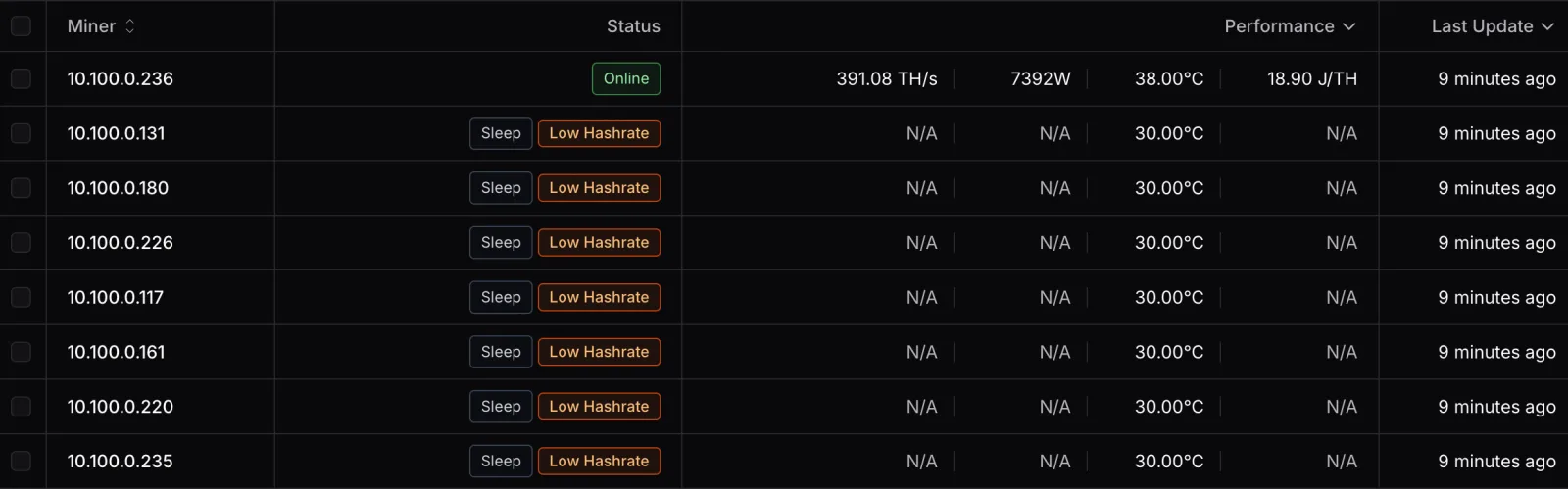
Real-time hashrate reflects the current operating status of a miner. It helps operations staff quickly identify offline devices, throttled devices, and devices with abnormal performance. However, real-time hashrate naturally fluctuates.
Therefore, professional miners usually observe the 15-minute average hashrate, 1-hour average hashrate, and 24-hour average hashrate at the same time, rather than relying solely on instantaneous data.
Mining Pool Hashrate
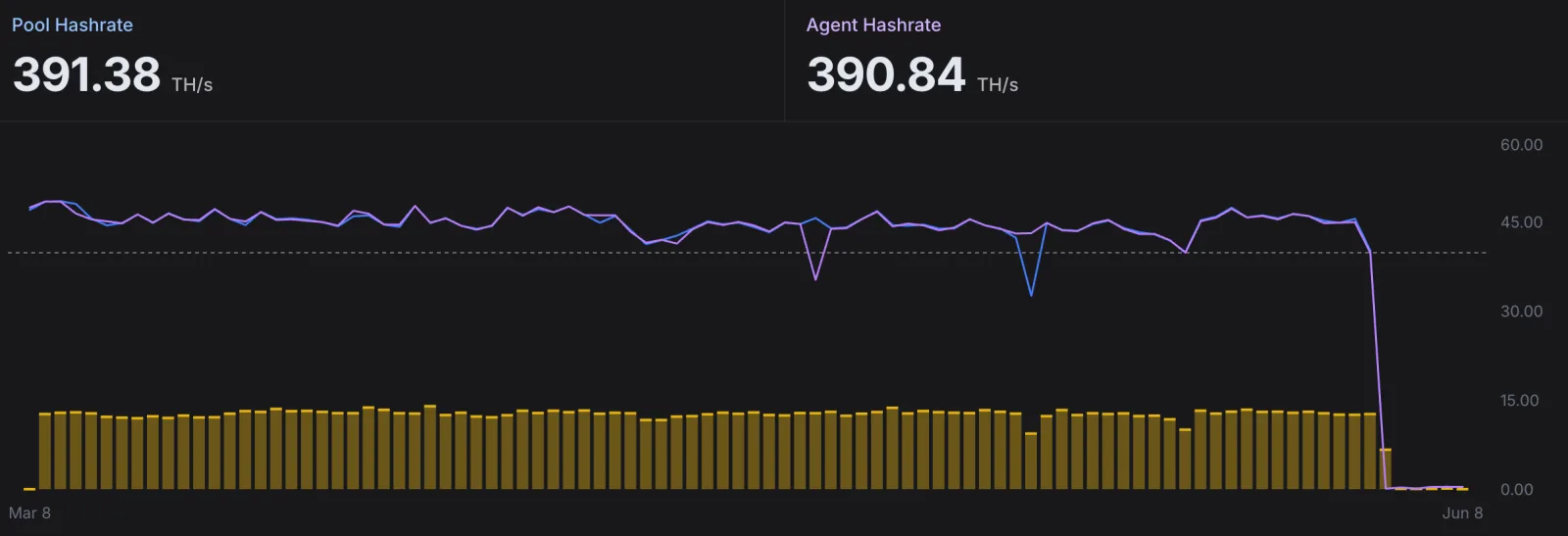
Mining pool hashrate is usually closer to actual revenue performance because the pool sees the effective work submitted by the miner. If a miner's local hashrate looks normal but pool hashrate remains low for a long time, it usually indicates network issues, a high rejection rate, or abnormal mining pool connection.
Rejection Rate
The rejection rate is a metric many miners easily overlook. It represents the percentage of shares rejected by the mining pool. A high rejection rate means that although the miner is running, some calculation results cannot generate revenue. Common causes of a higher rejection rate include network latency, mining pool issues, abnormal clock synchronization, firmware errors, and more.
Temperature and Power Consumption
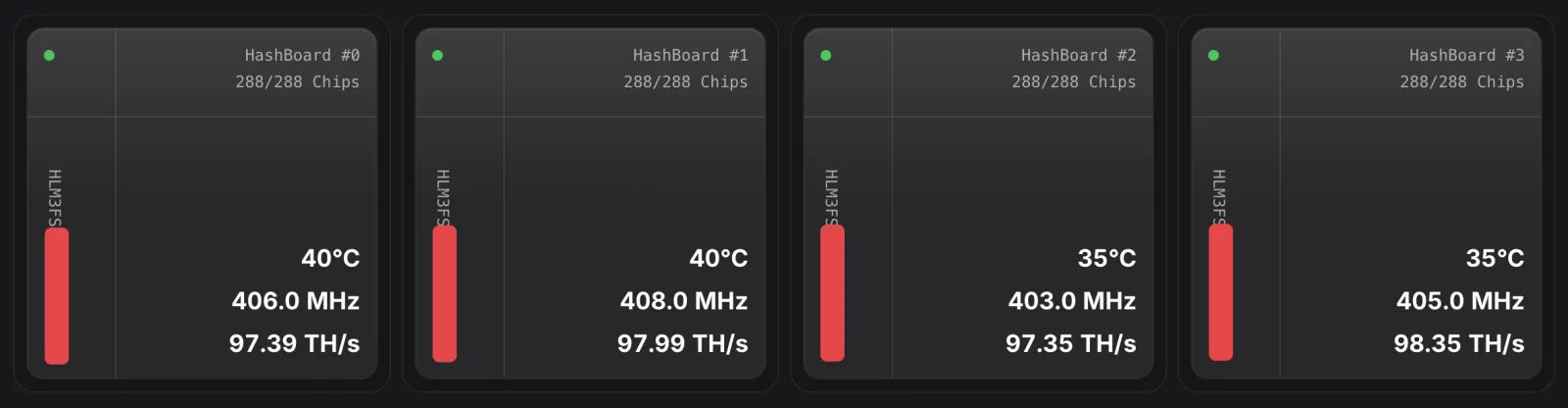
In addition to hashrate, professional mining sites usually monitor chip temperature, ambient temperature, power consumption, and fan speed continuously. Temperature abnormalities often appear before failures occur. Many device problems are already reflected in temperature data before hashrate begins to decline.
Why Do Mining Sites Need Unified Miner Management?
For miners with only a few machines, manual management is not a problem. But when the number of miners grows to hundreds or thousands, the situation becomes completely different. At that point, operations teams need to handle issues such as offline devices, abnormal hashrate, firmware upgrades, network failures, temperature alerts, and mining pool configuration changes every day.
If management still relies on Excel spreadsheets, manual inspections, and mining pool dashboards, operational efficiency will quickly decline. Many mining sites do not lose money because devices fail, but because devices have already developed problems and the operations team does not discover them in time. As a result, modern mining sites increasingly prefer unified management platforms that centralize monitoring of ASIC hashrate performance, online status, temperature data, and alert events. This reduces manual inspection time and improves device uptime and overall operational efficiency.
What Capabilities Should a Good Mining Site Management Platform Have?
For modern Bitcoin mining sites, management software has gradually evolved from a supporting tool into core infrastructure. Over the past few years, ASIC miner performance has continued to improve, and the number of devices managed by a single mining site has also continued to grow. At the same time, the challenges faced by mining operations teams are no longer limited to equipment procurement and electricity costs. More and more operational issues now center on device monitoring, operations efficiency, failure response, team collaboration, and data management. Therefore, choosing the right mining site management platform has become an important operational decision.
So, what capabilities should a good mining site management platform have?
Auto-Discovery and Asset Management
For large mining sites, the first step is often not monitoring, but knowing exactly how many devices they have. In reality, many sites continuously add, replace, or migrate devices. If they rely on manual registration, asset information can easily become inaccurate. Therefore, good platforms usually provide auto-discovery capabilities. They can automatically scan ASIC devices on the network and build a unified asset inventory. Operations teams can quickly view miner models, IP addresses, firmware versions, assigned mining sites, online status, and more, reducing device management costs.
Real-Time Monitoring and Alerts
Monitoring is the most basic capability of a mining site management platform, but truly valuable monitoring is not just about displaying data. More importantly, it should notify the operations team in time when anomalies occur. For example, when miners go offline, hashrate drops, temperatures become abnormal, rejection rates rise, or mining pool connections fail, the system should actively trigger alerts.
Compared with manual inspections, automatic alerts can significantly shorten failure detection time. For large mining sites, the speed of failure detection often directly affects revenue loss.
Batch Operations
As miner scale grows, batch operations become increasingly important. For example, operations teams may need to complete the following tasks at the same time:
- Modify mining pool configuration;
- Upgrade firmware in batches;
- Reboot devices in batches;
- Adjust frequency parameters;
- Update network configuration;
If these actions are handled one by one, even simple operations may take hours. Therefore, batch management has become one of the fundamental capabilities of modern mining site software.
Multi-Site and Multi-Team Collaboration
As mining operations scale, many teams begin managing multiple sites. These sites may be distributed across different regions around the world. At this point, operations teams need to view hashrate performance, device status, alert information, and operations records in one place, rather than switching between multiple systems.
At the same time, different team members usually take on different responsibilities. Therefore, permission management and collaboration capabilities have gradually become important requirements for enterprise-level mining sites.
API and Automation Capabilities
In recent years, mining site operations have gradually moved toward automation. More and more teams are using APIs, webhooks, automation scripts, and AI agents to build their own operational workflows. For example, when a miner goes offline, a work order can be created automatically; when temperatures become abnormal, on-duty staff can be notified automatically; and when a mining pool connection fails, the system can automatically switch to a backup pool.
Therefore, open APIs have become an important part of modern mining site management platforms.
Why Is ASIC Monitoring Becoming Mining Site Infrastructure?
Ten years ago, miners were most concerned with how to obtain more hashrate. Today, more and more mining sites are focused on how to keep existing hashrate continuously online.
In mature markets, revenue growth increasingly depends on operational efficiency. If a mining site with 5 EH/s under management can reduce average failure detection time from two hours to 15 minutes, the long-term revenue improvement may far exceed the gains from purchasing additional equipment. Therefore, ASIC monitoring is no longer just a monitoring tool. It is becoming an important part of the mining operations system. Operations teams increasingly focus on:
- Uptime
- Mean time to recovery
- Alert response speed
- Operations efficiency
rather than only the raw hashrate number.
How Does Nonce Help Mining Sites Improve Operational Efficiency?
As mentioned above, for operations teams, the goal of managing a mining site is never just to view data. What truly matters is keeping more devices online and reducing manual operating costs as much as possible.

Nonce is a management platform built for modern Bitcoin mining sites. It is designed to help operations teams centrally monitor, manage, and optimize ASIC devices. Nonce provides a range of capabilities, including:
- Automatic miner discovery
- ASIC monitoring
- Real-time alerts
- Batch operations
- Firmware management
- Multi-site management
- API integration
- AI agent capabilities
Instead of switching between multiple systems, operations teams can view the following in one unified platform:
- Device status
- Hashrate performance
- Online status
- Alert events
- Operations records
This helps teams detect problems faster and improve response efficiency. For miners with dozens of devices, these capabilities mean fewer manual checks. For mining sites with hundreds or even thousands of devices, they mean higher operational efficiency and better large-scale management capabilities.