Why Are Bitcoin Miners Pivoting to AI Data Centers? Mining Operations and Efficiency Are Becoming More Important
Bitcoin miners are repackaging power, land, and buildings as AI data-center infrastructure. But AI compute will not immediately replace mining; it gives power a new opportunity cost, forcing sites to prove with data that every megawatt still earns more by mining, shifting competition from scale to operating efficiency.
Bitcoin mining companies are currently undergoing a structural shift. In the past, miners’ core competitiveness was usually summarized through a few metrics: how much hashrate they controlled, how efficient their mining machines were, whether their electricity prices were low enough, the production cost of each bitcoin, and how many bitcoins they held on their balance sheets. As the AI compute expansion cycle begins, that evaluation framework is changing. More and more listed miners are repackaging their power, land, substations, buildings, cooling, and operations capabilities as infrastructure for high-performance computing and AI data centers.
This is not simply a chase for a market narrative. Training and inference for AI models are rapidly pushing up data-center electricity demand. According to the International Energy Agency, global data-center electricity demand grew 17% in 2025, with AI-related data centers growing faster, far above the roughly 3% growth rate of global electricity demand.[1] Goldman Sachs Research expects global data-center power demand, using 2023 as the baseline, to grow 50% by 2027 and potentially 165% by 2030.[2]
Against this backdrop, the resources that Bitcoin miners have accumulated over many years have suddenly become more valuable: large-scale power access, land that can be used to build data centers, substation capacity, experience operating high-power equipment, fast deployment capabilities, and operating systems that are highly sensitive to energy costs. What the AI compute industry lacks is exactly this kind of infrastructure that can be turned into deliverable compute as quickly as possible.
But the market can easily overlook the other side of the story: miners’ pivot toward AI compute does not mean Bitcoin mining operations are becoming unimportant. On the contrary, when the same power resource can be used either for mining or for AI computing, a mining site must prove the economic rationale for continuing to mine with greater precision.
AI compute is repricing miners’ power assets. It is also repricing mining-site operating capability.
Miners’ pivot to AI compute has entered the contract and delivery stage
In the past, miners’ AI transition looked more like a capital-market narrative. Now, it is showing up in concrete contracts, site conversions, customer partnerships, and power development. Representative examples include:
| Miner | Main action | Key data |
|---|---|---|
| IREN | Signed an AI cloud services contract with NVIDIA and advanced large-scale AI infrastructure cooperation | The five-year contract is valued at about $3.4 billion; related services are supported by roughly 60 MW of capacity at the Childress campus in Texas; NVIDIA and IREN also plan to support up to 5 GW of AI infrastructure deployment, with NVIDIA receiving investment rights of up to $2.1 billion.[3][4] |
| Core Scientific | Signed high-performance computing infrastructure hosting contracts with CoreWeave | After CoreWeave exercised its final option, Core Scientific’s contracted high-performance computing infrastructure for CoreWeave increased to about 500 MW of critical IT load, and potential cumulative revenue over 12 years rose to $8.7 billion.[5] |
| TeraWulf | Formed an AI compute joint venture with Fluidstack and received support from Google | The project is sized at 168 MW of critical IT load; the 25-year lease corresponds to about $9.5 billion in contracted revenue; Google supports roughly $1.3 billion of long-term lease obligations; TeraWulf has contracted more than 510 MW of critical IT load for high-performance computing platforms.[6] |
| Bitfarms | Converted its Washington State Bitcoin mining site into an AI and high-performance computing facility | The 18 MW Bitcoin mining site will become the company’s first site fully converted to AI and high-performance computing; the company signed a fully funded, binding agreement worth $128 million, with a target power usage effectiveness of 1.2 to 1.3.[7] |
| HIVE | Expanded its AI cloud business through the BUZZ platform | BUZZ signed approximately $30 million in AI cloud customer contracts, with an initial deployment of 504 liquid-cooled server GPUs under two-year contracts.[8] |
| HIVE | Advanced sovereign AI infrastructure in Canada | BUZZ announced plans to advance an approximately 320 MW AI infrastructure project in the Greater Toronto Area, with plans to support more than 100,000 GPUs when fully built out.[9] |
| CleanSpark | Expanded from a pure Bitcoin miner into AI data-center development | The company secured rights to about 271 acres in Austin County, Texas, and signed long-term power supply agreements totaling 285 MW for the construction of a next-generation data-center campus.[10] |
| Cipher Mining | Signed an AI compute hosting agreement with Fluidstack | A 10-year high-performance computing hosting agreement; Cipher will deliver 168 MW of critical IT load at its Barber Lake site in Texas, corresponding to up to 244 MW of gross capacity.[11] |
What these cases have in common is not that miners are no longer mining. Rather, they are beginning to reassess how their power assets should be used. Power used to primarily serve mining machines. Now, the same power may also serve AI computing, cloud services, and high-performance computing customers.
This means the strategic question for miners is changing. In the past, the question was how to mine more bitcoin at lower cost. Now, the question is whether each megawatt of power should be used for mining or for higher-value compute services.
The core of the transition is not replacing miners, but repricing power assets
Many people understand miners’ pivot to AI as unplugging ASIC miners and replacing them with GPUs. This view is too simplistic. Bitcoin mining and AI data centers both consume large amounts of electricity, but their infrastructure requirements are not the same. Bitcoin mining sites focus more on low electricity prices, cooling, miner stability, hashrate output, and rapid deployment. AI data centers require higher standards for power stability, network connectivity, rack density, liquid cooling, security and compliance, customer service levels, and long-term contract delivery.
Therefore, what is truly being repriced is not the mining machines themselves, but the infrastructure capability behind mining companies. Miners’ long-accumulated ability to secure power, build sites, execute mechanical and electrical engineering, and operate high-power equipment is becoming a resource contested by the AI compute value chain.
This is also why large listed miners are more likely to enter the AI compute market first. They have larger power portfolios, stronger financing capabilities, more mature engineering teams, and more complete site-development experience. The cooperation between IREN and NVIDIA emphasizes not mining-machine assets, but IREN’s power, land, data centers, GPU deployment, and infrastructure operations capabilities.[4] Bitfarms also disclosed that its North American energy portfolio had reached 2.1 GW, distributed across data-center hot spots with power and fiber infrastructure.[7]
This shows that the AI compute boom is not merely changing the name of miners’ main business. It is changing how mining-company assets are valued. In the past, the value of a mining site’s power mainly depended on how much bitcoin it could mine. Now, it also depends on whether that power can be converted into AI compute load, whether long-term customers can be signed, and whether stable contracted revenue can be formed.
AI compute will not immediately replace mining, but it will eliminate rough operations
Even if AI compute demand is strong, most miners will not completely stop Bitcoin mining in the short term. The more likely reality is a longer phase of hybrid operations: some sites will continue mining, some sites will undergo AI data-center conversion, and some sites will wait for customers, financing, grid-connection approvals, equipment delivery, or engineering construction.
This phase raises the bar for mining-site operations. The reason is that AI compute gives power resources a new opportunity cost. In the past, as long as the bitcoin price was in an upcycle, inefficient miners, higher failure rates, and rough management might have been masked by market conditions. But when the same megawatt of power can be used for AI compute hosting, a mining site must prove whether continuing to mine is still a rational choice.
This forces mining sites to answer more specific questions. Which sites still generate positive cash flow if they continue mining? Which miners are dragging down overall returns because of low hashrate, overheating, downtime, fan abnormalities, or excessive maintenance costs? Which miners are suitable to keep running, and which should be underclocked, relocated, repaired, or retired? Which sites have electricity prices, temperatures, network conditions, and maintenance costs that make them more suitable to remain dedicated to mining? When the bitcoin price, network difficulty, electricity prices, and temperatures change, can the mining site adjust its power strategy in time? If part of the power is redirected to AI compute, can the remaining miners still maintain sufficiently high revenue per unit of power?
These questions cannot be solved over the long term through experience alone. The larger the mining operation, the more distributed the sites, and the more complex the equipment, the more it needs a unified system that puts hashrate, power consumption, temperature, miner status, costs, and revenue into the same operating view. This is the deeper impact of the AI compute boom on the Bitcoin mining industry: it is not simply taking mining power away, but forcing mining sites to move from hashrate-scale competition to operating-efficiency competition.
The core metric for future mining sites will shift from total hashrate to return per unit of power
Bitcoin miners used to emphasize total hashrate because total hashrate directly corresponded to theoretical production capacity. But in the new industry environment, total hashrate alone is no longer enough.
High total hashrate does not mean high operating quality. If miner efficiency is behind the curve, the offline rate is high, cooling is unstable, electricity prices are too high, or maintenance is frequent, a mining site’s real revenue may be significantly lower than what its surface hashrate suggests. Especially after the Bitcoin halving, block rewards declined, network difficulty continued to change, and mining-site margins were already under pressure. AI compute further raises the alternative value of power resources.
Therefore, the more important metric for future mining sites is not how much hashrate they have, but how much effective revenue each kilowatt-hour of electricity produces. This requires mining sites to rebuild operations across several levels:
First, miner status must be transparent in real time. Problems such as offline machines, low hashrate, zero hashrate, overheating, and fan abnormalities need to be discovered quickly, rather than only appearing in daily summaries.
Second, costs must enter revenue calculations. Electricity and maintenance costs should not remain only in financial spreadsheets. They should be combined with sites, miners, hashrate, and estimated revenue to form an operating-level view of profitability.
Third, power strategies must be dynamically adjustable. Under high temperatures, high electricity prices, or declining revenue, mining sites need to control risk through underclocking, sleep mode, resuming normal power, or other strategies. When conditions are favorable, they can also improve returns through more aggressive operating strategies.
Fourth, operations must be executable in bulk. Large mining sites cannot rely on manually processing miners one by one. Scanning, rebooting, power-mode switching, firmware management, mining-pool configuration, and other operations must support bulk execution and result tracking.
Fifth, data must be retained. Mining sites need historical data to judge site performance, equipment performance, and the effects of strategies, rather than troubleshooting every issue from scratch each time.
These capabilities determine whether a mining site can continue to prove the operating value of its Bitcoin mining business during a cycle in which AI compute is repricing power assets.
Whether a mining site should pivot to AI first depends on whether its existing mining business has been fully calculated
Not every mining site is suitable for a pivot to AI compute. AI data centers have high requirements for infrastructure standards, capital capacity, customer contracts, cooling systems, network connectivity, and engineering delivery. Having low-cost power does not mean having the ability to deliver an AI data center. A site that is suitable for Bitcoin mining may not be suitable for AI customers.
For many mining sites, the more realistic path is not to pivot immediately, but first to manage the existing mining business clearly enough. Only when a mining site can accurately calculate the economic impact of each site, each batch of miners, each type of failure, and each power strategy can management judge which power should continue to be used for mining, which power is suitable for other compute workloads, and which equipment should be adjusted or retired.
In this process, a mining site needs more than a monitoring dashboard. It needs an operations system designed for business decisions. The system must answer not only whether miners are online, but also whether they are running efficiently, whether failures are causing revenue losses, whether it is still worth running at the current electricity price, and whether one site is more suitable than another for retaining mining operations.
This is exactly the scenario where Nonce fits.
Nonce: helping mining sites clarify their mining business during the transition cycle
Nonce is an operations management tool for Bitcoin mining sites. Its product goal is to help mining sites increase Bitcoin output and reduce operating costs. The product is built around metric monitoring, asset management, and automated strategies, with an emphasis on helping mining sites understand which devices are working normally, which devices require attention, and how to use data and automation to improve output per unit of power.
Nonce covers several key parts of mining-site operations.
During initialization, Nonce supports creating workspaces and mining sites, entering miner models and quantities, configuring mining-pool observer data, installing agents, and scanning the network to discover miners. In mining-site settings, operators can enter electricity and maintenance costs, which are used to estimate operating costs and mining profitability. This step may look basic, but it is critical for business judgment at a mining site, because without cost data, hashrate data alone cannot show whether the business is healthy.
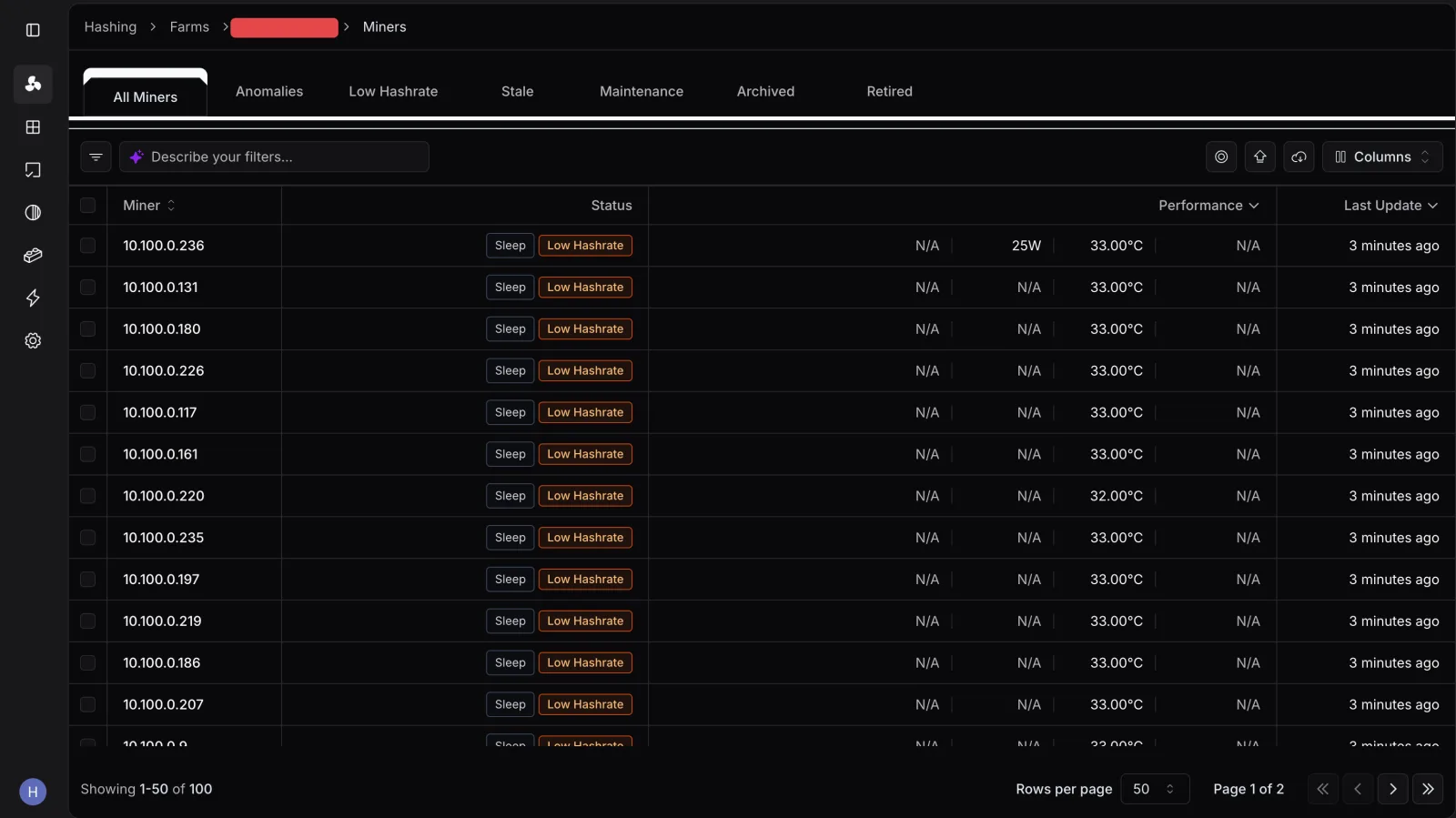
At the daily monitoring layer, Nonce’s mining-site overview can track real-time hashrate, miner efficiency, miner status, and estimated revenue in the same view, and it helps operators quickly locate offline devices. For multi-site or large-scale mining operations, this kind of unified view can reduce management losses caused by fragmented information.
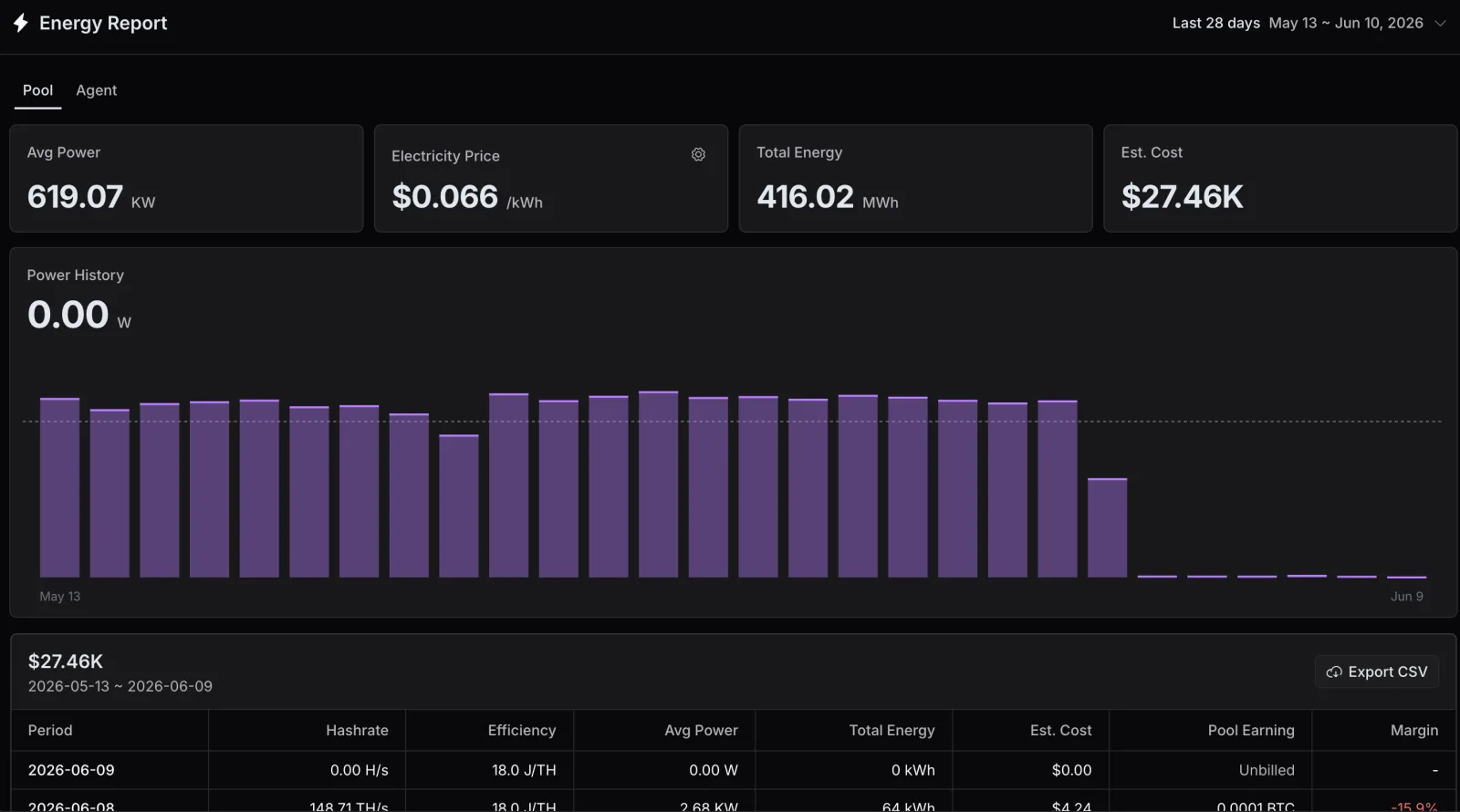
At the exception-handling layer, Nonce supports quickly locating problem miners, including machines that are overheating, producing zero hashrate, producing low hashrate, offline, or showing fan abnormalities. These problems are common sources of erosion in mining-site revenue. A single machine’s abnormality may look minor, but at the scale of thousands or even tens of thousands of devices, the long-term accumulation can significantly affect effective hashrate and return per unit of power.
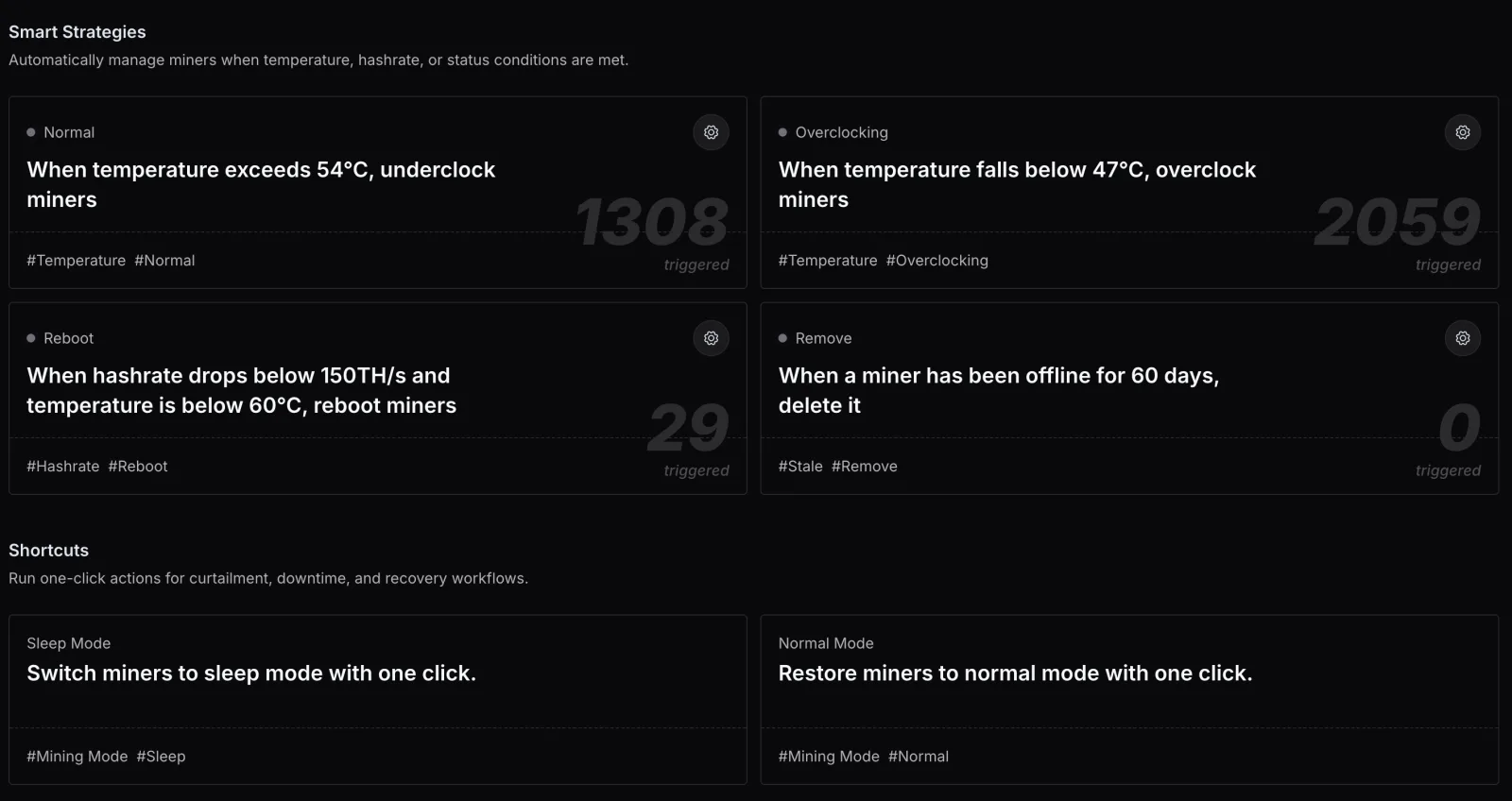
At the execution layer, Nonce supports bulk operations, including scanning, overclocking, underclocking, firmware handling, and rebooting. It also supports automated strategies, such as overclocking and underclocking automation, as well as temperature-based power-mode switching. According to the documentation, Nonce can also switch miner power modes when electricity prices change or temperatures are high, including overclocking, normal, underclocking, and sleep modes, in order to balance hashrate, cost, and temperature risk.
At the API and extension layer, Nonce’s private API provides workspace management, mining-site monitoring, miner control, and task execution capabilities. Its Model Context Protocol integration also supports querying mining-site and miner status through an AI assistant, monitoring changes in hashrate, temperature, and mining-pool configuration, and executing bulk operations.
The common value of these capabilities is that a mining site no longer sees only total hashrate, but can get closer to the real business: which batch of miners is making money, which batch is consuming profit, which site deserves continued investment, and which operating strategy is more reasonable under current market and power conditions.
Against the backdrop of rapid AI compute development, this capability is especially important. Whether a mining site should pivot is a strategic question. But before making that strategic choice, it must first clarify the current mining business. Nonce’s value is not in deciding for a mining site whether it should pivot to AI, but in helping it build an observable, calculable, and executable operating foundation.
The real industry change: miners are moving from resource holders to resource allocators
The real change brought by the AI compute boom is not the end of the mining industry, but a change in miners’ role. In the past, miners were more like resource consumers: they secured low-cost power, deployed miners, and converted electricity into bitcoin. In the future, leading miners will become more like resource allocators: allocating power, buildings, and capital to the compute workloads with the highest returns across different market cycles.
This will create a stricter asset-comparison mechanism inside mining companies. Bitcoin mining, AI compute hosting, high-performance computing, and cloud services will all compete for the same power resource. Which business receives power will no longer depend only on industry narratives, but on verifiable returns, risks, and execution capability.
Therefore, mining sites that continue to engage in Bitcoin mining must have stronger data-driven operating capabilities. They need to use data to prove that, under current electricity prices, miner efficiency, network difficulty, and bitcoin price conditions, continuing to mine is still a rational use of assets.
This is a form of industry screening. Inefficient mining sites will be squeezed out by the higher opportunity cost of power, while efficient mining sites will retain their Bitcoin mining competitiveness because of stronger operating capabilities.
AI compute reprices power; Nonce helps mining sites reprice operations
Bitcoin miners’ pivot to AI compute is an important trend in the digital infrastructure industry. IREN, Core Scientific, TeraWulf, Bitfarms, HIVE, CleanSpark, Cipher Mining, and other listed companies have already entered this stage through long-term contracts, site conversions, customer partnerships, and power development.
But AI compute will not automatically weaken the value of Bitcoin mining. What it truly changes is the evaluation standard: mining sites cannot only prove that they have hashrate. They must also prove that every megawatt of power, every miner, and every site is efficiently creating returns.
The future competition among mining sites will not only be a competition over electricity prices and scale. It will also be a competition over operating systems. Whoever can discover abnormal miners faster, calculate site-level returns more accurately, adjust power strategies more flexibly, and integrate costs, hashrate, status, and revenue into a unified view will be more capable of making the right decisions in an era where AI compute and Bitcoin mining coexist.
This is exactly the problem Nonce addresses: helping Bitcoin mining sites bring scattered devices, costs, statuses, and strategies into a unified operations management system. For mining sites evaluating expansion, optimization, or transition, the first step is not chasing a new concept, but clarifying the existing mining business.
When power resources are repriced by AI compute, mining sites need to know the real return of every kilowatt-hour even more clearly. What Nonce provides Bitcoin mining sites is precisely this operating foundation for future competition.
Reference links: