A 1-Cent Rise in Electricity: How Much Annual Profit Does a Mining Farm Lose?
A $0.01/kWh change is trivial for a home miner, but for a commercial farm running thousands or tens of thousands of ASICs it can mean hundreds of thousands, even millions, of dollars less profit per year. This article models how electricity price, miner efficiency, and per-coin cost decide a farm's survival.
For an ordinary home miner, a change of $0.01/kWh may not be noticeable. But for a commercial mining farm operating thousands or even tens of thousands of ASIC miners, a 1-cent increase in electricity prices can mean hundreds of thousands, or even millions, of dollars less profit per year.
This is also why large mining companies treat power cost as one of the most important metrics when choosing a site. Regions such as Texas, Wyoming, Northern Europe, and the Middle East attract Bitcoin mining investment in large part because they can offer lower and more stable energy prices.
As the block reward has fallen after the Bitcoin halving and network-wide hashrate keeps growing, competition among miners has gradually shifted from owning more machines to running machines at lower cost.
And among all mining costs, Bitcoin mining electricity cost is always the core factor that determines the profit margin.
Why is Bitcoin mining profit so dependent on electricity cost?
The essence of Bitcoin mining is using ASIC miners to consume electricity to produce hashrate, and competing on hashrate to earn BTC block rewards. A miner's daily income comes mainly from the amount of BTC mined, the BTC market price, and transaction fees. Among these, BTC price and network difficulty are variables that miners cannot control. But miners can control what efficiency of machine they use, the electricity procurement price, the operating status of the machines, and the efficiency of operations and maintenance. And of these, power cost usually accounts for the largest share.
According to industry research data such as the Bitcoin Mining Council published by the Cambridge Centre for Alternative Finance (CCAF), the Bitcoin mining industry has long been a highly energy-intensive industry, and electricity consumption is the main source of expenditure in a miner's operations.
This means that every small increase in electricity cost directly compresses miner profit. To see intuitively how price changes affect profit, we take a currently mainstream ASIC miner as a case study. Assume one machine:
| Parameter | Value |
|---|---|
| Miner model | Antminer S21 |
| Hashrate | 200 TH/s |
| Power consumption | 3500 W |
| Daily runtime | 24 hours |
| Annual runtime | 365 days |
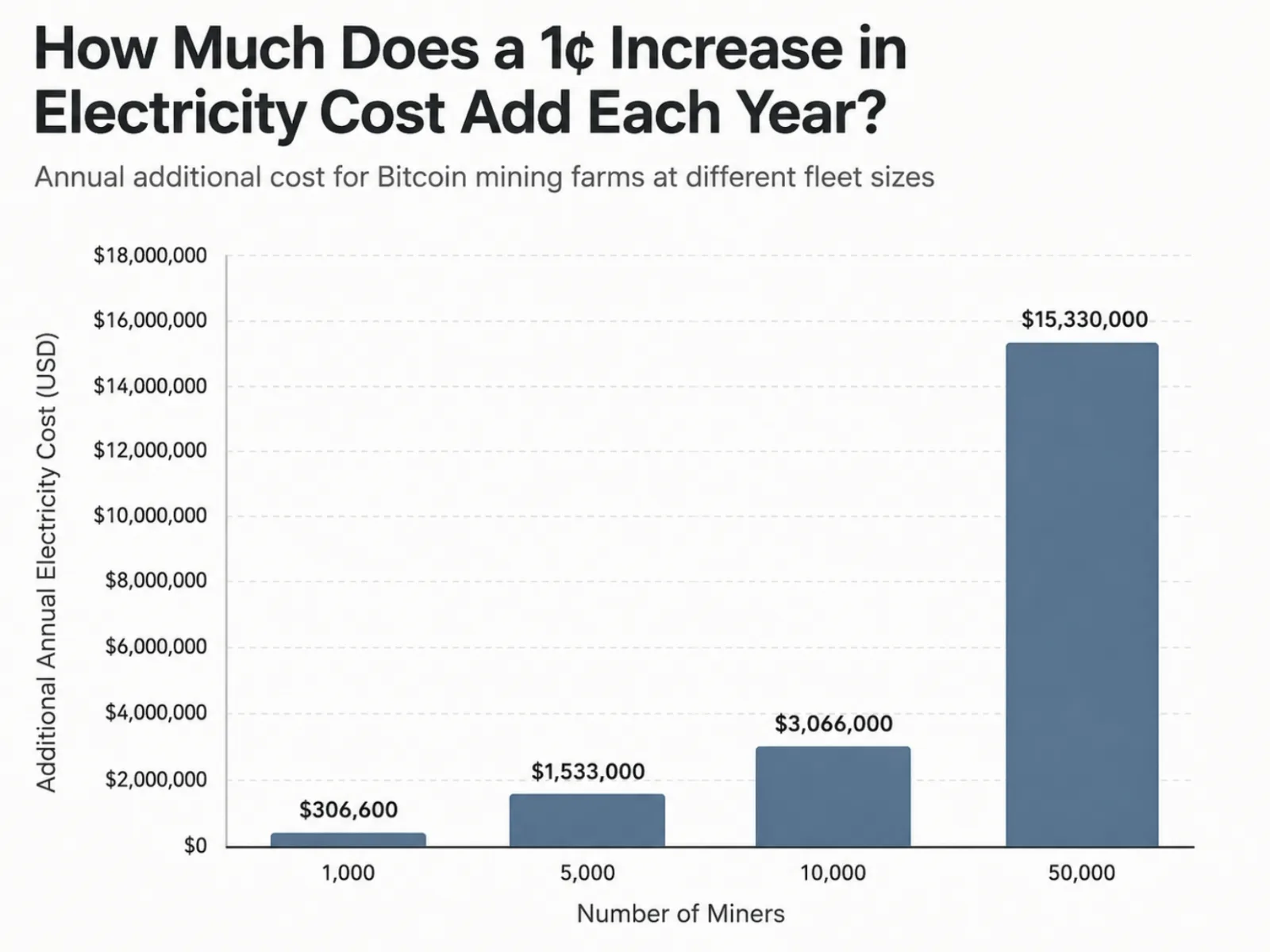
The official Antminer S21 specifications show a power consumption of about 3500W and an efficiency of about 17.5 J/TH. The machine's annual electricity consumption is 3.5 kW × 24 × 365 = 30,660 kWh. If the electricity price rises from $0.05/kWh to $0.06/kWh, the electricity cost increases by $306.6 — this is the added annual electricity cost for a single machine. So when a commercial mining farm has thousands or tens of thousands of units, this figure becomes enormous.
| Miner fleet size | Annual added cost after a $0.01/kWh price increase |
|---|---|
| 1,000 miners | about $306,600 |
| 5,000 miners | about $1,533,000 |
| 10,000 miners | about $3,066,000 |
| 50,000 miners | about $15,330,000 |
Bitcoin miner profitability at different electricity prices
Electricity price determines a machine's room to survive. Miner efficiency is usually measured in J/TH. It is calculated as power consumption (W) ÷ hashrate (TH/s) — for example, a machine with 3500W of power and 200 TH/s of hashrate has an efficiency of 17.5 J/TH.
The lower the value, the less energy consumed per unit of hashrate, and the higher the efficiency. This is also why a new generation of ASIC miners, such as the Antminer S21 series, has a clear advantage over the earlier S19 series. Because when electricity prices rise, high-efficiency machines can keep running, while low-efficiency machines enter the shutdown zone sooner.
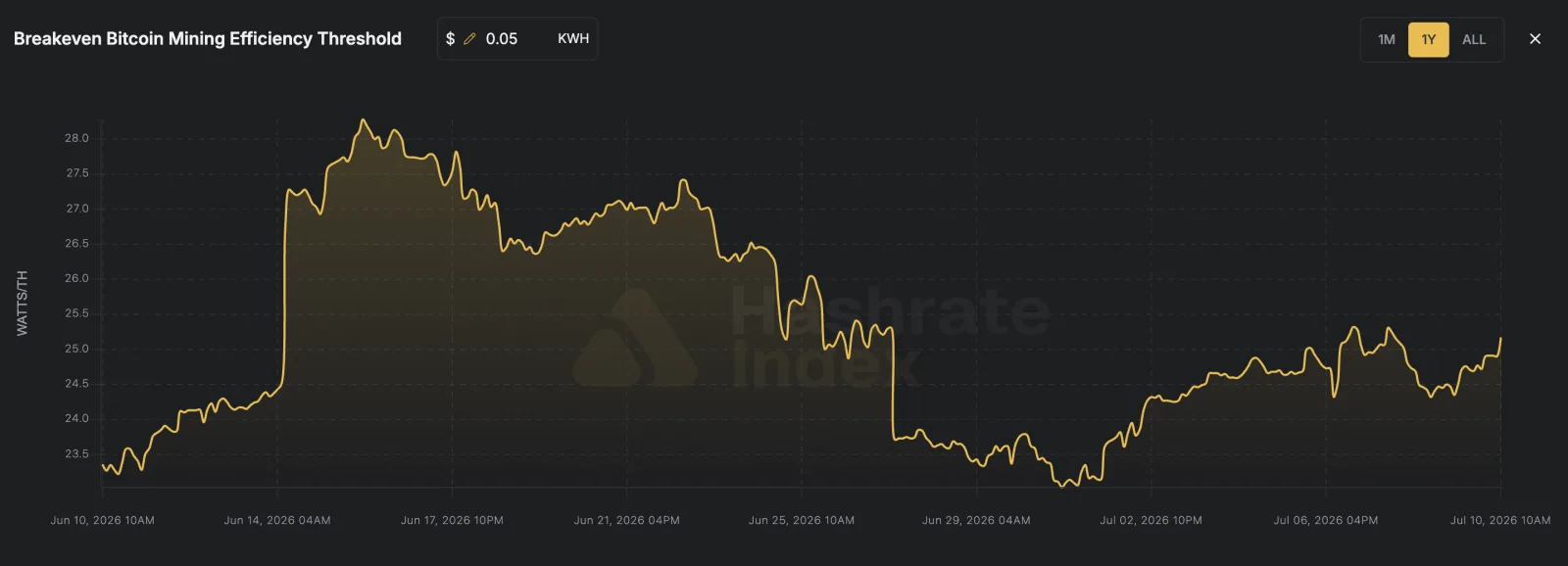
Hashrate Index's Breakeven Efficiency Threshold data shows the minimum efficiency a machine needs to reach breakeven under different electricity price conditions.
| Electricity price | Approximate breakeven efficiency |
|---|---|
| $0.03/kWh | about 50 J/TH |
| $0.05/kWh | about 25 J/TH |
| $0.07/kWh | about 18 J/TH |
| $0.10/kWh | about 12 J/TH |
This set of data reflects a very important industry rule: the higher the electricity price, the stricter the requirement a mining farm places on miner efficiency. In a low-price environment of $0.03/kWh, some older machine models may still keep running. But when the electricity price rises to $0.07/kWh or even $0.10/kWh, only the latest generation of high-efficiency ASICs can more easily stay profitable.
The impact of electricity cost on per-coin cost
Although electricity price is the most direct factor affecting Bitcoin mining profit, professional mining companies usually do not look only at the price per kilowatt-hour. The reason is simple: at the same electricity price, different mining farms may have completely different profitability.
One farm uses the latest generation of high-efficiency ASIC miners and can maintain a high uptime; another farm uses old machines and has a large number of low-hashrate, abnormal-power devices. Even if the two have exactly the same electricity price, the final cost of mining 1 BTC may differ enormously.
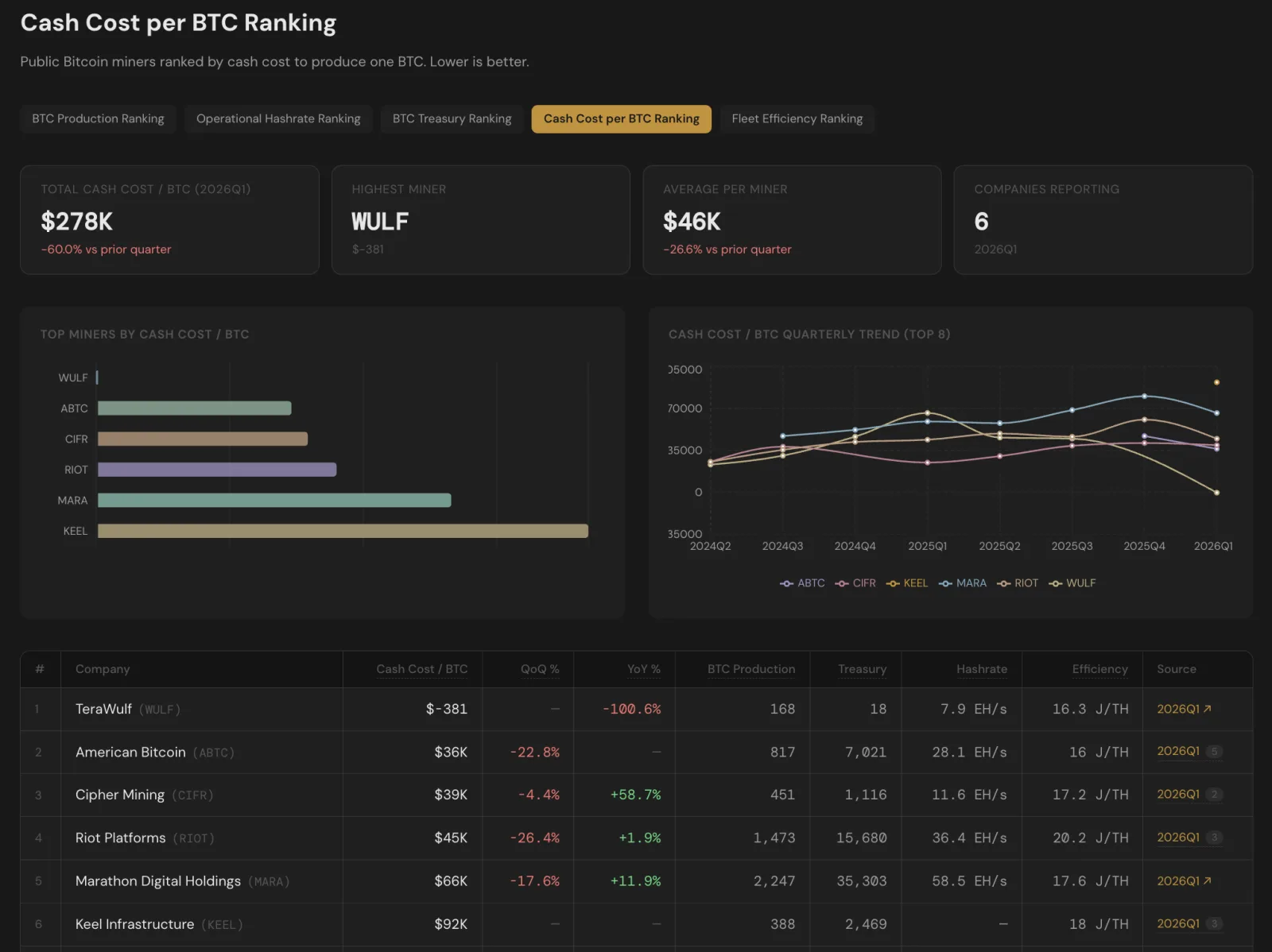
Therefore, listed mining companies and large mining farms pay more attention to one metric: cost per BTC. Simply put, how many dollars of cost it takes to mine one BTC. Among these, energy cost is usually the largest part of the cost per BTC. According to the Nonce website (covering the 6 listed mining companies that have published data), the average per-coin cost for Q1 2026 was $46k.
The impact of electricity cost on miner efficiency
Many miners believe that as long as the BTC price rises, old machines can keep running. But the reality is not so. Because miner income is affected in two directions: on one hand, a rising BTC price increases income; on the other hand, increasing network-wide hashrate reduces the amount of BTC each machine earns. And electricity is a fixed cost incurred every day. Therefore, when the market enters a competitive phase, low-efficiency machines are the first to be affected.
The mainstream ASIC miners on the market today have gradually transitioned from the previous S19 series to the S21 series. Below are typical parameters from public specifications:
| Miner model | Hashrate | Power consumption | Efficiency |
|---|---|---|---|
| Antminer S19 XP | 140 TH/s | 3010W | about 21.5 J/TH |
| Antminer S21 | 200 TH/s | 3550W | about 17.5 J/TH |
| Antminer S21 Pro | 234 TH/s | 3531W | about 15 J/TH |
Data source: Bitmain official product specifications
We can see that the S21 Pro, compared with the S19 XP, improves hashrate by about 67%, while lowering efficiency by about 30% at similar power consumption. This means that in a low-price environment, the S19 XP may still have operating value. But as the electricity price rises, the advantages of the S21 and S21 Pro become increasingly clear.
About the shutdown price
In Bitcoin mining there is a concept called the shutdown price. Put simply, when the income a machine produces cannot cover its electricity cost, continuing to run only creates a loss. A mining farm usually does not wait until it is completely losing money to act; instead, it judges in advance, based on the BTC price, network difficulty, electricity price, and miner efficiency, which machines need to reduce power or shut down.
At the same time, a mining farm will not completely shut down all machines when a loss appears; it usually adopts a tiered approach — for example, first shutting down some old machines, then reducing the power of some machines, keeping only the highest-efficiency devices running at full load. This is also why large mining farms do not simply turn on all machines with one click, but need to continuously manage the operating status of different devices.
Why do mining farms need to monitor miner status in real time?
Traditional mining farm management usually relies on manual inspections, Excel records, and scattered management tools. But once the fleet size grows, this approach becomes increasingly hard to meet the needs. Because a mining farm needs to answer a large number of questions every day, and if problems cannot be found in time, electricity will still keep being consumed.
Therefore, large mining farms need to use data monitoring to promptly detect issues such as hashrate drops, abnormal power consumption, and abnormal temperature, to avoid continued power waste.
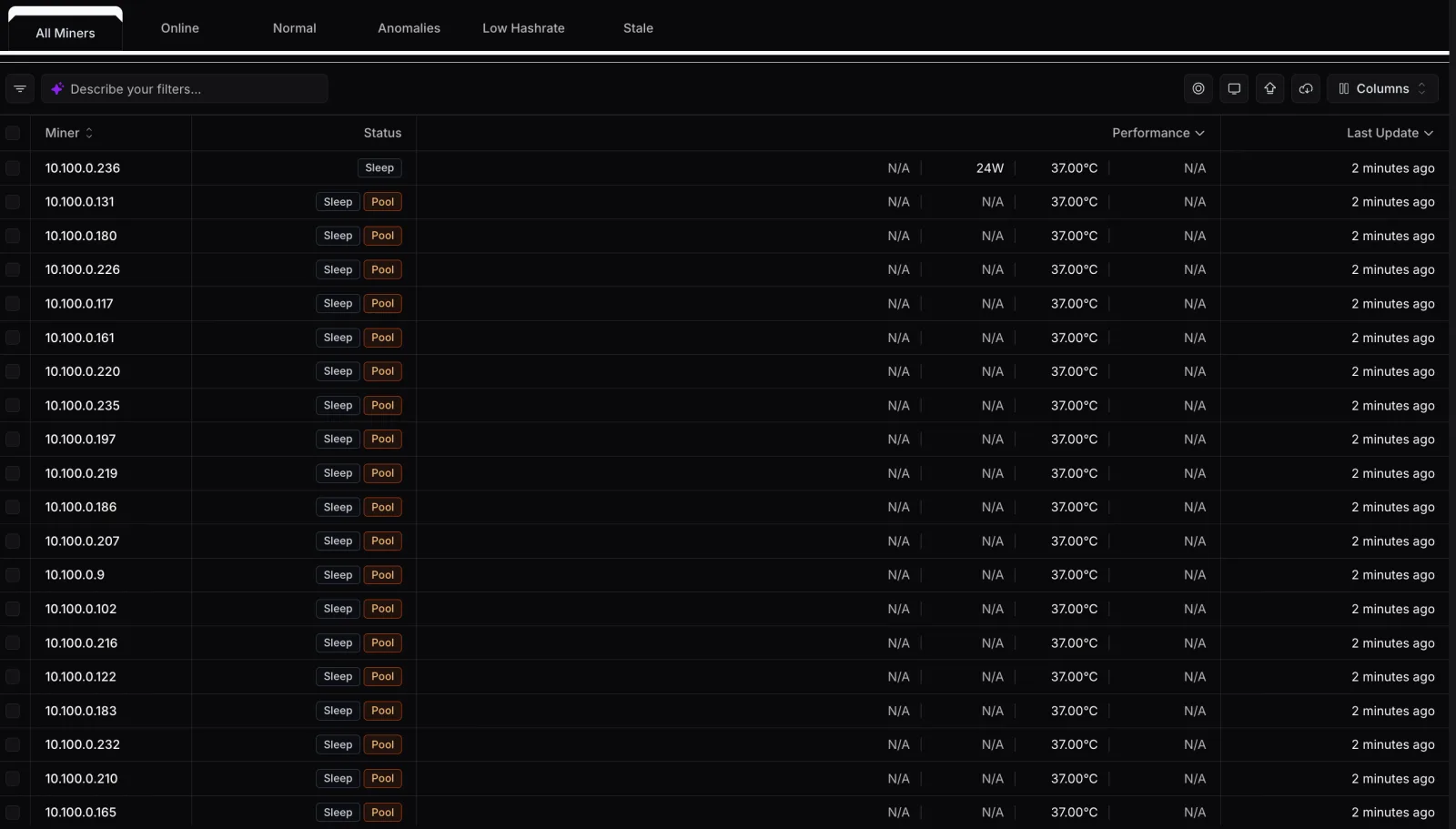
Reducing electricity cost does not mean a mining farm can only look for cheaper power. In fact, a lot of room for optimization comes from the farm's internal operations.
For example, a mining farm can adjust its machine operating strategy based on the electricity price: when the price is low, the farm can raise power, turn on more devices, and maximize hashrate output; and when the price rises, the farm can lower power, adjust frequency, and pause low-efficiency devices. This kind of dynamic management can reduce losses under extreme market conditions. These functions can also be automated through a bulk miner management tool such as Nonce.

Reducing power waste through anomaly detection
In mining farm operations, an important goal is to keep every machine in optimal running condition. For example, a high-temperature machine may automatically throttle its frequency; a low-hashrate machine may consume normal power but produce insufficient output; an offline machine may need manual handling to recover. Through a unified management platform, the operations team can quickly locate these issues.
Future competition trends in Bitcoin mining
Over the past few years, the Bitcoin mining industry has undergone clear changes. With the Bitcoin halving, network hashrate growth, and improvements in miner efficiency, industry competition has gradually shifted to who can run more effective hashrate at lower cost. The number of blocks the Bitcoin network produces each day is essentially fixed, while the block reward falls with each halving cycle. After the fourth halving in 2024, the single block reward dropped from 6.25 BTC to 3.125 BTC. For miners, income falls while competition rises, further raising the importance of cost control.
Under these conditions, electricity is no longer merely an operating cost but has become a core metric determining a mining farm's ability to survive. If a mining farm cannot control power cost, miner efficiency, and hashrate stability, then even with a large number of ASIC miners it may not be able to stay profitable over the long term.
Frequently Asked Questions (FAQ)
What is the biggest cost in Bitcoin mining?
For most commercial mining farms, power cost is usually the largest operating cost. Because ASIC miners need to run 24 hours a day all year round, large-scale mining farms consume large amounts of electricity every day, so changes in the electricity price directly affect profit.
Does a 1-cent electricity price increase have a big impact on a mining farm?
The impact depends on the size of the mining farm. For a single 3500W machine, a $0.01/kWh price increase adds about $307 in electricity cost per year. But if a mining farm has 10,000 units, the added annual cost is more than about $3 million.
What electricity price is needed for Bitcoin mining to be profitable?
There is no fixed answer. Profitability depends on the BTC price, network difficulty, miner efficiency, and operating costs. In general, the lower the electricity price, the wider the range of machines that can run. In a high-price environment, only high-efficiency ASICs can more easily stay profitable.
Why do mining farms need to pay attention to J/TH?
J/TH is an important metric for measuring the energy efficiency of an ASIC miner. It indicates how many joules of energy are consumed to produce 1 TH of hashrate. The lower the value, the higher the miner's efficiency.
Is lowering the electricity price the only way to reduce Bitcoin mining cost?
No. A mining farm can also reduce the actual cost per BTC by improving miner uptime, reducing inefficient operation, optimizing power modes, and automating operations and maintenance.