Why Don't Miners Profit When BTC Rises? Hashprice Is the Key Metric
Miners don't earn the BTC price itself; they earn the share of revenue their hashrate captures across the network. What truly determines daily income is Hashprice, the revenue a unit of hashrate produces per day. Watching BTC price alone misjudges the market; combine price, hashrate, difficulty, fees, electricity, and efficiency to see real profit.
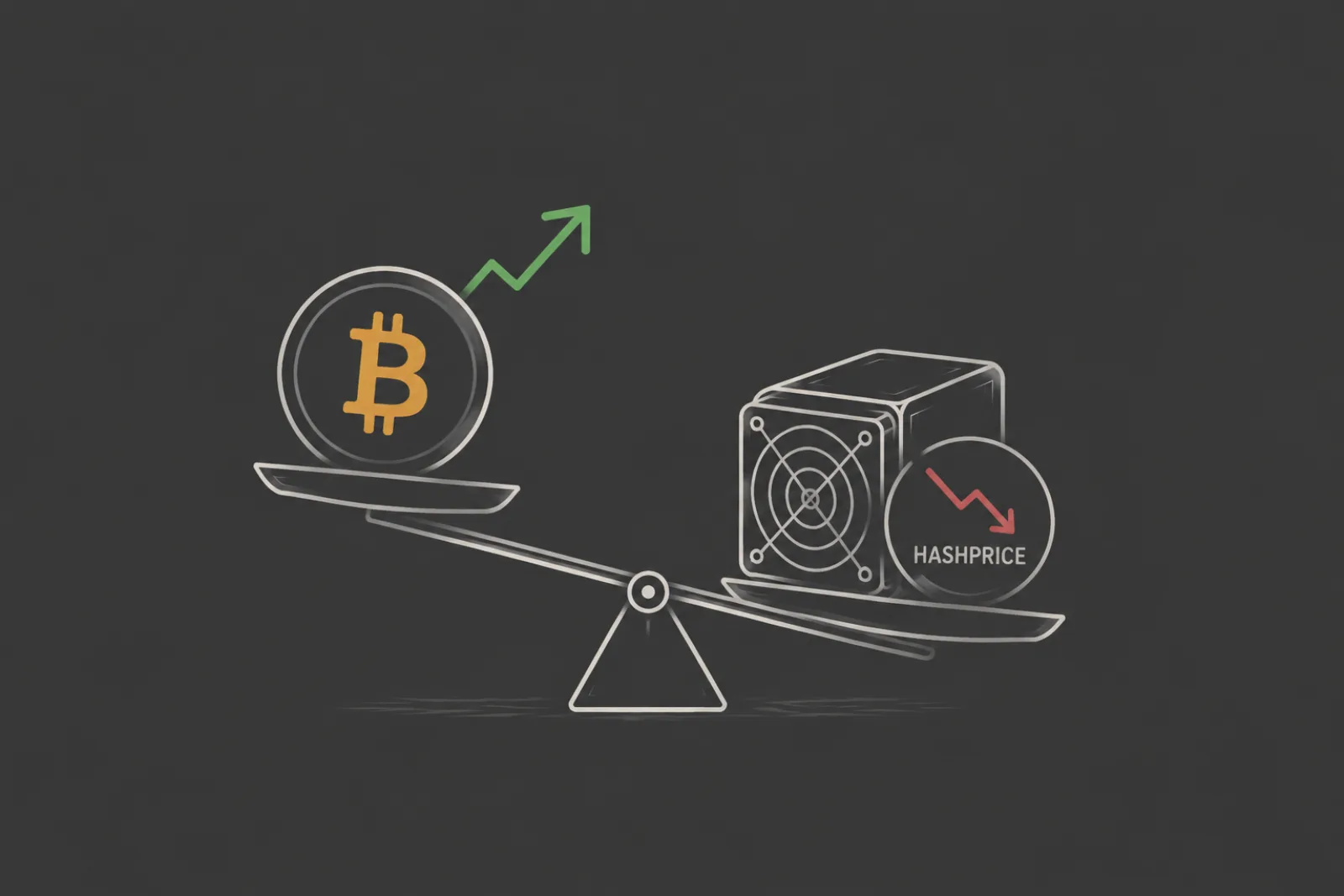
Many mining farm operators run into the same problem: the price of BTC has clearly gone up, yet farm profits show no obvious improvement, and some machines are even still close to the shutdown line.
The essence of this problem is that miners don't earn the BTC price itself; they earn the share of revenue their own hashrate captures in the competition across the entire network.
The BTC price is only one variable in a miner's revenue. What truly determines a miner's daily income is Hashprice, that is, how much revenue a unit of hashrate can produce per day. If a farm only watches the BTC price, it can easily misjudge the market; if it only watches a single machine's hashrate, it can easily misjudge output. Only by looking at the BTC price, total network hashrate, mining difficulty, transaction fees, pool fees, electricity cost, and machine efficiency together can you get close to the real profit.
BTC went up, so why doesn't miner revenue necessarily go up?
For someone buying coins, when BTC rises from $80,000 to $100,000, the change in return is very direct. But for miners, revenue does not change in that linear way. How much a miner can earn each day depends on the proportion of total network hashrate that their own contributed hashrate represents, multiplied by the block reward, transaction fees, and the BTC price.
If the BTC price rises 20%, but over the same period total network hashrate rises 30% and mining difficulty is adjusted upward accordingly, then the amount of BTC each machine is allotted per day may actually decline. The end result is this: the BTC unit price is higher, but you are allotted less BTC, and revenue does not necessarily increase noticeably.
This is also why many farms still feel profit pressure during a bull market. Rising coin prices attract more hashrate into the network, old machines come back online, new machines are deployed, and institutional miners expand. As total network hashrate rises, the Bitcoin network maintains a roughly 10-minute-per-block rhythm through difficulty adjustment. After difficulty is adjusted upward, the probability of each unit of hashrate mining BTC decreases, and miner revenue is diluted again.
So a rising BTC price is only one of the tailwinds on the revenue side. If total network hashrate grows faster, difficulty adjusts up more strongly, and transaction fees don't rise in step, farm profits will not rise along with the BTC price.
What is Hashprice?
Hashprice can be understood as the "price of a unit of hashrate." It measures roughly how many US dollars of revenue each 1 TH/s or each 1 PH/s of hashrate can produce per day. Hashrate Index, Bitdeer, and Simple Mining all treat Hashprice as an important metric for understanding miner revenue, because it is closer to a miner's real income than the BTC price.
Put simply, Hashprice answers a question a farm operator truly cares about: how much is each 1 T of my hashrate actually worth today?
If the BTC price is the market that investors watch, then Hashprice is the market that miners watch. When BTC rises, it means the coin price rose; when Hashprice rises, that is what signals an improvement in revenue per unit of hashrate.
Here is a simple example. Suppose a machine has a hashrate of 200 TH/s, and that day's Hashprice is $0.05/TH/s/day, then this machine's theoretical daily revenue is about 200 × 0.05 = $10/day. This is only gross revenue, before deducting electricity, pool fees, maintenance fees, and hosting fees. If this machine's electricity costs $8 per day and other costs are $0.5, then net profit is about $1.5. If Hashprice falls to $0.04/TH/s/day, gross revenue becomes $8/day, which might just cover electricity, and that's before other costs.
This is the significance of Hashprice. It is the core metric a farm uses to judge whether a unit of hashrate is still worth running right now.
The key factors that influence Hashprice
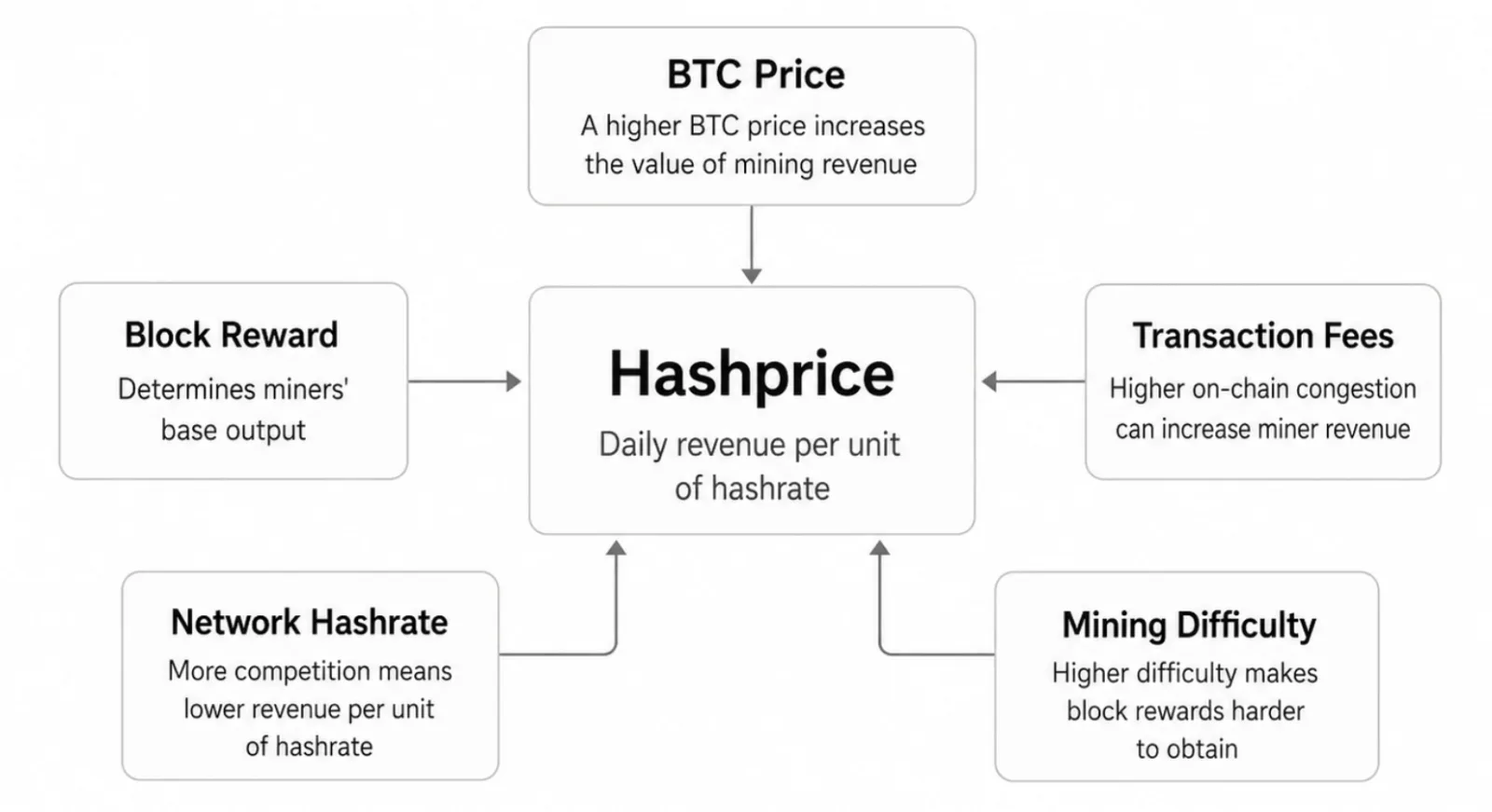
Hashprice is not determined by a single factor; it is determined jointly by the BTC price, block reward, transaction fees, total network hashrate, and mining difficulty.
The higher the BTC price, the higher the revenue when the same amount of BTC is converted into US dollars—this is the easiest part to understand. But a rising BTC price also attracts more hashrate into the network, which in turn pushes difficulty higher, so the boost to miner revenue from a rising coin price is not always fully transmitted.
The block reward determines how much base revenue a miner earns per block. After Bitcoin's 2024 halving, the block subsidy dropped from 6.25 BTC to 3.125 BTC. This means that, without considering transaction fees, the amount of newly issued BTC a miner receives per block was directly halved. The halving does not halve a machine's power consumption, nor does it halve electricity costs, so farm profits are noticeably compressed.
Transaction fees are another part of miner revenue. When on-chain transactions are congested and fees rise, miner revenue increases; when on-chain activity is quiet, the contribution from transaction fees is limited, and miners rely more on the block subsidy. For miners, transaction fees are not fixed revenue but volatile revenue.
Total network hashrate and mining difficulty are the most easily overlooked yet most critical variables. Bitcoin mining is a global hashrate competition. Your machines don't earn money in isolation; they split the same batch of block rewards with all machines across the network. The higher the total network hashrate, the lower your hashrate share; the higher the difficulty, the lower the probability of each unit of hashrate mining BTC.
You can think of miner revenue as a pool of water. A rising BTC price means the water in the pool is worth more; the halving means less new water flows into the pool each day; transaction fees mean extra water flowing in; rising total network hashrate means more people coming to share the water. How much a miner ultimately gets depends not only on the price of water, but also on the size of the pool, the number of people sharing it, and how big your own bucket is.
Why are miners more easily diluted when BTC rises?
A rising BTC price improves mining expectations. Old machines that were originally shut off may come back online, the newest generation of machines is deployed faster, new farms begin connecting, and public miners may also expand their hashrate. In the short term, miners may enjoy the revenue improvement that comes with rising coin prices; but as more hashrate enters the network and difficulty is adjusted upward, revenue per unit of hashrate is thinned out again.
This is the biggest difference between mining and simply buying coins. Buying coins mainly comes down to the asset price, while miners must also watch the intensity of competition. The more BTC rises, the more excited the market becomes, the more incentive there is for new hashrate to enter, and the more miners must pay attention to whether Hashprice is truly improving.
Often, an improvement in farm profit exists only within a window: BTC rises quickly while total network hashrate and difficulty have not fully caught up. Once new machines come online at scale and difficulty finishes adjusting, Hashprice may fall back again. If a farm only watches the BTC price, it can easily overestimate subsequent profit during this stage.
Watching Hashprice alone isn't enough—you also need to watch your own breakeven line
Hashprice tells you how much each unit of hashrate can earn in the market, but it can't directly tell you whether your own farm is profitable. Because every farm's electricity price, machine models, efficiency, hosting fees, maintenance fees, and uptime are different.
So a farm also needs to calculate its own Breakeven Hashprice, that is, the break-even Hashprice.
The formula is simple: total daily cost ÷ total hashrate = breakeven Hashprice.
Suppose a farm has total hashrate of 10 PH/s, and daily electricity, maintenance, site, and other costs total $450, then its breakeven Hashprice is 450 ÷ 10 = $45/PH/s/day.
If the market Hashprice is above $45/PH/s/day, the farm is theoretically profitable; if it is below $45/PH/s/day, the farm begins to lose money.
This metric is very important, because breakeven lines vary greatly across different farms and different machine models. Low-electricity-price farms can tolerate a lower Hashprice, while high-electricity-price farms are more easily eliminated; high-efficiency machines are more cycle-resistant, while old machines hit the shutdown line faster when Hashprice declines.
So what a farm should really watch is not whether BTC went up today, but rather: is the market Hashprice above my breakeven Hashprice? If the answer is no, then even if BTC went up it doesn't mean you're making money.
| Electricity source / price | Antminer S19j Pro ~21.9 J/TH | Antminer S21 Pro 15 J/TH | Antminer S21 XP+ Hyd ~11 J/TH |
|---|---|---|---|
| Texas clean PPA price: $55/MWh, i.e. $0.055/kWh | $28.91 / PH / day | $19.80 / PH / day | $14.52 / PH / day |
| Ameren average retail price: 8.05¢/kWh, i.e. $0.0805/kWh | $42.31 / PH / day | $28.98 / PH / day | $21.25 / PH / day |
| Georgia Power average retail price: 9.86¢/kWh, i.e. $0.0986/kWh | $51.82 / PH / day | $35.50 / PH / day | $26.03 / PH / day |
| Texas clean PPA forecast price: $121/MWh, i.e. $0.121/kWh | $63.60 / PH / day | $43.56 / PH / day | $31.94 / PH / day |
Single-machine hashrate isn't the key—revenue and cost per TH/s are the key
When many farms look at a machine, their first instinct is to look at hashrate: this one is 140T, that one is 200T, another is 300T. Hashrate matters, of course, but looking only at hashrate is not enough. A machine's real competitiveness is not its total single-machine hashrate, but how much revenue each TH/s can produce and how much cost each TH/s consumes.
Revenue per TH/s comes from Hashprice. Cost per TH/s comes mainly from electricity, pool fees, maintenance fees, hosting fees, and machine depreciation.
For two machines that are both 200T, if one has better efficiency and consumes less power per unit of hashrate, it survives more easily in a low-Hashprice environment. Conversely, a machine with very high hashrate but also high power consumption may quickly become a negative-revenue machine if electricity prices rise or Hashprice falls.
This is also why farm operations cannot pursue only total hashrate. Total hashrate represents scale, but net revenue per TH/s represents quality. When the market is good, coarse operations are easily masked; when the market worsens, high electricity costs, low efficiency, low uptime, and faulty machines all directly eat into profit.
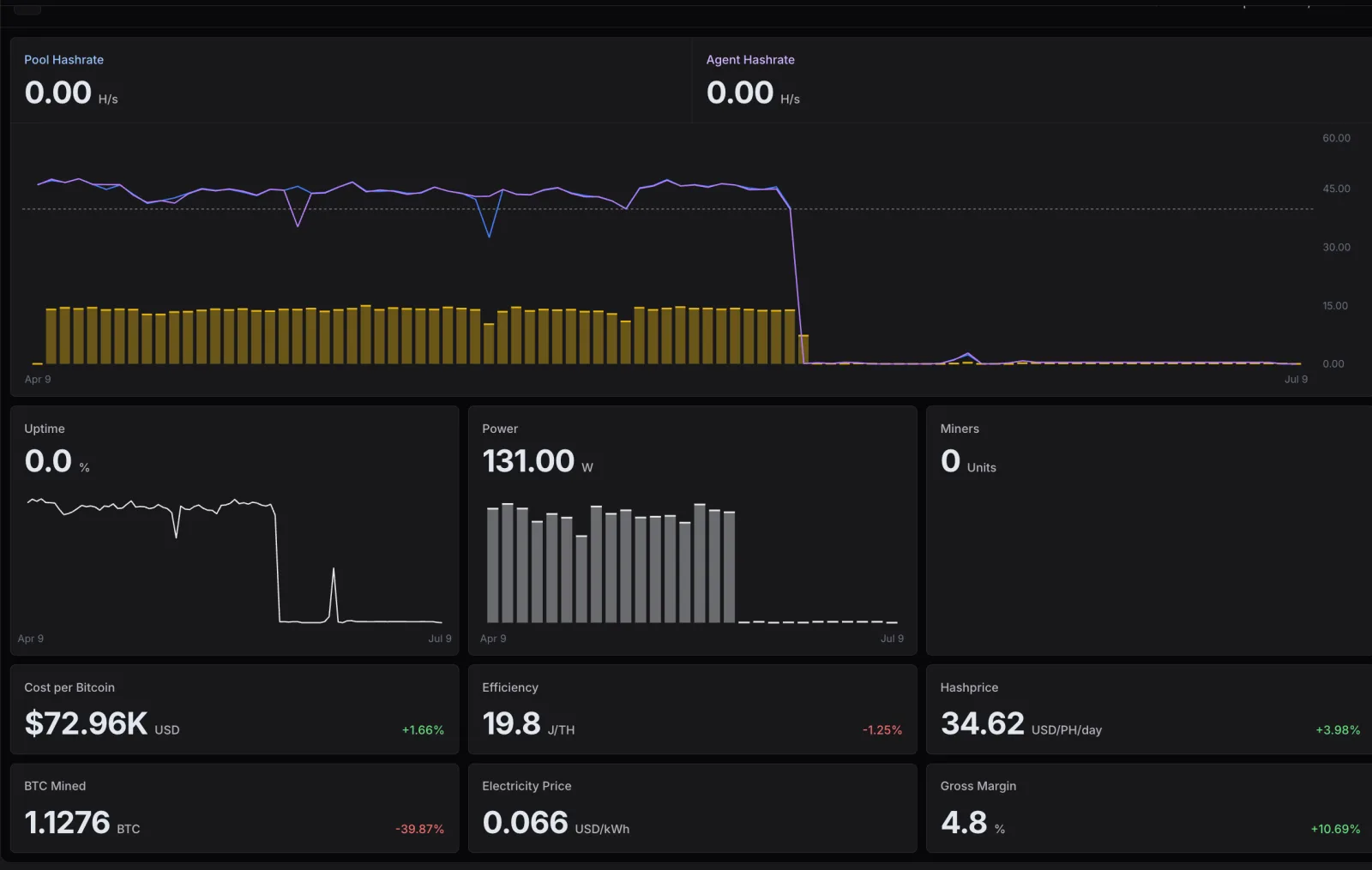
A farm needs more than just to know whether machines have hashrate; it needs to continuously watch low hashrate, offline, overheating, abnormal power consumption, batch power modes, and task results. Only by looking at each machine's operating status alongside its revenue per unit of hashrate can a farm judge which machines are making money and which are only burning electricity.
BTC went up but profit didn't—what should a farm check first?
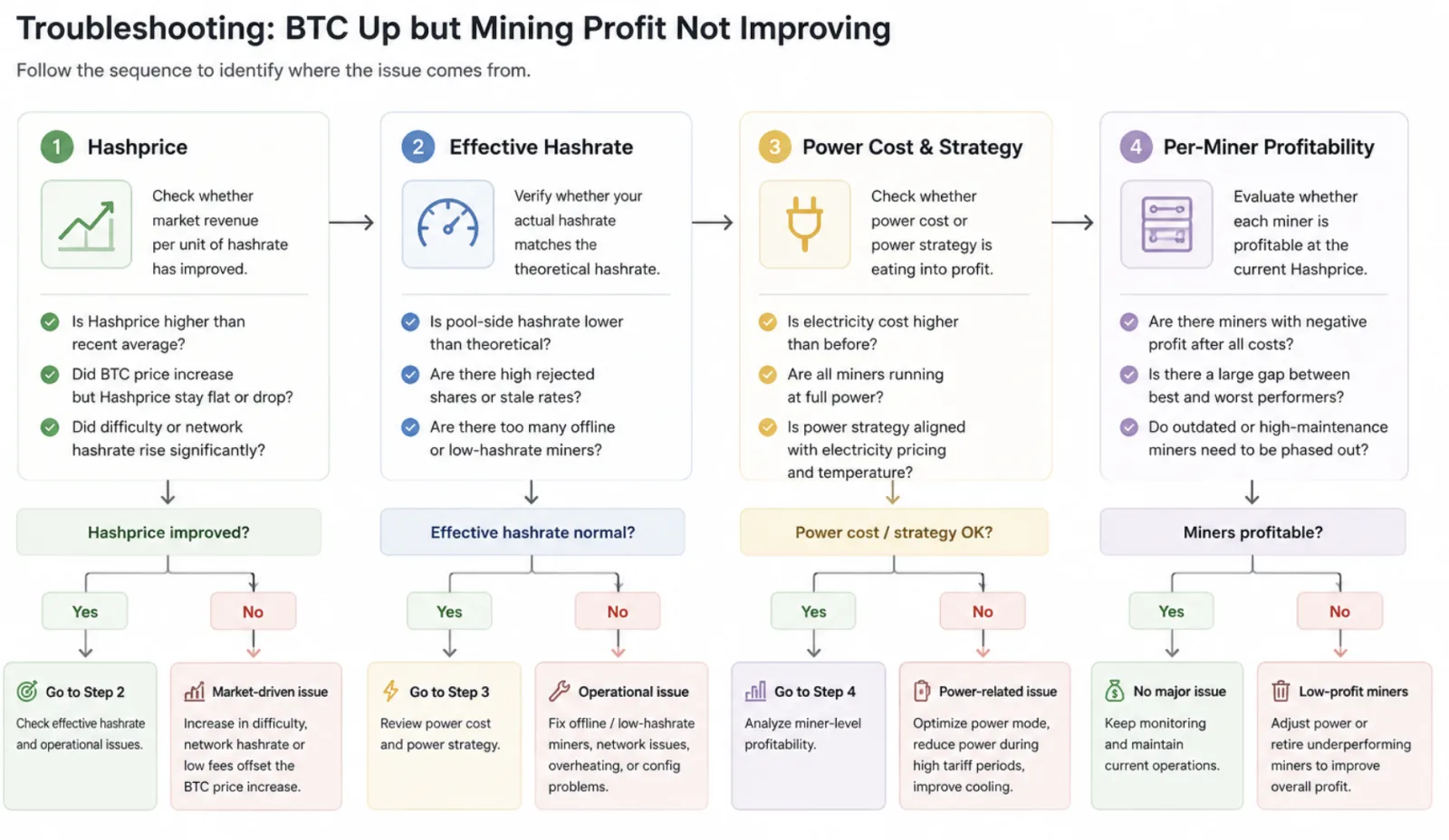
When the BTC price rises but farm profit shows no obvious improvement, don't rush to conclude that the market simply isn't good enough. A more effective approach is to investigate four things in order.
First, check whether Hashprice rose in step. If BTC went up but Hashprice didn't, it means changes in total network hashrate, difficulty, or transaction fees have already offset part of the coin-price tailwind. This is a market-level issue, not necessarily an operational problem with the farm itself.
Second, check whether effective hashrate is stable. A machine's nameplate hashrate does not equal the hashrate the pool actually receives. If the pool-side effective hashrate is persistently below the theoretical hashrate, it means the farm has losses. Low hashrate, offline machines, network fluctuations, pool rejection rates, firmware anomalies, and excessive temperatures can all cause electricity to be spent while revenue doesn't come back.
Third, check electricity costs and power strategy. When Hashprice is high, some machines can consider raising power to capture more revenue; but when Hashprice is declining, electricity prices are rising, or temperatures are too high, continuing to run at full power isn't necessarily worthwhile. A farm needs to adjust its operating strategy based on electricity price, temperature, and machine model, rather than treating all machines the same way.
Fourth, check the profit contribution of individual machines. A farm's overall profit being positive doesn't mean every machine is profitable. Old models, high-temperature zones, and frequently faulty machines may already be negative contributors. Mature farm management is not running all machines together and shutting them all off together, but managing them in tiers based on model, efficiency, electricity price, and status.
When Hashprice declines, shutting down isn't a farm's only option
A declining Hashprice does not mean a farm's only option is to shut everything down. A better approach is to handle it in tiers.
High-efficiency machines can keep running, because their breakeven line is lower. Medium-efficiency machines can adjust power based on electricity-price periods, running during low-price periods and throttling or sleeping during high-price periods. Low-efficiency machines that fault frequently and cost a lot to maintain need to be reassessed for whether they should keep running.
In regions where electricity prices fluctuate noticeably, Hashprice should be viewed together with the electricity-price curve. In some periods Hashprice can cover electricity, and in others it cannot. If a farm still runs at full power 24 hours a day, it may actively lose money during high-price periods.
So the goal of farm operations is not to keep all machines at full load forever, but to convert every kilowatt-hour into positive revenue as much as possible. After Hashprice changes, a farm's power strategy, maintenance priorities, and on/off strategy should all change accordingly.
Which metrics should farm operators watch?
If a farm has only the BTC price, total hashrate, and today's coin output, that's actually not enough. The metrics better suited to a farm operator's attention should include at least these:
| Metric | Purpose | What to focus on |
|---|---|---|
| BTC price | Judge the US-dollar value of BTC output | Whether the price change is enough to cover rising difficulty |
| Hashprice | Judge revenue per unit of hashrate | How much each TH/s can earn per day |
| Breakeven Hashprice | Judge the farm's shutdown line | Whether market Hashprice is above your own cost line |
| Effective hashrate | Judge real output capacity | Whether pool-side hashrate is below theoretical hashrate |
| Uptime | Judge downtime losses | Whether too many machines are offline |
| Efficiency | Judge power-conversion efficiency | How much electricity each TH/s consumes |
| Electricity cost per TH/s | Judge cost per unit of hashrate | Whether it eats up revenue per unit of hashrate |
| Count of low-hashrate / overheating / offline | Judge operational anomalies | Which machines need priority handling |
These metrics separate market problems from operational problems. If BTC went up but Hashprice didn't, it's mainly market competition causing revenue per unit of hashrate not to improve. If Hashprice went up but farm revenue didn't, the issue may be with effective hashrate, uptime, pool configuration, or machine status. If revenue went up but profit didn't, then you should focus on checking electricity costs, efficiency, hosting fees, and maintenance costs.
For multi-farm, multi-model, multi-electricity-price environments, it's hard to catch problems in time using manual spreadsheets. A farm needs to put hashrate, status, temperature, power mode, and batch task results into the same workflow. Nonce's operations approach can be summarized as: first query abnormal machines, then select the target machines, execute batch operations, and finally track the task results. This flow is well suited to converting Hashprice changes into actual operational actions, rather than staying at the level of metric observation.
How should farm operators use Hashprice to make decisions?
Hashprice should enter a farm's daily operating decisions, rather than being just industry data glanced at occasionally.
When Hashprice is clearly above the farm's breakeven line, the farm should prioritize raising uptime and effective hashrate. In this stage every downtime loss is more expensive, and low-hashrate, offline, and overheating machines need faster handling. Whether to overclock should be judged together with temperature, fault rate, and machine lifespan, and not based only on short-term revenue.
When Hashprice is near the breakeven line, the farm should enter a state of fine-grained control. High-efficiency machines keep running, medium machines adjust power based on electricity price and temperature, and low-efficiency machines are assessed primarily for whether to throttle, sleep, or retire. What to avoid most in this stage is treating all machines the same way.
When Hashprice is below the breakeven line, the farm must judge whether the pressure is a short-term fluctuation or a long-term trend. If it's a short-term fluctuation, losses can be controlled by throttling, sleeping, and reducing operation during high-price periods. If it's long-term pressure, then the electricity contract, machine-model structure, hosting costs, and equipment-update plan need to be reassessed.
A truly mature farm doesn't predict whether BTC will rise or fall tomorrow, but builds a set of operating systems that can respond to Hashprice changes.
BTC price is the market; Hashprice is the miner's revenue thermometer
A rising BTC price matters, of course, but it is not the whole of a miner's profit. What miners actually face is a dynamic competitive system: the BTC price determines the value of output, block rewards and transaction fees determine block revenue, total network hashrate and difficulty determine how much you're allotted, and electricity price and machine efficiency determine how much you get to keep.
So when you find that BTC went up but farm profit didn't, don't just look at the BTC quote in your market app. You should instead ask:
- Did Hashprice rise?
- Was network difficulty adjusted upward?
- Did transaction fees increase noticeably?
- Is your own effective hashrate stable?
- Were low-hashrate, offline, and overheating machines handled in time?
- Does revenue per TH/s cover cost per TH/s?
Future competition among farms is not just competition in total hashrate, but competition in the ability to operate per unit of hashrate. Whoever can read Hashprice more accurately, whoever can calculate revenue and cost per TH/s faster, and whoever can handle low-hashrate, offline, overheating, and high-electricity-cost problems more promptly, is more likely to retain more profit within the same BTC market.
The BTC price is the market opportunity, Hashprice is the miner's revenue thermometer, and fine-grained operating capability is the key to turning opportunity into profit.