How Much Does It Cost to Mine 1 BTC? Real 2026 Data from Public Mining Companies
After Bitcoin's fourth halving, competition among miners is increasingly about who can produce BTC at a lower cost. In the first quarter of 2026, cash cost per BTC varied widely across public mining companies, ranging from around \$21,661 to \$91,760, a gap exceeding 4x between highest and lowest.
Introduction
How much does it actually cost to mine 1 Bitcoin? For miners, mining farm operators, and institutional investors, this has become an increasingly important question. After Bitcoin's fourth halving, network hashrate has continued to reach new highs. Competition among miners is no longer simply about who owns more machines. It is increasingly about who can produce BTC at a lower cost.
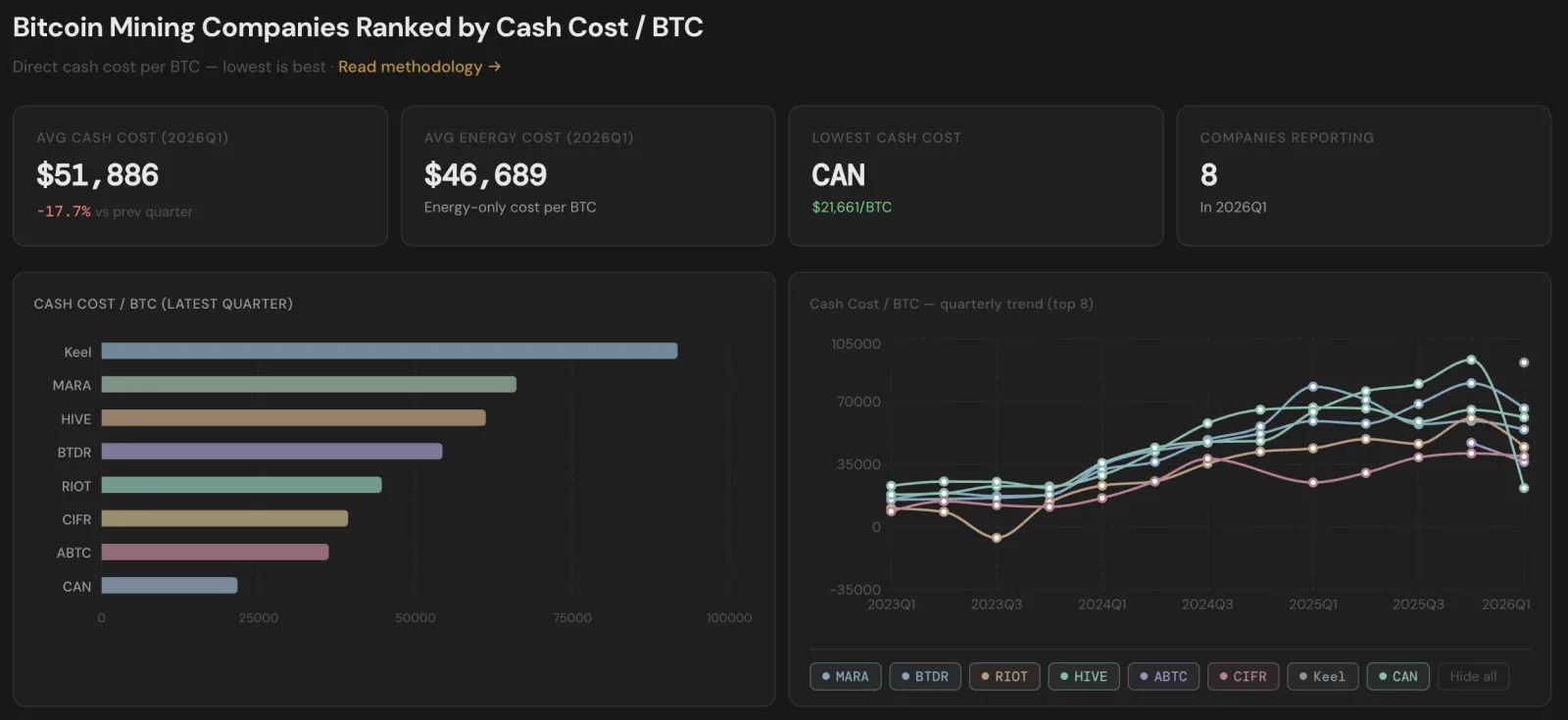
According to public mining company data released by Nonce, in the first quarter of 2026, cash cost per BTC varied widely across mining companies, ranging from around $21,661 to $91,760. The gap between the highest and lowest cost exceeded 4x.
Why can the cost of mining the same 1 Bitcoin vary so dramatically? This article combines public mining company data, Bitcoin mining cost models, and mining farm operating practices to analyze the core factors that affect BTC cost per coin, as well as how mining farms can reduce production costs through data-driven operations.
What Is BTC Cost per Coin (Cost per BTC)?
BTC cost per coin, also known as cash cost per BTC, usually refers to the cost required for a miner to produce 1 Bitcoin. Different organizations may use slightly different calculation methods, but the metric typically includes electricity costs, operations and maintenance costs, hosting fees, labor costs, repair costs, management expenses, and losses from downtime.
The final formula is:
Cost per BTC = total operating cost ÷ BTC production
For miners, this metric is more important than the number of mining machines. Ultimately, miners are not competing over who owns more machines. They are competing over who can produce Bitcoin more cheaply.
How Is the Cost of Mining One Bitcoin Calculated?
Many people first think of electricity price. In fact, electricity price is indeed one of the biggest factors affecting cost. A classic model looks like this:
Energy cost per BTC = (total electricity consumption × electricity price) ÷ BTC production
For example, if the electricity price is $0.05/kWh, total electricity consumption is 1 million kWh, and BTC production is 10 BTC:
Energy cost per BTC = 1,000,000 × 0.05 ÷ 10 = \$5,000/BTC
But the real world is far more complex. Even with the same mining machines and the same electricity price, the final cost per BTC may differ by several times. The reason is that operational efficiency also determines cost.
2026 Q1 Public Mining Company Cost per BTC Ranking
According to statistics from The Hash Research for 2026 Q1:
| Rank | Company | Cash Cost / BTC |
|---|---|---|
| 1 | Canaan (CAN) | $21,661 |
| 2 | American Bitcoin (ABTC) | $36,200 |
| 3 | Cipher Digital (CIFR) | $39,257 |
| 4 | Riot Platforms (RIOT) | $44,629 |
| 5 | Bitdeer (BTDR) | $54,300 |
| 6 | HIVE Digital (HIVE) | $61,184 |
| 7 | Marathon Digital (MARA) | $66,096 |
| 8 | Keel Infrastructure (formerly Bitfarms) | $91,760 |
The average cash cost was around $51,886/BTC. The lowest-cost company, CAN, was at $21,661/BTC, while the highest-cost company, Keel, was at $91,760/BTC. The difference was 4.24x, which means that even when the Bitcoin price is the same, profitability can vary dramatically from one mining company to another.
Why Do Costs Differ So Much Across Mining Companies?
Electricity Price
Electricity remains the largest source of spending for mining farms. Some electricity prices disclosed by mining companies are shown below:
| Company | Electricity Price |
|---|---|
| RIOT | $0.03/kWh |
| CAN | $0.04/kWh |
| BTDR | $0.052/kWh |
| Keel | $0.058/kWh |
At first glance, these look like differences of only a few cents. But for mining farms operating at hundreds of MW, every 1-cent increase in electricity price can add millions of dollars in annual cost.
Miner Efficiency
Miner efficiency is usually measured in J/TH, or joules per terahash. The lower the number, the less electricity is consumed per unit of hashrate. Some disclosed figures from mining companies are shown below:
| Company | Efficiency |
|---|---|
| ABTC | 16 J/TH |
| BTDR | 16.4 J/TH |
| HIVE | 16.5 J/TH |
| RIOT | 20.2 J/TH |
| CAN | 23.6 J/TH |
In theory, higher efficiency leads to lower energy cost per BTC. But this still does not fully explain why some companies have much lower costs than their peers. There are other key factors as well.
Uptime and Downtime
Many mining farm managers overlook one fact: downtime itself is a cost. Suppose a mining farm has 10 EH/s of hashrate and theoretically produces 1 BTC per day. If average uptime drops by 10%, actual daily production may fall to only 0.9 BTC. However, electricity, labor, hosting, and management costs do not fall by the same 10%. The result is lower BTC production and a higher cost per BTC.
For large mining farms, every offline miner, every fan failure, and every network issue directly shows up in the final cost per BTC.
Mining Farm Operational Efficiency
This is also an area that more public mining companies are paying attention to. Mining farm operations have moved from the era of manual inspections into the era of data-driven operations. Operations teams need to know in real time:
- Which miners are offline
- Which miners have low hashrate
- Which miners are overheating
- Which miners have abnormal power consumption
- Which miners need to be restarted
- Which miners should be underclocked
- Which miners should be overclocked
If a problem is discovered even one minute late, the entire mining farm loses real revenue.
Why Are More Mining Farms Paying Attention to Energy Cost per BTC?
Over the past few years, the core metrics in mining farm management were usually uptime, total hashrate, and BTC production. But as profit margins shrink, more mining farms are paying attention to Energy Cost per BTC. The reason is that energy cost usually accounts for the majority of mining farm operating expenses. Without continuous monitoring of energy consumption, it is impossible to truly understand mining farm profitability.
From Energy Data to Cost per BTC: Mining Farms Need a Real-Time Operational View
This is also the biggest difference between the new generation of mining farm operations platforms and traditional miner management software. Taking Nonce's Energy Report as an example, mining farms can directly see:
- Avg Power
- Electricity Price
- Total Energy
- Estimated Cost
- Power History
Operations teams no longer need to export data from multiple systems for manual calculations.
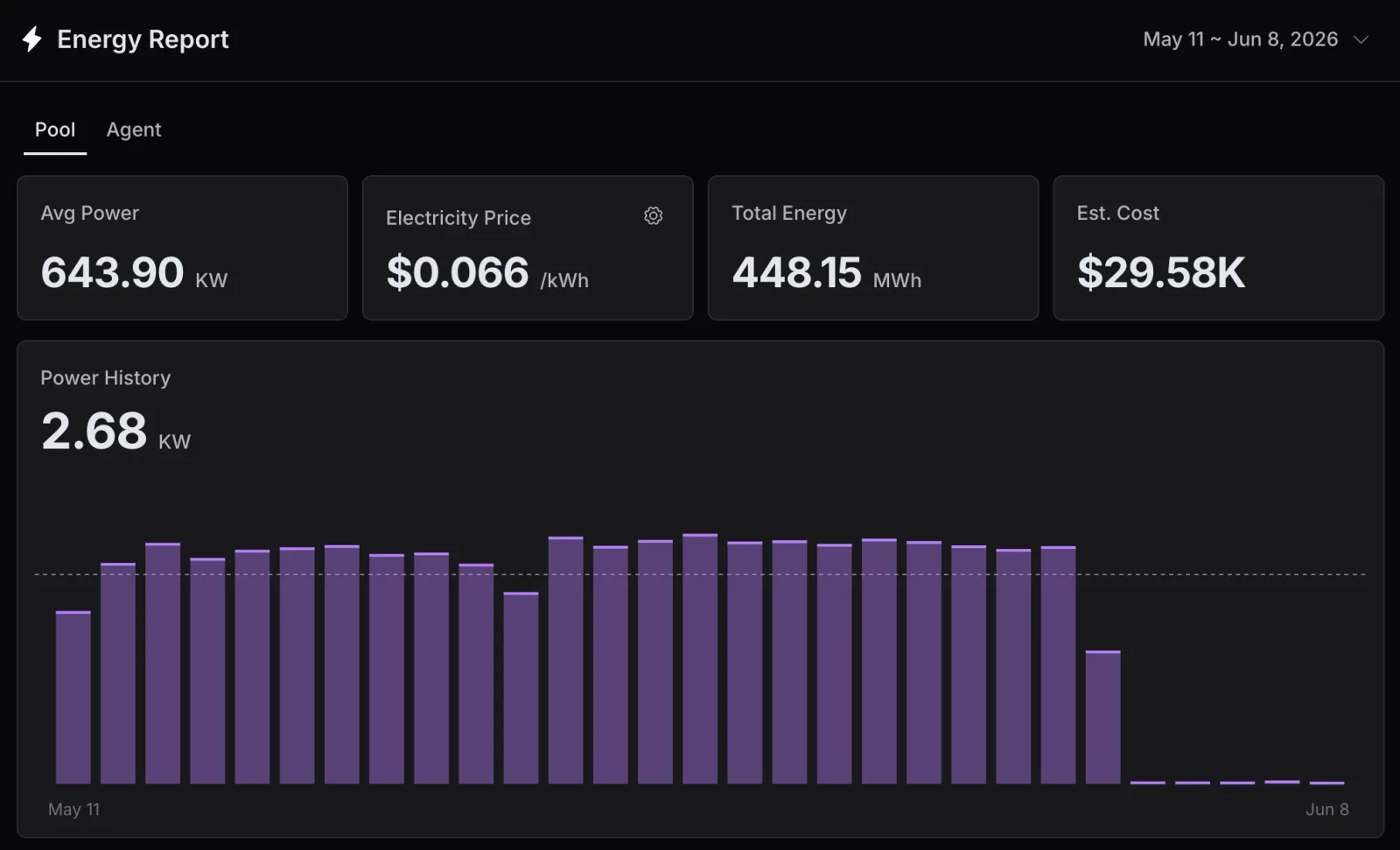
This allows mining farm operators to directly understand how much electricity was used this month, how much it cost, whether power changes are normal, whether abnormal energy consumption exists, and whether current energy costs are pushing up cost per BTC. For large mining farms, this data is often more important than simply looking at hashrate.
Reducing BTC Cost per Coin Is Not Just About Finding Cheaper Electricity
Many miners believe there is only one way to reduce costs: find cheaper electricity.
In reality, that is not the case. In mature mining farms, a growing share of cost optimization comes from operational efficiency. This includes improving uptime, reducing fault recovery time, automating operations and maintenance, managing miners in batches, using dynamic power strategies, and applying data analytics and alerts. Together, these factors determine the final cash cost per BTC. For mining farms with hundreds or even tens of thousands of miners, the gains from operational efficiency are often far greater than the benefit of simply reducing electricity price by a fraction of a cent.
Future Competition Among Mining Companies Is Essentially Competition on Cost per BTC
The Bitcoin price cannot be controlled. Network difficulty cannot be controlled. Block rewards cannot be controlled either. For miners, the only variable they can truly control is the operating efficiency of their own mining farms.
Public mining company data from 2026 shows that cost per BTC can differ by more than 4x across companies. This gap comes not only from electricity prices and miner models, but also from mining farm uptime, equipment utilization, abnormal issue response speed, and overall operational management capability. Therefore, understanding cost per BTC is only the first step. What matters more is continuously tracking:
- How much hashrate each kWh of electricity generates;
- Whether each miner stays in its optimal operating state;
- Whether offline, low-hashrate, and abnormal miners are discovered in time;
- Whether energy costs are continuously rising;
- Which factors are pushing up the production cost of BTC.
This is also why more professional mining farms are adopting data-driven operations platforms.
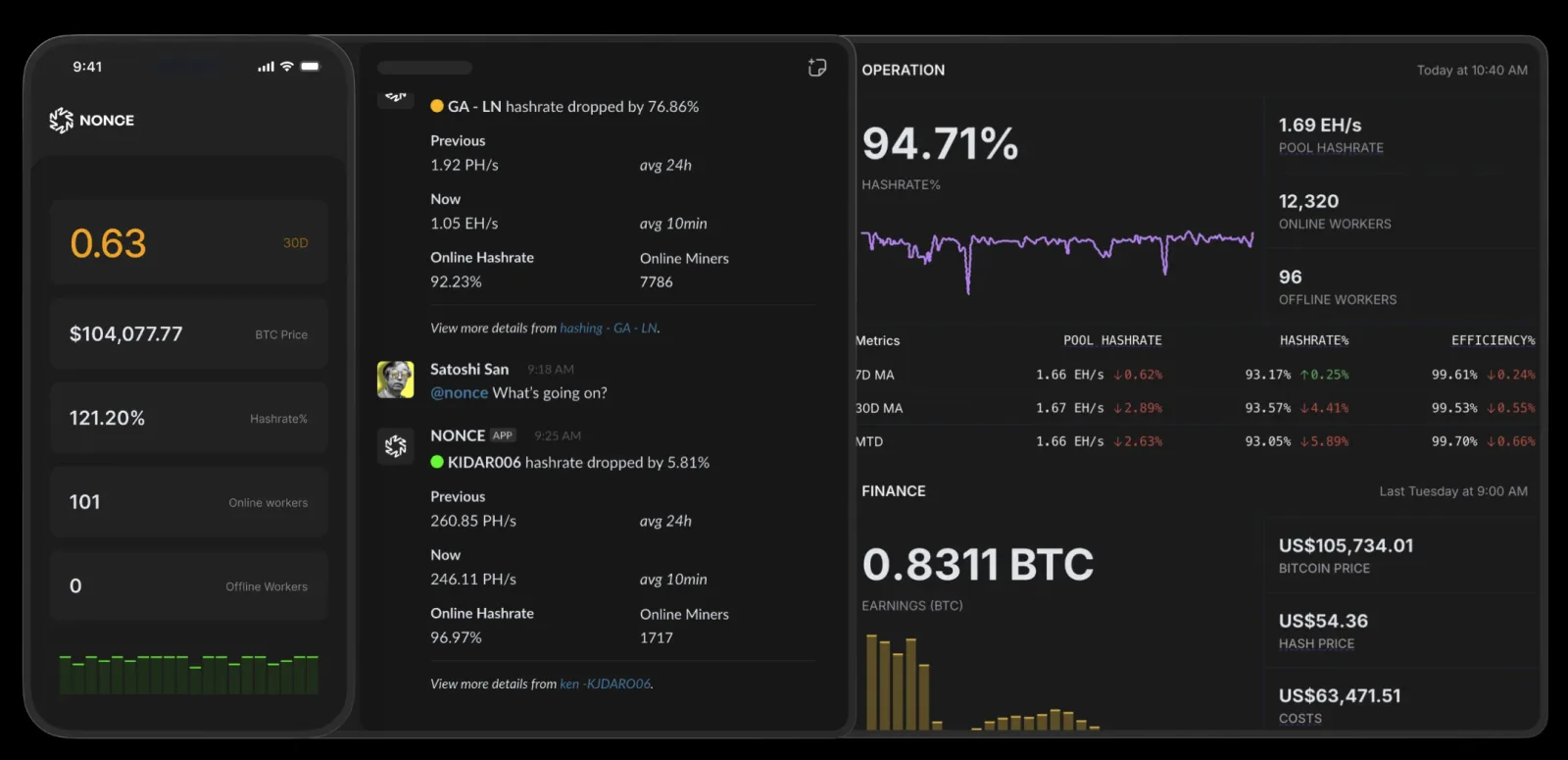
With Nonce, mining farm teams can monitor miner status, track energy consumption, analyze operational data, and quickly handle abnormal situations through automation tools in one unified platform. This helps improve uptime, reduce downtime, and continuously optimize BTC cost per coin.
As the industry enters a stage of refined operations, the mining companies that can continuously reduce cost per BTC will have a better chance of gaining a competitive advantage in the next cycle.