How Much Does a Miner Lose in a Day Offline? Don't Let Low Hashrate Quietly Eat Your Profit
How much a miner loses in a day offline is only the surface question; what matters more is how much of a fleet's theoretical hashrate never converts into pool revenue each day. Low hashrate is more dangerous than a full outage: it consumes power without effective output, eroding profit at scale.
The easiest thing to notice in a mining farm is a machine that has stopped; the easiest thing to underestimate is a machine that has not fully stopped.
When a miner goes completely offline, the monitoring page turns red, the pool hashrate drops, and on-site staff usually notice quickly. But if a miner is still online, with its fans spinning normally and its dashboard still accessible, yet its hashrate is 10% or 20% below the rated value, this often fails to draw immediate attention. It produces no obvious fault, yet every day it submits a little less effective hashrate while continuing to consume power.
This is exactly why low hashrate is more dangerous than being completely offline. A full outage causes a clearly visible loss over a defined period; low hashrate causes an ongoing, hidden cost spread across hundreds or even thousands of miners. A single machine earning a few cents or a dollar or two less per day hardly seems worth handling on its own; but when the same kind of problem persists across an entire fleet, what the farm ultimately loses may not be a day's revenue from a few machines, but the equivalent of an entire row of miners, a whole rack, or even dozens of PH/s of hashrate that never materializes over the long run.
So how much a miner loses in a day offline is only the most surface-level layer of this question. The more important question is: how much of the farm's theoretical hashrate each day is never actually converted into pool revenue?
How to correctly view the loss from a miner going offline
After a miner stops running, the most direct loss is the mining revenue it fails to earn over a period of time. The higher the miner's hashrate, the higher the Hashprice at the time, and the longer the offline duration, the larger the loss naturally becomes.
Suppose a miner has a rated hashrate of 200 TH/s. With a Hashprice of $40 per PH/day, going completely offline for 24 hours means about $8 of gross revenue not earned. If 100 miners of the same spec go offline for a day at the same time, the gross revenue gap is about $800; if it is 1,000 miners, it reaches about $8,000.
This is only to illustrate the scale of the loss; the actual result changes constantly with the price of Bitcoin, network hashrate, mining difficulty, transaction fees, and the pool's settlement method. A farm should not rely on a fixed revenue figure over the long term, but should estimate dynamically based on the daily or weekly Hashprice.
But even after calculating the mining revenue not earned, you still have not arrived at the true operating loss.
After a miner is fully powered off, the farm usually saves some electricity cost. However, miner depreciation, hosting fees, site rent, network fees, operations staff wages, spare-parts inventory, and infrastructure costs do not stop in sync just because one miner goes offline. If the hosting contract includes a fixed management fee, a minimum power commitment, or a capacity charge, the cost that can be saved during downtime may be less than imagined.
There are also miners that have not truly lost power. The control board is still running, the fans are still spinning, and the power supply is still delivering output, but the hashboards are not working properly. In this state the miner neither produces enough revenue nor fully saves electricity; instead it sits in the state a farm least wants to see: consuming resources without generating effective output. Therefore, when judging offline loss, you should at least distinguish three situations:
| Miner status | Revenue change | Power change | Operating impact |
|---|---|---|---|
| Fully powered off / offline | Revenue goes to zero | Electricity cost drops noticeably | Loss is relatively easy to identify |
| Online but zero hashrate | Revenue near zero | May still keep consuming power | Double loss of revenue and electricity |
| Online but low hashrate | Revenue partially drops | Power draw not necessarily down proportionally | Most hidden, and most likely to persist long term |
For a farm manager, a full outage is actually a relatively easy problem to handle. What truly demands vigilance are the latter two situations.
Low hashrate is not a minor fault, but a continuously levied tax on profit
Low hashrate is often treated as an equipment-status problem, but it is first of all a profit problem.
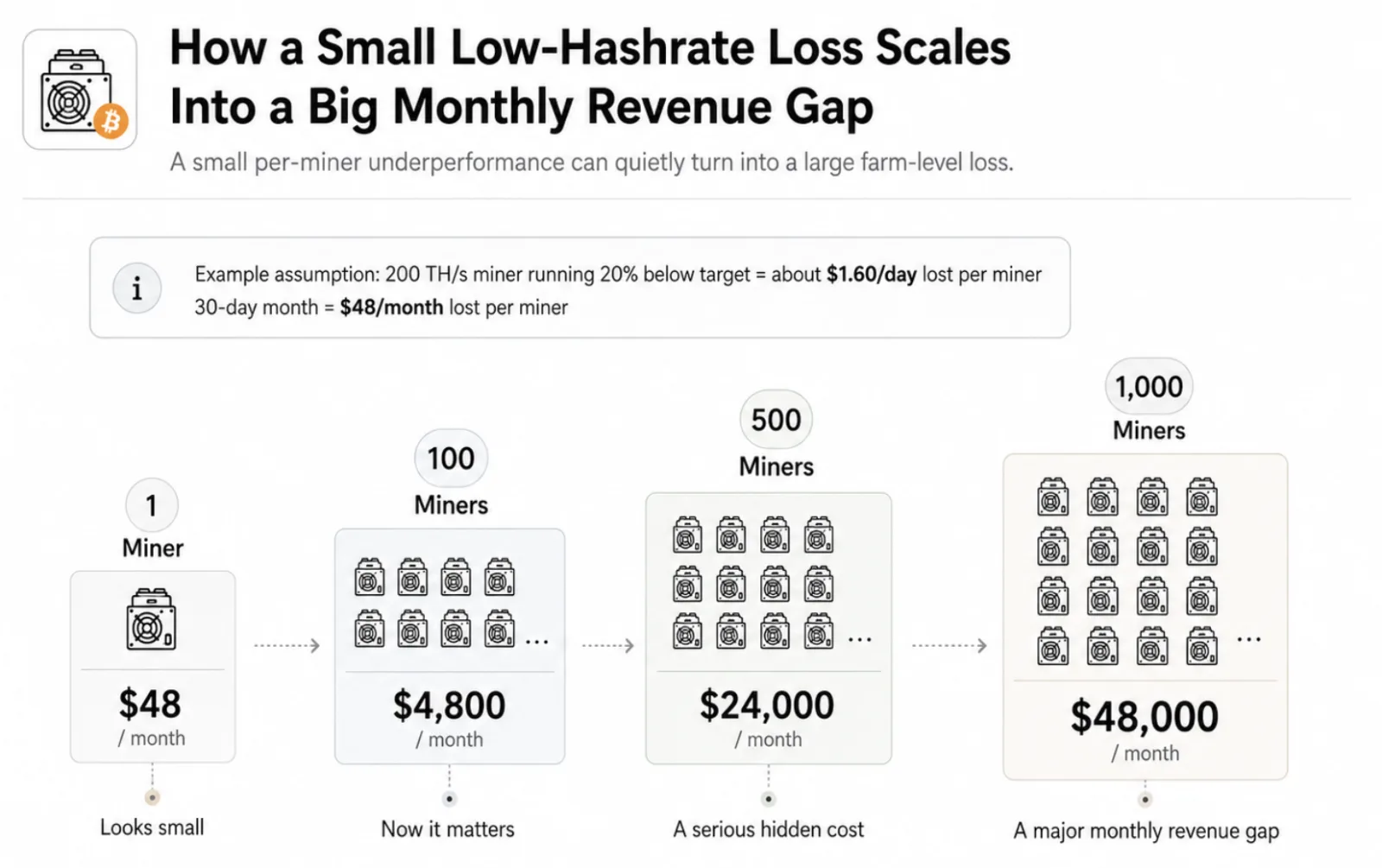
A miner rated at 200 TH/s that can only stably output 180 TH/s in practice means 10% of theoretical capacity never materializes. If this miner's power draw also drops by 10% in sync, the loss might be relatively limited; but in actual operation, the drop in hashrate and the drop in power draw are usually not fully aligned.
A miner may lose hashrate due to an abnormal hashboard, partial chip failure, thermal throttling, fan problems, unstable power supply, or abnormal frequency configuration, while its other components keep working as usual. The result is less revenue while power consumption does not fall by the same proportion, so the power consumed per unit of hashrate rises accordingly.
This means low hashrate brings not only a bit less mining, but also worse energy efficiency and a worse per-coin cost for the farm. Suppose a farm has 1,000 miners rated at 200 TH/s, for a theoretical total hashrate of 200 PH/s. If most of these miners are running but on average only reach 95% of rated hashrate, on the surface each is just 5% short, yet the whole farm is effectively missing 10 PH/s of hashrate over the long term. Estimated at a Hashprice of $40 per PH/day, these 10 PH/s correspond to about $400 of gross revenue per day, about $12,000 per month, and possibly over $140,000 per year. And this is only the case of being 5% low on average.
Many farms will not allow a single miner to stay more than 30% below rated hashrate for long, because such an anomaly is fairly obvious; but problems of being 3%, 5%, or 8% low over the long term are easily lumped in with equipment fluctuation. A single unit does not look serious, but across an entire fleet it can become a persistent operating cost.
The reason low hashrate is easily overlooked is that farms usually organize operations around the number of faults: how many machines are offline today, how many need repair, how many hashboards are damaged. But profit does not care about the number of faults; profit only cares about how much effective hashrate is ultimately delivered.
Ten miners each losing 20 TH/s and one miner losing its full 200 TH/s may create a similar hashrate gap for farm revenue; but the former is more dispersed, harder to detect, and more easily overlooked in daily reports.
Therefore, low hashrate should not merely be an alert label for technicians to handle, but should be converted into lost hashrate, lost revenue, and increased cost per unit of hashrate. Only in this way can a farm judge whether it is a minor fluctuation that can be deferred or an operating problem that is continuously eroding profit.
A miner being online does not mean it is running normally
Many farms use uptime, that is, the online rate or availability rate, as the core metric for operating performance. This direction is not wrong, but what "online" actually represents is often not clearly defined.
If a miner can be accessed by the management system, it counts as online; if the control board is normal and the fans are spinning, it also counts as online; if the device is connected to the pool but only outputs 70% of rated hashrate, it may still be counted as online. This kind of uptime is closer to a device connection rate than to production efficiency.
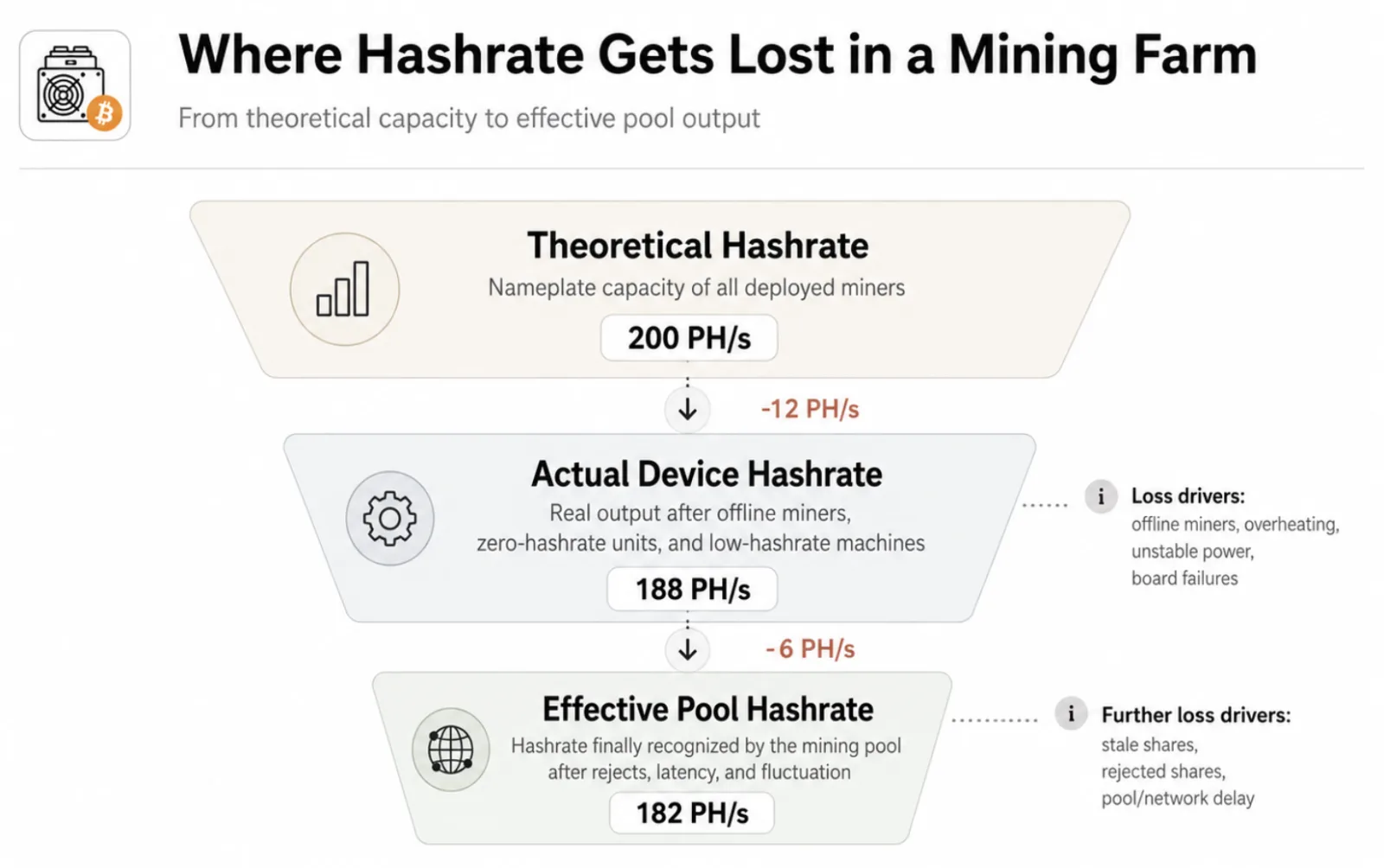
For a Bitcoin farm, what truly has value is not whether the machine's lights are on, but whether it continuously outputs the effective hashrate it should. A farm can have a 99% device online rate while only 94% of its theoretical hashrate is actually materialized. The gap between the two is the part that should enter operational analysis.
For example, a farm has 1,000 miners, of which 990 show as online, for a 99% device online rate. If these online miners on average only reach 95% of rated hashrate, then the hashrate the farm ultimately materializes is not 99% of the theoretical value, but only about 94%.
On the management page, this may still be a farm with a very high online rate; from a revenue standpoint, it is equivalent to nearly 6% of capacity not participating in production.
This is also why uptime in a hosting agreement cannot be judged by a single percentage alone. The miner also needs to confirm how the service provider defines uptime, which outages are excluded, whether scheduled maintenance is counted, whether curtailment or demand response is deducted, and whether a device that is online but at zero hashrate still counts as running normally.
If uptime is calculated only by power availability, it reflects whether the infrastructure supplied electricity; if calculated by device network status, it reflects whether the miner can connect; only when pool-side effective hashrate is included in the statistics does it come closer to the production capacity the miner actually purchased.
For a farm's internal management, more worthy of attention than uptime is the hashrate realization rate: how much hashrate should theoretically be produced, and how much hashrate actually reaches the pool continuously in the end.
This metric can simultaneously absorb problems such as full outages, zero hashrate, low hashrate, hashrate fluctuation, and network rejections, and is closer to the farm's true operating performance than simply counting the number of offline miners.
What a farm should really manage is not faults, but the hashrate gap
Traditional operations habits revolve around equipment: which miner is broken, which board needs repair, which fan needs replacing. But from an operating standpoint, what a farm needs to manage is the hashrate gap.
Even with ten abnormal miners, the impact can be completely different. Ten high-hashrate new machines going completely offline and ten old miners showing slight fluctuation should not have the same handling priority; one miner offline for 24 hours and twenty miners with low hashrate persisting for a week should also not be compared merely by the number of faulty units. A more reasonable approach is to convert all anomalies uniformly into how many TH/s or PH/s of hashrate is lost, and how long this portion of hashrate has already been lost.
In this way, a farm can see a completely different operations priority ordering:
A certain miner may already be offline, but its lost hashrate is small and there is no suitable spare part on site, so it can enter the routine repair queue; if dozens of miners in the same rack have low hashrate at the same time, with a cumulative impact of several PH/s, then power, network, and environmental issues need to be checked first; a batch of miners that show as online yet have zero hashrate for several consecutive hours should get higher priority than ordinary offline devices, because they may still be consuming power ineffectively.
This management approach changes how a farm judges many problems. Spare parts are no longer just a cost in the warehouse, but a tool for shortening downtime of high-value miners; nighttime alerts are no longer just a reminder for someone to go take a look, but a way to help the farm stop the hashrate gap from widening further; repair turnaround time is also no longer just an efficiency metric for the technical department, but directly affects farm revenue.
Suppose a miner can generate $8 of gross revenue per day and repair requires a 20-day wait, then the repair decision must include at least about $160 of downtime opportunity cost. If the repair fee is $100, the farm is not facing a $100 repair but a combined cost of at least $260, not yet counting shipping, labor, and hosting fees.
If the miner is already close to retirement, repair may no longer be worthwhile; if the miner has high efficiency and a long remaining service life, then shortening the repair cycle is often more important than shaving a few dozen dollars off the repair quote.
High-value farm operations is not about handling every fault as fast as possible, but about restoring the most valuable hashrate first.
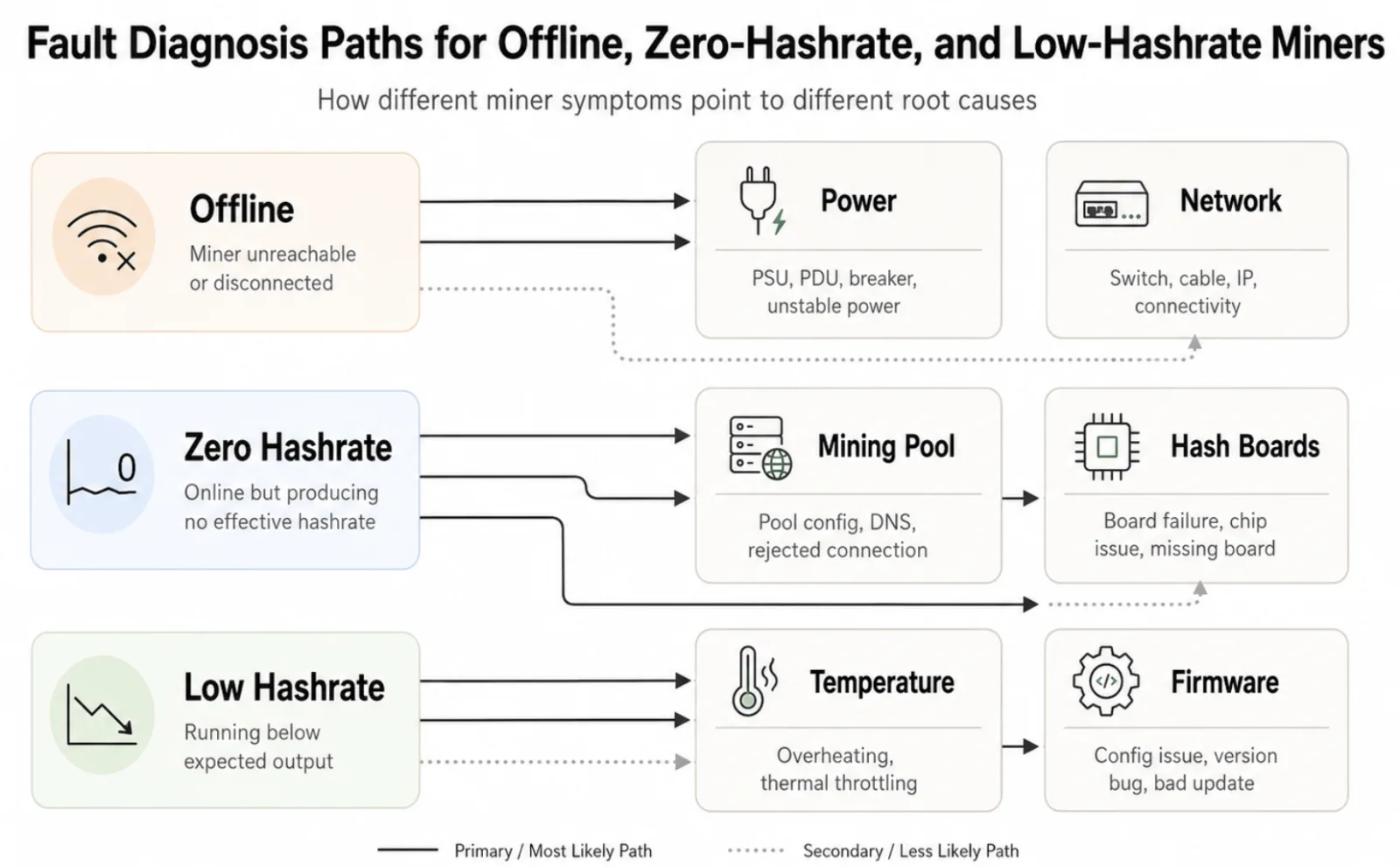
Offline, zero hashrate, and low hashrate are three different problems underneath
In a farm, people often lump offline, zero hashrate, and low hashrate together and hand them all to on-site staff to "reboot and see." Rebooting can indeed resolve some temporary faults, but without first distinguishing the type of problem, a farm easily falls into a cycle of repeated reboots, brief recovery, and renewed anomaly.
Offline usually means the management system cannot access the miner. The problem could lie in the power supply, switch, network cable, IP address, control board, or upstream network. If only one miner is offline at a given time, you should check the device and connection first; if miners under the same rack, the same switch, or the same PDU go offline at the same time, it is more likely a shared infrastructure problem.
A zero-hashrate miner can usually still be accessed but is not continuously submitting effective hashrate to the pool. It could be that the hashboard has not started, the pool configuration is wrong, the network cannot reach the pool, overheating protection has triggered, the firmware is abnormal, or the power output is insufficient. This kind of device most deserves priority attention, because it may still be consuming some power without generating corresponding revenue.
The causes of low hashrate are more complex. A single hashboard dropping out, partial chip anomalies, thermal throttling, abnormal fan speed, unstable voltage, pool latency, a rising reject rate, and power-mode configuration can all keep a miner from reaching its expected output while it "looks normal."
If a certain miner model has widespread low hashrate, it may be related to firmware, aging, or operating parameters; if different miner models in the same area have low hashrate at the same time, you should check temperature, power supply, and network; if hashrate drops during the day and recovers at night, it may be related to ambient temperature or a power-usage strategy.
This is also why a farm cannot look only at abnormal results but must also look at the distribution of anomalies. Miner model, firmware version, rack position, PDU, switch, temperature, power draw, and pool status are all important dimensions for judging the root cause of a problem. A single device's problem can usually be solved by repair, while problems that appear in groups often need to be handled at the infrastructure or configuration level.
Farm profit is often lost to discovering problems too late
Miner faults cannot be completely avoided. Fans will break, hashboards will age, and the network and power supply may also fluctuate. What truly separates farm operations is usually not whose equipment never breaks, but who can discover, accurately locate, and quickly recover earlier.
If a miner drops offline at 2 a.m. and is only discovered during the manual inspection at 9 a.m. the next day, the farm has already lost seven hours; if the alert is discovered at 2:05 a.m. but is not clearly assigned to on-site staff, another two hours are delayed; if the technician still has to search machine by machine for the specific device after reaching the rack, the recovery time will stretch further.
Therefore, a farm's downtime loss consists of at least four segments of time: the time from the anomaly occurring to being discovered, the time from discovery to starting to handle it, the time from starting to handle it to locating the device, and the time from completing the operation to confirming that hashrate has recovered.
Many farms record only the last segment, that is, "how long the repair took," while ignoring the earlier waiting segments. In reality, what truly lengthens the downtime cycle is often not the repair action itself, but the fault being discovered too late, incomplete information, an unclear responsible party, or the failure to confirm whether pool hashrate has stably recovered after handling is complete.
A successful reboot does not equal fault recovery, and a miner coming back online does not equal revenue recovery. After a reboot, a miner may briefly show hashrate and then drop offline again due to overheating or power problems; or the device dashboard may show normal while the pool side takes a long time to recover. If the operations process ends at "command executed," the farm still does not know whether the problem is truly solved.
The complete closed loop should be: discover the anomaly, judge the scope, filter the devices, execute the operation, observe device hashrate, confirm pool hashrate, record the recovery time. If the same kind of problem recurs, you should further track the repeat-fault rate to keep the team from repeatedly handling surface phenomena.
The most effective way for a farm to improve uptime is often not to propose a higher target number, but to continuously shorten the mean time to detect and the mean time to recover.
From machines online to effective hashrate online
When a farm has only a few dozen miners, on-site staff can grasp most of the situation through inspections, spreadsheets, and the pool page. As the scale expands to hundreds, thousands, or even multiple farms, anomalies become more dispersed, and manual machine-by-machine checking becomes increasingly hard to sustain.
At this point, what a farm needs is not just a page that shows miner status, but a set of operations processes built around hashrate loss.
In Nonce, operations staff can centrally query offline, zero-hashrate, low-hashrate, and overheating miners, and further filter devices through multiple conditions. For example, combining low hashrate with temperature, miner model, rack, or farm location makes it faster to judge whether a problem is a single-machine fault or a shared anomaly in a certain area.
For miners confirmed to be recoverable via reboot, you can select target devices to execute a batch task and continue to view the task results and miner status, without logging into each device dashboard one by one. More importantly, after the operation you still need to observe whether hashrate stably recovers, rather than treating "command sent successfully" as the end of the problem.
The value of this kind of centralized management is not to replace on-site technicians, but to reduce the time spent finding devices, repeatedly logging in, manually aggregating, and passing information along, so that technicians can focus their energy on problems that truly require on-site judgment.
What a farm should ultimately form is not an ever-growing fault list, but a data system that can continuously answer operating questions: how many miners are currently online, how much effective hashrate is generating revenue, how much hashrate has not materialized due to being offline, zero hashrate, or low hashrate, and how fast these losses are being recovered.
Don't let low hashrate become a loss the farm accepts by default over the long term
How much a miner loses in a day offline can be roughly estimated from hashrate scale, Hashprice, and offline duration. But for a farm, what is more worthy of attention is not one miner being down for a day, but how much theoretical hashrate the entire fleet fails to convert into effective revenue each day.
The problem of a full outage is usually fairly obvious and more easily enters the repair process. Low hashrate, zero hashrate, and repeated fluctuation can hide for a long time behind a high device online rate, letting the farm obtain lower-than-expected output while continuously consuming power.
If a farm looks only at whether devices are online, it easily overestimates its own operating efficiency; only when it begins to focus on the effective-hashrate online rate, the hashrate realization rate, the anomaly detection time, and the recovery time does it truly connect operations to profit.
The core of farm operations is not to keep every miner's status page green, but to let the hashrate that has already been purchased, deployed, and continuously powered reach the pool as stably as possible. A small amount of low hashrate can be normal fluctuation, but low hashrate that is long-term, at scale, and unquantified should not become an operating loss the farm accepts by default.
The cost gap between farms often comes not only from electricity prices and miner models, but also from these hashrate losses that occur every day and seem trivial each time. Whoever can see them earlier, judge their causes more accurately, and restore effective hashrate faster is the one who can turn theoretical hashrate on paper into real Bitcoin revenue in the pool.