What Is Nonce Bitcoin Mining Software? From the Nonce Concept to Farm Management Software
Nonce Bitcoin mining software is a farm management platform, not the block-header Nonce search itself: ASICs and firmware do hashing, pools assign work, and Nonce monitors, filters, bulk-manages, and automates large miner fleets.
When searching for "Nonce Bitcoin mining software," the most common misunderstanding is treating the Nonce in the Bitcoin protocol, the mining program inside an ASIC miner, and the farm management software named Nonce as the same thing. In reality, they sit at completely different technical layers: Nonce is first a field in the Bitcoin block header—one of the values that keeps changing during Proof-of-Work mining; ASIC miners perform massive SHA-256 hash computation; pools assign work to miners and receive Shares; miner firmware controls device operation; and Nonce is a farm-oriented miner management platform used to monitor, bulk-manage, and automate operations for ASIC miners.
So to truly understand "what Nonce Bitcoin mining software is," you cannot start from one software feature alone. You first need to understand how a Bitcoin block is found by miners, then why modern ASIC farms need management software independent of miner firmware.
What Is a Nonce? Why Is It a Core Concept in Bitcoin Mining
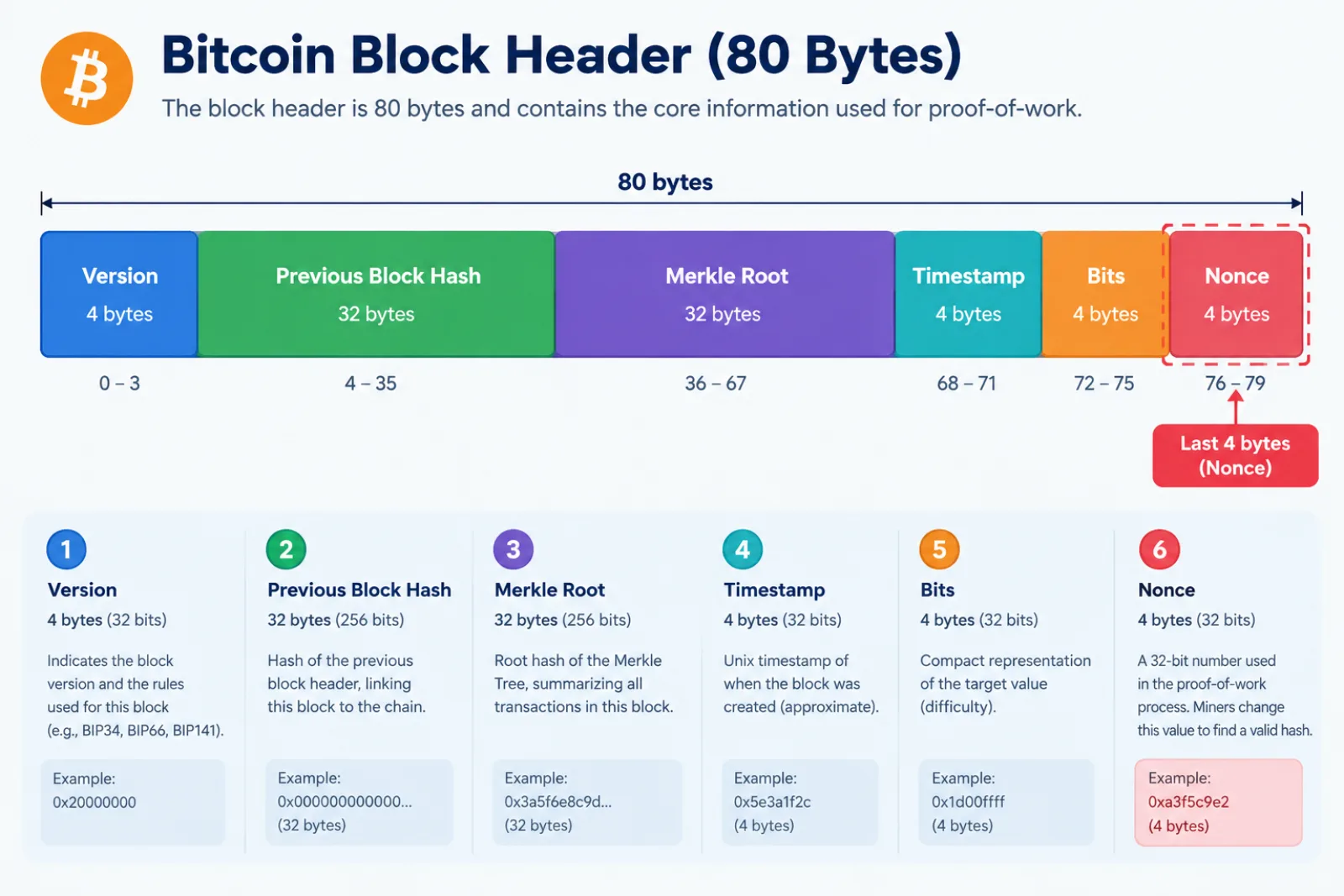
A Nonce is a 32-bit field in the Bitcoin block header. During Proof-of-Work calculation, miners continuously change the Nonce in the block header, hash the block header, and check whether the result is less than or equal to the target required by the current network. Bitcoin's original white paper describes this process as repeatedly changing the Nonce until a hash that meets the Proof-of-Work condition is found. Bitcoin white paper
A Bitcoin block header is 80 bytes total, including a 4-byte version, 32-byte previous block hash, 32-byte Merkle root, 4-byte timestamp, 4-byte target encoding, and a final 4-byte Nonce. Because the Nonce is a 32-bit unsigned integer, the basic Nonce space for a single block header has 2³², or 4,294,967,296 possible values. Miners do not know which value will produce a qualifying hash—they can only try at scale.
| Block Header Field | Size | Role in Mining |
|---|---|---|
| Version | 4 bytes | Identifies the rule version used by the block |
| Previous block hash | 32 bytes | Links the new block to the previous one |
| Merkle root | 32 bytes | Summarizes transaction data in the block |
| Timestamp | 4 bytes | Records block time information |
| Target encoding | 4 bytes | Represents the Proof-of-Work target |
| Nonce | 4 bytes | The field miners keep changing to find a valid hash |
Source: Bitcoin Developer Reference.
It is especially important that a Nonce is not a "mysterious correct number," and miners do not first compute an answer and then verify it. SHA-256 is a cryptographic hash algorithm: the same input produces a deterministic output, but when the input changes, the output changes too. What miners truly do is keep creating new block-header inputs, compute the corresponding hashes, and check whether each hash meets the network target. SHA-256 algorithm specifications are available in the Secure Hash Standard published by the U.S. National Institute of Standards and Technology.
How Do ASIC Miners Keep Searching for a Nonce?
The essence of Bitcoin mining is not "digging up a coin," but competing to find a block hash that meets the network's Proof-of-Work requirement. A pool or mining program first prepares a candidate block and corresponding block-header data, then hands the computation to the ASIC. ASIC chips run SHA-256 over large numbers of different inputs and check whether results meet the requirement.
The Bitcoin mining developer guide describes this clearly: mining software constructs the block and the 80-byte block header, then passes the header and target to mining hardware; the hardware tries different Nonces and computes corresponding hashes. If it finds a valid result below the target, it returns the successful result.
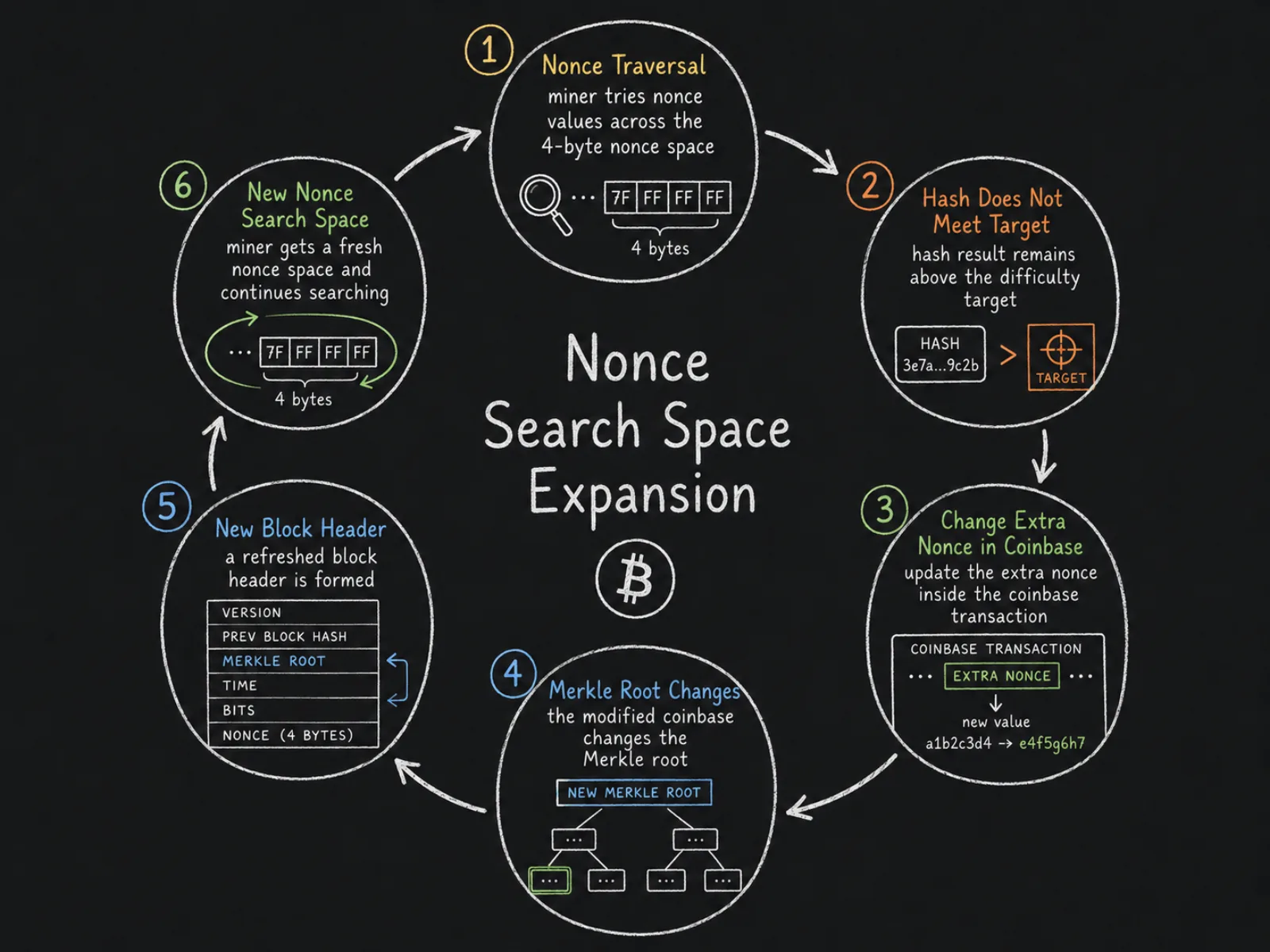
Modern Bitcoin mining, however, cannot be simplified to trying Nonces from 0 to 4,294,967,295 in order and then stopping. The Nonce space is only 32 bits, while modern ASIC hash rates are extremely high, so miners must keep producing new block headers. When the base Nonce space is insufficient, they can change the extra nonce in the Coinbase transaction, which changes the Coinbase transaction, then the Merkle root, and finally forms a new block header and a new Nonce search space. The Bitcoin developer guide describes this mechanism as well: when a block header's Nonce range produces no valid result, mining software can change data in the Coinbase to generate a new Merkle root and continue computing.
So more accurately, Bitcoin mining is a continuous process of generating candidate work, changing the block header, running massive hash computation, and verifying results. The Nonce is a very important variable in that process—but not the only data that can change.
Pool, Miner Firmware, and ASIC: Who Actually Performs the Work of "Mining Software"?
Today, most professional Bitcoin miners do not let a single miner find blocks independently—they join a pool. The pool assigns compute tasks to many miners and sets a Share target used to measure work. After computing, miners return Shares that meet the pool's requirements; a tiny fraction of those results also meet the Bitcoin network target and may form a valid block.
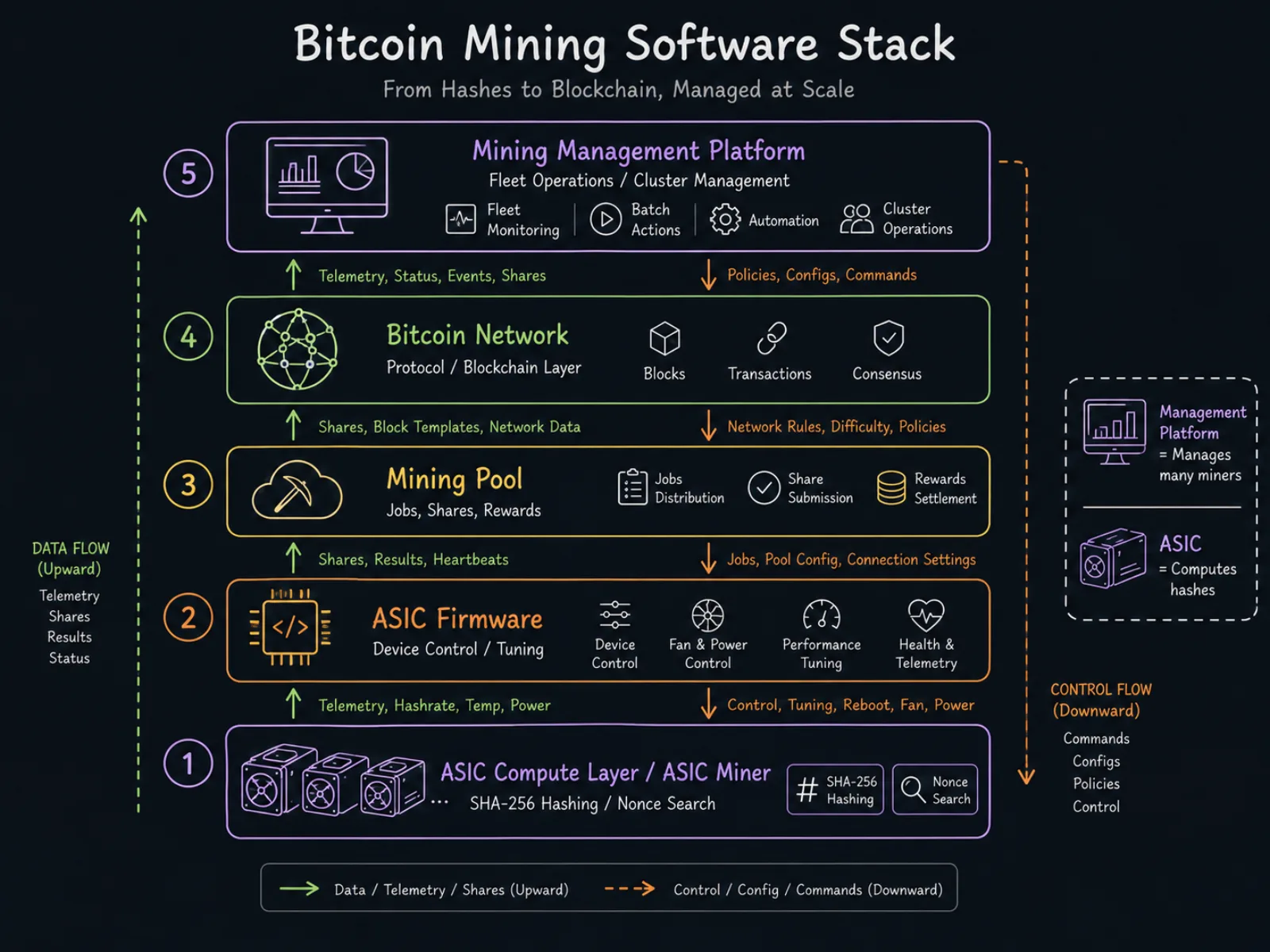
In this process, "Bitcoin mining software" actually spans multiple layers. Calling any single layer alone "mining software" easily creates misunderstanding.
| Technical Layer | Primary Responsibility | Relationship to Nonce | Responsible for Farm Ops? |
|---|---|---|---|
| Bitcoin network | Validates transactions, blocks, and Proof of Work | Verifies whether the final block hash meets the target | No |
| Mining pool | Assigns mining tasks, receives Shares, tracks contribution | Provides data miners need to construct compute tasks | No |
| Miner firmware | Controls the miner, chips, frequency, fans, and pool connection | Coordinates ASICs to run hash computation | Mostly single-device level |
| ASIC chips | Execute SHA-256 at high speed | Actually perform large-scale Nonce / block-header search | No |
| Farm management software | Monitors and manages large ASIC fleets | Does not directly search for a valid Nonce | Yes |
This is also the key to understanding Nonce farm management software: Nonce does not replace ASICs to compute hashes, and does not replace pools to assign work—it sits as an operations management layer above miners. What determines any given hash result is the underlying mining computation; farm management software solves how hundreds, thousands, or more miners can keep completing that computation continuously, stably, and efficiently.
Why Do You Need Independent Farm Management Software After Miner Counts Grow?
With only one or two ASICs, a miner can log into the miner IP to check temperature, hashrate, and pool connection, then reboot manually when something is wrong. But when fleets grow to hundreds, thousands, or even multiple farms, what truly affects revenue is often no longer "whether miners can compute Nonces," but how many machines are working normally, how many show low hashrate, how many are already offline, whether temperature is abnormal, whether pool configs are correct, and how quickly anomalies are discovered and recovered.
For example, a miner being reachable on the LAN does not mean it is producing hashrate normally. Nonce's miner anomaly filters distinguish offline, zero hashrate, low hashrate, overheating, and other runtime states, and support finding abnormal miners by status, temperature, hashrate, and combined conditions. That distinction matters for large farms, because "device online" and "device effectively mining" are not the same metric.
Nonce's farm overview consolidates hashrate, miner runtime status, efficiency, and estimated revenue into one farm view. For farm operators, this software layer does not make SHA-256 computation itself different—it turns runtime data scattered across large fleets into farm status that can be observed and handled uniformly.
In other words, ASICs solve "how to compute," while farm management software solves "how to keep the whole compute cluster running stably for the long term." That is the clearest boundary between individual mining software and large-farm management software.
What Does Nonce Bitcoin Mining Software Mainly Manage?
Nonce focuses on Bitcoin farm and ASIC fleet management. In daily ops, you can first locate overheating, zero-hashrate, low-hashrate, or offline miners with conditional filters, then run bulk actions on selected devices. Nonce's miner operations center currently covers major scenarios such as miner query, bulk management, and automation—including scanning miners, adjusting operating modes, upgrading firmware, rebooting, and changing pool configs.
For example, when electricity prices rise or ambient temperature is too high, not every miner should stay at high power. Nonce's bulk power-mode management can uniformly switch among overclock, normal, underclock, and sleep modes so farms can adjust device status by temperature, electricity price, and operating strategy—without operators logging into each miner backend one by one.
Pool configuration is similar. Changing a pool address on one miner is not hard, but migrating large numbers of miners one by one creates massive repetition. Nonce supports bulk pool connection changes, updating primary and backup pool configs uniformly on selected miners.
These capabilities show an important distinction: farm management software cares not about whether any single Nonce is correct, but about whether the whole miner fleet keeps producing effective hashrate. A single hash computation happens in milliseconds or less at the low level; farm operations care about device availability, hashrate stability, energy efficiency, and anomaly recovery speed over hours, days, or even months.
From Manual Management to Automation: Modern Mining Software Is Managing "Operating Strategy"
As miner counts keep growing, merely consolidating data into one UI is still not enough, because human discovery, judgment, and execution themselves become bottlenecks. Farm management software therefore moves from "seeing devices" toward "executing strategy by condition."
Nonce's temperature automation operating modes can judge from average temperature over a period whether miner operating modes need adjustment—for example lowering intensity after temperature exceeds a set condition, then adjusting status again by rule after temperature recovers, linking environmental change to miner operating strategy.
Likewise, low-hashrate auto reboot can judge from average hashrate over a sustained period whether a miner is abnormal, then reboot when set conditions and protection rules are met. Rules can also include temperature protection, execution-frequency limits, and reboot-count limits so "finding low hashrate" is not equated with endless reboot loops.
For large farms, this shift matters a lot. Past logic was usually "ops discover miner anomaly → find IP → log into device → diagnose → act," while automated management gradually becomes "continuously collect status → evaluate anomaly conditions → locate target devices → auto-execute strategy → keep verifying runtime results." What management software truly saves is not one click—it turns large amounts of repeated judgment and repeated action into rules that can keep running.
From the Nonce Concept to Nonce Farm Management Software: Two Different Layers
Returning to the original question—"What is Nonce Bitcoin mining software?"—a more accurate answer should split into two parts.
In the Bitcoin protocol, a Nonce is the 32-bit field in the block header. Miners keep changing block-header data and running SHA-256 hash computation to find a result that meets the current Proof-of-Work target. Modern ASIC miners, pools, and miner firmware together complete the actual mining flow, and the Nonce is only one of the most representative variables in that computation.
In farm operations, Nonce is a Bitcoin farm management platform that sits above ASICs and miner firmware. It does not replace ASICs computing Nonces, and does not replace pools generating mining tasks—it helps farms organize large numbers of scattered devices into miner fleets that can be uniformly monitored, filtered, bulk-operated, and automated.
These two "Nonces" happen to reflect two scales of modern Bitcoin mining: at the micro level, an ASIC chip keeps changing inputs and computing new hashes; at the macro level, farm operators care whether thousands of devices stay online every day, keep reasonable temperature and hashrate, and run at the most effective energy utilization possible.
So understanding Bitcoin mining software cannot look only at "who is searching for a Nonce." From the Bitcoin network, pools, miner firmware, and ASIC chips to the farm management platform, each layer has different responsibilities. ASICs determine compute capacity, pools organize work, firmware controls a single miner, and farm management software keeps the whole ASIC fleet running stably. Once mining expands from one device into true industrial infrastructure, software value extends from "executing hash computation" to "managing the farm's entire hashrate production process."