Why Do Bitcoin Miners Need Nonce? Understanding the Random Number Mechanism in PoW Mining
Bitcoin miners do not dig up coins directly—they compete to find a valid block by adjusting the Nonce in the block header until the SHA-256 hash meets the network difficulty. Nonce is the core PoW variable; modern farms also expand search space via ExtraNonce and other fields, and higher hashrate raises the odds of finding a valid block.
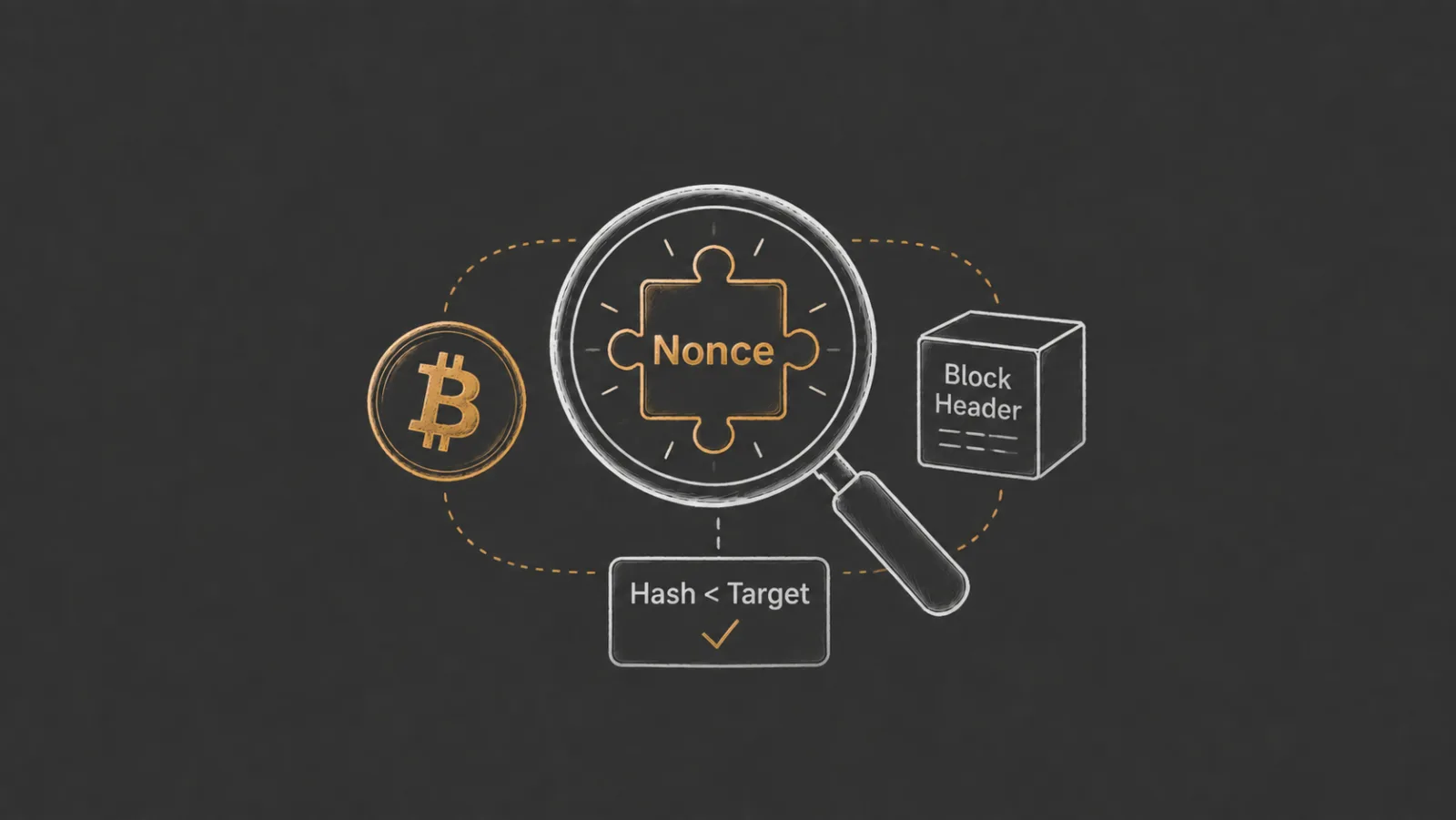
Many newcomers to cryptocurrency ask the same question: what exactly are Bitcoin miners mining? Are they digging up real money? In reality, Bitcoin miners are not directly searching for Bitcoin. Instead, they compete to find a block that satisfies the Bitcoin network's rules as quickly as possible. In this process, a seemingly simple number — the Nonce — becomes one of the most important variables in the Proof of Work (PoW) mechanism.
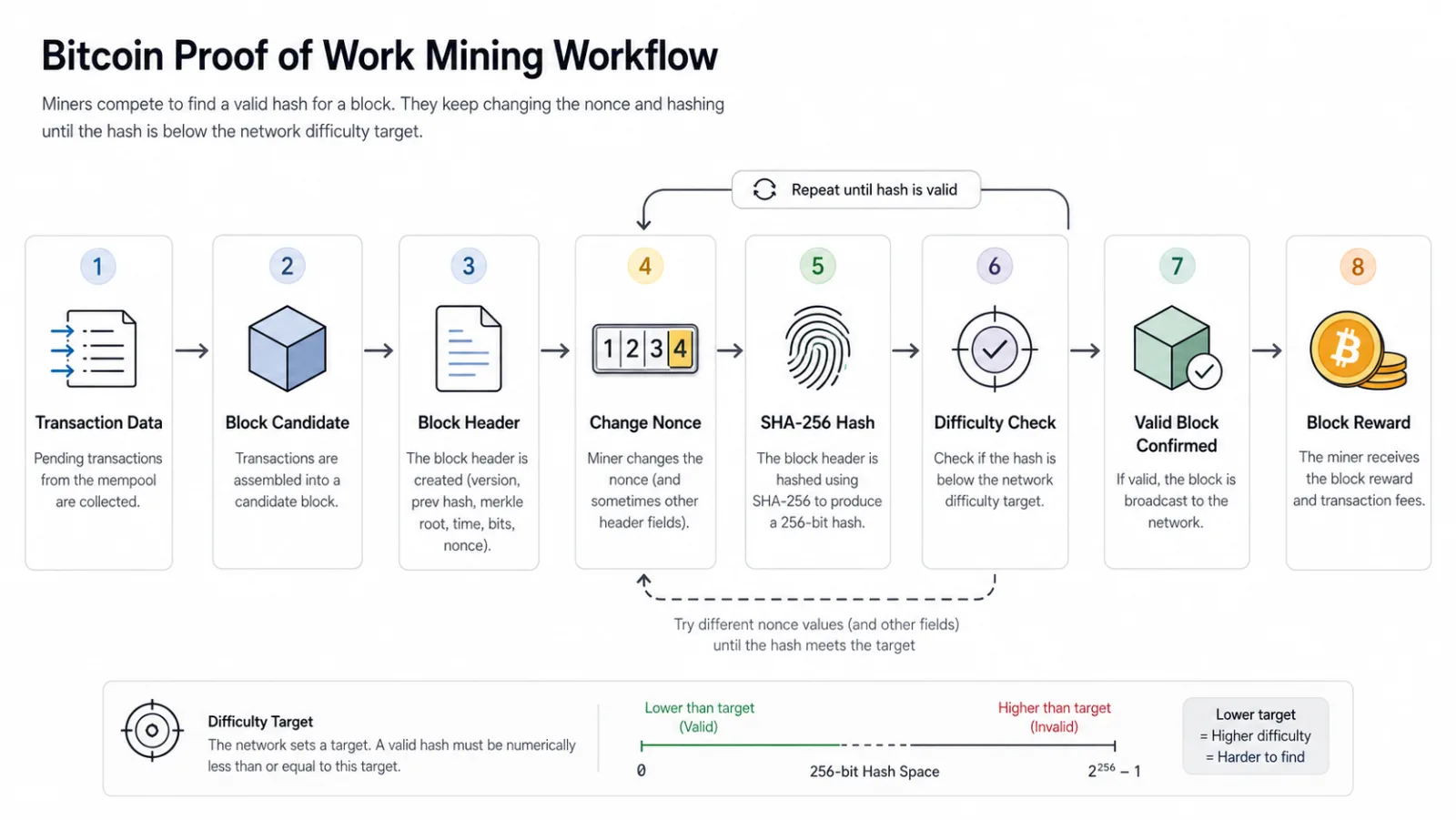
Nonce stands for Number Used Once. In Bitcoin mining, the Nonce is a number miners continuously adjust. By changing the Nonce, miners produce different results when the block header is run through the SHA-256 hash function, until they find a hash that meets the network's difficulty requirement. Miners keep trying different Nonces → generate new hashes → check whether they meet the difficulty requirement → find a valid hash → earn the block reward. This is the core process of Bitcoin Proof of Work.
Why Do Bitcoin Miners Need Nonce?
What Is a Nonce? Why Does Bitcoin Need This Random Number?
Before understanding Nonce, you need to know the basic structure of a Bitcoin block. Transactions on the Bitcoin network do not become blocks directly — miners must pack large batches of transactions into a candidate block. This block has two parts:
- Transaction data, such as BTC transfer records between users.
- The block header, which contains the information the Bitcoin network needs to validate the block.
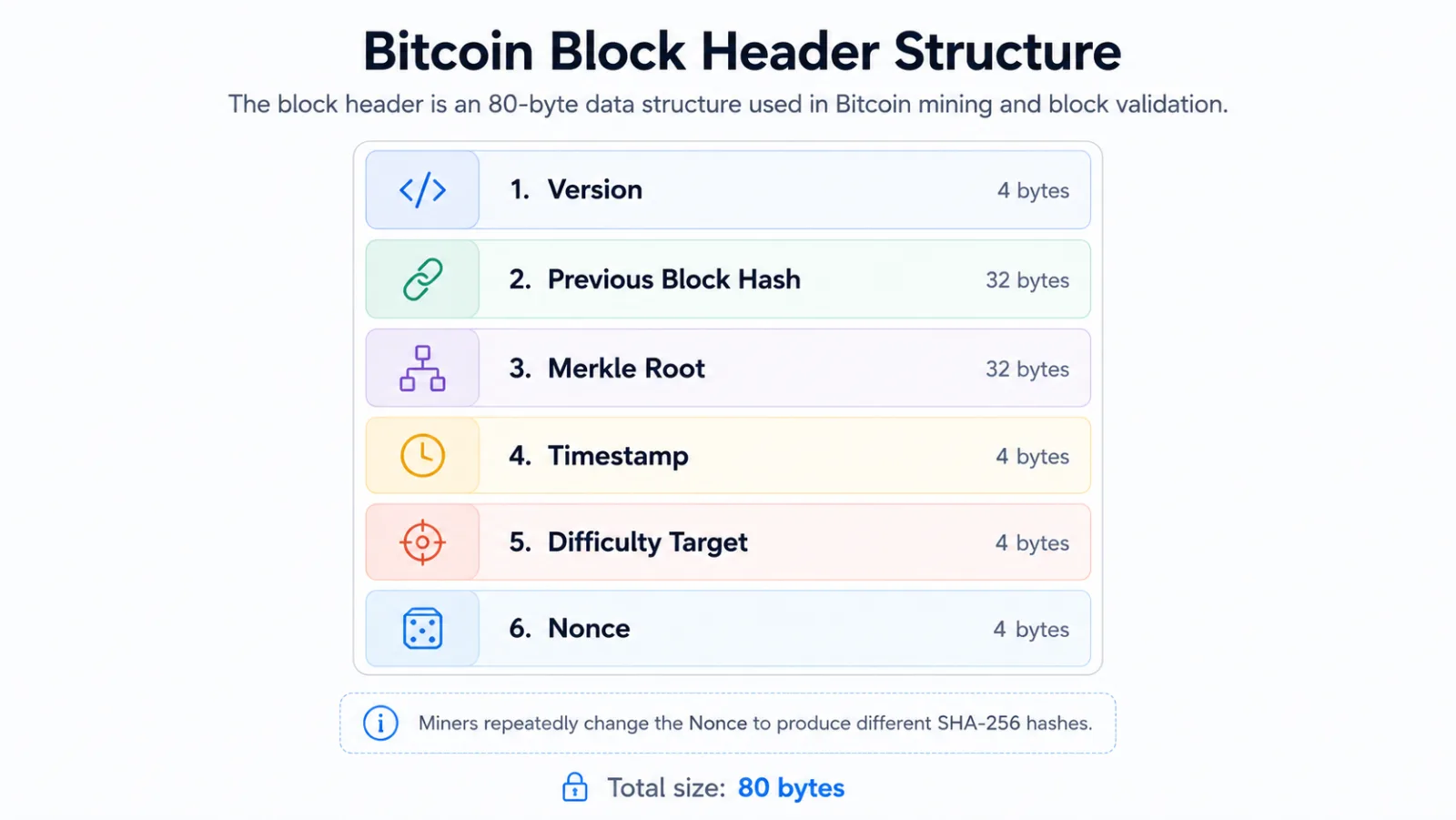
A Bitcoin block header is 80 bytes in total, made up of the following fields:
| Field | Size | Purpose |
|---|---|---|
| Version | 4 Bytes | Block version |
| Previous Block Hash | 32 Bytes | Hash of the previous block |
| Merkle Root | 32 Bytes | Summary of the transaction set |
| Timestamp | 4 Bytes | Block time |
| Difficulty Target | 4 Bytes | Current network difficulty |
| Nonce | 4 Bytes | Random number adjusted by miners |
The Nonce occupies 4 bytes — a 32-bit integer. Its value range is 0 to 4,294,967,295, meaning miners can try at most about 4.3 billion different Nonces.
Why Must Miners Keep Searching for the Right Nonce?
The reason is that Bitcoin uses the Proof of Work (PoW) mechanism. Bitcoin's proof of work allows anyone to compete, but they must prove they have spent real computational cost. This is achieved through the SHA-256 hash algorithm. SHA-256 is a cryptographic hash function with several key properties:
- The same input always produces the same output;
- Even a one-digit change in the input produces a completely different output.
At the same time, miners cannot calculate which Nonce will produce a qualifying hash. Their only option is to keep trying. That is why Bitcoin mining is essentially a probabilistic competition.
How Do Hash and Difficulty Determine Whether a Nonce Is Valid?
After finding a Nonce, miners feed the entire block header into the SHA-256 algorithm. The Bitcoin network then checks whether the resulting hash is less than the current target value. If it is, the block is valid. If not, the miner keeps adjusting the Nonce.
Key Data Points
- The Bitcoin network adjusts difficulty roughly every 2,016 blocks, aiming to keep the average block time at about 10 minutes
- According to Bitcoin network data: Difficulty = 1 at the genesis block; tens of trillions by 2020; above tens of trillions after 2024; historically high levels in 2026
- The Bitmain Antminer S21 hashrate is around 200 TH/s, with power consumption around 3,500W and efficiency around 17–18 J/TH — over 200 trillion hash operations per second
- The Nonce is a 32-bit integer with at most ~4.3 billion possibilities; modern ASICs also adjust ExtraNonce, Timestamp, Coinbase Transaction, and Merkle Root to expand search space
- According to Hashrate Index data, Bitcoin network hashrate has stayed in the hundreds of EH/s range since 2024
Observations
Early Bitcoin mining used ordinary CPUs. Miners later found GPUs better suited for large volumes of hash computation. Eventually, ASIC (Application Specific Integrated Circuit) miners appeared — designed for one purpose: executing SHA-256 at high speed. Miners do not manually pick Nonces; chips internally iterate through vast numbers of possible values at high speed. The more attempts per second, the higher the probability of finding a valid Nonce.
Many people notice that the Nonce is only 32 bits — at most about 4.3 billion possibilities — but modern ASICs can perform quadrillions of hashes per second. If miners only changed the Nonce, they would exhaust the full range very quickly. So Bitcoin mining does not rely on the Nonce alone. ExtraNonce is especially important: mining pools assign different ExtraNonces to different miners, giving large fleets of machines distinct search spaces. Modern Bitcoin mining is not about finding a single Nonce — it is about continuously adjusting block data so miners have a search space that is effectively unlimited.
Hashrate represents how many hash operations a miner can perform per second. Units include KH/s, MH/s, GH/s, TH/s, PH/s, and EH/s. Higher hashrate means more Nonce and other variable combinations tried per unit of time, and therefore a higher probability of finding a valid block.
The Nonce may look like just a number in the block header, but it connects some of the most important parts of the Bitcoin network: Proof of Work consensus, SHA-256 hash algorithm, Mining Difficulty, ASIC hashrate competition, and global miner coordination. Miners keep searching for Nonces not because the Nonce itself has value, but because it provides a fair way to compete — letting participants worldwide maintain Bitcoin network security through computational power. From early CPU mining to today's hundreds-of-EH/s competition, the core of Bitcoin mining has never changed: keep trying, keep computing, until you find the answer that satisfies the rules. And the Nonce is the key variable in that process.